
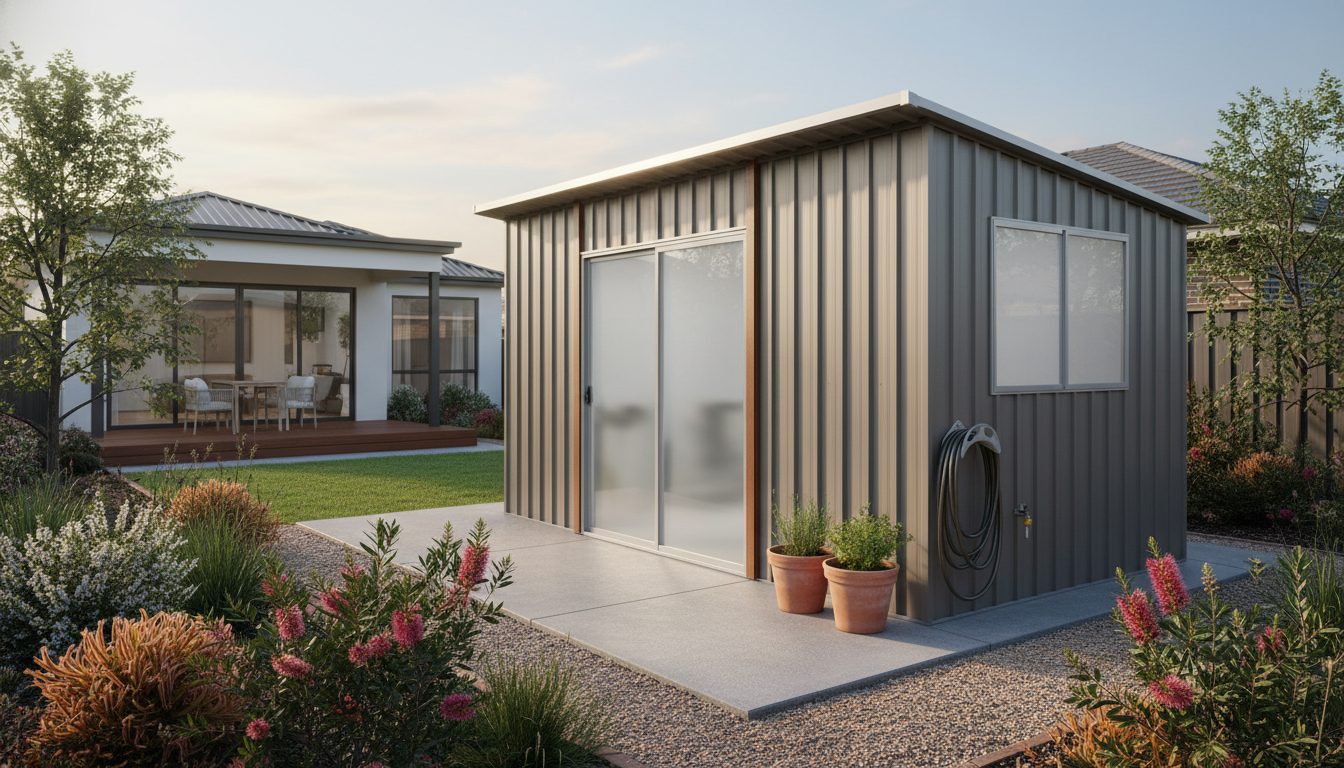
Searching for a free garden shed or a free shed giveaway usually leads to two paths: second-hand removals or “free” plans that still cost time and money to build. This guide cuts through the noise so you can secure a durable, council-compliant Colorbond steel shed without surprise costs—especially vital in places like Perth, Brisbane, and regional NSW where wind ratings and corrosion zones matter.
We benchmarked Australia’s top pages for “free garden shed” and added what they miss: WA council steps, cyclone ratings for QLD, and material specs that affect lifespan and warranty. Added 2024 WA wind-rating compliance notes
What does “free garden shed” really mean in Australia?
- Free to collect: Often a used shed on Gumtree/Facebook Marketplace listed as “free if you dismantle.” You’ll still pay for transport, new fixings, and possibly a new slab.
- Free plans: Downloadable DIY shed plans. Materials, fasteners, and bracing will cost, and plans may not meet AS/NZS loads or local wind regions.
- Free delivery or upgrades: Common promos from shed suppliers—e.g., free delivery in metro areas, free skylights, or free Colorbond roof upgrade.
- Free quotes and council help: Many reputable suppliers provide engineering certification and council lodgement support at no charge.
What Are the Best Shed Materials for Perth’s Climate?
In coastal WA, high UV and salt-laden winds punish low-grade steel. Two common cladding choices are Colorbond and Zincalume.
Colorbond vs Zincalume — Which is better for WA conditions?
| Feature | Colorbond (e.g., Colorbond Ultra/Matte) | Zincalume (AZ150) |
|---|---|---|
| Coating | Painted, baked-on finish over metallic coating | Aluminium-zinc alloy coating (no paint) |
| Coastal resistance | Better near coast (choose Ultra near severe marine) | Good, but shows patina; less suited to severe marine |
| Heat reflectance | High with lighter colours (reduces heat gain) | Good reflectance when clean |
| Aesthetics | Wide colour range; matches modern homes | Industrial, silver-grey |
| Typical warranty | Up to 20–36 yrs (conditions apply, AS 1397) | Up to ~25 yrs (conditions apply, AS 1397) |
| Best use | Backyard storage, custom Colorbond garages Perth, coastal carports | Rural sheds NSW, farm machinery storage inland |
Pro Tip: Did you know using insulated roof panels can reduce internal shed temperatures by up to 10°C in summer? Consider anti-con condensation blanket or insulated sandwich panels to improve comfort and reduce radiant heat. See guidance on reflective insulation from Energy.gov.au.
Learn more on reflective insulation
Can you really get a free garden shed? 5 options that actually work
- Free removal listings: Search “free shed” with removal required. Budget for tek screws, replacement sheets, and a new footing/slab.
- Salvage yards and auctions: Reclaimed Colorbond panels and C-section purlins can slash costs if you’re comfortable with DIY shed kits.
- Manufacturer promos: Look for free delivery, free vermin-proofing, or free skylights—often better long-term value than a worn-out freebie.
- Community groups: Local Facebook groups often list small garden sheds free to a good home.
- Free plans: Fine for hobby projects, but always cross-check against AS/NZS wind loads and your council’s requirements.
Reality check: Even a “free” second-hand shed must be re-engineered for your site if you want a council-approved structure. That’s where engineered, wind-rated sheds for cyclonic areas add peace of mind—and often end up cheaper than retrofitting a freebie.
Do I need council approval for a garden shed?
Many councils allow small garden sheds as exempt or complying development if they meet height, setback, and area limits. Larger structures, custom carports, and garages usually require approvals. Always verify local rules.
How to Get Council Approval for Your Custom Shed in WA
- Site check: Identify wind region (A, B, C, or D per AS/NZS 1170.2), terrain category (e.g., TC2), and corrosion zone.
- Engineering: Request a site-specific design certificate from your shed supplier covering AS/NZS 1170.2 (wind), AS/NZS 4600 (cold-formed steel), and NCC 2022.
- Drawings: Provide plan, elevations, slab details, and stormwater management.
- Application: Lodge with your local WA council or via a private certifier if available. Include engineering, energy compliance (if needed), and bushfire BAL documentation where applicable.
- Inspection: Slab and final structure inspections as required.
This is essential for council-approved sheds WA, especially in coastal and high-wind corridors. For Queensland, request cyclone-rated sheds QLD with Region C/D certification and Form 15/16 as applicable.
Useful references:
Bureau of Meteorology cyclone guidance,
Housing Industry Association,
Australian Steel Institute.
Which shed type suits your use-case?
- Backyard garden sheds (metro): Compact Colorbond steel sheds Perth with vermin-proofing and anti-con for heat control.
- Custom carports Melbourne: Skillion or gable carports engineered to boundary setbacks and local snow/wind loads.
- Rural sheds NSW: Open-bay machinery sheds using C/U-section purlins; consider Zincalume cladding inland and Colorbond near coast.
- Custom-built double garage in Perth: Insulated roof, roller doors with wind-locks, and 0.42 BMT roofing in high-UV zones.
- American barns and farm machinery storage: Allow larger clear spans, add sliding doors, and specify higher design life coatings.
How much does a “free” shed actually cost? (2024–2025 snapshot)
- Transport and dismantling: $200–$1,200 depending on distance and size.
- New slab or footings: $110–$180/m² typical metro pricing (site dependent).
- Replacement fixings/flashings and damaged sheets: $150–$600.
- Engineering for approvals: Often included with reputable suppliers for new builds; expect fees for second-hand retrofits.
According to the 2025 Australian steel market commentary, domestic supply remains stable with local manufacturers focusing on compliant, engineered systems—good news for lead times and pricing consistency for steel sheds. See the
Australian Steel Institute and
HIA 2025 Outdoor Structures and Home Improvement insights.
5-Step Buying Guide for Custom Sheds in Australia
- Define your load and use: Storage only, workshop, or vehicle? Add door heights for 4WDs and trailers.
- Match to wind region: Ask for site-specific engineering to AS/NZS 1170.2 with tie-down details and door wind-locks.
- Choose cladding and coatings: Colorbond for coastal/urban, Zincalume inland. Consider anti-con or panel insulation.
- Plan the slab: Confirm slab thickness, edge thickenings, and hold-down bolts from engineering drawings.
- Get council-ready: Request drawings, certificates, and a compliance checklist. Choose a supplier who helps with approvals.
Local wind ratings and cyclonic design explained
Australia’s wind regions (A–D) and terrain categories drive your shed’s frame, bracing, and connections. In QLD’s coastal belts (Region C/D), you’ll need cyclone-rated doors, additional hold-downs, and specific cladding fastener patterns. In WA’s coastal strips, check corrosion zones and upgrade to Colorbond Ultra where recommended.
Mini case studies
Perth backyard upgrade (free shed vs new Colorbond)
A homeowner removed a free shed that leaked at every cyclone screw. Replaced with a 3.0 x 3.0 m Colorbond steel shed in Surfmist, anti-con blanket, and vermin-proofing. Result: 2-hour internal temp drop on hot days, zero leaks, and compliant with local setbacks.
Rural NSW machinery bay
A 9 x 6 m rural shed used Zincalume walls and Colorbond roof for heat reflectance, engineered to Region A with C-section purlins and knee braces. Open gable end for tractor clearance, with gravel hardstand instead of slab to save costs.
Brisbane Region C garage
Custom Colorbond garages Perth get the spotlight, but in SE QLD a double garage needed Region C certification, wind-locked roller doors, and additional roof battens. Passed final inspection with Form 16 sign-off.
FAQs: Free garden sheds, DIY kits, and approvals
Are free garden sheds worth it?
They can be—if you’re handy and the frame isn’t rusted. Budget for a new slab, fixings, and potential re-cladding. For long-term value and compliance, a new engineered kit is often the smarter buy.
Do DIY shed kits meet Australian Standards?
Reputable kits do. Ask for engineering to AS/NZS 1170.2, AS/NZS 4600, and compliance with NCC 2022. Cheap imports or old second-hand frames may not comply.
What roof profile should I use?
Popular options include Trimdek/Monoclad for low pitch and Corrugated for classic looks. Choose 0.42 BMT for most small sheds and 0.48 BMT for higher spans or harsher wind zones (engineer to confirm).
How do I keep sheds cool in Perth?
Light Colorbond colours, reflective insulation or insulated panels, roof ventilation (whirlybirds), and eaves/shade where possible. Planting on the west side helps.
How long does approval take?
Typically 2–6 weeks depending on council and completeness of documentation.
When a “free shed” isn’t the best deal
- Coastal rust: Old Zincalume near the coast can be heavily corroded—replacement often costs more than a new kit.
- Non-compliant frames: No engineering certificate means delays and potential rejection.
- Hidden costs: Dismantling, transport, and modifications can exceed a new, council-ready shed price.
Consider value-rich offers like free delivery, free upgrade to Colorbond, or bundled approvals help from established suppliers. These often beat the true cost of a “free” shed.