
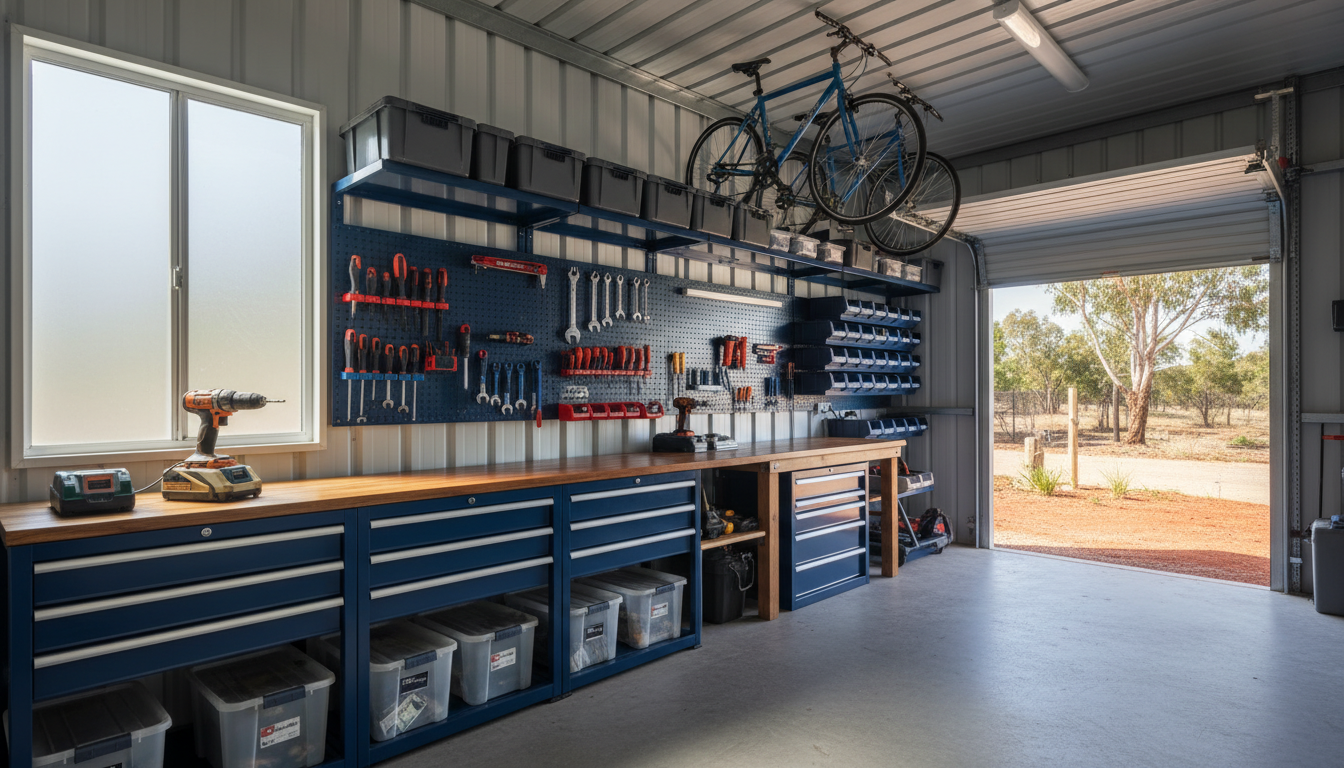
Primary keyword: garage wall storage • Secondary: garage wall shelving, storage wall, wall hanging garage cabinets, wall storage systems
Whether you’re fitting out a custom-built double garage in Perth or converting a rural shed in NSW into a workshop, the right garage wall storage can double your usable space, keep tools off the slab, and protect gear from moisture. This guide blends practical mounting advice with Australian standards, climate factors, and compliance so you can build once and build right.
Why garage wall storage matters in Australian steel sheds
- Space efficiency: Free up floor area for vehicles, farm machinery storage, and benches.
- Safety: Proper load-rated wall shelving and lockable cabinets reduce trip hazards and theft risk.
- Durability: Systems designed for Colorbond steel sheds handle condensation, coastal air, and heat.
- Resale: A well-organised storage wall lifts perceived value for renovators and property investors.
What Are the Best Shed Materials for Perth’s Climate?
Perth’s hot, dry summers and coastal exposure make heat reflectivity and corrosion protection important. For exterior cladding, Colorbond is common. For internal wall storage systems, focus on corrosion-resistant coatings and fixings that interface correctly with steel girts.
Colorbond vs Zincalume — Which Is Better for WA Conditions?
| Feature | Colorbond | Zincalume |
|---|---|---|
| Finish | Pre-painted colours; superior UV stability | Metallic finish; can be painted later |
| Heat reflectivity | High with light colours; helps reduce heat gain | Good; reflectivity varies by sheen |
| Corrosion resistance (coastal) | Excellent in many coastal zones; follow BlueScope coastal limits | Strong base performance; requires maintenance in salt spray zones |
| Aesthetics | Premium look; matches carports and homes | Industrial look; budget friendly |
| Cost | Higher | Lower |
| Best use | Visible garages, custom Colorbond garages Perth | Agricultural/rural sheds NSW interiors and roofs |
Tip: For interior wall storage systems, the cladding material matters less than the frame you fix to (girts/studs). Always anchor heavy loads to the steel frame or structural battens, not just the sheet.
Wall storage systems that actually work in a Colorbond shed
Slatwall panels (PVC, aluminium, or steel)
- Best for flexible layouts (hooks, baskets, bike racks). Aluminium slatwall suits humid or coastal settings.
- Mount on treated timber battens or Unistrut aligned with girts; use Class 3 or 4 self-drilling Tek screws for steel.
- Indicative load: 25–100 kg/m depending on panel and fixing. Check manufacturer ratings.
Pegboard and rail systems
- Steel pegboard with powdercoat resists rust better than MDF in sheds.
- Rail-and-hook systems (French cleat, gear tracks) make quick work of tool walls and sports gear.
Heavy-duty garage wall shelving
- Go for deep, braced steel brackets (300–600 mm) with load ratings; fix brackets directly into girts or to a continuous ledger board bolted to the frame.
- Use marine ply or steel shelves; avoid raw MDF near roller doors due to humidity.
Wall hanging garage cabinets
- Lockable, powder-coated steel cabinets with corrosion-resistant hinges suit coastal suburbs.
- Use a continuous top rail screwed into at least two girts; add bottom anti-lift clips.
Modular wall storage systems
- Panel-based grid systems integrate cabinets, bins, and benches. Great for workshop fit-outs and DIY shed kits.
- Confirm aggregate load per bay and anchoring method into steel frames.
Structural fixings, load paths, and condensation control
In steel sheds Perth to Brisbane, the wall sheet is not structural. Create a robust load path from the storage system to the frame.
How to mount heavy cabinets safely
- Locate girts with a stud finder for metal, or measure from corner columns (usually 900–1200 mm centres).
- Fix a 35–45 mm treated pine or steel ledger across at least two girts; then mount cabinets to the ledger.
- Use Class 4 screws or stainless where coastal. Consider M8 rivnuts in heavier RHS frames.
Moisture, condensation, and ventilation
- Add anti-condensation roof foil or insulated panel roofing to reduce drip onto shelves.
- Cross-ventilation with eave vents and a whirlybird/turbine helps keep stored items dry.
- Keep storage off the slab by 50–100 mm to avoid splashback and allow airflow.
Regional design: wind, corrosion, and bushfire
Added 2024 WA wind-rating compliance notes and cyclone design for northern QLD to ensure your wall storage fixings match shed ratings under AS/NZS 1170.2.
Wind-rated sheds for cyclonic areas (QLD)
- For cyclone-rated sheds QLD (Regions C/D), ensure wall storage adds minimal sail area near big roller doors. Use through-bolted fixings into frames, not just cladding.
- Confirm your shed’s N rating and fix storage to suit. Heavy racking may require engineer sign-off.
Coastal corrosion
- Within ~1 km of surf coasts, choose stainless or hot-dip galvanised brackets, and rinse salt monthly.
- Specify Colorbond Ultra or appropriate warranties where applicable.
Bushfire areas (BAL)
- In BAL-12.5 to BAL-40, opt for steel cabinetry, ember-proof vents, and sealed gaps behind storage walls.
- Check cladding and door assemblies against the relevant BAL requirements.
Council approvals and compliance
Most internal wall storage fit-outs inside existing compliant sheds won’t need council approval. Structural changes, mezzanines, or live loads may.
How to Get Council Approval for Your Custom Shed in WA
- Confirm planning requirements with your local council (setbacks, height, site coverage).
- Engineer-certified drawings to AS/NZS 1170.2 (wind), AS/NZS 4600 (cold-formed steel), and NCC.
- Apply for a building permit with site plan, slab details, and wind region noted.
- Council-approved sheds WA often require stormwater management and tie-down details.
- Book mandatory inspections (footings/slab, frame if required, final).
Do internal wall-storage systems need approval?
Usually no, if they don’t alter the structure. However, heavy storage walls, racking over 2.4 m, or occupied mezzanines may need engineering and notification. Ask your certifier.
DIY shed kits vs custom-built fit-outs
- DIY shed kits: Lower cost, quick, ideal for standard tool walls and garage wall shelving. Check load ratings and use correct fasteners.
- Custom-built: Best for integrated benches, power, compressed air lines, and custom Colorbond garages Perth where aesthetics matter.
Cost guide (2025): typical ranges in Australia
- Slatwall (aluminium) installed: $140–$260 per m²
- Heavy-duty wall shelving (per bay): $250–$700
- Wall-hanging steel cabinets: $450–$1,200 each
- Rail/track systems (per metre): $60–$160
- Labour (licensed installer): $85–$130/hr
Indicative only. Request itemised quotes that include corrosion class of fasteners and fixing method to steel frame.
Real-world build examples
Case study: Double garage fit-out in Joondalup, WA
- 6 m x 7 m Colorbond steel shed, gable roof, Region A (non-cyclonic).
- Aluminium slatwall on treated battens fixed into girts with Class 4 screws.
- 75 mm insulated roof panels cut peak summer heat; simple eave vents for airflow.
- Outcome: Tools off the floor, bikes on vertical hooks, clear parking for two cars.
Case study: Cyclone-rated workshop in Townsville, QLD
- Wind Region C with engineer-specified fixings; minimal projection storage near doors.
- Through-bolted cabinet rails into RHS columns; stainless fasteners throughout.
Case study: Coastal hobby garage in Wollongong, NSW
- Colorbond Ultra cladding, stainless hardware, sealed penetrations to reduce corrosion.
- Powder-coated steel cabinets; raised kick rails to avoid slab splashback.
Use-case keyword clusters (for planning)
- Urban: steel sheds Perth, custom carports Melbourne, affordable carports for Australian homes
- Rural: rural sheds NSW, farm machinery storage, workshop fit-out
- Technical: Colorbond vs Zincalume comparison, wind-rated sheds for cyclonic areas
- Compliance: council-approved sheds WA, cyclone-rated sheds QLD
- Product: DIY shed kits, wall storage systems, garage organisation systems Australia
5-Step Buying Guide for Custom Sheds in Australia (Checklist)
- [ ] Define purpose: parking, workshop, or storage wall focus (tools, bikes, bins).
- [ ] Site and climate: wind region, BAL rating, coastal distance, sun exposure.
- [ ] Structure: choose Colorbond or Zincalume; roof type (gable, skillion, flat) and insulation.
- [ ] Fit-out plan: map girts/columns; select garage wall shelving, wall hanging garage cabinets, and power/lighting.
- [ ] Compliance: engineering to AS/NZS, council permits, and warranty-compatible fasteners.
FAQs
Can I fix garage wall storage directly to Colorbond cladding?
Light hooks, maybe. Anything heavy (shelves, cabinets) must fix into the steel frame (girts/columns) or a ledger spanning multiple girts.
What fasteners should I use in a steel shed?
Class 4 self-drilling Tek screws for most Australian sheds; stainless or hot-dip galvanised near surf coasts. Use rivnuts/bolts for heavy loads into RHS.
Do I need insulation behind my storage wall?
In hot or humid regions, yes. Anti-condensation foil or insulated panels help protect tools and reduce rust and mould risk.
What’s the best roof for storage-heavy sheds: flat, gable, or skillion?
Gable and skillion encourage airflow and allow overhead storage. Flat roofs are cheaper but can run hotter without insulation and ventilation.
Will my insurance care about wall storage?
Insurers may ask about non-standard structural additions. Keep receipts, specifications, and photos of load-rated installations.
Related planning questions
How to wire power safely around storage walls
Use licensed electricians. Run conduits in service cavities, not through cladding folds. Add RCD protection and IP-rated GPOs in damp areas.
Lighting for organised garages
LED batten lights over benches, task lighting under cabinets, and motion sensors at entries. Choose 4000–5000K for task clarity.
Helpful references and standards
- National Construction Code (NCC) and relevant AS/NZS standards (e.g., AS/NZS 1170.2 wind actions; AS/NZS 4600 steel structures).
- Bureau of Meteorology climate data — plan for heat, humidity, and wind region.
- Housing Industry Association (HIA) and Master Builders Australia — project guidance and reports.
- Australian Steel Institute — steel design notes and corrosion guidance.
- CSIRO on condensation management — reducing moisture in sheds.
- Energy.gov.au insulation advice — improve comfort and energy efficiency.
- Industry outlooks: “2025 Australian Steel Market Outlook” and “2025 HIA Outdoor Structures and Home Improvement Report” (consult latest editions for trends).