
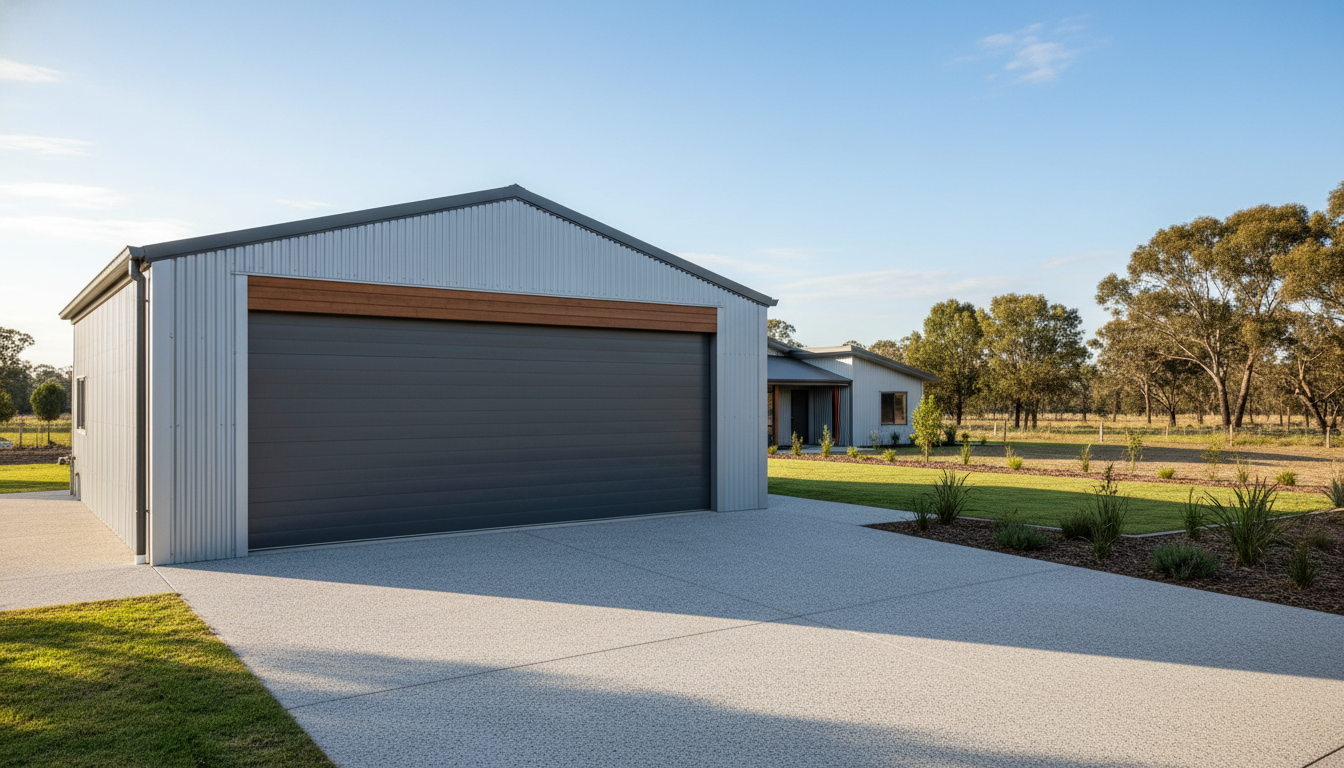
If you’re weighing up a custom-built double garage in Perth, cyclone-rated sheds in QLD, or a lock-up bay for rural sheds in NSW, this article is your practical, Australia-specific roadmap. We cover design, engineering, council approvals, and “garage door metal” options—so your investment performs in heat, wind and coastal corrosion.
What do we mean by a “garage with door” in Australia?
In shed industry terms, this usually means a Class 10a steel garage (portal frame) with a secure opening: roller door, sectional door, or tilt panel. For most homes, a single (3–3.5 m wide) or double garage (5.4–6.2 m wide) with one or more roller doors is typical. A “garage door metal” specification matters—thicker gauge, wind-locks in cyclonic areas, and corrosion-resistant hardware greatly improve durability.
- Roller doors (Colorbond cladding) — cost-effective, minimal headroom, can include wind-locks
- Sectional doors — premium look, insulated options, good sealing, smooth operation
- Tilt doors — simple mechanism, useful where headroom is limited, fewer panels
- Hardware — marine-grade fixings for coastal sheds; high-cycle springs for frequent use; smart openers for remote access
What Are the Best Shed Materials for Perth’s Climate?
Perth’s hot summers and strong afternoon sea breezes demand heat-reflective roofing, robust fasteners, and proper ventilation. For steel sheds Perth-wide, we typically recommend light Colorbond colours (e.g., Surfmist) with an anti-condensation blanket under the roof, plus ridge vents or whirlybirds to exhaust heat.
Colorbond vs Zincalume — Which Is Better for WA Conditions?
| Factor | Colorbond (painted) | Zincalume (unpainted) |
|---|---|---|
| Heat reflectivity | High with light colours; reduces heat load | Reflective but can glare; warms over time |
| Coastal performance | Use Colorbond Ultra near surf (check distance zones) | Good, but prefer painted/Ultra near severe marine |
| Aesthetics | Large colour palette; complements modern homes | Industrial look; can dull/patina |
| Maintenance | Low; periodic wash-down (especially coastal) | Low; rinse to remove salts/dust |
| Cost | Slightly higher upfront | Often lowest initial cost |
| Best for | Residential garages, custom Colorbond garages Perth, architectural finishes | Rural sheds NSW, farm machinery storage, budget DIY shed kits |
Tip: Within 200–400 m of breaking surf, consider Colorbond Ultra and stainless or marine-grade fasteners to manage C4–C5 corrosion categories.
Flat Roof vs Gable Roof — Which suits your garage with door?
| Roof type | Pros | Cons | Best use |
|---|---|---|---|
| Flat (low pitch) | Modern look, lower height, economical | Needs careful drainage and overflow provisions | Urban blocks with height limits, side setbacks |
| Gable | Great runoff, extra headroom, classic form | Slightly higher material/height | Double garage with roller door, car hoists |
Also consider a skillion roof shed for simple, clean lines and easy solar PV placement.
Which garage door metal should you choose?
For most homes, Colorbond-clad roller doors are the sweet spot: durable, colour-matched, and compatible with wind-locks in exposed sites. Sectional doors with insulated panels excel for thermal comfort and noise reduction, particularly where the garage doubles as a workshop.
- “Garage door metal” thickness: opt for reputable brands and appropriate gauge in windy sites
- Wind-locks: essential for Region C/D cyclone-rated sheds QLD and exposed coastal sites
- Seals and vermin flashing: keep dust, water and pests out
- Automation: quiet DC motors, battery backup, and smart app control
Do you need council approval for a garage with door in Australia?
Most regions require a building permit for a Class 10a steel garage, including engineering to AS/NZS 1170.2 (wind) and slab design (AS 2870 suburb soil class). Heritage overlays, bushfire (AS 3959), boundary setbacks and stormwater design also affect approvals.
How to Get Council Approval for Your Custom Shed in WA
- Site check: boundaries, easements, sewer/water lines, BAL zone, coastal corrosion
- Pre-application: confirm planning triggers (setbacks/over-height walls/streetscape)
- Engineering: wind region (mostly A/B in WA coast; local gusts), terrain category, importance level (2), portal frame, footings, slab
- Building permit: submit certified drawings, engineering, energy/lighting if required, stormwater (soakwells common in WA)
- Inspection and compliance: footing/slab pour, final sign-off
Added 2024 WA wind-rating compliance notes: Ensure garage doors include wind-bracing or wind-locks where engineering specifies. Check gutter overflow provisions and downpipe sizing per local amendments.
QLD and cyclonic regions
For Region C/D, choose cyclone-rated sheds QLD with certified door wind ratings, heavier purlins, closer portal spacings, and screw patterns to match the design actions. Engage licensed installers (e.g., QBCC where applicable) and verify tie-down details to the slab.
VIC/NSW quick notes
- VIC: Building permit and RBS engagement; check planning overlays (flood/heritage)
- NSW: Complying Development possible for many garages; verify site setbacks and BASIX triggers
Design and engineering essentials for durability
- Wind actions: AS/NZS 1170.2 (Regions A–D), terrain category, shielding, topography
- Portal frame sheds: high-tensile galvanised columns and rafters with tek-screw systems
- Purlins/girts: sized to limit deflection at large door openings
- Slab engineering: AS 2870, thickened edge beams, dowelled footings; allow for door thresholds
- Corrosion: choose Colorbond Ultra or stainless near surf; marine-grade screws and sealed laps
- BAL (AS 3959): bushfire-prone areas may require ember protection, non-combustible cladding, and mesh screening
- Condensation: anti-condensation blanket under roof, sarking to walls, ventilation (ridge vents or whirlybirds)
- Drainage: gutters, overflow paths, downpipes to soakwells (WA) or legal point of discharge
- Openings: roller door wind-locks, heavier tracks, and jamb wind posts in high-wind areas
Real build examples (Australia-wide)
Perth, WA — Custom-built double garage
- 6.0 m x 6.5 m x 2.7 m eave; gable roof, Surfmist Colorbond
- Single wide roller door with motorised opener; side personnel door
- Region A, Terrain Cat 2; anti-condensation blanket + ridge vent for heat control
- Outcome: Secure parking and workshop that blends with modern façade
Townsville, QLD — Cyclone-rated double garage
- 6.0 m x 7.0 m x 3.0 m; skillion roof, Colorbond Ultra
- Two wind-rated roller doors with wind-locks, heavier tracks, jamb posts
- Region C; engineered tie-downs and closer portal spacing
- Outcome: cyclone-rated sheds QLD solution meeting coastal corrosion and wind demands
Dubbo, NSW — Rural shed with lock-up bay
- 12 m x 7.5 m x 3.6 m; 3-bay portal frame with 1 lock-up garage door
- Zincalume walls/roof; vermin seals; wide apron for farm machinery storage
- Outcome: Budget-friendly storage with a secure garage with door for tools
5-Step Buying Guide for Custom Sheds in Australia
- Define use: daily parking, workshop, gym, farm machinery storage
- Choose materials: Colorbond vs Zincalume comparison for your site conditions
- Engineer to site: wind region, terrain, BAL, corrosion category, slab design
- Door strategy: width, height for 4WD/ute racks, “garage door metal” strength, automation
- Approval and build: council-approved sheds WA process, licensed installers, warranties, maintenance plan
DIY Kit vs Custom-Built Installed
| Option | Pros | Cons | Who it suits |
|---|---|---|---|
| DIY shed kits | Lower cost, flexible timing, great for rural blocks | Time/skills needed; must manage permits/slab/logistics | Owner-builders, regional projects with mates’ help |
| Custom-built (turnkey) | Design help, council pack, professional install, warranty | Higher upfront cost | Time-poor homeowners, metro sites, complex approvals |
Costs and lead times (2024–2025)
Pricing varies by size, site wind rating, door type, slab thickness, insulation and coastal upgrades. As a ballpark, small single garages (non-cyclonic) start in the mid-thousands for DIY kits, while turnkey double garages with motorised doors and a slab can range significantly higher. Lead times fluctuate with steel supply and council processing—factor in design/engineering, permit approval, slab cure time, and install scheduling. Request a fixed, itemised quote for apples-to-apples comparisons.
FAQs
What size is a standard double garage?
Common footprints are around 6.0 x 6.0 m to 6.5 x 6.0 m. If you run roof racks or a lifted 4WD, consider 2.4–2.7 m door height and extra internal clearance.
Do I need insulation?
For workshops and hot climates (Perth/WA North), yes—combine anti-condensation blanket, roof/wall insulation and ventilation. Insulated sectional doors help too.
Can you match my house colours?
Yes. Colorbond offers a wide palette for walls, roof, gutters and garage doors.
How do I ensure it’s wind-rated?
Ask for engineering to AS/NZS 1170.2 with your site’s wind region, terrain and shielding. Confirm door wind rating and tie-down details in the paperwork.
What about bushfire areas?
In mapped BAL zones, design to AS 3959 requirements. Non-combustible cladding, ember protection and appropriate glazing/mesh may be required.
Why choose a premium Australian steel garage?
- Engineered strength: portal frames, compliant tie-downs, and wind-rated doors
- Longevity: BlueScope substrates, quality coatings, and marine-grade fasteners
- Value: adds secure storage and boosts property appeal
- Flexibility: custom carports Melbourne, affordable carports for Australian homes, and lock-up bays on larger rural sheds
Ready to design your garage with door?
From custom Colorbond garages Perth to regional NSW lock-up bays and council-approved sheds WA, we help you compare materials, wind ratings and door systems. Ask for a site-specific design pack with engineering, elevations, and an itemised quote.
Useful references (Australia)
- National Construction Code (NCC) and building classifications
- Standards Australia (AS/NZS 1170.2 wind actions, AS 2870 slabs, AS 3959 bushfire)
- Bureau of Meteorology — climate and wind region context
- Housing Industry Association (HIA) — permits and building guidance
- Master Builders Australia — industry insights
- Australian Steel Institute — steel performance and design
- energy.gov.au — energy efficiency in outbuildings
- CSIRO — research on bushfire, materials and climate