
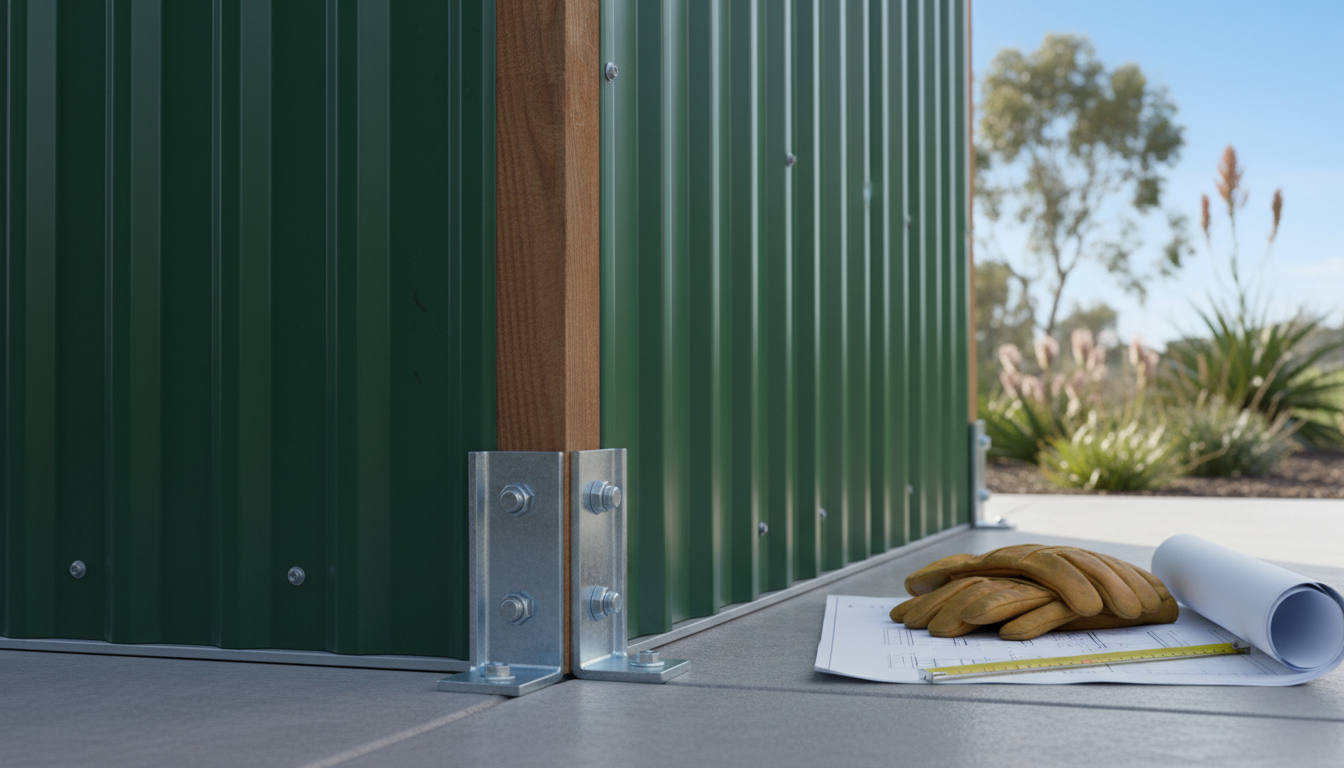
Your complete Australian guide to garden shed brackets and tie-down systems
Built for Colorbond sheds, coastal installs, and cyclonic conditions—without blowing the budget.
Whether you’re anchoring a 3×3 Colorbond garden shed in Perth, upgrading storage shed brackets on a rural block in NSW, or specifying cyclone-rated tie-downs for North QLD, the right bracket system is critical. This guide explains bracket types, wind ratings, corrosion choices, and how to install for long-term performance in Australian conditions.
What are garden shed brackets and why do they matter in Australia?
Garden shed brackets are steel connectors that fix your shed’s frame to the slab, subfloor, or wall/roof members, transferring wind, uplift, and shear forces into the structure and ground. In Australian weather—Perth sea-breezes, Melbourne squalls, and QLD cyclones—brackets and hold-downs are your shed’s insurance policy.
Which bracket types are best for Colorbond garden sheds?
Match bracket style to your frame type (SHS/RHS, light-gauge channel, timber subfloor) and wind classification (AS 4055 or AS/NZS 1170.2). Common options:
- Base plate/post brackets: Anchor SHS/RHS posts to slabs or footings. Typical plate 6–8 mm, M12–M16 anchors.
- L-brackets/angle brackets: Fix wall frames to slabs or timber bearers; useful for DIY shed kits.
- Stirrups/U-shoes: For timber posts; choose hot-dip galvanised (HDG) in soil-contact or coastal sites.
- Apex/rafter/knee brace brackets: Stiffen roof connections at ridge and eaves; critical for uplift paths.
- C/Z purlin brackets: Connect cold-formed purlins/girts to portals; select thickness to suit wind loading.
- Strap tie-downs/hurricane ties: Added uplift resistance for cyclone-rated sheds in QLD/WA.
For most Colorbond steel garden sheds, a combination of base plates at posts, L-brackets along walls, and strap tie-downs at corners delivers reliable performance.
What are the best shed materials for Perth’s climate?
Perth homeowners often choose Colorbond for cladding and HDG brackets for anchors. Combine UV-stable Colorbond cladding with corrosion-resistant fixings and insulated roof panels for thermal comfort.
| Feature | Colorbond steel | Zincalume steel |
|---|---|---|
| Coating & looks | Painted, colourfast; wide colour range for custom Colorbond garages Perth | Metallic finish; no factory colour |
| Heat performance | High solar reflectance colours available; cooler interiors in WA summers | Reflective but can glare; limited thermal control |
| Coastal resistance | Excellent with correct grade and maintenance | Good but can mark near surf or salt spray |
| Price | $$ (premium) | $ (budget-friendly) |
| Best use | Residential sheds, custom carports Melbourne, visible builds | Farm machinery storage, rural sheds NSW, utility buildings |
How to choose garden shed brackets by wind rating and site conditions
Start by confirming your site’s wind classification (AS 4055 for housing or AS/NZS 1170.2 otherwise). Examples:
- Metro Perth: typically N2–N3 (check micro-site exposure).
- Regional WA and coastal QLD: N3–N4 or cyclonic (C1–C3), requiring wind-rated sheds for cyclonic areas.
- Elevated/coastal escarpments: higher uplift; consider heavier hold-downs.
When securing larger sheds, such as a 6×3 Garden Shed, brackets are highly recommended.
Bracket selection tips:
- Anchors: Use M12–M16 mechanical anchors (sleeve/expansion) or bonded anchors (epoxy/chemset) with minimum embedment per manufacturer. Chemset often outperforms DynaBolt-style anchors in edge distances and cracked concrete.
- Thickness: Light garden sheds: 3–5 mm bracket steel; larger portals: 6–10 mm.
- Fasteners: Class 4 screws/bolts for coastal; 316 stainless near surf; follow AS/NZS 4680 for galvanizing.
- Spacing: Corner and every second stud/panel as a baseline; increase frequency in high wind zones.
- Load path: Ensure continuous tie-down from roof cladding to purlins to frame to brackets to slab/footings.
What corrosion protection should I choose near the coast?
Use AS 4312 corrosivity categories to guide selection (C3–C5 for many coasts). Choose HDG brackets (≥85 μm zinc) or 316 stainless within 1 km of breaking surf. Avoid mixing dissimilar metals without isolation washers/tapes.
Which brackets do I need for a DIY shed kit versus a custom-built shed?
- DIY shed kits: Pre-punched L-brackets and base plates, tek-screw friendly, simple M12 anchors. Ideal for garden sheds and affordable carports for Australian homes.
- Custom builds: Engineered base plates, knee braces, heavier purlin cleats, and specified chemical anchors to suit AS/NZS 1170.2 wind actions—common in council-approved sheds WA and cyclone-rated sheds QLD.
How to get council approval for your custom shed in WA
Many small garden sheds may be exempt, but larger sheds and carports require approvals. Provide a site plan, engineered drawings (including bracket schedules and footings), and wind classification.
Added 2024 WA wind-rating compliance notes: For coastal or open-terrain sites, ensure your engineer nominates hold-down capacities for each bracket/anchor and shows edge distances and slab thickenings at posts. Councils may request evidence of AS/NZS 4600 (cold-formed steel) and AS 4100 (steel structures) compliance for frames.
Step-by-step: How to install garden shed brackets like a pro
- Confirm wind class and engineering. Get an uplift (kN) per connection from your plans.
- Prepare the slab or footings. Ensure minimum thickness and edge beam; mark bracket locations away from slab edges per anchor specs.
- Drill anchor holes. Use SDS drill, blow out dust; set bonded anchors if specified (observe cure times) or torque mechanical anchors.
- Fix brackets to frame. Use specified bolts/tek screws; tighten to torque; fit washers.
- Complete tie-down path. Add strap ties at rafters, fix purlin brackets, and check every joint.
- Seal and protect. Apply cold galv spray to cut edges; fit isolation washers between stainless and zinc where mixed.
- Final inspection. Confirm edge distances, embedment depth, and fastener class. Photograph for council records.
What size anchors and bolts should I use?
Common specs for garden and storage shed brackets:
- M12 anchors for light sheds; M16 for larger portals or cyclonic tie-down points.
- Minimum 70–100 mm embedment into 25–32 MPa concrete (verify with anchor manufacturer data).
- Class 4 coated or 316 stainless fasteners in coastal sites.
Always follow the engineered schedule and anchor manufacturer installation instructions.
Buying checklist: 5-step guide for custom sheds in Australia
- Define the use-case: Garden tools, farm machinery storage, or a custom-built double garage in Perth?
- Pick materials: Colorbond vs Zincalume comparison, plus HDG or 316 brackets per AS 4312 category.
- Confirm wind rating: N2/N3 for many suburban areas; N4/C cyclonic for QLD north coast. Specify wind-rated sheds for cyclonic areas.
- Choose bracket system: Engineered base plates, L-brackets, knee braces, and strap tie-downs to suit your frame.
- Plan approvals and install: Council paperwork, slab details, and qualified installers for chemset anchors.
Case studies: Real-world bracket solutions
Perth backyard 3×3 garden shed on slab
Scope: Colorbond shed, N2 site. Solution: 3 mm L-brackets at every panel, M12 sleeve anchors (75 mm embedment), strap ties at corners. Result: Passed final inspection; no water ingress or movement after first winter storm.
Cairns cyclone upgrade kit
Scope: Existing light-gauge shed, C2 site. Solution: Retrofit HDG base plates to slab thickenings, M16 bonded anchors, additional knee braces and roof straps. Result: Engineer-certified cyclone-rated upgrade for insurance compliance.
Wollongong coastal storage shed
Scope: Within 500 m of surf. Solution: 316 stainless brackets and fasteners, isolation washers to prevent galvanic corrosion, Colorbond Ultra cladding. Result: Minimal corrosion after two summers; easy maintenance.
FAQs about garden shed brackets
Do I need council approval for brackets themselves?
Approvals typically cover the whole shed. Brackets and anchors form part of the engineered design. For council-approved sheds WA and NSW, include bracket schedules in your documents.
Can I fix a shed to pavers?
No. Move pavers and pour a slab or install concrete footings. Anchoring to pavers won’t provide compliant tie-down.
What if my slab is thin or has edge chipping?
Use bonded anchors with reduced edge distances, add slab thickenings, or install new footings. Seek engineering advice.
Are timber subfloors okay?
Yes, with stirrups or U-shoes on concrete piers, plus cross-bracing and hurricane ties on the roof members.
What Australian standards and references apply?
- AS/NZS 1170.2 (Wind actions)
- AS 4055 (Wind loads for housing)
- AS/NZS 4600 (Cold-formed steel structures)
- AS 4100 (Steel structures)
- AS/NZS 4680 (Hot-dip galvanizing)
- AS 4312 (Corrosivity zones)
- AS 3959 (Bushfire construction) if in BAL-rated areas
For climate and design insights, see Bureau of Meteorology wind/climate data and industry guidance from the Australian Steel Institute and Housing Industry Association.
Local context: Picking brackets for your region
- Steel sheds Perth: Favor HDG base plates, Class 4 screws, light-colour Colorbond; consider insulation.
- Custom carports Melbourne: Variable winds; specify engineered knee braces and purlin brackets.
- Rural sheds NSW: Larger portals; 6–8 mm base plates, M16 anchors, and deeper edge beams.
- Cyclone-rated sheds QLD: Strap tie-downs, increased anchor embedment, and certified bracket systems.
Storage shed brackets: What to look for when comparing brands
- Stamped capacities: kN uplift/shear ratings with test or design basis.
- Coating type: HDG thickness or stainless grade declaration.
- Hole patterns: Suits M12/M16 and tek-screw options without on-site rework.
- Documentation: Installation instructions and edge-distance diagrams.
- Warranty: 10–20 years for non-immersion exposure when installed per guidelines.
Costs and budgeting
- L-brackets: $8–$20 each (HDG premium at coastal).
- Engineered base plates: $30–$90 each depending on thickness and finish.
- Anchors: $2–$12 each for mechanical; $20–$40 per set for bonded anchors including epoxy.
- Professional install (typical garden shed): From $400–$900 for bracket and anchor works, excluding slab.
Indicative retail ranges only. Obtain quotes for your location and wind class.
What Are the Best Shed Materials for Perth’s Climate?
For hot, dry summers and salty breezes, choose Colorbond cladding in lighter colours, HDG or 316 brackets, Class 4 fasteners, and insulated roofing. Combine with adequate ventilation to keep temperatures down and reduce condensation risk.
Flat roof vs gable roof for small sheds—any bracket differences?
- Flat/skillion: Fewer apex brackets; focus on eave connections and wall-to-slab L-brackets.
- Gable: Requires apex brackets and often knee braces; check rafter-to-column details for uplift.
Compliance and documentation checklist
- Site wind classification and terrain/exposure noted.
- Engineer drawings with bracket schedule and anchor specs.
- Anchor installation data (embedment, torque/cure times) recorded.
- Photos of reinforcement/slab thickenings at post points.
- Product datasheets and warranties filed for handover.
Helpful resources
- Bureau of Meteorology climate and wind info
- Australian Steel Institute design resources
- HIA resources on approvals and construction
- CSIRO: Building for extreme weather
- Energy.gov.au: Insulation guidance
- Master Builders Australia homeowner advice
Also refer to the “2025 Australian Steel Market Outlook” and the “2025 HIA Outdoor Structures and Home Improvement Report” for demand and specification trends.
Ready to specify your brackets?
If you’re planning a new Colorbond steel shed for regional WA or upgrading tie-downs on an existing structure, start with wind classification, pick the right storage shed brackets and anchors, and get engineering sign-off. You’ll end up with a stronger, safer shed that lasts—no surprises when the wind picks up.
If you’re considering a bigger build, see our 9×12 Storage Shed in Australia planning resource.