
Planning a Colorbond steel shed for regional WA or a compact backyard shed in suburban Sydney? The right garden shed brackets and anchor kits are the unsung heroes of strength, safety, and warranty compliance. This guide distils what the top Australian suppliers don’t always tell you—so your shed passes engineering, survives summer storms, and stays square for decades.
What are garden shed brackets and why do they matter?
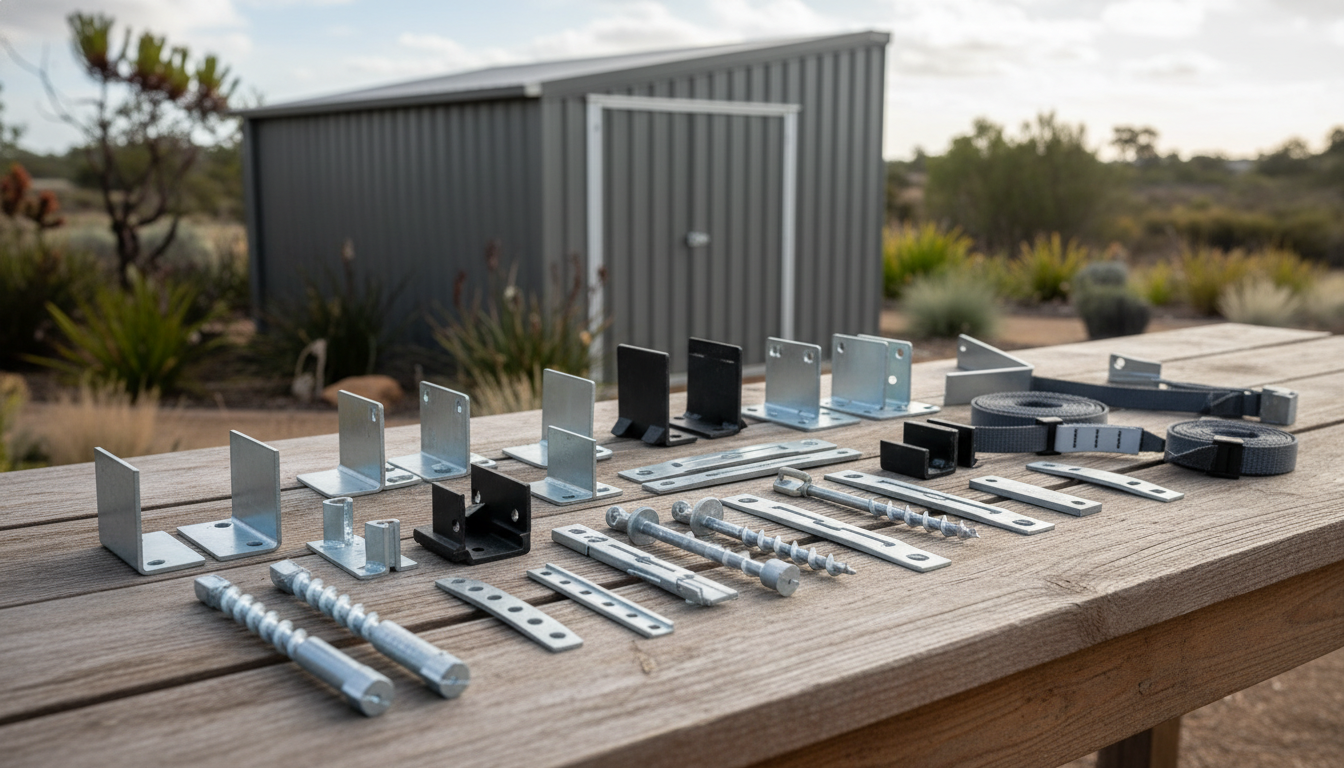
Garden shed brackets include base plates, L-brackets, post supports, cyclone tie-downs, and shelving/rafter brackets that fix your shed to the slab and tie the frame together. Good brackets transfer loads—wind uplift, shear, and racking—so your shed meets engineering and insurance requirements.
Which brackets do you need for your Colorbond garden shed?
Match the bracket set to your shed size, roof type (skillion or gable), region wind rating, and base (slab, piers, or footings). Below is a quick map of what’s typically required for DIY shed kits and custom builds.
1) Base and foundation brackets
- Post base brackets (also called base plates or stirrups): Fix wall studs or portal legs to the slab or piers. Choose heavy-gauge galvanised or hot-dip galvanised steel; 316 stainless near marine environments.
- L-brackets / angle brackets: Tie the bottom frame to the slab edge; common with light garden sheds and storage shed brackets that come in a garden shed anchor kit.
- Anchor bolts: M10–M12 mechanical expansion anchors or chemical anchors; embedment depth and edge distance to engineer’s spec.
2) Tie-down and wind-rated connections
- Cyclone tie-down straps: Required for wind-rated sheds for cyclonic areas (Region C/D QLD, WA North). Look for engineer-certified kits labelled for cyclone-rated sheds QLD.
- Rafter/rafter-to-plate brackets: Prevent uplift of roof members in high winds.
- Cross-bracing kits: Reduce racking in taller walls or wide openings (e.g., custom Colorbond garages Perth).
3) Roof and wall connection brackets
- Top plate brackets: Secure wall frames to rafters/purlins for gable or skillion roof sheds.
- Girt and purlin brackets: For cold-formed steel framing (AS/NZS 4600), especially on larger rural sheds NSW.
4) Storage and shelving brackets
- Shed shelving systems: Heavy-duty galv shelf brackets tie into studs; specify load ratings for farm machinery storage parts and tool storage solutions.
- Internal utility brackets: For hooks, garden tool racks, and overhead storage—choose fasteners compatible with Colorbond internal liners or steel studs.
5) Door and security hardware
- Hinge reinforcement and lock keepers: Stop prying under wind load. Pair with garden shed lockable doors and anti-jemmy brackets.
What are the best shed materials for Perth’s climate?
Perth summers are hot, dry, and windy. Your bracket and cladding choices should handle heat, sea breeze salinity, and UV. Colorbond steel (coated to AS 1397) is the benchmark for aesthetics and durability; Zincalume offers excellent value where salt exposure is lower.
Colorbond vs Zincalume — Which is better for WA conditions?
| Factor | Colorbond | Zincalume |
|---|---|---|
| Corrosion resistance (Perth coastal) | Excellent; opt for Ultra near severe marine zones | Very good; avoid heavy salt spray zones |
| Heat reflection | High with light colours (Cool roofing benefits) | High reflectance in bare metallic finish |
| Aesthetics | Broad colour palette for custom builds | Industrial/silver look |
| Cost | Higher | Lower |
| Warranty support | Strong BlueScope warranty | Strong BlueScope warranty |
| Best use | Custom carports Melbourne, custom Colorbond garages Perth, premium gardens | DIY shed kits, rural sheds NSW interiors |
How do you anchor a shed to concrete, pavers, or soil?
Your garden shed anchor kit must match the base. Below is a practical, engineer-friendly approach.
Anchoring to a concrete slab
- Confirm slab spec: Minimum thickness and reinforcement to the engineering certificate (Class 10a, NCC). Many sheds specify 100 mm slabs; larger structures may specify N32 concrete and slab edge rebates.
- Mark and drill: Use a rotary hammer; drill holes to specified embedment. Respect edge distances (often 50–60 mm minimum—check anchor datasheet).
- Install anchors: For mechanical anchors, clean holes and torque to spec; for chemical anchors, blow-brush-blow and inject resin before inserting M12 studs.
- Fit brackets: Tighten base plates/L-brackets and check plumb. Seal penetrations to prevent corrosion.
Anchoring on pavers or compacted soil
- Pavers: Not suitable alone. Core through to a concrete pad or replace pavers with a small footing pad at anchor points.
- Soil: Use pier-and-beam with embedded stirrups/post bases, or a perimeter concrete beam with hold-down rods per engineer’s details.
How to get council approval for your custom shed in WA
Many local governments in WA require a building permit for sheds over set sizes/heights or within setbacks. Here’s the fast path to a council-approved sheds WA outcome.
Steps to approval
- Site plan and setbacks: Mark boundaries, easements, and distances.
- Engineering certificate: Wind region (A–D), terrain category, and tie-down schedule to AS/NZS 1170.2; AS 4100/AS/NZS 4600 for steel design.
- Drawings: Elevations, slab or footing details, door openings, and stormwater disposal.
- Energy and condensation: Ventilation plan; consider anti-condensation blanket in cooler regions.
- Submission: Lodge BA2 (uncertified) or certified application with structural certification. Timeframes vary by council.
Added 2024 WA wind-rating compliance notes: Confirm Region B vs C boundaries in coastal WA, and increase tie-down capacity for exposed sites with low shielding.
QLD note: For engineered sheds, you’ll typically see Form 15 (design) and Form 16 (inspection). Cyclonic areas require cyclone-rated sheds QLD with specific bracketry and fixings.
Are your brackets compliant with Australian Standards?
Look for bracket systems supported by engineering to these references:
- AS/NZS 1170.2 Wind actions (Region A–D, hills, topography factors)
- AS/NZS 4600 Cold-formed steel structures (common in shed purlins and girts)
- AS 4100 Steel structures (for heavier members)
- AS 2870 Residential slabs and footings (soil reactivity classes, slab thickening)
- AS 1397 Steel sheet and strip—zinc/alu-zinc coatings (Colorbond/Zincalume substrate)
- NCC Volume 2 Class 10a buildings (sheds, carports)
Cross-check wind regions with the Bureau of Meteorology and your engineer, especially for coastal QLD and WA north. Tie-down capacities must meet the engineer’s demand actions for your exact site and building geometry.
5-Step Buying Guide for Custom Sheds in Australia
- Define the brief: Size, use (farm machinery storage, garden tools, workshop), and roof style (gable roof sheds vs skillion roof shed).
- Select materials: Colorbond vs Zincalume comparison, insulation, whirlybirds, doors and windows.
- Bracket and anchor schedule: Specify garden shed brackets, cyclone tie-downs, and M12 anchor bolts per engineering.
- Compliance and permits: Engage an engineer; confirm council requirements; plan inspections.
- Install and QA: Follow torque specs, embedment depths, and spacing; photograph hold-downs before cladding for records and warranty.
Real builds: Perth and Cairns case studies
Perth (Region B), custom Colorbond garden shed, 3.0 m × 2.2 m
- Use: Tool storage + potting bench
- Brackets: Galv L-brackets at 600 mm centres; M12 mechanical anchors with 75 mm embedment; rafter-to-plate brackets
- Extras: Insulated roof panels, whirlybird, shelving brackets tied to steel studs
- Outcome: Passed private certification; internal temps reduced; zero racking in winter storms
Cairns (Region C), cyclone-rated garden shed, 3.6 m × 3.0 m
- Use: Garden equipment + small workbench
- Brackets: Engineer-specified cyclone tie-down straps; chemical anchors M12 with 110 mm embedment; cross-bracing kit
- Compliance: Wind Region C with shielding Category 2; Form 15/16 completed
- Outcome: Structure remained plumb after a severe summer storm season
Choosing brackets near the coast (corrosion zones)
In C3–C4 marine exposure categories (within ~1 km of breaking surf), use hot-dip galvanised or 316 stainless steel brackets and compatible fasteners. Avoid dissimilar metal contact that can trigger galvanic corrosion. Apply edge sealing on cut Colorbond. Consider a sacrificial zinc primer on drilled areas.
FAQs
Do I really need a garden shed anchor kit on a small shed?
Yes. Even small sheds can experience uplift and sliding. A compliant anchor kit is key for safety, insurance, and warranty.
Are dynabolts or chemical anchors better?
Both work when installed to spec. Chemical anchors shine near slab edges and in high-uplift zones. Follow the anchor manufacturer’s ETA/ICC reports and your engineer’s instructions.
What spacing for base brackets?
Commonly 600–1200 mm centres, but always follow the engineered tie-down schedule. Openings (doors) often require closer spacing.
Can I build on pavers?
Not without proper footing pads or a slab. Anchors must fix into structural concrete to resist uplift and shear.
Will shelving brackets void my warranty?
No, if fastened to structural members with compatible screws and you maintain corrosion protection. Avoid overloading.
What about energy and heat?
Use insulated roof panels or an anti-condensation blanket plus roof ventilation. Energy.gov.au guidance supports passive cooling strategies that reduce summer heat load.
Related garden shed accessories
- Storage shed brackets and heavy-duty shelf systems
- Garden shed anchor kit (M12 anchors, base plates, cyclone straps)
- Door security hardware and lock keepers
- Roof insulation, anti-condensation blankets, and whirlybirds
- Skylights, gutters, and downpipes
- Termite protection barriers for slab penetrations
Why this guide beats the typical results
- Local codes and council-approved sheds WA process, plus QLD cyclone notes
- Engineer-grade bracket selection and anchoring detail
- True Australian context: steel sheds Perth, rural sheds NSW, and custom carports Melbourne
Sources and further reading
- Housing Industry Association (HIA) — Outdoor structures and approvals guidance
- Bureau of Meteorology — Wind regions and climate data
- Australian Steel Institute — Steel selection and corrosion guidance
- CSIRO — Building science and condensation management
- Energy.gov.au — Passive cooling and insulation tips
Industry outlook: The 2025 Australian Steel Market Outlook and the 2025 HIA Outdoor Structures and Home Improvement Report both indicate sustained demand for compliant, engineered sheds and carports across WA, QLD, NSW, and VIC, with a shift toward premium Colorbond finishes and energy-smart accessories.
Keyword clusters covered
Primary: garden shed brackets. Secondary: garden shed accessories, storage shed brackets, garden shed anchor kit. LSI: steel sheds Perth, custom carports Melbourne, rural sheds NSW, Colorbond vs Zincalume comparison, wind-rated sheds for cyclonic areas, farm machinery storage, DIY shed kits, affordable carports for Australian homes, shed footing brackets, cyclone tie-downs, M12 anchor bolts, chemical anchors for concrete, slab edge rebates, gable roof sheds, skillion roof shed, insulated roof panels, shed shelving systems, tool storage solutions, garden shed lockable doors, council-approved sheds WA, cyclone-rated sheds QLD, custom Colorbond garages Perth, BlueScope warranty, anti-condensation blanket, whirlybirds roof ventilators, termite protection barriers, galvanised steel brackets, hot-dip galvanising, stainless steel 316, marine exposure categories, soil reactivity classes, pier and beam footings, N32 concrete.