
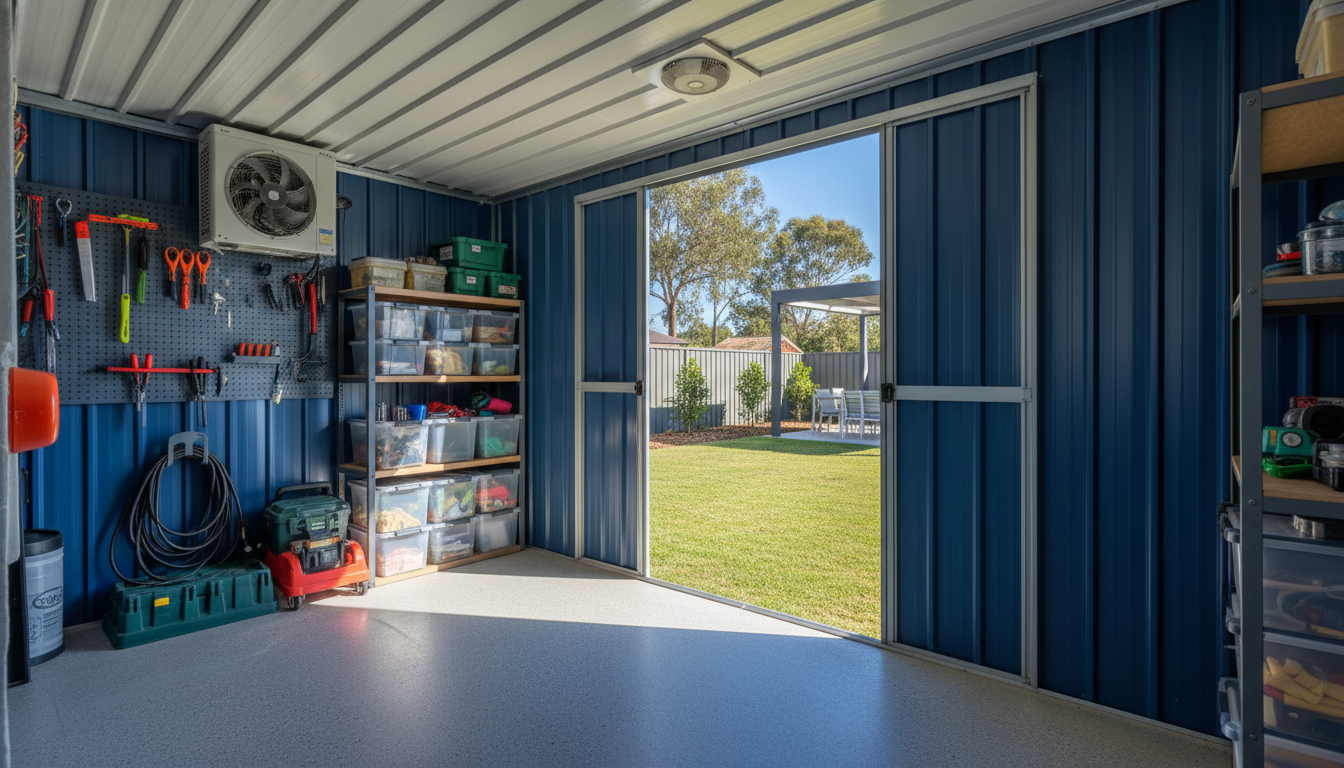
Why Organising Your Garden Shed Matters for Australian Homes
Whether you own a compact 3×3 garden shed in Perth or a larger 6×3 backyard workshop in Brisbane, good shed organization saves time, protects equipment, and makes weekend jobs safer. For investors and renovators, a tidy Colorbond steel shed adds utility and resale appeal without blowing the budget.
We draw on Australian conditions, standards, and trade practice to help you plan storage, cooling, and compliance—using the same thinking shed builders Sydney to Darwin deploy for residential and rural projects. You’ll see references to wind ratings, BAL (bushfire) considerations, and material choices like Colorbond vs Zincalume.
Relevant LSI topics we’ll cover include: steel sheds Perth, rural sheds NSW, farm sheds Victoria, cyclone-rated sheds QLD, Darwin cyclonic sheds, Tasmanian sheds, custom Colorbond garages Perth, DIY shed kits, affordable carports for Australian homes, and custom carports Melbourne.
What Are the Best Shed Materials for Perth’s Climate?
In hot, coastal, and windy environments, selecting the right cladding and roof sheeting is critical. WA homeowners typically choose between Colorbond and Zincalume for garden sheds, small workshops, and custom-built double garages in Perth.
Colorbond vs Zincalume — Which Is Better for WA Conditions?
| Factor | Colorbond Steel | Zincalume Steel |
|---|---|---|
| Coastal corrosion resistance | Excellent when correct grade used; better near the coast with maintenance and wash-downs | Good, but metallic finish can show corrosion earlier in marine spray zones |
| Heat reflectance (Perth summers) | High with light colours; can reduce radiant heat load | High reflectance; metallic finish reflects well but can glare |
| Colour range | Wide Colorbond palette to match home facades and fences | Limited (silvery metallic) |
| Warranty & paint system | Painted system; long warranties when installed to spec | Alloy coating; long warranties when installed to spec |
| Initial cost | Slightly higher | Usually lower |
| Best fit for WA | Best overall choice for urban and coastal suburbs | Good value inland or where a metallic look is preferred |
Technical note: For structural frames, many premium builders use hot-dip galvanised components or high-zinc coatings. In high-wind suburbs or open terrain, specify 0.42 BMT roof sheeting, compliant fasteners, and adequate purlin spacing per AS/NZS 1170.2.
Australian Steel Institute guidance and Energy.gov.au resources support durable, thermally smart material selections for sheds in hot climates.
How Should You Plan Zones in a Garden Shed?
Think like a tradie. Map out zones to reduce steps and put heavy items low, dangerous items locked away, and daily-use tools within arm’s reach.
- Entry wall zone: Hooks for hats, gloves, PPE, keys.
- Hand tool wall: Pegboard or a shadow board with outlines for spanners, secateurs, hammers.
- Power tool bay: Wall-mounted shelving plus a charging station with cable management.
- Garden & mower bay: Floor-level area for the mower, whipper-snipper, and a jerry can spill tray.
- Potting bench corner: Bench with splashback, sink or wash tub (optional), and overhead racking for pots.
- Chemicals cabinet: Lockable, ventilated steel cabinet for pesticides and fuels—away from heat.
- Overhead storage: Mezzanine shelf for bulky but light items (Christmas lights, tarps).
What Storage Systems Actually Work in a 3×3 or 6×3 Shed?
- Ply-lined walls + French cleats: Fast, flexible hanging for rakes, loppers, and blowers.
- Pegboard + labelled bins: For screws, irrigation fittings, and fixings.
- Adjustable steel shelving: Rated shelves for heavy items; anchor to the wall.
- Shadow boards: Prevents tool loss; obvious when something’s missing.
- Overhead racking: Store long items—conduit, timber lengths, aluminium ladder.
- Bike rails or vertical hooks: Keep bicycles off the floor in multi-use sheds.
- Magnetic strips: For drill bits, blades, small metal tools.
- Slide-out bins: Garden hose fittings, plant ties, and drip emitters.
- Label everything: Clear labels reduce rummaging and trips to Bunnings.
How Do You Keep a Shed Cool, Dry and Pest‑Free?
Australian sheds face heat, humidity, and condensation. Address all three.
- Insulation: Use an anti‑condensation blanket under roof sheets or insulated roof panels; add wall batts where possible.
- Ventilation: Ridge vents, screened eave vents, or whirlybirds promote airflow. Cross-vent with louvres where practical.
- Moisture control: Install roof sarking; seal slab edges; use a vapour barrier under slabs.
- Pest-proofing: Fit vermin seals at sheet bases, door seals, and mesh vents.
- Sun control: Light Colorbond colours, shade sails, or a skillion roof overhang reduce heat load.
What Does Council Approval Look Like for Sheds Around Australia?
Rules vary by council. Check setbacks, maximum heights, site coverage, and drainage. In high-wind or bushfire areas, additional design specs apply. For investors, council-approved sheds WA and compliant documentation help avoid delays during sale or leasing.
How to Get Council Approval for Your Custom Shed in WA
- Size and site plan: Decide dimensions (e.g., 3×3, 6×3), identify boundaries, easements, and sewer lines.
- Engineering: Obtain site-specific engineering for Region A/B wind ratings (Perth metro) or higher in exposed sites per AS/NZS 1170.2.
- Documents: Provide drawings, slab specs, drainage, and material schedule (e.g., 0.42 BMT roof, Colorbond cladding).
- Permit application: Lodge a Building Permit (BA2 or BA1) with fees. Many builders offer a permit service.
- Inspection & compliance: Slab and final inspections as required; keep warranties and engineering on file.
Added 2024 WA wind‑rating compliance notes Ensure your shed includes compliant fixings, hold‑down anchors, and door wind‑locks where specified.
Cyclone and Wind Ratings Explained for QLD and NT
In North Queensland and the NT, specify cyclone-rated sheds QLD for Region C/D. That means engineered connections, heavier sheeting, and door systems with wind-locks. For Darwin cyclonic sheds, look for tested roller doors and C-section portal frames designed to AS/NZS 1170.2 and AS/NZS 4600.
Check regional wind categories and severe weather risks with the Bureau of Meteorology.
Which Roof Style Suits Your Garden Shed?
| Roof Style | Best For | Pros | Considerations |
|---|---|---|---|
| Flat | Low-profile urban yards | Modern look, low height | Less natural venting; ensure adequate fall and drainage |
| Gable | General-purpose garden sheds | Great airflow, classic style | Slightly taller; check height limits near boundaries |
| Skillion | Side access or solar aspect | Simple structure; good for solar orientation | Wind loading differs by pitch—engineer accordingly |
DIY Shed Kit or Custom‑Built? What’s Better for You?
| Option | Advantages | Best For | Cautions |
|---|---|---|---|
| DIY shed kits | Cost-effective; fast lead times; weekend build | Small garden sheds; basic storage | Need a level slab; follow engineering exactly; allow for extra fixings in windy sites |
| Custom-built | Made-to-measure; integrated storage; permit support | Premium finish; tight spaces; sloping sites | Higher upfront cost; book installers ahead of peak seasons |
Many homeowners start with DIY shed kits, then upgrade to custom Colorbond garages Perth or custom carports Melbourne as needs grow. For farms, look at farm machinery storage designs and rural sheds NSW engineered for open terrain.
Safety, Chemical Storage and Bushfire Readiness
- Lockable cabinets: For fuels and pesticides; add a bunded tray.
- Fire safety: Keep an ABE dry powder extinguisher; don’t store gas bottles inside.
- BAL planning: Use ember mesh on vents; maintain a debris-free perimeter in bushfire season.
- Electrical safety: RCD-protected circuits; charge lithium batteries on non-combustible surfaces with spacing.
- Flooring: A 100 mm concrete slab with mesh reinforcement resists moisture and pests better than pavers or bare ground.
For standards context, see Housing Industry Association and Standards references via your builder. Always follow the National Construction Code (NCC) and relevant AS/NZS standards.
Real‑World Build: Perth Backyard Shed Makeover (Case Study)
Brief: 3×3 Colorbond garden shed in a coastal Perth suburb. Owner wanted mower access, tool organization, and cooler summer temps.
- Materials: Colorbond walls and 0.42 BMT roof sheeting; hot‑dip galvanised screws; vermin flashing.
- Cooling: Anti‑condensation blanket under roof, ridge vent, and light roof colour.
- Storage: Ply-lined rear wall with French cleats; shadow board on side wall; adjustable shelves; overhead rack for camping gear.
- Safety: Lockable chemical cabinet; extinguisher by door; RCD-protected GPOs for battery charging.
- Outcome: 40% faster tool access (owner estimate), no drips after winter cold snaps, and easier weekend maintenance.
5‑Step Buying Guide for Custom Sheds in Australia
- Define the brief: Size, height, door type, and purpose (e.g., garden tools, small workshop, farm machinery storage).
- Match to climate: Choose Colorbond colours for heat control; consider insulated panels in hot zones.
- Engineer for wind: Confirm site wind region (A–D). For coastal QLD, specify wind‑rated sheds for cyclonic areas with door wind‑locks.
- Plan storage from day one: Frame blocking for shelves, French cleats, and overhead racks before lining.
- Get approvals sorted: Use builders who handle permits and supply drawings for council-approved sheds WA and other states.
FAQs: Shed Organisation and Australian Compliance
Do I need a concrete slab?
For stability, moisture control, and pest-proofing, a reinforced concrete slab is best. In cyclonic regions or for larger sheds, a slab with engineered hold-downs is typically required.
Can I attach my shed to a fence?
Generally no. Fences aren’t structural. Maintain setbacks and self-supporting construction unless your council permits otherwise.
How do I stop condensation?
Install anti-condensation blanket or insulated roof panels, add ridge/eave vents, and control ground moisture with a vapour barrier under the slab.
What BMT should I choose?
For windy or exposed sites, specify 0.42 BMT roof sheeting. Follow engineering for purlin spacing and fasteners.
What about bushfire areas?
Follow BAL requirements for ember protection and clear zones around the shed. Ask your builder for BAL-compliant options.
Can a carport integrate with my garden shed?
Yes. Many sites combine a small shed with affordable carports for Australian homes or upgrade to custom Colorbond garages Perth as needs grow.
Local Standards, Climate and Market Notes
- Standards: AS/NZS 1170.2 (Wind Actions), AS/NZS 4600 (Cold-formed steel), and NCC compliance apply.
- Climate: Use BoM data to check wind and cyclones; coastal sites need enhanced corrosion protection.
- Market: Industry outlooks into 2025 indicate steady demand for outdoor structures and steel sheds. Refer to the HIA and Australian Steel Institute for updates, as well as the “2025 Australian Steel Market Outlook” and “2025 HIA Outdoor Structures and Home Improvement Report”.
Note: Always verify current council guidelines and Australian Standards applicable to your site and project date.
Keyword Clusters to Explore Next
- Local builds: steel sheds Perth, sheds Adelaide, shed builders Sydney, rural sheds NSW, farm sheds Victoria, Tasmanian sheds, cyclone-rated sheds QLD, Darwin cyclonic sheds
- Technical: Colorbond vs Zincalume comparison, C-section portal frames, hot-dip galvanised fixings, 0.42 BMT sheeting, roller door wind-locks, anti-condensation blanket, BAL rating
- Use-cases: DIY shed kits, farm machinery storage, garden tool storage, custom carports Melbourne, affordable carports for Australian homes