
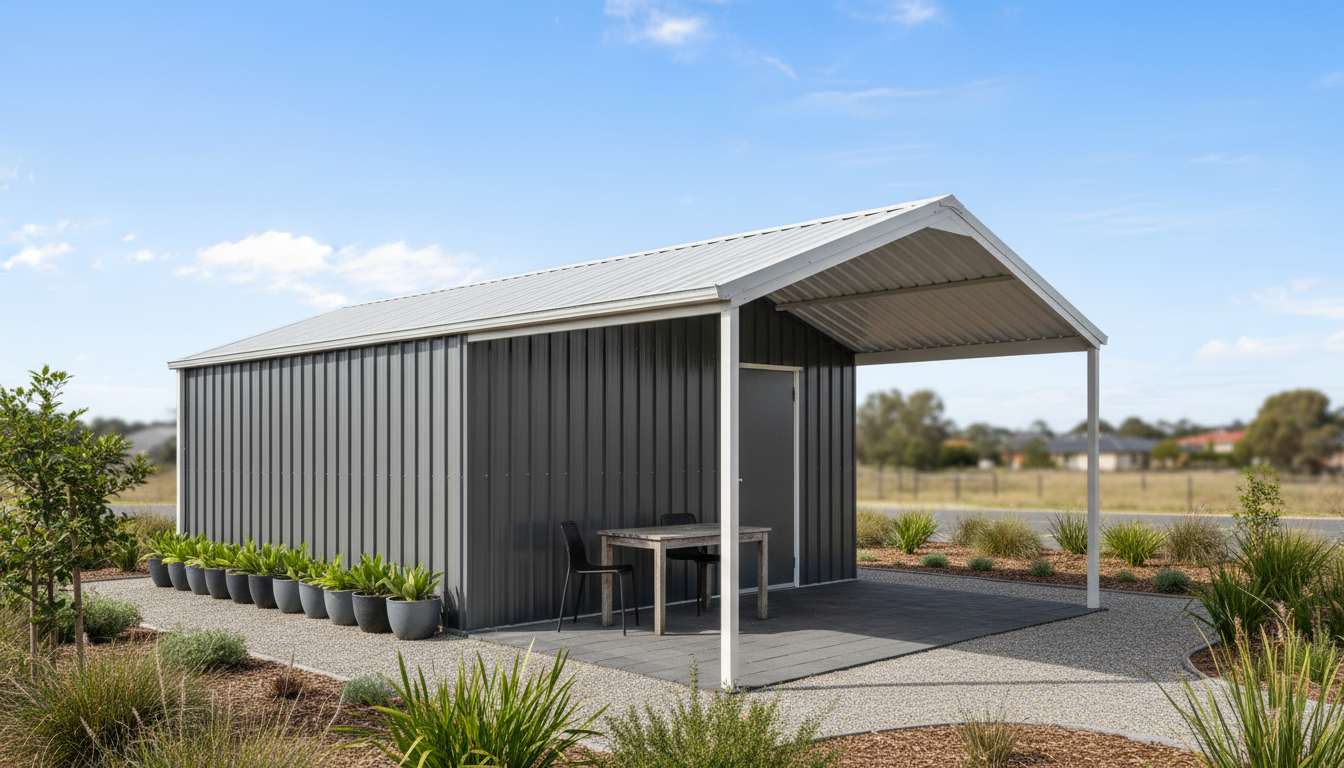
Whether you’re in Perth’s heat, coastal NSW salt air, or cyclonic North QLD, a well‑engineered garden shed with awning blends storage and sheltered outdoor living. Below you’ll find local compliance notes, material choices, and practical examples drawn from Australian standards and on-the-tools experience.
What is a garden shed with awning?
A garden shed with awning is a Colorbond 12×6 Shed or Zincalume steel shed with an attached lean‑to or skillion roof extension. The awning (often 2–6 metres deep) creates covered space for outdoor entertaining, boat/caravan parking, or simply weather-protected access. Many Australian homes use these as mini‑workshops, mower/tool storage, or to extend an alfresco without major renovation.
What Are the Best Shed Materials for Perth’s Climate?
Perth’s hot summers, coastal breezes, and high UV make roof colour, coating type, and insulation critical. For metro and coastal WA, Colorbond steel (especially lighter, higher Solar Reflectance colours) paired with anti‑condensation blanket or insulated roof panels will keep the shed and awning usable year‑round. In inland WA or regional NSW, Zincalume remains a cost‑effective option if aesthetics permit. Near surf coasts or estuaries, marine‑grade fasteners and enhanced corrosion detailing are essential.
Colorbond vs Zincalume — Which Is Better for WA Conditions?
| Feature | Colorbond (BlueScope) | Zincalume |
|---|---|---|
| Best use | Urban/coastal homes; premium look; heat-reflective colours | Budget-friendly rural/utility sheds |
| Coastal corrosion resistance | Excellent with correct grade and maintenance; specify coastal fasteners | Good inland; near surf coasts upgrade detailing and maintenance |
| Heat performance | Light colours can lower roof surface temps; pair with insulation | Metallic finish warms; insulation still essential |
| Aesthetics | Modern profiles and colours; matches Colorbond fencing/fascia | Industrial look; can paint later |
| Typical cladding thickness | 0.42–0.48 TCT wall/roof sheets | 0.42–0.48 TCT wall/roof sheets |
| Indicative cost | $$ to $$$ | $ to $$ |
| BlueScope warranty | Up to 20–40 years (site-specific) | Up to 20–40 years (site-specific) |
LSI tip: For “steel sheds Perth” and “custom Colorbond garages Perth,” ask for coastal fasteners (Class 4), sarking or insulated panels, and gutter guard. In QLD cyclonic areas, opt for 0.48 TCT roof sheets with cyclone screw patterns and engineered hold‑downs.
How much does a garden shed with awning cost in Australia (2025)?
Allow for steel market normalisation noted in the “2025 Australian Steel Market Outlook” and regional logistics. Below are typical ranges for compliant, engineered Colorbond solutions:
- 3×3 m shed + 2 m awning (kit): $3,900–$6,900 inc. GST
- 4.5×3 m shed + 3 m awning (kit): $5,900–$9,900 inc. GST
- 6×4 m shed + 3 m awning (kit): $8,900–$14,900 inc. GST
- Installed (incl. footings/slab, average metro): add $4,000–$10,000
Extras impacting price: cyclonic engineering (Region C/D), BAL requirements, 0.48 TCT roofing, insulated roof panels, large openings (roller doors), stormwater connection, and site works.
Reference (no-follow): Australian Steel Institute, HIA, Energy.gov.au. Market note: 2024–2025 reports indicate steadier domestic supply after earlier volatility.
Do I need council approval for a shed with an awning?
Most Australian councils require a building permit for sheds and awnings beyond minor sizes/heights, or when near boundaries and easements. Planning approval may also apply for setbacks, coverage, heritage, or overlays. Another great option for flexible shelter is the Garden Shed with Lean-To. Requirements vary by state:
- WA: Building Permit (BA1/BA2) under the Building Act 2011; NCC 2022 compliance; R‑Codes setbacks may apply. Added 2024 WA wind-rating compliance notes
- QLD: Private certifier building approval (BA) referencing NCC and AS/NZS 1170.2; cyclonic detailing in Region C/D
- NSW: Exempt or Complying Development (SEPP) possible; otherwise DA/CC with certifier
- VIC: Building Permit via RBS; siting per local planning scheme
- SA, TAS, ACT, NT: Check local council/Private Certifier; wind/snow/bushfire overlays may change specs
How to Get Council Approval for Your Custom Shed in WA
- Site plan and setbacks: confirm R‑Codes and any estate covenants.
- Engineering: request site-specific certificate referencing AS/NZS 1170.2 (Region A Perth; terrain, shielding) and AS/NZS 4600.
- Drawings: elevations, sections, connection details, slab/footings, stormwater plan.
- Forms: BA1 (applicant) or BA2 (builder), owner consent, fees, and proof of owner‑builder or registered builder as applicable.
- Inspections: footing/slab and final as required by the permit.
Tip: For council-approved sheds WA, include awning posts/footings and roof loads in the same engineering package so the certifier signs off once.
What wind rating and engineering do I need?
Engineering must meet NCC 2022 and AS/NZS 1170.2 (Wind actions). The correct wind region (A, B, C, D), terrain category, topography, and shielding determine pressures and fixings. In non‑cyclonic suburbs (e.g., Perth metro), N2/N3 load cases are common; coastal or hilltops may require higher. In North QLD and northern WA, design for Regions C/D with C2–C3 fixings and detailing.
- Cladding: 0.42 TCT minimum; 0.48 TCT recommended for cyclonic or high suction zones
- Fasteners: Class 4 coated cyclone screws in C/D regions; increased fixing density at edges
- Framing: Cold‑formed C/Z purlins, SHS/UB posts; hold‑downs sized to uplift loads
- Bracing: Strap bracing or portal frame knee/haunch plates per engineering
- Footings: Slab thickening or piers with cast‑in anchors; verify soil class
Additional overlays: AS 3959 (BAL for bushfire), AS/NZS 1170.3 (snow in alpine), AS/NZS 1562 (roof cladding), and corrosion categories per AS 4312 for coastal sites.
If you need cyclone-rated sheds QLD, ask for a C‑region certificate with connection schedules and screw patterns specific to your address.
Design options for sheds with awnings
Custom design lets you tune the awning space to real use—BBQ area, boat bay, or a covered workbench.
- Roof styles: flat/skillion (lower cost), gable (classic look), or dutch gable
- Awning depth: 2–6 m; clear heights 2.2–3.6 m for caravans and 4WDs
- Profiles: Corrugated or Trimdek/Monoclad for modern lines
- Doors: single PA, double hinged, or roller doors (manual/motorised)
- Windows and ventilation: louvres, whirlybirds, ridge vents, insect screens
- Thermal control: anti‑condensation blanket, sarking, or insulated roof panels (EPS/PIR)
- Gutters and rainwater: oversized gutters, sumps, DP size per rainfall intensity (BoM data)
- Electrical: LED battens, outdoor GPOs, fans; run conduits before slab pour
- Security: internal framing, tamper‑proof fixings, deadbolts
- Add‑ons: mezzanine storage, workbench, polycarbonate skylights, solar PV, water tank
For “custom carports Melbourne” or “affordable carports for Australian homes,” a shed plus awning can outperform a standalone carport by giving lockable storage and covered parking in one build.
DIY shed awning kits vs custom-built installs
Shed awning kits are great for handy owners with time and basic tools. Custom builds suit sloping sites, tight access, or cyclonic regions.
- DIY kits: lower cost, quick metro delivery, pre‑engineered; allow for slab, tools, and at least two people
- Custom install: site‑measure, council handling, crane/boom if needed, faster install; higher upfront cost
Ask for “shed awning kits” that include engineering, fastener schedules, and full bill of materials. Ensure the awning structure is engineered—not just tacked onto fascia.
Real build examples (Australia)
- Perth (City of Wanneroo): 6×4 m Colorbond shed + 3 m awning, Surfmist roof, 0.42 TCT walls, N2 wind. 100 mm slab with N12 bars, vermin seals, LED lights. Outcome: workshop + covered BBQ zone.
- Cairns (Region C): 6×3 m shed + 3 m awning, 0.48 TCT roof, Class 4 cyclone screws, extra edge fixings, SHS posts with cast‑in hold‑downs. Certifier approval achieved first pass.
- Rural NSW: 7×4 m shed + 4 m awning for farm machinery storage; Zincalume cladding, Colorbond gutters, tank harvesting 10,000 L.
What are the climate and corrosion considerations?
- Perth heat: pick light Colorbond colours and insulation for cooler interiors (BoM high summer temps)
- Coastal NSW/WA: upgrade fasteners, add washdown access, apply cut-edge sealing
- Tropics (QLD): design for cyclones, specify robust gutters and downpipes
- Alpine VIC/NSW: check snow load combinations (AS/NZS 1170.3)
- Bushfire zones: detail per AS 3959; metal mesh ember guards for vents
Climate references: Bureau of Meteorology climate data, CSIRO bushfire research.
5-Step Buying Guide for Custom Sheds in Australia
- Measure and plan: confirm footprint, awning depth, vehicle clearances, stormwater path, and setbacks.
- Choose materials: Colorbond in light colours for heat; 0.48 TCT roof in windy/coastal zones; Class 4 fasteners.
- Engineering and wind rating: get a site-specific certificate (AS/NZS 1170.2). Include awning loads and connections.
- Council/Certifier: prepare drawings, forms, and energy/bushfire notes if applicable. council-approved sheds WA and similar processes in other states.
- Build and maintain: prepare slab or piers, erect frame to schedule, then set a washdown and inspection routine.
Frequently asked questions
Do sheds with awnings need gutters?
Yes. Capture runoff with correctly sized gutters and downpipes for your local rainfall intensity (BoM). Direct to stormwater or a water tank.
Can I build on the boundary?
Often no, unless specific height, fire, and drainage criteria are met. Check local planning codes. Fire separation may trigger non-combustible walls and no openings.
What slab or footings do I need?
Commonly a 100 mm slab with mesh for the shed and separate piers for awning posts. Cyclonic or uplift-prone sites use cast‑in anchors or thickened beams.
Can the awning be added later?
Yes, if the original engineering allowed for it. Otherwise, get new calculations and check footings for additional loads.
How long does installation take?
DIY kits: 1–3 days for smaller builds with two people. Custom installs: 1–4 days depending on size and weather.
What warranties should I expect?
BlueScope material warranty (site-specific) plus installer warranty on workmanship. Ask for documentation and keep your approvals and drawings.
Pro Tip
Did you know? Using insulated roof panels can reduce internal shed temperatures by up to 10°C in summer, improving comfort under the awning and lowering heat transfer to the shed.
Keyword clusters to help you plan
- Local builds: steel sheds Perth, sheds Adelaide, custom carports Melbourne, industrial sheds Sydney, garage kits Brisbane, rural sheds NSW, farm sheds Tasmania, shed builders Gold Coast
- Technical: Colorbond vs Zincalume comparison, wind-rated sheds for cyclonic areas, BAL-rated sheds, 0.48 TCT cladding, Class 4 fasteners
- Usage: farm machinery storage, boat/caravan awning, DIY shed kits, affordable carports for Australian homes
Standards, codes, and references
- NCC 2022; AS/NZS 1170.2 (Wind actions); AS/NZS 4600 (Cold-formed steel structures); AS 3959 (Bushfire); AS/NZS 1562 (Sheet roof/wall); AS 4312 (Corrosion categories)
- Industry: Housing Industry Association (HIA), Master Builders Australia, Australian Steel Institute
- Climate/Energy: Bureau of Meteorology, CSIRO, Energy.gov.au
- Market: “2025 Australian Steel Market Outlook”; “2025 HIA Outdoor Structures and Home Improvement Report”
Ready to design your shed and awning?
Ask for a site‑specific wind report, Colorbond colour samples, and an engineered connection detail for the awning. If you’re in WA, include Added 2024 WA wind-rating compliance notes with your BA submission; in QLD, request a cyclonic certificate if you’re in Region C/D. With the right materials and paperwork, your garden shed with awning will perform for decades.