
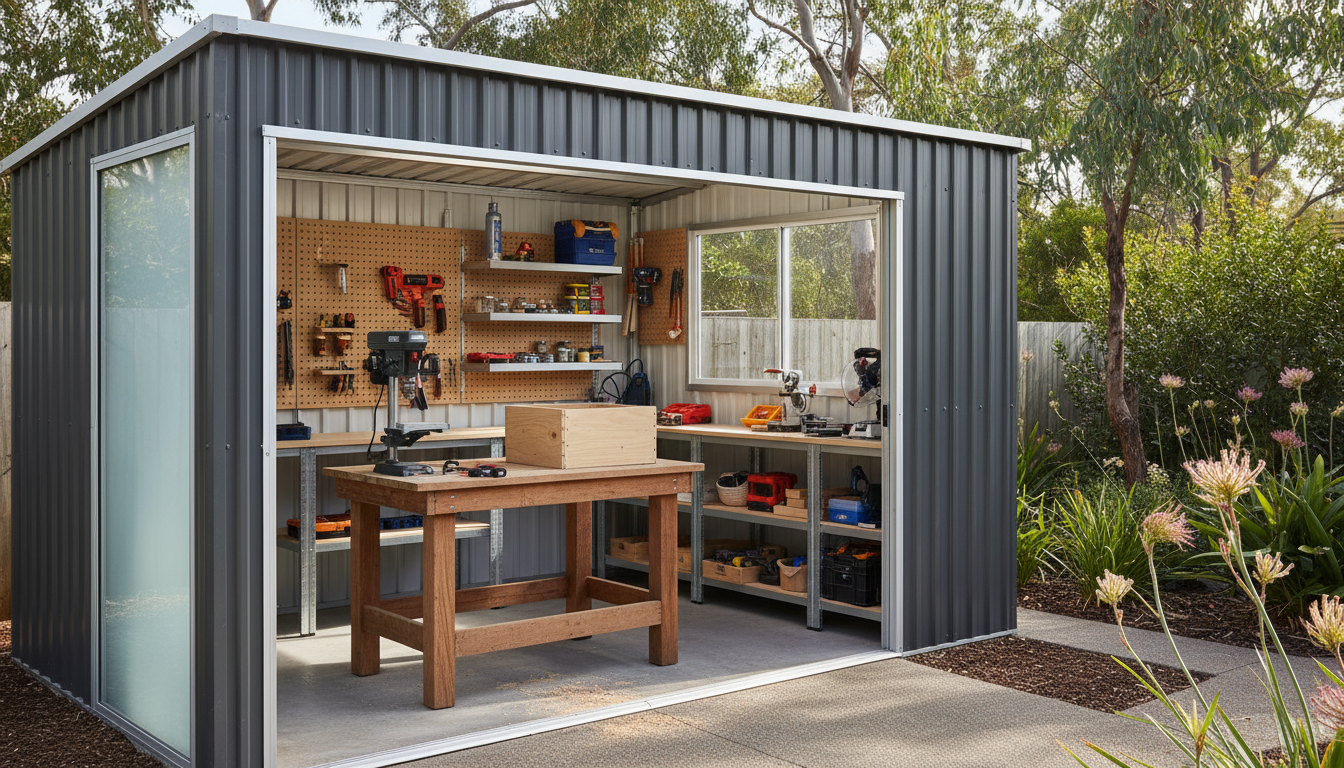
Turn Your Garden Shed Into a Hard-Working Australian Workshop
Whether you’re in Perth heat, coastal NSW sea spray, or cyclonic North QLD winds, this expert guide shows you how to plan, engineer and fit out a premium-quality shed workshop using Australian standards, local council processes, and trade-proven details. Expect practical ideas, wind-rated options, and smarter layouts.
What Are the Best Shed Materials for Perth’s Climate?
For most Australian backyards and small acreage blocks, a steel portal-frame shed clad in BlueScope COLORBOND or ZINCALUME offers the best durability and value. In Perth and regional WA, heat reflectivity and corrosion resistance are critical. Choose sheeting and flashings based on proximity to coast and fertiliser exposure.
COLORBOND vs ZINCALUME — Which Is Better for WA Conditions?
| Feature | COLORBOND Steel | ZINCALUME Steel |
|---|---|---|
| Coating | Painted (multiple layers over zinc/aluminium/magnesium base) | Unpainted zinc/aluminium/magnesium alloy |
| Heat performance (Perth) | Lighter colours reflect heat better; lower surface temps | Good reflectivity initially; can weather/age to dull grey |
| Coastal resistance | Use COLORBOND Ultra near surf coasts and marinas | Needs increased setbacks from breaking surf; frequent washdown |
| Aesthetics | Modern colours (Monument, Surfmist, Shale Grey) | Industrial silver/grey look |
| Cost | Higher upfront | Lower upfront |
| Best for | Premium homes, hot climates, coastal exposure | Budget builds inland, farm machinery storage |
In Perth and the Mid West, we typically specify COLORBOND in light colours plus an anti-condensation blanket under roof sheets to cut radiant heat. For coastal WA and QLD, step up to COLORBOND Ultra and stainless fixings.
How Big Should a Garden Workshop Be for Australian Homes?
Right-size your shed by bay width, usable wall space, and door clearances—not just overall footprint.
- Popular footprints: 6×6 m (double-bay), 7×9 m (tradie workshop), 9×12 m (rural sheds NSW with farm machinery storage).
- Bay spacing: 3–4 m bays suit small workshops; 4.5–6 m for larger spans.
- Eave height: 2.7–3.6 m clears roller doors, mezzanine storage and 4WD roof racks.
- Door openings: Allow 100–150 mm extra height above vehicles and benches; use wind-lock roller doors in exposed sites.
Which Roof Style Is Best for a Workshop?
| Roof Style | Pros | Cons | Best Use |
|---|---|---|---|
| Gable roof | Classic look, good runoff, easy ridge venting | Higher ridge height in strict planning controls | Suburban blocks; custom Colorbond garages Perth |
| Skillion (mono) | Modern look, simple gutters, solar-friendly pitch | May need deeper fascia gutters in heavy rain | Contemporary homes; steel sheds Perth with solar |
| Flat (low-pitch) | Low profile for boundary setbacks | Stricter box gutter design; more maintenance | Where height is restricted |
If your ‘workshop’ is essentially a double or triple-bay garage, begin with our home garage & steel shed guide for sizing, wind ratings and approvals.
What Layout Works Best Inside a Shed Workshop?
- Zones: machining (noise), clean bench, storage, dirty work (grinders/welders), and a 900–1200 mm wide circulation path.
- Power: 32 A circuit for welders, multiple 15 A GPOs, weatherproof external outlets.
- Lighting: LED battens (4000–5000 K), task lights over benches, skylight/Polycarb sheets on south-facing roof areas.
- Flooring: 100 mm slab-on-ground, SL72 mesh minimum, thickened edge beams; epoxy floor for spill resistance.
- Storage: mezzanine over a bay, pallet racking, French cleat walls for garden tools.
How Do You Keep a Shed Cool in Summer and Dry in Winter?
- Roof insulation: anti-con blanket plus R2.0–R3.6 bulk batts or insulated sandwich panels.
- Ventilation: ridge vents, whirlybirds, wall louvres, and crossflow via high/low vents.
- Condensation control: vapour-permeable sarking on walls, sealed slab, vermin flashing, and correct gutter overflows.
- Orientation: doors away from prevailing rain; eaves or awnings on sunny west aspects (Perth afternoons).
Pro Tip: Did you know using insulated roof panels can reduce internal shed temperatures by up to 10°C in summer? It also quietens rain noise and helps with condensation control.
Do You Need Council Approval? State-by-State Pointers
How to Get Council Approval for Your Custom Shed in WA
- Check R-Codes and local planning policy for setbacks, height, and site coverage.
- Engineer to NCC 2022 and AS/NZS 1170.2 for wind actions; provide certified drawings and slab details. Added 2024 WA wind-rating compliance notes
- Apply for a Building Permit (BA2) with site plan, elevations, specifications, and energy/roof drainage notes.
- In bushfire areas, confirm BAL construction details for doors and vents.
- For council-approved sheds WA, allow 10–25 business days for assessment depending on shire.
NSW and QLD Quick Notes
- NSW: Some small sheds may be exempt or Complying Development; check height and floor area triggers. Rural sheds NSW often need farm use verification.
- QLD: In Region C/D (cyclonic), an RPEQ-engineered design and tie-down schedule is mandatory; specify cyclone-rated sheds QLD with C/D-rated doors and connections.
What Wind Rating Does Your Shed Need?
Australian sheds must be engineered to AS/NZS 1170.2. Your site’s wind region (A, B, C, D), terrain category, shielding, and topography determine design pressures. Northern WA and coastal QLD often fall into Regions C or D (cyclonic), requiring higher-capacity hold-downs, purlins, and door systems.
- Connections: M12–M20 hold-down anchors, cyclone washers, and tie-down straps at critical joints.
- Doors: Wind-lock roller doors and wind-rated PA doors with multi-point locking for exposed sites.
- Cladding fixings: Class 4 screws in coastal exposure; increased fastener density to suit design suction zones.
Workshop Fit-Out Ideas Australian Tradies Swear By
- 2400 mm high sheeted wall behind benches for easy cleaning.
- Compressed air ring main with drops at each bay.
- Dust extraction for saws/routers; acoustic panels to tame reverberation.
- Combination of hinged doors and high-cycle roller doors for quick access.
- Rainwater tank off the shed roof; external wash-down bay.
- Security: motion sensors, braced door jambs, laminated glazing on windows.
Real Build Examples Across Australia
Case Study #1 — Custom-Built Double Garage in Perth
6×7.5 m gable, 3.0 m eave, COLORBOND Surfmist, anti-con blanket + R2.0 batts, insulated sectional door. Result: 7–9°C cooler in summer afternoons; quiet enough for evening woodworking. Keywords addressed: steel sheds Perth, custom Colorbond garages Perth.
Case Study #2 — Rural Workshop, Central West NSW
9×12 m, three 4 m bays, ZINCALUME cladding, skillion roof with 10° pitch, whirlybirds, mezzanine storage. Fits tractor plus farm machinery storage. Local council approved as an agricultural outbuilding.
Case Study #3 — Cyclone-Rated Garden Workshop, Townsville QLD
7×7 m, Region C design, wind-lock door, extra wall bracing, Class 4 fasteners. Passed RPEQ sign-off and insurance requirements for cyclone season.
DIY Kit vs Custom-Built: What’s Right for You?
| Option | Pros | Cons | Best For |
|---|---|---|---|
| DIY shed kits | Lower cost, fast delivery, weekend build with mates | Limited customisation; check wind rating; time commitment | Handy owners; inland areas; affordable carports for Australian homes |
| Custom-built (supply & install) | Tailored to site and council; cleaner finish; warranty-backed | Higher upfront cost; lead time | Premium homes; complex sites; coastal/cyclonic zones |
For current price ranges and inclusions on modular options, see our prefab garage & modular shed kits guide.
How Much Does a Quality Shed Workshop Cost in 2025?
Indicative supply-and-install prices (metro, level site, slab included):
- 6×6 m double-bay: $14,000–$22,000
- 7×9 m workshop: $22,000–$35,000
- 9×12 m rural workshop: $36,000–$58,000
Costs vary with wind rating, insulation, doors, and finishes. According to the 2025 HIA Outdoor Structures and Home Improvement Report and the 2025 Australian Steel Market Outlook, steel input volatility and labour availability continue to influence pricing. Get fixed quotes with detailed inclusions.
What Are the Best Garden Shed Workshop Ideas Right Now?
- Skillion roof with solar array and battery cabinet.
- Bench-height windows to keep wall space free for racking.
- Mezzanine accessed via space-saving stair or ships ladder.
- Hybrid lining: ply behind benches, steel lower walls for hose-down.
- External lean-to for mowers and dirty gear; clean workshop inside.
- Motion-activated LEDs and smart GPOs for safety and energy savings.
5-Step Buying Guide for Custom Sheds in Australia
- Define use-case and size: hobby, tradie lock-up, farm storage; plan bays and door openings.
- Select materials: COLORBOND vs ZINCALUME comparison, insulation, door types, vermin flashing.
- Engineer for site: wind-rated sheds for cyclonic areas, terrain, shielding; check slab spec.
- Get approvals: planning and building permits (council-approved sheds WA, CDC/DA NSW, RPEQ QLD).
- Lock inclusions: gutters/downpipes, ventilation, electrical rough-in, warranties, and lead times.
New to shed building? Our step‑by‑step storage sheds DIY guide covers materials, wind ratings and council basics.
FAQs: Shed Workshop Essentials for Australian Conditions
How long will a COLORBOND shed last?
With correct specification and maintenance, 20–30+ years. Near surf coasts, specify COLORBOND Ultra and rinse cladding regularly.
What slab thickness should I pour?
Commonly 100 mm with SL72 mesh for light workshops; thicken to 125–150 mm with extra mesh or bar chairs for hoists or heavy loads. Engineer to soil class and point loads.
Can I add a carport to the shed?
Yes—custom carports Melbourne and other cities can attach as a lean-to or freestanding. Match wind rating and gutter capacity.
What about condensation?
Use anti-con blankets, breathable wall wraps, vents, and slab vapour barriers. Position insulation correctly to avoid trapped moisture.
Typical lead times?
DIY shed kits: 2–4 weeks. Custom builds: 6–12+ weeks including council and engineering, longer in cyclonic regions.
Helpful Standards and Local Resources
Keyword Clusters You Might Be Searching For
steel sheds Perth, custom carports Melbourne, rural sheds NSW, custom Colorbond garages Perth, DIY shed kits, affordable carports for Australian homes, wind-rated sheds for cyclonic areas, farm machinery storage, garden shed workshop ideas, shed workshop ideas, Colorbond vs Zincalume comparison, council-approved sheds WA, cyclone-rated sheds QLD, double garage in Perth, insulated roof panels, gable roof sheds, skillion sheds, vermin flashing, anti-condensation blanket, epoxy flooring for sheds, mezzanine storage.
Excerpt: Smarter Australian garden shed workshop ideas—materials, wind ratings, approvals and layouts that actually work. Compare COLORBOND vs ZINCALUME, gable vs skillion, DIY kits vs custom builds, and get a 5-step buying checklist. Includes WA wind notes, QLD cyclone tips, and trade-proven cooling and condensation fixes.