
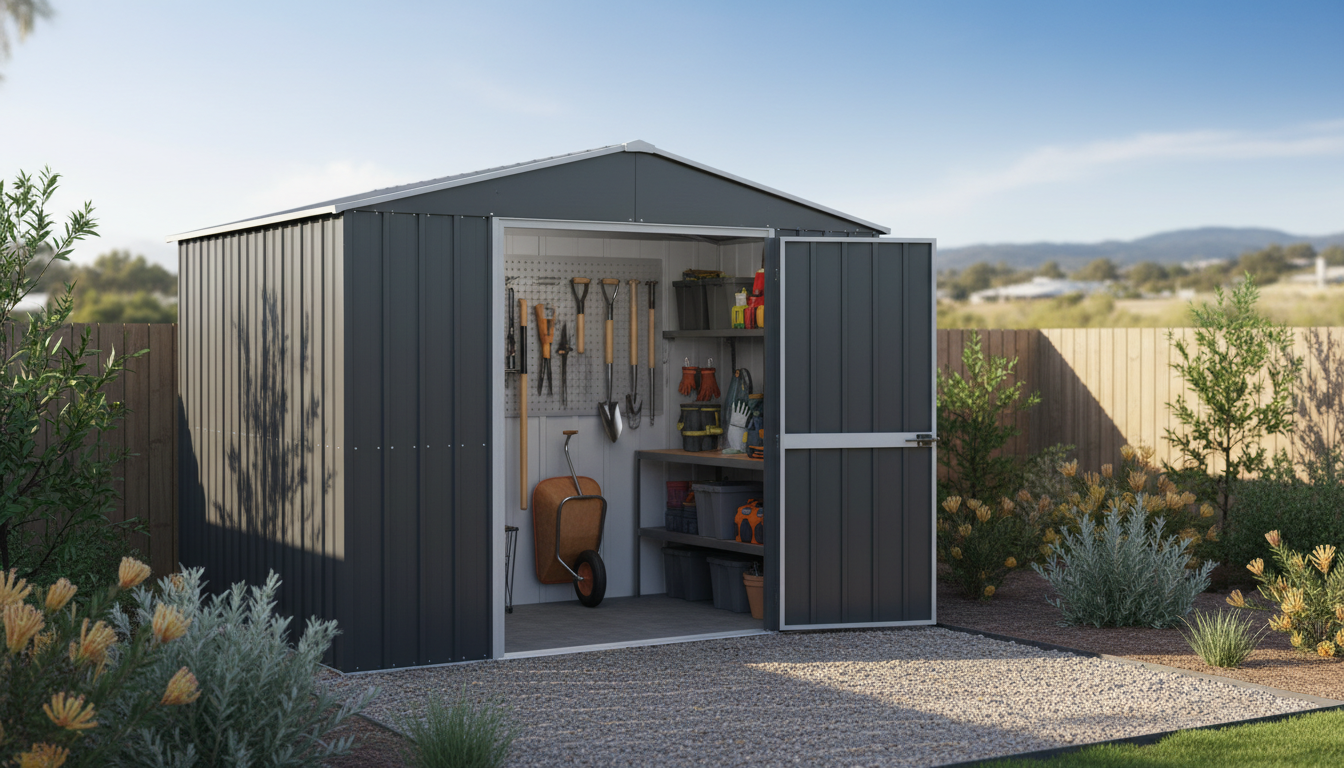
Smart Garden Tool Storage for Australian Conditions
Maximise space, protect your gear, and add value with a purpose-designed garden tool storage shed. Whether you’re in Perth heat, QLD cyclones, or a coastal NSW microclimate, this guide shows how to choose a Colorbond steel shed that’s council-compliant, wind-rated, and optimised for garden equipment storage.
What Are the Best Shed Materials for Perth’s Climate?
For WA heat and UV exposure, Bluescope Colorbond and Zincalume are the dominant cladding choices. Both are engineered for Australian conditions, but each shines in different scenarios.
| Criterion | Colorbond Steel | Zincalume Steel |
|---|---|---|
| Finish | Painted baked-on finish; wide colour range to match Colorbond roofing/gutters | Metallic alloy finish; silver appearance, often painted later |
| Heat Resistance | Thermatech variants reflect more solar heat; good for Perth summers | High reflectivity but can glare; may still need insulation |
| Corrosion Resistance | Excellent, even inland coastal; check specific warranties | Excellent; superior bare-metal corrosion resistance in many environments |
| Cost | Typically higher due to coatings and colours | Usually more affordable upfront |
| Best Use | Premium residential, matching facades, BAL-rated designs | Budget builds, farm and rural outbuildings |
Looking for classic durability? Discover the benefits of a Corrugated Garden Shed for traditional style with modern performance.
How Much Garden Tool Storage Do You Really Need?
Start by auditing your gear by category: long-handle tools (rakes, hoes), power tools (whipper snipper, blower), seasonal items (fertiliser, hoses), and bulky equipment (lawn mower). A tight 1.5 m × 3 m shed suits tools plus a mower; 3 m × 3 m gives room for a workbench, garden tool box, and vertical racking. If you store soil, pots, or a wheelbarrow, consider 3 m × 4.5 m or larger with double doors.
- Garden equipment storage essentials: wall-mounted rails, adjustable shelving, pegboards, lockable garden tool box drawers.
- Floor area vs volume: add 600–900 mm aisle space in front of shelves for easy access.
- Door type: roller for vehicle access; hinged or sliding for tight side yards.
Which Shed Type Suits Your Property?
Compact Backyard Sheds (1.5 m–2.3 m depth)
Great for courtyards and narrow setbacks in Perth or Melbourne inner suburbs. Opt for skillion roof to meet height limits and boundary setbacks. Consider vermin-proofing and integrated tool rails to avoid clutter.
If you’re working with a tight area, the Lean-To Shed Australia Guide covers compact designs that fit snugly against existing structures.
Mid-Size Utility Sheds (3 m × 3 m to 3 m × 6 m)
Ideal for families and hobby gardeners. Add a polycarbonate skylight, whirlybird ventilation, and insulated roof panels to manage heat. Modular shelving keeps fertilisers and chemicals off the floor.
Multi-Use Garages and Workshops
Many owners pair storage with a workspace or small “garden bay” inside a custom-built double garage. Popular options include custom Colorbond garages Perth, steel sheds Perth, custom carports Melbourne, and rural sheds NSW where an extra bay is set aside for farm machinery storage or mowers.
How to Get Council Approval for Your Custom Shed in WA
Most WA LGAs require a building permit for steel sheds above certain sizes or where attached to services. Typical steps:
- Site plan: show boundaries, setbacks, easements, existing structures.
- Engineering: shed certification to AS/NZS 1170.2 (wind actions), AS/NZS 4600 (cold-formed steel), and NCC 2022 requirements.
- Slab/specs: concrete slab thickness (often 100 mm), footing details, anchor bolts, vermin flashing.
- Documentation: drawings, energy/ventilation notes, colour schedule (Colorbond), and stormwater plan.
- Lodge: apply for a “council-approved shed” with fees and any neighbour consultation if required.
Added 2024 WA wind-rating compliance notes Verify your wind region (A, B, C, D) and terrain category. Many Perth metro sites are Region A; coastal or exposed sites may need higher ratings. Your engineer will nominate N2/N3 or higher, and detail hold-downs, purlin spacing, and door bracing.
Do You Need Cyclone-Rated Sheds in QLD and NT?
In North QLD and NT cyclonic zones, specify cyclone-rated sheds QLD engineered to C2 or C3. Key inclusions: stronger portal frames, cyclonic roller doors, extra hold-downs, and certified fasteners. Always request site-specific engineering and Region C/D compliant documentation for council and insurance.
What Roof Design Is Best for Garden Equipment Storage?
| Roof Type | Pros | Considerations | Best For |
|---|---|---|---|
| Skillion (Mono) | Great drainage, simple install, lower height on boundary | Wind load asymmetry needs engineering | Narrow side yards, modern architecture |
| Gable | Classic look, good airflow with vents, strong portal options | Taller ridge may affect setback limits | Mid–large sheds, workshops |
| Flat (Low Pitch) | Minimalist, can tuck under eaves, cost-effective | Drainage must be designed; debris build-up | Small courtyard storage |
Should You Choose a DIY Shed Kit or a Custom-Built Shed?
| Aspect | DIY Shed Kits | Custom-Built |
|---|---|---|
| Cost | Lower upfront; great for smaller garden tool storage | Higher; tailored engineering and finishes |
| Compliance | Kit engineering available; you handle approvals | Supplier assists with council approvals and certificates |
| Speed | Fast delivery; install over a weekend | Longer lead time; professional installation |
| Fit-out | Basic shelving/pegboard add-ons | Fully integrated storage wall, benches, power, lighting |
DIY shed kits suit budget-friendly builds and straightforward sites. Custom sheds excel where you need premium aesthetics, bushfire or cyclonic certification, or integrated workshop bays.
How to Plan the Inside of Your Shed for Tools and Equipment
- Zones: mower and fuel at the door; long tools on wall racks; small parts in a lockable garden tool box; potting bench under a window for light.
- Shelving: heavy-duty racking bolted to the slab; 450–600 mm deep; top shelf for seasonal items. Maximise your space and efficiency by exploring Garden Shelves for Australian Sheds tailored to your storage needs.
- Ventilation: whirlybird + eave vents; add fly-mesh to keep pests out.
- Lighting: LED batten with motion sensor; consider a solar kit for off-grid.
- Flooring: sealed concrete slab with 1–2% fall to door; rubber mats at workbench.
- Moisture control: breathable sarking and condensation control blanket under roof sheets.
How to Prevent Rust and Heat Damage in Australian Sheds
- Coastal builds: upgrade fixings to class 4, rinse salt regularly, and consider marine-grade coatings within 1 km of surf.
- Thermal comfort: choose lighter Colorbond colours, add roof insulation, and cross-ventilation to cut summer heat load.
- Condensation: install sarking and ventilate; store fertilisers and chemicals sealed and off the slab.
- Warranty: follow BlueScope installation guidelines to keep cladding warranties valid.
5-Step Buying Guide for Custom Sheds in Australia
- Set the brief: tools now + 5-year growth; pick dimensions and door type.
- Choose cladding and roof: Colorbond vs Zincalume comparison; skillion vs gable.
- Engineering and wind rating: confirm AS/NZS 1170.2 region/categorisation; BAL if bushfire-prone.
- Approvals: prepare site plan, engineering certificate, and stormwater details for a council-approved shed WA or your local LGA.
- Build and fit-out: pour slab, erect frame, add shelving, ventilation, and lighting; commission electrical safely.
Case Studies: Real Australian Builds
Perth, WA — Courtyard Storage, Skillion Roof (2.2 m × 3 m)
Brief: quiet storage for mower and hand tools; boundary setback limitations. Solution: Colorbond Surfmist skillion, hinged door, wall racks, and compact garden tool box. Outcome: compliant with Region A N2 rating; heat managed via insulation blanket.
Townsville, QLD — Cyclone-Ready Tool and Mower Bay (3 m × 4.5 m)
Brief: secure space for mower and power tools in Region C. Solution: cyclone-rated shed with C2 engineering, cyclonic roller door, upgraded hold-downs. Outcome: council-approved; insurance accepted due to certified wind design.
Central West, NSW — Farm Machinery Storage with Tool Nook (9 m × 6 m, 3 bays)
Brief: combine farm machinery storage and garden equipment storage. Solution: Zincalume cladding with Colorbond doors, gable roof, dedicated tool bay with racking and bench. Outcome: value-focused build with future-proof extra bay.
Frequently Asked Questions
Do I need a permit for a small garden shed? Many LGAs allow exempt structures up to certain sizes and heights, but rules vary. Always check your council’s planning portal before ordering.
What slab thickness should I use? A 100 mm reinforced concrete slab is common for garden sheds; larger spans or vehicle loads may require thicker or edge beams per engineering.
Can I put a shed on pavers? You can, but anchoring and moisture control are harder. For long-term stability and vermin-proofing, choose a concrete slab with proper hold-down bolts.
Is Colorbond worth the extra cost? For coastal or high-visibility installs, yes. Colour stability, warranties, and heat-reflective options often justify the upgrade.
What about bushfire areas? Ask for BAL-compliant design (e.g., metal mesh ember screens, non-combustible cladding). Your designer will reference local BAL mapping.
Can I add power? Yes—engage a licensed electrician for a sub-circuit, RCDs, and weatherproof outlets. Plan conduit before the slab pour where possible.
Glossary: Quick Definitions
Local Choices and Keyword Clusters
- Locations: steel sheds Perth, custom carports Melbourne, rural sheds NSW, cyclone-rated sheds QLD.
- Use-cases: garden tool storage, garden equipment storage, farm machinery storage, affordable carports for Australian homes.
- Technical: Colorbond vs Zincalume comparison, wind-rated sheds for cyclonic areas, BAL-rated sheds, engineering certification.
- Products: DIY shed kits, custom-built double garage in Perth, council-approved sheds WA, custom Colorbond garages Perth, garden tool box storage systems.
Australian Standards, Climate, and Industry Links
- Standards: AS/NZS 1170.2 (Wind Actions), AS/NZS 4600 (Cold-formed steel), NCC 2022. Refer to your engineer for site-specific design.
- Weather and climate design: wind regions and cyclones per the Bureau of Meteorology.
- Material guidance and industry updates: Australian Steel Institute, HIA, Master Builders.
- Sustainability and energy: Energy.gov.au; durability research from CSIRO.
- Market outlooks: see current steel supply commentary in the “2025 Australian Steel Market Outlook” and HIA’s “2025 Outdoor Structures and Home Improvement Report.”
Planning Tips for a Trouble-Free Build
- Site classification: note exposure, shielding, and topography—impacts wind load and fixings.
- Drainage: add gutters and connect to stormwater; avoid pooling at the slab edge.
- Security: key-lockable doors, internal hasps for tool boxes, motion lighting, and camera options.
- Future proof: stub out conduit, oversize the slab by 300 mm, and add an extra bay if budget allows.
Whether you need a neat garden tool shed, a council-approved workshop, or a multi-bay garage with storage, a well-specified Colorbond steel solution will protect your equipment and enhance property value for years.