
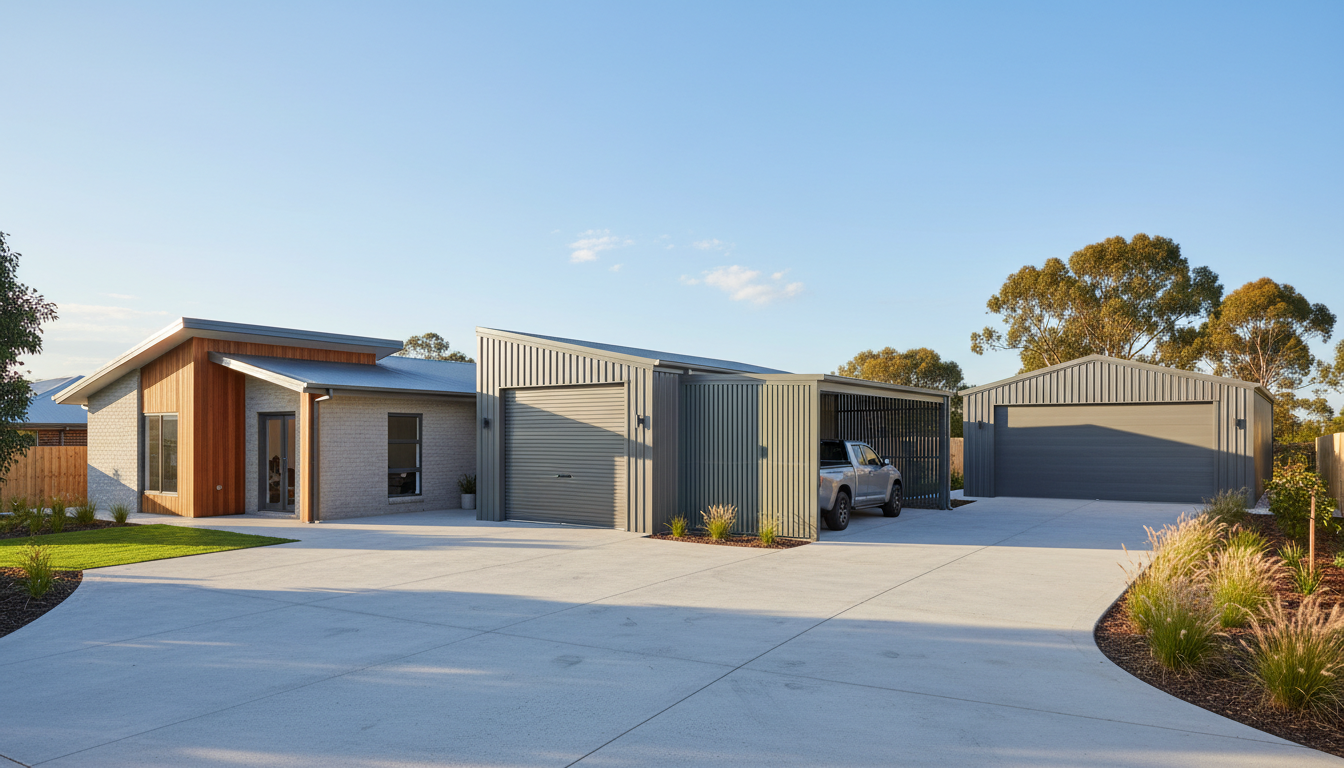
What Are the Best Shed Materials for Perth’s Climate?
For urban backyards and coastal suburbs across WA, the gold standard remains Colorbond steel cladding and roofing over a galvanised RHS portal frame. In higher heat zones like Perth’s north and regional WA, lighter Colorbond colours (Surfmist, Classic Cream, Shale Grey) reduce heat gain and prolong paint life. Near the coast, opt for marine‑grade fasteners and pay attention to distance-to-shore guidance from the manufacturer.
Colorbond vs Zincalume — Which Is Better for WA Conditions?
If you’re weighing up aesthetics, heat reflectivity, and coastal performance, here’s the snapshot many Perth homeowners use to decide.
| Factor | Colorbond | Zincalume |
|---|---|---|
| Coastal suitability | Good with correct grade/fasteners; observe distance-to-marine limits | Good inland; more cautious near surf coasts and salt-spray zones |
| Heat reflectivity | High in light colours; better thermal comfort for Perth summers | Moderate; bare-metal look can heat up faster |
| Colour range | Extensive Colorbond palette (incl. Matt) | Limited (metallic finish) |
| Finish longevity | Painted topcoat resists chipping/fading | Excellent substrate durability; no paint finish |
| Cost | Typically higher material cost | Usually more affordable |
| Maintenance | Low; periodic washdown near coast | Low; washdown still recommended |
| Best use | Premium house‑matching sheds, custom Colorbond garages in Perth | Rural or industrial sheds inland, budget DIY shed kits |
Tip: Check solar absorptance values and lightfastness when choosing colours for heat‑exposed suburbs. See independent energy guidance via Energy.gov.au.
Which House Shed Ideas Actually Add Value in Australia?
Value comes from function, finish, and compliance. Here are proven, resale‑friendly concepts that suit Aussie blocks and climate zones.
- Custom Colorbond double garage in Perth (6 x 6 m): Match your roof/trim to the home; add wind‑lock roller doors for coastal gusts.
- Workshop shed Adelaide (6 x 9 m): 3‑phase ready, insulated roof blanket, LED high‑bays, epoxy floor coating.
- Garden studio Brisbane: Skillion roof shed with insulated panels, sliding stackers, and split‑system AC for a calm office or teen retreat.
- Rural sheds NSW for farm machinery storage: Wide bays, tall eave height, hot‑dip galvanised columns.
- Custom carports Melbourne: Gable roof carport to complement heritage streetscapes; add screening for side boundaries.
- Boat and caravan covers in QLD: Cyclone‑rated sheds for Region C/D with extra hold‑down and tie‑down points.
- Affordable carports for Australian homes: Kit‑based skillion designs for quick installs where height is tight.
Keywords Australian buyers actually use include: steel sheds Perth, custom carports Melbourne, rural sheds NSW, DIY shed kits, wind‑rated sheds for cyclonic areas, and custom Colorbond garages Perth.
How Do You Choose the Right Size, Roof and Layout?
Step 1 — Check setbacks, easements, and services
Before drawing anything, pull your Title, sewer diagram, and estate covenants. Typical rear/side setbacks range from 500–1500 mm depending on height and council. Keep clear of easements and overhead lines; confirm drainage to soakwells in WA.
Step 2 — Pick the right footprint
- Single car garage: ~3.6 x 6 m
- Double garage: ~6 x 6 m (allow 5.2–5.5 m clear opening for two cars)
- Workshop + storage: 7.5–9 m depth helps with benches and a mower bay
- Caravan/boat cover: Check towball to motor length and outboard height; allow 3.0–3.6 m clearance
Step 3 — Choose roof style for climate
- Skillion roof: Great for boundary builds and solar PV. Use higher pitch (5–10°) for heavy rain zones.
- Gable roof: Classic look, excellent water shedding; suits double garages.
- Flat roof carports: Clean lines; ensure box‑gutter sizing and overflow provisions to AS/NZS 3500.
What Wind Rating and Engineering Do You Need?
In Australia, shed design is engineered to AS/NZS 1170.2 (wind actions), with steel design to AS 4100/AS/NZS 4600 and roofing to AS 1562.1. Regional wind categories (A, B, C, D) and terrain/topography determine hold‑down, frame spacing, and door hardware.
Added 2024 WA wind-rating compliance notes Many coastal WA suburbs are Region B with severe gusts around storm fronts; exposed headlands and parts of the Pilbara are Region C. Your engineer will confirm site wind speed, terrain category, topographic multiplier, and importance level, then specify footing depth, anchor type, and purlin spacing.
- Council-approved sheds WA: Provide certified engineering drawings and a site plan showing distances to boundaries and buildings.
- Cyclone-rated sheds QLD: Expect heavier base plates, extra mullions at openings, and reinforced roller doors tested for cyclic loading.
- Non‑cyclonic (A/B): Common in southern states; still require compliant hold‑down and door bracing for storm events.
See wind maps and seasonal storm context via the Bureau of Meteorology. For engineering context, refer to Standards Australia listings.
How to Get Council Approval for Your Custom Shed in WA
Documents you’ll likely need
- Scaled site plan with setbacks, easements, stormwater (soakwells) and driveway location
- Certified engineering drawings (AS/NZS 1170.2, AS 4100/4600) and slab design if applicable
- Elevations, colours/finishes (often Colorbond), and roof pitch
- Planning approval if over local size/height thresholds or in heritage/estate overlays
- BAL assessment if in bushfire‑prone area (AS 3959)
In metro Perth, simple compliant sheds are often Building Permit only; rural or coastal sites may require Planning first. Timeframes vary 10–35 business days depending on council workload. For other states, requirements mirror this but check terms like “Complying Development” (NSW) or “Private Building Surveyor” (VIC) pathways.
Useful approvals guidance is available from the Housing Industry Association (HIA) and Master Builders Australia.
DIY Shed Kits vs Custom-Built Sheds: What’s Better?
Both work—your site, wind rating, and schedule will nudge the decision.
- DIY shed kits: Lowest material cost, quick dispatch, excellent for non‑cyclonic sites. Be realistic about slab prep, accurate set‑out, and safe lifting. Owner‑builder permits may apply.
- Custom-built: Tailored to awkward blocks, height‑critical carports, or cyclonic regions. Faster approvals with full documentation. Ideal for council‑approved sheds WA and cyclone‑rated sheds QLD.
What Does a Quality Shed Cost in 2025?
Budgets vary by size, wind region, slab, doors, insulation, and electrical fit‑out. As a broad guide, kit‑only prices are lowest; turn‑key builds with slab, power, and insulation are highest. Cyclonic upgrades, tall openings for caravans, and insulated roof panels add cost but deliver performance and longevity. Always compare like‑for‑like engineering and door wind ratings when reviewing quotes.
Shed Interior Ideas That Work in Aussie Conditions
If you’re searching for shed interior ideas, prioritise heat management, dust control, and smart storage.
- Thermal/condensation control: Anti‑condensation blanket under the roof, breathable sarking to walls, and ridge/slot vents; consider insulated panel roofing.
- Power and lighting: 15‑amp GPOs for welders, dedicated compressor circuit, and LED high‑bay lights.
- Floors: 100 mm concrete slab with mesh or fibre reinforcement; epoxy floor coating for easy clean‑up.
- Storage: Mezzanine storage over benches, wall‑hung tool boards, and bike hoists.
- Dust/vermin: Door brush seals, vermin‑proofing seals at wall/floor junction, louvre windows with insect screens.
- Doors and windows: Cyclone‑rated roller doors where required, glazed sliders with tint for glare control.
- Acoustics: Acoustic batts behind internal wall linings if using machinery at night.
Energy-Smart and Heat-Safe Sheds for Hot Summers
- Choose light‑colour Colorbond roofs and walls with low solar absorptance.
- Add whirlybirds or solar‑powered vents plus eave/door cross‑flow ventilation.
- Consider insulated roof panels or blanket; seal air gaps for AC efficiency.
- Install ceiling fans in studios and use external shading on west walls.
Pro Tip: Did you know using insulated roof panels can reduce internal shed temperatures by up to 10°C in summer, especially on high‑radiation western aspects? Pair with light colours and shading for best results.
Real Projects Across Australia
Perth — Custom Colorbond Double Garage
- Size: 6.5 x 7 m; Roof: 15° gable; Cladding: Colorbond Surfmist walls/roof
- Engineering: Region B, terrain category 2; compliant to AS/NZS 1170.2
- Features: Wind‑lock roller doors, anti‑condensation blanket, 15‑amp GPOs
- Outcome: Street‑presenting, council‑approved, increases off‑street parking
Townsville — Cyclone-Rated Boat Shed (QLD)
- Size: 9 x 7.5 m; Clearance: 3.6 m
- Engineering: Region C; reinforced door mullions, heavier hold‑downs
- Features: Zincalume roof, Colorbond walls, stainless fixings
- Outcome: Secure cyclone‑ready storage with reliable wet‑season drainage
Dubbo — Rural Machinery Shed (NSW)
- Size: 12 x 9 m; 3 open bays + 1 lock‑up
- Frame: Galvanised RHS portal; roof bracing for wide bays
- Outcome: Flexible farm machinery storage with future solar allowance
Frequently Asked Questions
Do I need council approval for a backyard shed?
Most Australian councils require approval above small exempt sizes/heights. Documentation typically includes engineering and a site plan. In WA, many compliant sheds proceed via Building Permit only; check your local thresholds.
What wind rating should I design for?
It depends on your location, terrain, and exposure. Engineers use AS/NZS 1170.2 to determine site wind speed and specify connections. QLD coastal sites may require Region C or D cyclone‑rated designs.
Can I build near the ocean?
Yes, with the right materials: marine‑grade fasteners, appropriate steel grades, and regular washdowns. Confirm manufacturer coastal distance limits for Colorbond/Zincalume.
How thick should the concrete slab be?
Engineer‑designed slabs vary by soil, loads, and use. Common residential slabs are ~100 mm with mesh; heavier point loads need thickening/footings per the engineer.
Can I add a carport to my shed?
Yes. A skillion or gable awning can be engineered off the main frame. Check setbacks, fire separation to boundaries, and gutter/downpipe capacity.
5-Step Buying Guide for Custom Sheds in Australia
- Define use and size: Car storage, workshop, studio, farm machinery storage—note door clearances and bench space.
- Check site constraints: Setbacks, easements, overhead lines, drainage, driveway alignment.
- Choose materials: Colorbond vs Zincalume comparison, insulation level, door types (wind‑lock if required).
- Confirm engineering: Wind region, terrain category, footings, and bracing to AS/NZS 1170.2 and AS 4100/4600.
- Prepare approvals: Drawings, engineering, site plan, BAL (if applicable); apply for council or private certification.
Standards, Sources and Industry Notes
- Australian climate and wind info: Bureau of Meteorology
- Builder and approvals guidance: HIA and Master Builders Australia
- Steel and coating specs: Standards Australia (AS/NZS 1170.2, AS 4100, AS/NZS 4600, AS 1397, AS 2728, AS 1562.1) and the Australian Steel Institute
- Market outlooks and home improvement trends (2024–2025): Refer to HIA and industry reports for outdoor structures and steel supply updates.
Next Steps: Get an Engineered Quote Fast
Ready to turn your house shed ideas into a council‑approved, wind‑rated build? Pull together your site plan, preferred size, and any shed interior ideas, then request an engineered, apples‑to‑apples quote—materials, doors, insulation, and footings clearly listed.
Related reading: Compare kit vs custom in our prefab garage guide, pick the right foundation in shed with floor, and plan durable trade spaces with our work shed guide.