, council approvals, and Perth–QLD climate tips. Includes buying checklist and comparison tables.)
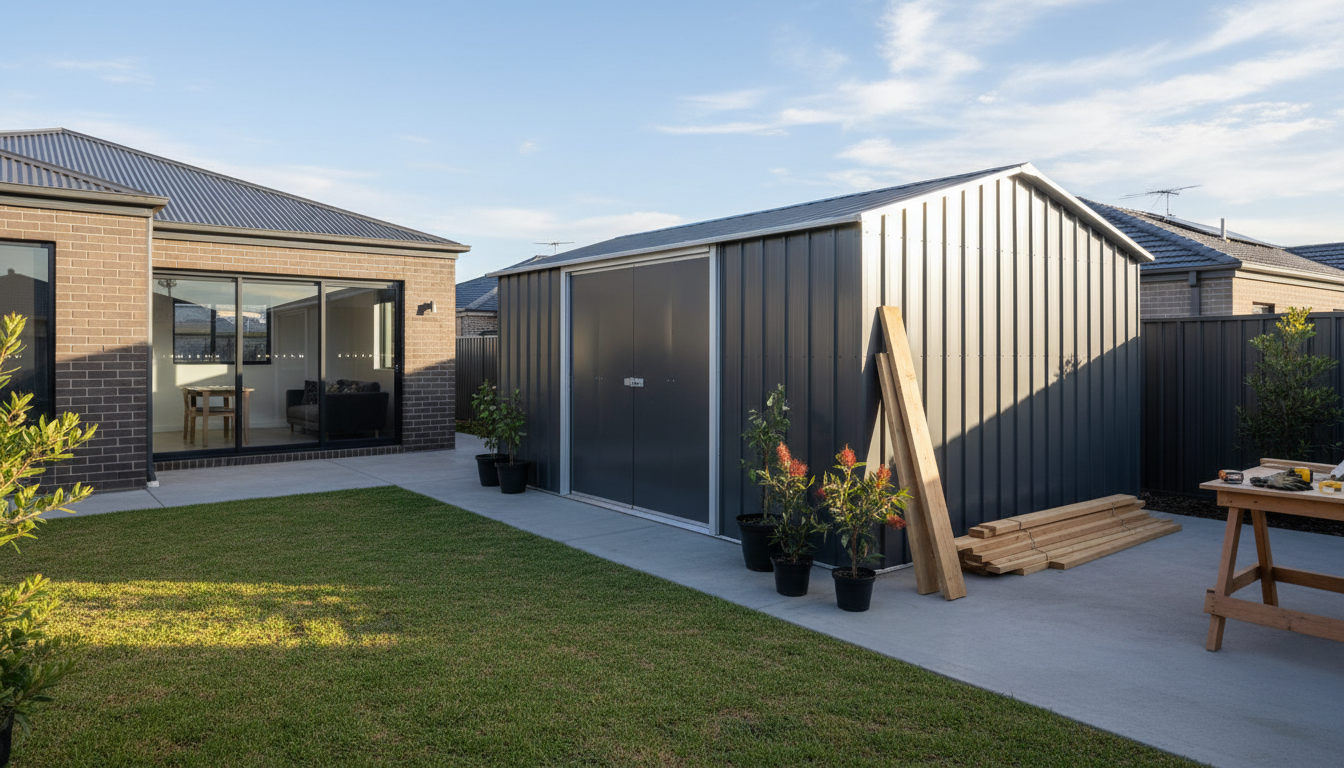
Your 2025 Australian Shed Pricing Guide
Whether you’re comparing DIY shed kits or a custom-built Colorbond steel shed, this guide explains real Australian costs, the factors that influence price, and how to choose a solution that meets local wind ratings, bushfire requirements, and council approval rules.
How much does a storage shed cost in Australia in 2025?
Short answer: from around $2,400 for a small DIY kit to $150,000+ for a large rural machinery shed built turnkey. Most homeowners looking for a premium, council-approved Colorbond storage shed will invest between $5,500 and $38,000 depending on size, site works, and inclusions.
At-a-glance price ranges (AUD, typical 2025)
- Small backyard storage (3×3 m to 6×3 m): kit $2,400–$6,500; installed $5,500–$12,000
- Single garage/workshop (6×3 m to 6×4 m): kit $7,500–$12,500; turnkey $15,000–$28,000
- Double garage (6×6 m custom Colorbond garages Perth): kit $9,500–$16,500; turnkey $20,000–$38,000
- Mid-size workshop (9×6 m): kit $13,000–$22,000; turnkey $30,000–$55,000
- Rural machinery sheds (12×9 m to 18×9 m): kit $20,000–$60,000; turnkey $60,000–$150,000+
- Carports (single/double): kit $2,500–$9,500; installed $5,000–$18,000 (great for affordable carports for Australian homes)
Expect regional adjustments for wind classification (N1–N4, C1–C4), coastal corrosion, and freight. Cyclone-rated sheds QLD and northern WA often add 15–30% for design and hardware upgrades.
What drives the cost for a storage shed?
- Footprint and height: Larger spans, taller eaves, and clear openings require heavier framing and more bracing.
- Steel grade and sheeting thickness: Common choices are 0.35 BMT and 0.42 BMT for wall/roof sheets; heavier sections add cost but improve performance.
- Cladding: Colorbond vs Zincalume, and coastal paint systems for sea-spray exposure.
- Wind rating and engineering: Higher wind regions (N3, N4, C2, C3) need additional tie-downs, purlin spacing changes, and upgraded connections.
- Roof design: Gable vs skillion vs flat; roof pitch affects water run-off, head height, and aesthetics.
- Openings and hardware: Roller doors, high-cycle motors, windows, personal access (PA) doors, and security upgrades.
- Slab and footings: 100–120 mm slab-on-ground (25–32 MPa), thickened edges, or piers for reactive soils and sloping sites.
- Site works: Cut/fill, compaction, drainage, driveway tie-ins, and stormwater.
- Compliance: Council approvals, bushfire (BAL) requirements, and energy/insulation upgrades.
- Labour and location: Metro vs regional, and access constraints.
What are typical line-item costs?
- Concrete slab: $120–$180 per m² (thicker edges, mesh, and pump extra)
- Roller doors: $900–$1,800 each; motors: +$350–$750 per door
- PA door: $250–$500; windows: $250–$600 each
- Insulation (roof/walls): $20–$35 per m² (Anticon or insulated panel roof options)
- Whirlybirds or ridge vents: $250–$450 each
- Stormwater connection: $500–$2,000
- Electrical rough-in and fit-off: $1,200–$4,000+
- Delivery and cranage: $120–$450 metro; regional freight higher
- Council/planning/building permits: $250–$2,500+ depending on council and class
Colorbond vs Zincalume — which is better for WA conditions?
Both are high-performance, Australian-made coated steels. For coastal or high-UV areas like Perth, Colorbond with appropriate paint system typically lasts longer and holds colour better.
| Feature | Colorbond | Zincalume |
|---|---|---|
| Finish | Pre-painted, wide colour range | Metallic aluminium-zinc coating (silver-grey) |
| Coastal resistance | Excellent with correct grade; choose marine-rated near surf | Good but shows patina; extra wash-downs near coast |
| UV durability (Perth) | Very good fade resistance | Not applicable (no colour), glare can be high |
| Cost | ~10–15% higher | Lower upfront |
| Aesthetics | Premium architectural look | Industrial look |
What are the best shed materials for Perth’s climate?
- Colorbond cladding and 0.42 BMT roof sheets for heat and hail resilience.
- Anticon blanket or insulated roof panels to reduce radiant heat (see Pro Tip).
- Hot-dip galvanised posts/portals or increased coating class for coastal fringe.
- High-flow gutters and leaf-guard for winter fronts; vermin flashing for sand and debris.
Roof styles and cost impact
| Roof Type | Pros | Cons | Typical Cost Impact |
|---|---|---|---|
| Flat/skillion | Modern look, easy water fall | Lower headroom at rear, watch drainage | Baseline to +5% |
| Gable | Classic, better run-off, central headroom | More flashings/ridge components | +5–10% |
| Hip | Great wind performance, premium look | Complex framing and flashings | +10–18% |
DIY shed kits vs custom-built — which suits you?
| DIY Shed Kits | Custom-Built (Turnkey) | |
|---|---|---|
| Upfront Cost | Lowest | Higher |
| Time & Risk | Owner-managed, slower if new to it | Builder handles program and QA |
| Approvals | You coordinate council & engineering | Included in service for council-approved sheds WA |
| Design Flexibility | Fixed kit options | Custom spans, openings, finishes |
| Best For | Simple garden sheds Sydney, DIY shed kits | Custom carports Melbourne, steel sheds Perth, rural sheds NSW |
Approvals, standards, and wind ratings (what you must know)
- NCC compliance with AS/NZS 1170.2 (wind actions), AS/NZS 4600 (cold-formed steel), AS 4100 (steel structures), AS/NZS 2312 (corrosion protection), and where applicable AS 3959 (bushfire construction).
- Wind classes: N1–N4 (non-cyclonic) and C1–C4 (cyclonic). Many suburbs of Perth are N2/N3; northern WA and coastal QLD may be C2/C3.
- Typical importance level: IL2 for sheds ancillary to a dwelling.
- BAL ratings for bushfire-prone land affect cladding, ember protection, and glazing.
How to get council approval for your custom shed in WA
- Check R-Codes and local planning overlays for setbacks and maximum heights.
- Obtain site plan, elevations, engineering certification, and slab/footing details.
- Lodge Building Permit (BA2/BA1) with your local council; allow 10–25 business days.
- Arrange inspections (footings/slab if required) and final sign-off.
- For cyclone-prone areas, ensure “C” wind design and tie-down schedule are stamped by a WA engineer. Added 2024 WA wind-rating compliance notes
Regional pricing notes across Australia
- Perth & WA: High UV — choose Colorbond and consider insulation; northern WA requires cyclone detailing (C2/C3). For local benchmarks, see shed prices Perth WA. (smalltrades.com.au)
- QLD: Cyclone-rated sheds QLD need upgraded frames, bracing, and fasteners; expect +15–30% cost.
- NSW & ACT: Rural sheds NSW often need larger eave heights for farm machinery storage and extra bay spacing.
- VIC & TAS: Alpine areas may require snow load checks; garages Tasmania may need additional bracing.
- SA & NT: Check soil reactivity; pier and beam or thickened slab edges may be preferred.
Case studies and realistic budgets
Perth metro — 6×3 m Colorbond storage shed
- Scope: Gable roof, 0.42 BMT roof sheets, one 2.4 m roller door, PA door, Anticon roof insulation.
- Costs: Kit $5,200; slab (18 m²) $2,700; install $3,200; permits $620; electrical $1,500; total ≈ $13,220.
Melbourne — custom-built double garage (6×6 m)
- Scope: Custom-built double garage in Perth/Melbourne equivalent spec; Colorbond walls/roof, two motors, gutters to stormwater.
- Costs: Kit $12,800; slab (36 m²) $5,600; install $6,800; permits $1,150; sundries $1,200; total ≈ $27,550.
Central QLD — rural bay shed (12×9 m, 3 bays)
- Scope: Open-front, C2 wind rating, hot-dip galvanised columns, Zincalume roof, Colorbond walls windward side.
- Costs: Kit $32,000; footings/piers $9,500; install $12,000; permits/engineering $1,800; drainage $2,600; total ≈ $57,900.
How to get a sharper price (without cutting corners)
- Standardise bay widths (e.g., 3 m bays) to optimise steel lengths.
- Minimise wall openings on windward sides to reduce bracing demands.
- Choose a gable or single-slope roof with efficient purlin spacings.
- Compare Colorbond vs Zincalume where appearance is less critical (e.g., rear walls).
- Bundle works: slab, stormwater, and power in one contract to avoid re-mobilisation fees.
Want to pay less without cutting corners? See sheds cheapest in Australia for smart ways to trim spend on materials and inclusions. (smalltrades.com.au)
5-step buying guide for custom sheds in Australia
- Define use-case: storage only, farm machinery storage, workshop, or hybrid carport/shed.
- Confirm site constraints: setbacks, easements, slope, access for trucks/crane.
- Lock your design brief: span, eave height, doors, finishes, insulation, security.
- Engineer for location: wind class (N or C), BAL, corrosion category; request sealed calcs.
- Choose delivery model: DIY shed kits vs turnkey. Demand a fixed-scope quote with inclusions and exclusions clearly listed.
Key terminology (fast definitions)
FAQ: quick answers Australian owners want
Is Colorbond worth the premium?
Yes for most coastal/UV-exposed sites. It offers colour stability, corrosion resistance, and a premium finish that helps resale value.
How long does approval take?
Typically 10–30 business days for a straightforward, code-compliant shed once documents are complete; longer if planning approval is required.
Can I add solar or battery later?
Yes. Ask for roof purlin spacing suitable for PV rail systems and include a dedicated sub-board during initial electrical works.
What if I’m in a cyclonic area?
You’ll need wind-rated sheds for cyclonic areas with engineered tie-downs, closer purlin spacings, and upgraded fasteners. Expect a 15–30% uplift in cost.
Do I need gutters and stormwater?
Most councils require stormwater management. It also protects slabs and reduces erosion, especially on sloping blocks.
Local insights, reports, and standards
Australian steel costs have stabilised compared with the 2021–2023 spikes, but premium coatings and engineered hardware remain in demand as homeowners prioritise durability and compliance. Sources worth checking:
- Housing Industry Association (HIA) — Outdoor structures trends and approvals guidance
- Master Builders Australia — Trade insights and building market outlooks
- Australian Steel Institute — Technical resources on steel design and corrosion
- Bureau of Meteorology — Local wind region maps and cyclone data
- CSIRO — Bushfire research and building performance
- Energy.gov.au — Insulation and energy efficiency guidance
For formal standards, see AS/NZS 1170.2, AS 4100, AS/NZS 4600, AS/NZS 2312, and AS 3959 via Standards Australia or SAI Global (fees apply).
Putting it together: get an apples-to-apples quote
Request a written scope that includes engineering to your wind class, slab design, door schedules, insulation spec, gutters/stormwater, electrical provisions, and lead times for council-approved sheds WA, cyclone-rated sheds QLD, and metro/regional installs. This levels the field when comparing steel sheds Perth, shed builders Adelaide, commercial workshops Brisbane, and rural sheds NSW providers.