
Smarter Shed Interiors for Australian Homes and Investments
Transform any Colorbond steel shed into a high-performing space: from garden storage and workshop zones to home offices, gyms, and farm machinery bays. This guide brings together shed interior design ideas built for Australian standards, climates, and council processes.
What Are the Best Shed Materials for Perth’s Climate?
In WA’s hot, dry summers and coastal corrosion zones, roof and wall cladding choice matters. Most premium sheds use either Colorbond steel or Zincalume, both to AS 1397 and AS/NZS 2728. For shed interiors, the cladding choice affects heat gain, condensation, and long-term maintenance.
For a classic heritage look, a Corrugated Garden Shed fits the bill and suits a range of traditional landscapes.
Colorbond vs Zincalume — Which Is Better for WA Conditions?
| Factor | Colorbond | Zincalume |
|---|---|---|
| Heat management | Cooler with pale Solar Absorbance colours (e.g., Surfmist); pairs well with Anticon | Highly reflective but can glare; similar roof temps without insulation |
| Corrosion resistance (coastal) | Excellent in C3–C4 zones when distances to surf are respected | Good; may weather faster near coast without paint system |
| Aesthetics & interior brightness | Colour choice for interior lining and trims improves lighting | Industrial look; interior can appear darker without lining |
| Maintenance | Low; periodic wash-down in marine zones | Low; periodic wash-down; watch tea-staining near coast |
| Cost | Higher material cost | More affordable |
| Best for | Premium custom Colorbond garages Perth, studios, offices, visible façades | Rural sheds NSW, farm machinery storage, budget DIY shed kits |
For Perth and coastal WA, choose light Colorbond colours plus roof insulation to cut radiant heat. Pair with sarking or Anticon blanket for condensation control.
How Should You Plan Shed Interior Layouts for Different Uses?
Start with a clear use-case, then zone the interior using purlins, girts, and portal-bay spacing. The best inside shed ideas combine storage efficiency, safety, and thermal comfort.
Garden shed ideas interior: tidy, bright, and dry
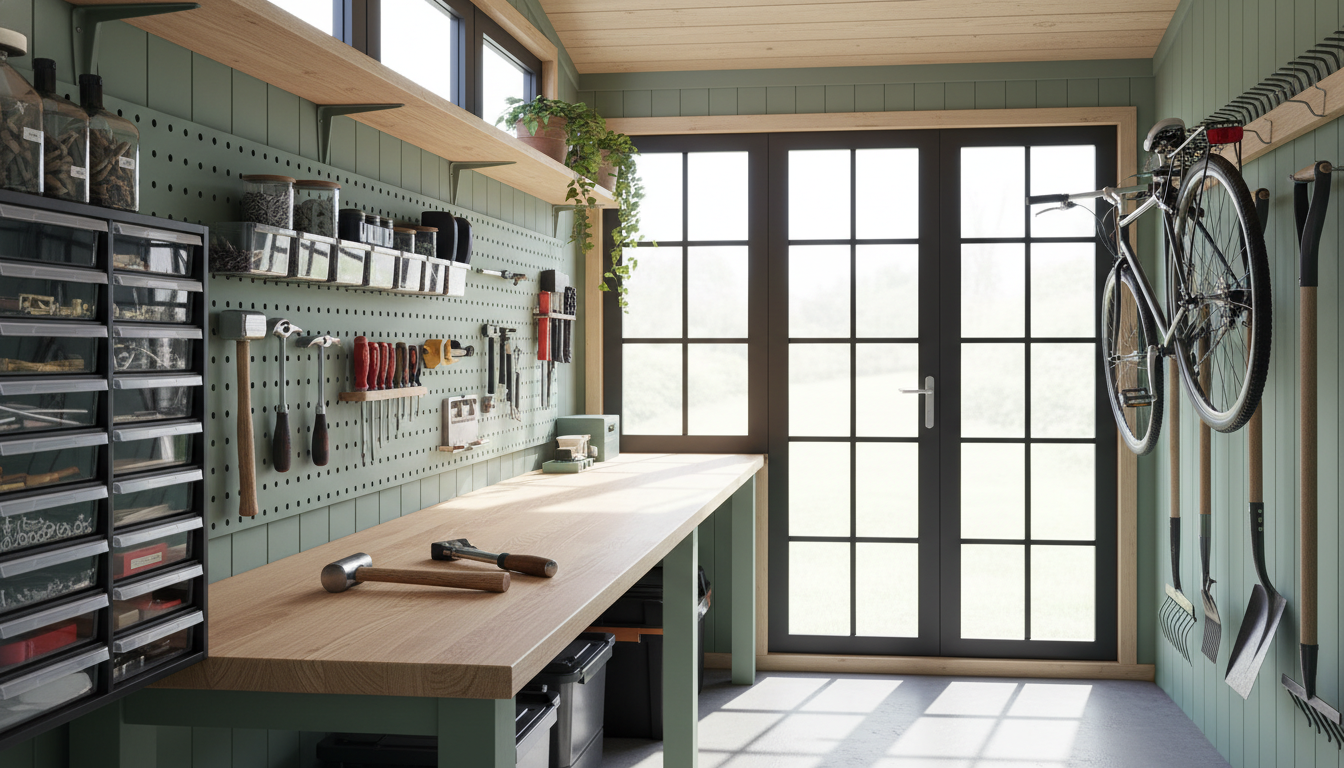
- Wall systems: Pegboards or French cleat rails on internal battens for flexible tool storage.
- Moisture: Anticon plus ridge vent stops mildew on stored gear.
- Floor: 25–28 MPa concrete slab with damp-proof membrane; epoxy coat for easy cleaning.
- Lighting: LED battens (4000–5000K) with motion sensors.
- Security: Reinforced PA door, deadbolt, and window grills.
Workshop shed interior design ideas: safe power and heavy-duty fixtures
If timber working is your passion, Wood Shed Kits in Australia offer both charm and practicality for your next shed project.
- Power: Dedicated RCD-protected circuits, 15A or 20A outlets for welders; cable trays for tidy runs.
- Storage: Pallet racking anchored to slab; mezzanine floor in higher bays; steel workbench with vice.
- Extraction: Turbine ventilators or inline fans for fumes; cross-ventilation through louvres.
- Walls: Impact-resistant internal lining (ply or steel liner panels).
- Dooring: Cyclone-rated roller doors in wind regions C/D; brush seals for dust.
Shed ideas interior for home office or studio
- Thermal: R2.5–R3.5 wall batts, R3.6+ roof; thermal break under cladding; double-glazed windows.
- Acoustic: Higher-density batts and acoustic plasterboard on a battened cavity.
- Comfort: Split-system air con; low-e blinds; draft seals to PA door.
- Connectivity: Conduit for data; 4G/5G antenna on gable for better signal.
Gym or hobby cave
- Floor: Rubber interlocking tiles over sealed concrete; extra slab thickness for heavy equipment.
- Ventilation: Ridge vent plus fan assist; ceiling fans with reverse mode.
- Storage: Wall-mounted racks; ceiling storage above non-traffic zones.
Rural and farm machinery storage
- Clear spans: 6–12 m bays with hot-dip galvanised portal frames; 4.2–5 m eave height.
- Access: Extra-wide roller doors or sliding doors; apron slab for safe turning.
- Dust and vermin control: Vermin flashing, brush seals, and graded site drainage.
Which Roof Style and Ventilation Work Best Inside a Hot Australian Shed?
- Gable roof: Classic look, good ridge venting, suits most custom steel sheds Perth.
- Skillion (mono-pitch): Modern, faster to build, great for solar orientation and water capture.
- Ventilation: Ridge vents, eave vents, and turbine ventilators reduce heat stratification.
- Condensation control: Anticon or high-performance sarking (taped) plus adequate airflow.
Pro Tip: Did you know using insulated roof panels can reduce internal shed temperatures by up to 10°C in summer?
What Are the Must-Have Fit-Outs for a Durable, Low-Maintenance Shed Interior?
- Insulation and sarking: R3.0–R4.0 roof with Anticon; R2.5 walls; tape all laps to limit moist air migration.
- Lining: Steel liner panel or ply to protect batts and improve light reflectance.
- Flooring: 28–32 MPa slab, saw-cut joints; epoxy or polyaspartic coating for dust-free interior.
- Electrical: LED high bays for tall sheds; IP66 fittings for dusty zones; smart switches.
- Plumbing: Insulated cold/hot lines; tundish for appliances; gutter guards for tank water.
- Storage: Mezzanines engineered to AS/NZS 4600; stairs with handrails to NCC.
- Security: Cyclone-rated roller doors, window shrouds, motion lights, and cameras.
How to Get Council Approval and Meet Australian Standards?
Most premium sheds require building approval. The process and triggers vary by state, site wind region, and use. Expect your supplier to provide certified engineering and site plans referencing AS/NZS 1170.2 (wind loads), AS/NZS 4600 (cold-formed steel), AS 4100 (steel structures), and NCC 2022.
How to Get Council Approval for Your Custom Shed in WA
- Check planning: Local planning scheme and R-Codes outbuilding provisions for setbacks, height, and site coverage.
- Wind region: Confirm A, B, C, or D with exposure category; coastal North-West often Region D. Added 2024 WA wind-rating compliance notes
- Engineering: Obtain certified drawings with hold-down bolts, bracing, cladding fixings, and door ratings.
- Apply: Lodge a BA application with site plan, elevations, specs, and energy/condensation details if required.
- Inspections: Concrete, frame, and final. Keep delivery dockets for steel and concrete MPA.
QLD coastal and northern areas require cyclone-rated sheds (Regions C/D) with upgraded connections, door wind-locks, and specific cladding screws to AS 1562.1. NSW rural properties may have simpler pathways but still need wind classification and bushfire checks (BAL) where relevant.
Council-approved sheds WA and cyclone-rated sheds QLD are common requests; ensure your quote explicitly lists wind region, importance level, and door ratings.
What Wind Ratings and Footings Should You Specify?
- Non-cyclonic (A/B): Common in VIC/SA/most NSW. Typical N2–N3 equivalent pressures in housing; sheds require engineer-calculated pressures.
- Cyclonic (C/D): QLD coastal, WA north-west. Specify cyclonic top-hats, additional bracing, wind-locked doors.
- Footings: 28–32 MPa concrete with N12–N16 starter bars; deepened edge beams or piers in poor soils; chemical anchors for retrofits.
- Corrosion zones: Use galvanised or hot-dip galvanised base plates and fasteners for C3–C4 areas; stainless fasteners near surf.
DIY Shed Kit vs Custom-Built — Which Fits Your Timeline and Budget?
DIY shed kits suit straightforward builds with basic fit-outs. Custom-built sheds deliver engineered solutions for complex sites, premium interiors, and tight council constraints.
For tailored solutions, check out Garden Sheds Warrnambool for fully custom Colorbond sheds and carports in regional Victoria.
- DIY shed kits: Cheapest upfront; ideal for garden sheds and simple workshops; ensure instructions include condensation management and tie-down details.
- Custom-built: Best for custom carports Melbourne integrations, mezzanines, bushfire areas, or coastal corrosion categories; faster approvals with full documentation.
How Much Does a Premium Shed Fit-Out Cost in 2025?
Indicative supply-and-install figures (GST inc., metro areas; regional logistics may add):
- Insulation and sarking: $45–$85/m² depending on R-value and Anticon thickness.
- Liner panels or ply lining: $40–$110/m² (steel liner highest durability).
- Electrical fit-out (small workshop): $1,800–$4,500; larger bays with high bays: $4,000–$9,000.
- Epoxy floor (double garage size): $2,200–$4,200 depending on system.
- Mezzanine (engineered): $250–$450/m² excluding stairs.
- Cyclone-rated roller door upgrade: +$800–$2,200 per door.
Steel pricing has stabilised after 2022–2023 spikes, with modest fluctuations reported in the 2025 Australian Steel Market Outlook and HIA’s 2025 Outdoor Structures insights.
Real Build Examples Across Australia
Custom-built double garage in Perth turned hybrid workshop-gym
- Shell: Colorbond Surfmist, gable roof with ridge vent, 28 MPa slab.
- Interior: R3.6 roof, R2.5 walls, steel liner panels, LED high bays, split A/C.
- Outcome: 8–10°C cooler in summer; dust-free storage thanks to brush seals.
Cyclone-rated shed QLD (Townsville Region C)
- Upgrades: Wind-locked roller doors, additional bracing, cyclonic roof battens.
- Fit-out: Anticon + sarking, vented ridge, galvanised fixings, vermin flashing.
- Outcome: Council approval first pass; secure storage during storm season.
Rural sheds NSW (Dubbo) for farm machinery storage
- Design: 12×24 m, 5 m eaves, 3 bays open, 1 bay enclosed workshop.
- Interior: Mezzanine parts store, 3-phase outlet, oil-resistant epoxy.
- Outcome: Faster servicing, safe parts storage above flood line.
5-Step Buying Guide for Custom Sheds in Australia
- Define use and climate: Garden storage, workshop, studio, or farm machinery? Note wind region, BAL, and corrosion category.
- Select structure: Gable or skillion, bay spacing, door types, and clear heights; specify Colorbond vs Zincalume.
- Plan the interior: Insulation, lining, power, lighting, mezzanine, racking, and ventilation.
- Get council-ready docs: Certified engineering, site plan, elevations, drainage and condensation notes. council-approved sheds WA
- Compare apples-to-apples: Ensure quotes list wind region, door wind ratings, footing design, insulation specs, and warranties.
FAQs: Inside Shed Ideas for Australian Conditions
What’s the fastest way to cool a shed in Perth?
Combine pale Colorbond roof, Anticon under-sheet, ridge vent or whirlybirds, and a split-system. Light-coloured internal liner panels boost reflectance and reduce heat.
Is Zincalume okay near the coast?
Yes, but maintain wash-downs and consider Colorbond in C3–C4 zones for added protection and aesthetics. Always use compatible fasteners.
Do I need a permit for small garden sheds?
Many councils exempt small sheds below certain sizes/heights, but setbacks and drainage still apply. Always check local rules before buying.
Can I convert a shed into a granny flat?
Only if it’s designed and approved as a habitable building to the NCC, not as a Class 10a shed. Different energy, egress, and fire rules apply.
Are DIY shed kits worth it?
For simple, non-cyclonic sites, yes. For cyclonic regions, tight sites, or premium interiors, custom engineering reduces risk and speeds approvals.
Local Standards, Data and Helpful Resources
Get a Council-Ready Quote
Ready to turn your shed into a high-performance space? Ask for engineered drawings, wind-region compliance, and a detailed interior schedule. Whether you need steel sheds Perth, custom carports Melbourne, rural sheds NSW, or custom Colorbond garages Perth, we’ll specify materials and fit-outs that last.