
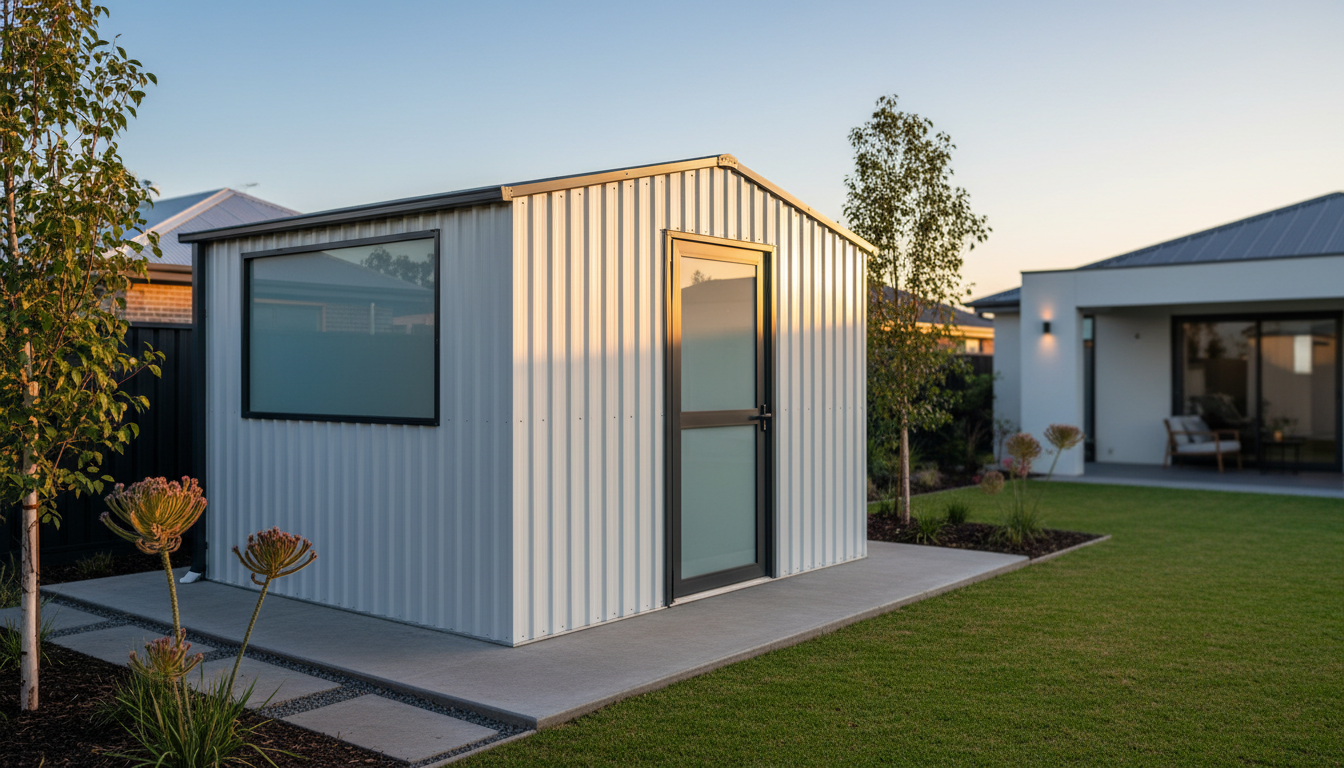
Insulated garden shed buying guide for Australian homes (2025)
An insulated garden shed is more than storage—it’s a cooler, quieter space for year-round use. Whether it’s a home office, hobby room, or insulated storage shed, the right design, steel grade, and insulation spec will determine how it performs in Perth heat, coastal WA, or cyclonic North Queensland.
This expert guide uses Australian standards, local wind classifications, and real-world build tips to help you spec an insulated shed that looks sharp in Colorbond steel, meets council, and lasts.
What are the benefits of an insulated garden shed in Australia?
- Thermal comfort: Insulation moderates extremes—valuable for Perth summers and cool Canberra mornings.
- Condensation control: Proper sarking and insulated roof/walls help prevent drips on tools or machinery.
- Noise reduction: Quieter work-from-shed or music practice area.
- Energy efficiency: Less reliance on portable air-con or heaters when paired with ventilation and sensible orientation.
- Protection of contents: Better for electronics, timber, and paints stored in insulated sheds.
- Higher resale appeal: Quality steel sheds with insulation add perceived value for buyers and investors.
What are the best shed materials for Perth’s climate?
Western Australia’s high UV, heat and coastal salinity make the steel and finish critical. Colorbond is a premium pre-painted steel designed for Australian conditions, while Zincalume is a popular alloy-coated base steel with excellent corrosion resistance. Some homeowners also opt for a Metal Garden Storage Shed for temperature control. Your choice depends on location, aesthetics, and budget.
Colorbond vs Zincalume — Which is better for WA conditions?
| Feature | Colorbond (inc. Ultra/Maritime options) | Zincalume (e.g., AZ150) |
|---|---|---|
| Finish | Pre-painted, wide colour range, high UV durability | Metallic silver-grey; can be painted later |
| Coastal performance | Colorbond Ultra recommended near surf coasts | Strong base corrosion resistance; still observe coastal set-back |
| Heat reflectivity | Thermatech colours reflect heat; lighter colours run cooler | Reflective finish; still benefits from insulation |
| Cost | Typically higher upfront | Usually more cost-effective |
| Best for | Premium look, coastal, harsh UV, matching the home | Budget-friendly, rural or utility structures |
- Colorbond: Painted, corrosion-resistant steel with Australian-tested coatings.
- Zincalume: Aluminium-zinc alloy coated steel offering excellent base corrosion protection.
- R-value: A measure of thermal resistance—the higher, the better the insulation performance.
- Anticon blanket: Reflective foil-faced glasswool insulation designed to reduce condensation and heat transfer under metal roofs.
- Sandwich panel: Pre-fabricated insulated panel (e.g., PIR/EPS core) for rapid install and high R-values.
How big should your insulated garden shed be?
Size depends on use, access, and setbacks. A popular footprint is a 5m x 3m shed—big enough for bikes, mower, a bench, and wall storage, yet small enough to navigate many suburban blocks. Consider a 2.4–2.7 m wall height if you want overhead storage or a mezzanine shelf.
- Home office/Studio: 5m x 3m to 6m x 4m with insulation, power, and acoustic linings.
- Garden/workshop: 3m x 3m to 6m x 3m with insulated roof and cross-ventilation.
- Small vehicle/ATV: 6m x 4m or larger; consider a custom-built double garage in Perth if you’ll expand later.
Which roof style suits your site?
| Roof Type | Why choose it | Notes |
|---|---|---|
| Skillion (mono-pitch) | Modern look, easy rainwater harvesting, good for solar | Pitch 5–10° typical; align fall away from neighbours |
| Gable | Classic style, good airflow via ridge vents | Add gable vents or whirlybirds to manage condensation |
What wind rating and compliance do you need?
Australian wind design is governed by AS/NZS 1170.2 and the National Construction Code (NCC 2022). Your shed must be engineered for the local region and terrain category. In cyclonic zones (Region C/D), specify wind-rated sheds for cyclonic areas with appropriate connections, tie-downs, and cladding fixings.
- Non-cyclonic regions: N1–N4 (e.g., many metro areas)
- Cyclonic regions: C1–C4 (e.g., coastal QLD, WA’s north)
- Structure: Comply with AS/NZS 4600 (cold-formed steel), footing design to AS 2870, and detail to AS 4100 where relevant.
Added 2024 WA wind-rating compliance notes: In WA, many coastal and regional areas require higher wind classifications; ensure engineering computations reflect local terrain (T1–T3) and shielding. Ask for an engineer’s certificate with site-specific tie-down details.
How to get council approval for your custom shed in WA
- Site plan: Position the shed with setbacks and easements shown; confirm height and roof pitch.
- Engineering: Obtain certified drawings showing wind classification and footing details (council-approved sheds WA often need signed calcs).
- Forms: Lodge a BA2 (uncertified) or BA1 (certified) application with your local authority; heritage/estate covenants may also apply.
- Stormwater: Show gutters, downpipes, and lawful point of discharge (soakwell or connection).
- Inspection: Footings and final may be inspected; keep documentation on site.
In QLD, check for siting relaxations, and ensure your engineer provides Form 15/16 for cyclone-rated sheds QLD.
Insulation options for insulated sheds
- Anticon blanket + foil sarking (roof): Excellent for condensation control under metal sheets; common in steel sheds Perth.
- PIR insulated panel roof: Higher R-value per thickness; fast install; clean interior finish.
- EPS sandwich panels (walls/roof): Cost-effective insulated panels for backyard studios and insulated storage sheds.
- Bulk glasswool batts (walls) + vapour permeable wrap: Good performance behind internal lining (ply/OSB/gyprock).
Target R-values vary by climate; for most Australian metros, R2.0–R3.0 walls and R3.5–R5.0 roofs are practical for year-round comfort in insulated sheds. Always add controlled ventilation to purge humidity.
Ventilation and moisture control
- Ridge vents or whirlybirds plus low-level eaves vents for crossflow.
- Seal slab to wall junctions with vermin flashing; fit moisture barrier under slab.
- Direct downpipes to soakwells/stormwater; avoid splashing onto wall sheets.
DIY shed kits vs custom-built installation
| Option | Pros | Cons | Best for |
|---|---|---|---|
| DIY shed kits | Lower cost, quick delivery, satisfying build | Time-consuming, needs tools/skills, council paperwork on you | Handy homeowners, small 5m x 3m sheds |
| Custom-built | Turnkey, engineered to site, premium finish, faster install | Higher upfront cost | Studios, council-sensitive sites, cyclonic or coastal builds |
5-step buying guide for custom sheds in Australia
- Define the use: storage, workshop, home office, farm machinery storage, or hybrid.
- Pick materials: Colorbond vs Zincalume comparison; consider Colorbond Ultra near surf coasts.
- Engineer for site: Confirm wind classification, soil type, slab/thickened edge beam, and tie-downs.
- Insulate and ventilate: Choose R-values, sarking, and vents; add daylight panels where suitable.
- Get approvals and quotes: Seek 2–3 quotes from local builders of council-approved sheds WA or your state, including delivery, slab, build, and electrical.
Real-world examples
Case study 1: Perth metro, 5m x 3m insulated garden shed
- Spec: Colorbond Monument walls/roof, Anticon R1.3 roof blanket + R2.5 wall batts, skillion roof at 7°.
- Outcome: Noticeably cooler summer interior; no roof drips during winter; quiet workspace for power tools.
Case study 2: Townsville, cyclone-rated insulated storage shed
- Spec: Zincalume roof with Anticon, Colorbond Ultra wall sheeting, C1 wind rating, upgraded hold-down bolts and heavier purlins.
- Outcome: Passed engineering and council first go; robust performance in wet season winds and humidity.
Common FAQs about insulated garden sheds in Australia
- Do I need council approval? Most sheds beyond minor exempt sizes need approval; check local planning rules and NCC 2022. Heights, boundary setbacks, and site coverage matter.
- Which is better near the coast—Colorbond or Zincalume? Colorbond Ultra/Maritime grades are often recommended; always observe coastal distance and maintenance schedules.
- What slab do I need? Many domestic sheds use a 100–120 mm reinforced concrete slab with thickenings—final design by your engineer to suit soil classification (AS 2870).
- Can I convert it to a home office? Yes—spec insulation, moisture control, power, and acoustic lining; check change-of-use requirements with council.
- What about bushfire risk? In BAL areas (AS 3959), choose compliant ember protection and materials; consult your certifier.
- How long does it take? Kits can arrive in 2–6 weeks; builds vary by season and approvals. Order early before peak spring/summer.
Local codes, engineering, and quality checkpoints
- NCC 2022 compliance and AS/NZS 1170.2 wind actions; cyclonic detailing where applicable.
- Framing to AS/NZS 4600 (cold-formed steel); correct fasteners for corrosion category.
- Genuine BlueScope Colorbond/Zincalume supply; request warranties and material certificates.
- Vermin flashing, sarking laps sealed, and compliant gutters/downpipes to a lawful discharge.
Related solutions and keyword clusters
- Steel sheds Perth, rural sheds NSW, custom carports Melbourne, affordable carports for Australian homes
- Custom Colorbond garages Perth, cyclone-rated sheds QLD, council-approved sheds WA
- Farm machinery storage, DIY shed kits, wind-rated sheds for cyclonic areas
Why Australians are upgrading to insulated sheds in 2025
Recent industry commentary from the Housing Industry Association and the Australian Steel Institute indicates sustained demand for outdoor structures and steel buildings, with a focus on comfort, energy performance, and compliance. Homeowners are choosing insulated sheds for liveable backyard space, while investors favour durable steel with low lifecycle costs.
Helpful resources and citations
- Energy.gov.au – choosing insulation
- Bureau of Meteorology – climate data for your region
- CSIRO – Bushfire Attack Levels (BAL)
- Housing Industry Association – homeowner guides
- Australian Steel Institute – technical insight
Quick checklist: spec your insulated shed like a pro
- Use genuine Colorbond or Zincalume with the right corrosion category.
- Engineer to your site’s wind region and terrain; get certification.
- Add sarking plus roof/wall insulation; include ridge and eaves vents.
- Plan access: roller door height, sliding doors, slab falls, and drainage.
- Document everything for council: site plan, elevations, engineering, stormwater.
For increased capacity, a Tall Garden Shed may be required.