
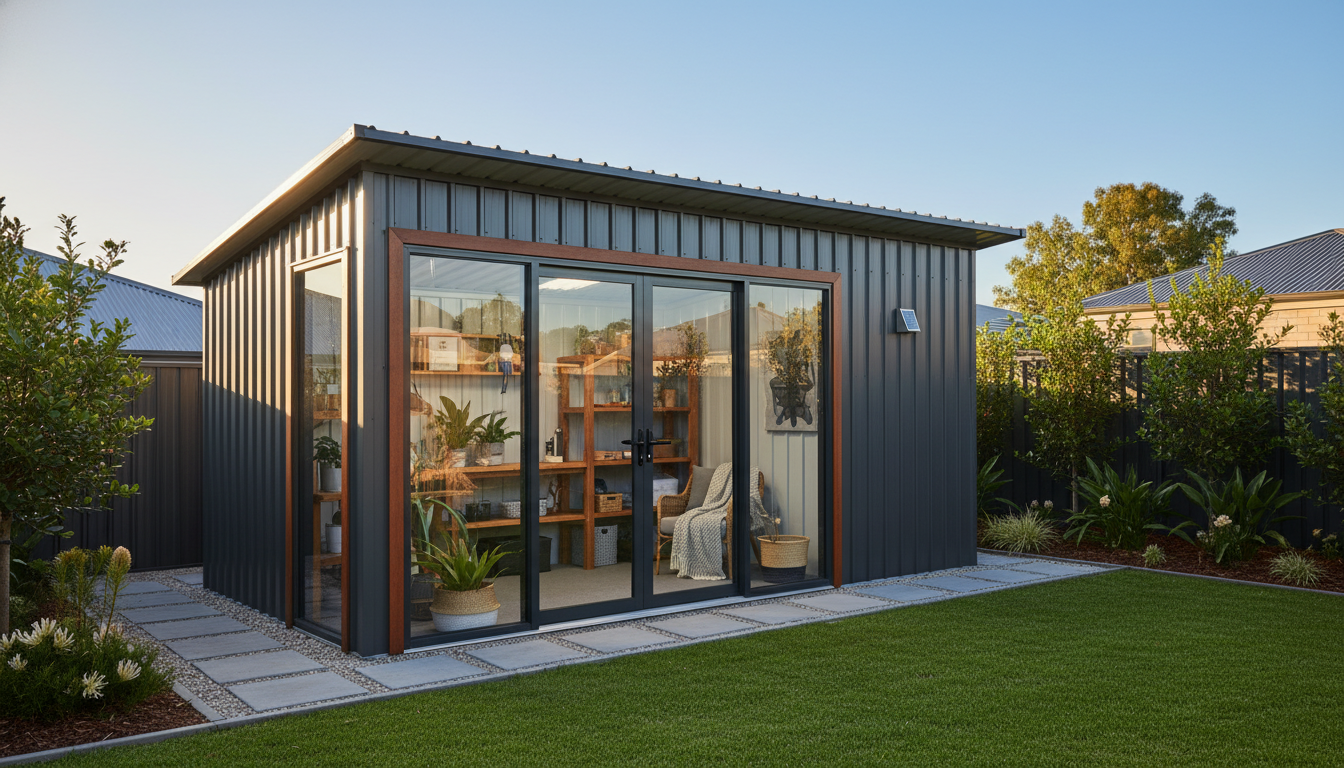
Your 2025 guide to insulated sheds built for Australian conditions
If you’re weighing up an insulated garden shed for year-round use—workshop, home office, or clean storage—you need more than a catalogue and a colour chart. This guide brings together engineering principles, local council rules, and Australian climate realities so you can specify, price, and approve an insulated storage shed with zero guesswork.
What is an insulated garden shed and why choose one in Australia?
An insulated garden shed pairs a steel portal frame with thermal and moisture control—usually via insulated roof and wall systems—so the space stays more comfortable and condensation-free. It’s a smarter choice for hot WA summers, humid Queensland winters, and coastal corrosion zones, where standard tin sheds can sweat, rust, and overheat.
- Portal frame: A rigid steel frame (columns and rafters) that carries roof and wind loads efficiently.
- Purlins/Girts: Cold-formed steel members supporting roof and wall cladding across the frame.
- R-value: A measure of thermal resistance. Higher R-value = better insulation.
- Sarking/Vapour barrier: Foil or membrane layer under roof/wall cladding that reduces condensation and heat gain.
- Regions A–D (wind): Australian wind regions per AS/NZS 1170.2, with C and D used for cyclone-prone areas.
What are the best shed materials for Perth’s climate?
For steel sheds Perth owners rely on Colorbond and Zincalume. Perth’s high UV, sea breezes, and summer extremes reward a system that resists heat and coastal exposure. Pairing a Colorbond roof and walls with a high R-value insulated panel or blanket delivers the best comfort and longevity.
Colorbond vs Zincalume — which is better for WA conditions?
| Feature | Colorbond steel | Zincalume steel |
|---|---|---|
| Heat reflectivity (light colours) | High (Thermatech technology improves solar reflectance) | High (bare metallic is reflective but heats internally without insulation) |
| Corrosion resistance (coastal) | Excellent with correct grade and maintenance | Very good; can dull over time near salt air |
| Colour range | Wide Colorbond palette, architectural finishes | Limited (silver-grey metallic) |
| Warranty (typical) | Up to 20–36 years (check product/location) | Up to 20–36 years (check product/location) |
| Cost | Higher | Lower |
| Best use | Premium residential, coastal, visible facades | Budget, rural interiors, hidden walls |
| Materials and insulation | Steel cladding with insulated panels or blanket systems; a timber frame garden shed can offer unique insulation benefits versus steel. | Lightweight metallic cladding works well with internal linings; timber framing alternatives can provide easier thermal breaks and cavity insulation options. |
For an insulated garden shed, many owners combine a Colorbond roof (lighter colour) with insulated roof panels or a sarking plus blanket system to cut peak temperatures. On coastal blocks, specify marine-grade fasteners and sealed vermin flashing to protect insulation from moisture and pests.
How much does an insulated garden shed cost in Australia? (5m x 3m example)
Budgets vary by wind region, slab, access, and finish level. As at 2025, expect:
- DIY shed kits (non-insulated): from $2,500–$4,500 for a basic 5m x 3m shed, Region A.
- Insulated roof + sarking walls: add $1,200–$2,200 depending on R-value and brand.
- Full insulated panels (roof and walls): add $3,500–$6,500+ for PIR/EPS sandwich panels.
- Concrete slab (100 mm, 25 MPa, mesh, vermin barrier): $1,600–$2,400 depending on site.
- Professional install and council fees: $2,000–$5,000+ (region, engineering, approvals).
Installed turnkey ballpark for a 5m x 3m insulated storage shed in a suburban Region A/B site: $8,500–$16,000. In cyclone-rated sheds QLD (Region C/D), allow 20–40% more for engineering, hold-downs, and heavier members.
Case study: 5m x 3m shed in Perth
- Spec: Colorbond skillion roof 6° pitch, insulated roof panels (PIR R2.6), sarked Zincalume walls with R1.3 blanket, single PA door, 1 window, vermin flashing.
- Compliance: N2 wind (Region A), slab 100 mm, M12 chemical anchors, edge thickenings.
- Total delivered and installed: $11,800 inc. GST, excluding electrical.
How to choose the right insulation system
- Insulated roof panels (PIR/EPS sandwich): Highest performance, fast install, clean ceiling look. Typical R2.0–R3.6. Great for workshops and home offices.
- Anti‑condensation blanket + sarking: Budget-friendly. Reduces drips, some acoustic benefit. Typical R0.9–R1.3 depending on thickness.
- Framed cavity with glasswool/rockwool batts: Good for walls in lined sheds; adds acoustic control. Needs vapour barrier and ventilation to avoid trapped moisture.
- Composite approach: Insulated roof panels plus sarked walls with blanket is a popular, cost-effective mix.
Thermal Comfort
For more information on temperature control and regulations, read about living in a shed in Australia.
Even the best-insulated sheds need strong airflow – learn about shed ventilation in Australia.
Organising efficiently can boost insulation performance—use Garden Shelves for Australian Sheds to prevent clutter and maximise space.
Always add thermal breaks between hot-climate metal roofs and framing to reduce thermal bridging. Include condensation management: vapour-permeable sarking, sealed penetrations, and a defined airflow path.
Wind ratings, cyclones, and compliance explained
Your engineer will design to the National Construction Code (NCC) and AS/NZS standards, especially AS/NZS 1170.2 (wind actions) and AS/NZS 4600 (cold‑formed steel structures). In QLD and northern WA, wind regions C and D call for heavier frames, extra hold‑downs, closer purlin spacing, and certified doors.
Added 2024 WA wind-rating compliance notes WA councils follow region maps and terrain multipliers that can upgrade sites near the coast or on hilltops. A “council-approved sheds WA” submission usually includes site plan, slab design, engineering certification, and tie‑down schedule stamped by a registered practitioner.
How to get council approval for your custom shed in WA
- Confirm zoning and setbacks on your lot. Ask your council’s planning desk for outbuilding rules (height, area, wall length near boundaries).
- Order engineering for your exact site: wind region, terrain category, shielding, importance level.
- Prepare drawings: floor plan, elevations, slab details, stormwater management, and colours (Colorbond palette if in a design area).
- Check bushfire (BAL) requirements if applicable; specify non‑combustible cladding for BAL‑rated sites.
- Lodge your building permit with engineering certificates. Aim for cyclone-rated hinges/doors if wind region demands it.
For cyclone zones in QLD, ask specifically for “wind-rated sheds for cyclonic areas” and “cyclone-rated sheds QLD” with certified roller doors and track systems. Many failures occur at door openings if not specified correctly.
Design options and specifications that add real value
- Roof profiles: Skillion (simple, modern, great for solar), gable (classic look, good airflow), or flat with falls (check minimum pitch per cladding).
- Openings: Wind-rated roller doors, sealed PA doors with weather strips, insect-proof louvres or windows.
- Thermal and acoustic: PIR roof panels + sarked walls; add acoustic batts if using tools or converting to a music room.
- Moisture control: Vapour-permeable sarking, ridge vent, eave vents, sealed penetrations, and vermin flashing.
- Hardware: Cyclone washers, screw class to match environment, galvanised or stainless anchors, neoprene-backed fasteners.
- Concrete: 100–120 mm slab, 25–32 MPa, mesh (SL72), perimeter thickenings for portal columns, damp-proof membrane.
- Electrical: Conduit through slab, LED high-bays, GPOs at bench height, provision for split-system AC if using as a studio.
- Finish: Custom Colorbond garages Perth aesthetic for matching streetscapes, or rural sheds NSW profiles for farm utility.
Latest design trends? Our Skillion Shed Guide (Australia) dives deep into the most popular roof styles and their benefits.
DIY shed kits vs custom-built installations
| Aspect | DIY shed kits | Custom-built |
|---|---|---|
| Cost | Lowest upfront | Higher but predictable turnkey |
| Insulation | Optional; more effort to fit neatly | Factory-cut insulated panels, clean finish |
| Engineering | Generic; may need upgrades for wind | Site-specific engineering and certifications |
| Time | Weekends and mates’ rates | 2–4 days on site for 5m x 3m |
| Council | You lodge and chase approvals | Handled for you; council-approved sets |
Use-cases: where insulated sheds shine
- Backyard workshop with dust extraction and bench power.
- Home office/studio with PIR roof panels and lined walls.
- Clean storage for bikes, boards, and seasonal goods without condensation.
- Farm machinery storage with lined service bay in rural sheds NSW.
- Add-ons: custom carports Melbourne, affordable carports for Australian homes to extend covered space.
Real build examples across Australia
- Townsville (Region C): 6m x 4m insulated panels to roof/walls, N3/C1 engineering, wind-rated roller door, 120 mm slab with N12 hold-down cages. Total $19,900 installed. Performs well in humid, cyclonic conditions.
- Geelong (VIC): 5m x 3m office conversion, Colorbond Monument walls, PIR roof R3.2, cavity walls with R2.0 batts and vapour barrier, split AC. $15,700 plus fitout. Quiet and comfortable year-round.
- Albany (WA south coast): 7m x 3.5m, Zincalume interior, Colorbond Surfmist roof, anti‑condensation blanket, marine fasteners. $13,200 installed; low corrosion maintenance plan.
5-step buying guide for custom sheds in Australia
- Define use and thermal target: storage vs workshop vs studio; pick target R-values and ventilation strategy.
- Confirm site and wind region: get terrain and shielding checked; plan slab, drainage, and access.
- Choose materials: Colorbond vs Zincalume for exterior; pick insulation system (PIR panels, blanket, batts).
- Engineer and approve: demand AS/NZS-compliant drawings, door ratings, and a council pack. Ask for council-approved sheds WA documentation if in WA.
- Install and seal: correct pitch, sealed laps, vermin flashing, vapour barriers, and certified anchors.
FAQs about insulated garden sheds
Do I need council approval? Most Australian councils require approval beyond certain sizes/heights or near boundaries. Expect a building permit with engineering, slab details, and site plan.
Will insulation stop condensation? It reduces it significantly when combined with sarking, controlled ventilation, and sealed penetrations. Add a ridge vent and low wall vents for airflow.
What BAL rating can sheds achieve? With metal cladding and non-combustible insulation, BAL-12.5 to BAL-29 is common with details like ember-proof vents. Check site-specific bushfire assessments.
Can I add solar? Yes—skillion roofs at 5–10° pitch suit solar. Ensure purlin layout and panel penetration seals meet the cladding supplier’s details.
What slab do I need? Typical is 100–120 mm, 25–32 MPa, SL72 mesh, with edge thickenings under portal frames and M12–M16 hold-downs per engineering.
Colorbond vs Zincalume? Colorbond offers colour stability and coastal resilience with the right grade; Zincalume is cost-effective and reflective but less architectural. Both need correct fasteners and maintenance.
Lead times? 3–8 weeks depending on panels, doors, and region. Cyclone hardware can extend this slightly.
Local codes, climate, and useful references
- Check wind region and design to AS/NZS 1170.2; steel design per AS/NZS 4600; cladding per manufacturer datasheets and NCC 2025 performance.
- BOM climate data helps size ventilation for Perth heat and QLD humidity; coastal C3/C4 environments need upgraded fasteners and maintenance plans.
- Industry guides: HIA and Master Builders provide templates for permits and contracts.
Helpful resources (external):
National Construction Code,
Bureau of Meteorology climate data,
CSIRO building science,
Housing Industry Association,
Master Builders Australia,
Australian Standards catalogue,
Energy.gov.au.
Market insights: see “2025 Australian Steel Market Outlook” and “2025 HIA Outdoor Structures and Home Improvement Report” for demand, pricing, and homeowner trends
(Australian Steel Institute,
HIA reports).
Added cyclone-region detailing for 2025 Include certified wind-rated roller doors and track systems in Regions C/D and verify door pressure ratings match your design wind speed.
Get your insulated shed designed and certified right the first time
Whether you want a 5m x 3m shed for tools, a custom-built double garage in Perth, or a cyclone-ready workshop in North QLD, specify compliant engineering, choose the right insulation system, and lock in council approvals early. We design and supply custom Colorbond sheds, council-approved packs, and DIY shed kits—plus matching carports and patios.