
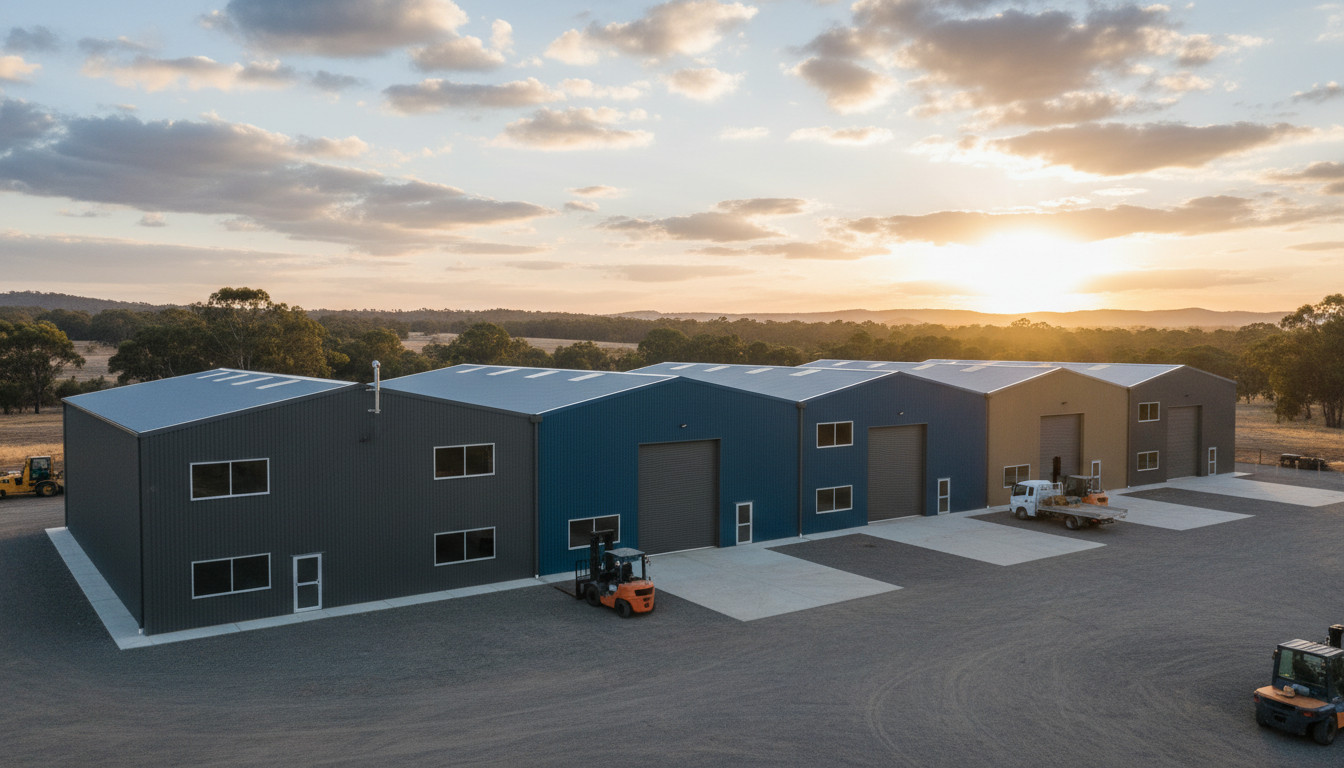
Find a Bigger, Better Aussie Shed—Built for Your Site and Climate
Chasing big sheds, industrial sheds, or a warehouse shed that won’t buckle in a storm? This guide distils what Australian homeowners, renovators, and property investors need to know about large sheds for sale—materials, wind ratings, council approvals, costs, and options like massive sheds for sale or large shed kits you can DIY. Expect practical tips, local compliance insights, and examples across Perth, Sydney, Melbourne, Brisbane, and regional Australia.
What Are the Best Shed Materials for Perth’s Climate?
In WA’s sun and coastal air, cladding choice matters. Most premium builds use BlueScope COLORBOND steel (often with Thermatech technology) or ZINCALUME. For coastal or industrial zones, many owners upgrade to Colorbond Ultra or additional coatings to resist corrosion.
| Feature | COLORBOND steel | ZINCALUME steel |
|---|---|---|
| Heat reflectivity (Perth summers) | High, Thermatech in lighter colours helps reduce heat gain | Good reflectivity due to metallic coating |
| Coastal resistance | Strong; Colorbond Ultra recommended near surf or estuaries | Good, but usually needs greater separation from breaking surf |
| Colour range | Extensive Colorbond palette (Classic & Matt) | Metallic/silver tone only |
| Typical use | Residential, commercial sheds, custom Colorbond garages Perth | Rural/ag sheds, budget-friendly large shed kits |
| Price | $$ (premium look and warranty) | $ (value-first) |
Frame systems use galvanised cold-formed C and Z sections, portal frames, and bolted connections per AS/NZS 4600. In cyclonic regions (QLD North/WA North), heavier connections and thicker baseplates are specified to meet AS/NZS 1170.2.
Which Large Shed Type Fits Your Property?
- Farm machinery storage (rural sheds NSW, VIC, SA): Wide bays, high eaves (4.2–6.0 m), open-front options.
- Industrial sheds and warehouse sheds: Clear spans (12–30 m), high-bay workshops, mezzanine storage, multiple roller doors.
- Commercial sheds: Showrooms + warehousing, integrated offices, glazing, fire egress compliance.
- Big sheds for residential blocks: Triple-bay workshop, custom-built double garage in Perth, boat/caravan storage.
- American barn or skillion roof shed: Versatile aesthetics, good water run-off, cost-effective spans.
- Large shed kits: DIY shed kits for competent owner-builders; supply-only with detailed drawings.
- Carports and awnings: Affordable carports for Australian homes, custom carports Melbourne, drive-through boat shelters.
A 12×6 Shed Buyer’s Guide for Australian Homes breaks down detailed design options for very large builds.
How Do You Get Council Approval for a Large Shed in Australia?
Most big sheds need building approval, and some need planning approval. Expect site plan, engineering drawings, slab/footing detail, wind design certificate, and bushfire/water management if relevant. Using a ShedSafe-aligned supplier and registered engineer speeds approval.
How to Get Council Approval for Your Custom Shed in WA
- Confirm zoning and setbacks with your local council (R-Codes, rural/residential, bushfire overlays).
- Order site-specific engineering to AS/NZS 1170.2 wind region A/B/C/D and terrain category.
- Provide slab/footing design to AS 2870 with geotechnical soil data if required.
- Submit BA forms, energy or stormwater notes if requested, and pay application fees.
- Book inspections (footings, slab, final). Keep product warranties and delivery dockets.
Added 2024 WA wind-rating compliance notes — Many councils now ask for clearly stated N or C wind classifications and importance level for sheds. Ask for “council-approved sheds WA” documentation in your quote.
QLD Cyclone Compliance
In North and coastal QLD, choose cyclone-rated sheds QLD with Region C/D design, cyclonic flashings, and upgraded hold-downs. Expect engineer certification and tie-down scheduling specific to your site wind speed and shielding.
NSW, VIC, SA and TAS Notes
- NSW rural sheds: Check LEP/DCP controls for maximum height and floor area; BAL (bushfire) may apply near vegetation.
- VIC: Planning overlays (bushfire, flood, heritage) can trigger extra documents. BAL-rated cladding/doors may be required.
- SA/TAS: Verify coastal corrosion categories; specify enhanced coatings near sea spray.
Wind Ratings, Regions, and Engineering — Explained Simply
- Non-cyclonic sites (N2/N3): Common in southern WA, SA, VIC, NSW inland. Standard portal frames with appropriate bracing.
- Cyclonic sites (C2/C3): North WA/QLD coast. Heavier connections, thicker sheeting/flashings, closer fastener spacing, upgraded doors.
- Importance level: Most private sheds are IL2; some commercial sheds may be IL3, increasing design loads.
- Doors matter: Wind-rated roller doors with wind locks prevent blow-in. Ask for ratings in kPa and certification.
For authoritative climate data, see the Bureau of Meteorology’s wind region mapping (external): BOM wind region guidance. The Australian Steel Institute’s ShedSafe program confirms engineering alignment: ShedSafe accreditation.
What Size Is a “Large Shed,” and What Does It Cost in 2025?
“Large” typically starts around 9 x 6 m and scales to 24 x 12 m (or bigger). Sizable options like the 6×9 Storage Shed Australia offer plenty of room for vehicles or machinery. Heights range 3.6–6.0 m. Costs vary by wind region, height, doors, slab, and site works.
- Residential workshop (9 x 7.5 x 3.6 m, N3): From ~$19k–$28k kit; installed with slab from ~$38k–$58k.
- Farm machinery shed (18 x 9 x 4.5 m, N3, open-front): From ~$32k–$48k kit; installed with posts/piers from ~$55k–$85k.
- Commercial/warehouse shed (18 x 12 x 5.5 m, C2): From ~$85k–$140k kit; turnkey with fit-out varies widely.
These are indicative only. Steel pricing and freight follow the “2025 Australian Steel Market Outlook” trends; check current rates with your supplier.
Real Build Examples (Australia-Wide)
Perth Metro: Custom Colorbond Double + Workshop
12 x 9 x 4.2 m, Colorbond Monument walls/roof, N3, 2 x wind-rated roller doors, PA door, vermin flashing, anticon blanket. Slab and footings to AS 2870. Use: car hoist, mezzanine storage. Delivered as a kit; built by a local installer in 3 weeks.
North QLD: Cyclone-Rated Service Shed
15 x 8 x 5.0 m, Region C (C2), cyclonic flashings, upgraded hold-downs, wind-locked doors. Zincalume roof, Colorbond Ultra walls near coast. Built for a civil contractor; council sign-off within 12 weeks.
Rural NSW: Farm Machinery Storage
18 x 9 x 4.8 m, three open bays + one enclosed bay, skillion roof shed, integrated lean-to. Zincalume roof, Colorbond Woodland Grey walls. Purpose: tractor, headers, fuel pod cover. Owner opted for DIY shed kit with local concreter.
Roof Profiles, Doors, and Smart Upgrades
- Roofs: Gable roof (classic look, efficient spans) vs skillion roof (cost-effective, great water fall to rear). Region C sites may need increased purlin depths and fastener density.
- Doors: Wind-rated roller doors with wind locks; motorisation; chain hoists for tall doors; steel-framed PA doors for security.
- Insulation: Anti-con blanket, bulk batts, insulated panels. Improves comfort and condensation control.
- Fit-out: Mezzanine platforms, internal partitioning for offices, electrical conduits pre-slab, roof ventilators, skylights.
- Coatings: Colorbond Ultra near surf; hot-dip galvanised posts in splash zones; additional sacrificial coatings in industrial air.
5-Step Buying Guide for Custom Sheds in Australia
- Scope your use: Farm machinery storage, warehouse operations, or “the biggest shed” your block allows? List clear-span, height, and door sizes.
- Choose materials: Decide Colorbond vs Zincalume, insulation level, door types, and corrosion upgrades for coastal sites.
- Engineer to site: Demand site-specific engineering to AS/NZS 1170.2 with wind rating (N3/C2), terrain category, and importance level.
- Council-ready pack: Ask for drawings, slab design, and a “council-approved sheds WA/NSW/QLD/VIC” document set as needed.
- Install plan: Confirm slab/footings, delivery, crane or telehandler, and a realistic construction sequence with safety and weather allowances.
DIY Shed Kits vs Custom-Built — What’s Right for You?
- DIY shed kits: Cheapest; best for straight sites and experienced owner-builders. Requires reading plans, drilling/bolting, accurate set-out.
- Custom-built: Faster, safer, and council stress-free. Recommended for cyclonic, sloping, or tight-access sites; includes QA on wind-rated doors and bracing.
Standards, Safety, and Sustainability
- Design loads: AS/NZS 1170.2 (wind), AS/NZS 4600 (cold-formed steel), AS 4100 (steel structures), AS 1562.1 (roof/wall cladding).
- Footings/slab: AS 2870. Engineer may specify piers or thickened edge beams for heavy point loads.
- BAL and fire: Check local bushfire Attack Level (BAL) if near vegetation. CSIRO guidance can help.
- Energy and heat: Light Colorbond colours and ventilation reduce heat gain; see Energy.gov.au for cooling strategies.
- ShedSafe: Using a ShedSafe-aligned supplier ensures structural compliance and clear engineering.
References and useful reading (external):
HIA Outdoor Structures & Home Improvement insights,
Master Builders Australia,
Australian Steel Institute,
CSIRO bushfire resources,
Energy.gov.au cooling and insulation.
FAQs: Large Sheds Australia
Do I need council approval for a large shed?
Usually yes. Most large or high sheds need building approval and, sometimes, planning approval. Your supplier should provide certified engineering and council-ready drawings.
Are your sheds wind-rated for cyclonic areas?
Yes. We supply wind-rated sheds for cyclonic areas with Region C/D engineering, upgraded connections, and compliant doors. Ask specifically for “cyclone-rated sheds QLD” options if you’re northern or coastal.
Colorbond or Zincalume—what should I choose?
Colorbond offers a premium finish and coastal resilience (Ultra for severe sites). Zincalume is cost-effective for inland ag and rural uses. Both are compliant when engineered and installed correctly.
Can I get a large shed kit and install it myself?
Yes. Large shed kits come with detailed plans. Ensure you’re capable with set-out, bracing, and safe lifting. For tall walls or cyclonic sites, a licensed installer is recommended.
What’s the lead time?
Typical lead times range 4–10 weeks depending on steel availability, coatings, and roller door production. Remote delivery may add time.
What about coastal corrosion?
Choose Colorbond Ultra or added protective systems. Rinse zones and galvanised columns/rails help. Maintain washdowns and keep soil away from wall sheets.
Local Keyword Clusters (So You Find the Right Team)
We service steel sheds Perth, custom steel sheds Perth, rural sheds NSW, custom carports Melbourne, commercial sheds Brisbane, industrial sheds Adelaide, and large sheds Australia-wide. Whether you’re after big sheds for sale, huge sheds for sale, or massive sheds for sale, we’ll engineer and supply “council-ready” packs that pass first time.
Recommended Reading
Want to know the best brands? Our Better Sheds Reviews rank the top choices for every need and budget.