
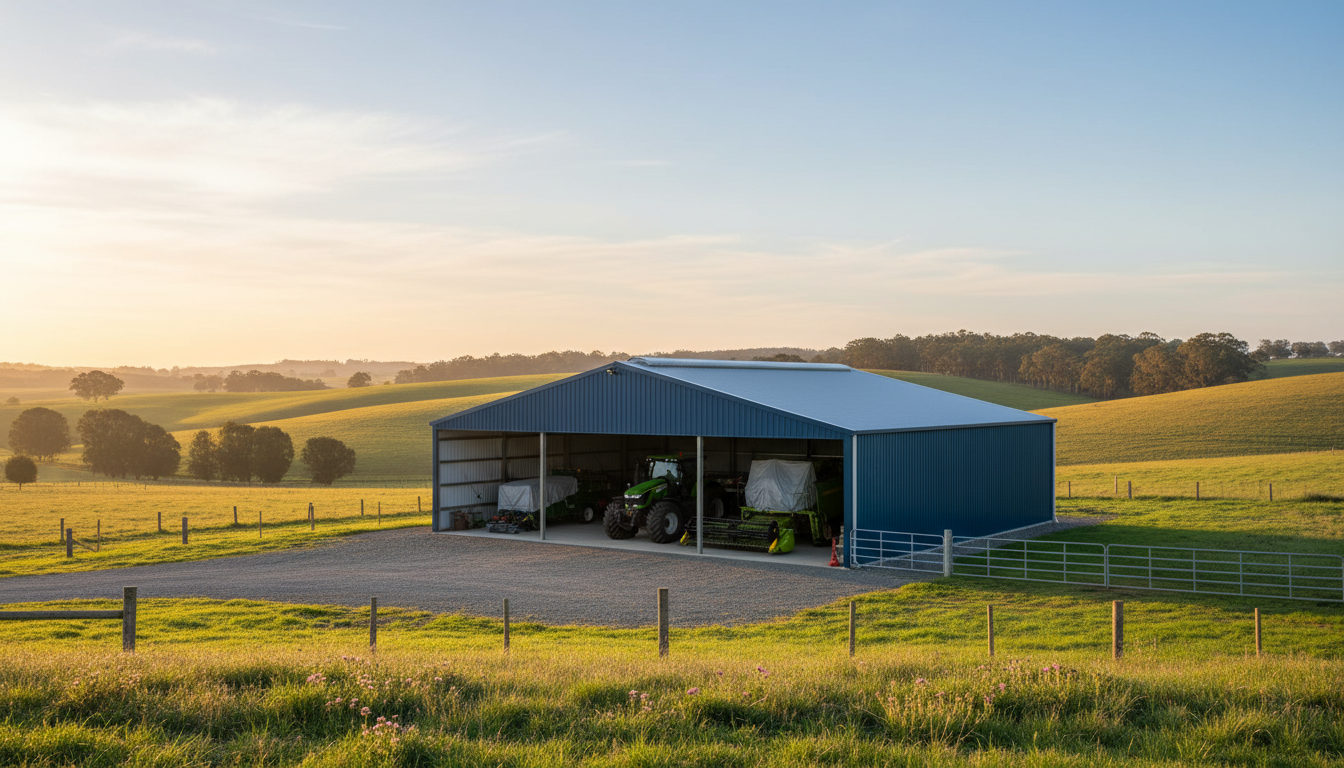
What is a machinery shed and who needs one?
A machinery shed (also called a machine shed or farm machinery shed) is a cold-formed steel portal-frame building designed to protect tractors, headers, sprayers, utes, and attachments from sun, rain, and corrosion. In towns and on farms across WA, NSW, QLD, VIC, SA, and TAS, these sheds also double as workshops, parts stores, and covered work areas.
Whether you’re shortlisting steel sheds Perth, pricing rural sheds NSW, or want cyclone-rated sheds QLD, the right spec balances durability, access, and compliance.
What are the best shed materials for Perth’s climate?
Perth’s hot summers, sea breezes, and coastal corrosion risk make cladding choice critical. Most premium builds use BlueScope substrates in either Colorbond steel or Zincalume, both engineered for Australian conditions.
| Feature | Colorbond steel | Zincalume steel |
|---|---|---|
| Finish | Painted top coat with baked-on colour; wide architectural palette | Spangled metallic coating (AZ150); silver-grey appearance |
| Corrosion resistance (coastal WA) | Excellent in C2–C3 with correct detailing; choose Ultra grades near surf coasts | Very good in inland C1–C2; needs increased maintenance near marine influence |
| Heat reflectivity | High for lighter colours; can lower internal temps vs dark finishes | Good reflectivity but can glare; aesthetics limit some sites |
| Maintenance | Low; periodic wash-down in salt zones | Low–moderate; rinse more frequently near coast |
| Cost | Usually higher material cost | Usually lower material cost |
| Best fit (Perth) | Premium choice for visual appeal, heat control, and coastal durability | Great value inland or for farm interior linings/purlins |
For sites within ~1 km of breaking surf or industrial zones, talk to your engineer about coating class, fastener selection, and extra wash-down. See corrosion guidance from the Australian Steel Institute and materials research from CSIRO.
How big should your farm machinery shed be?
Size is driven by your largest machine and how you turn, hitch, and service gear under cover. Start with the header or boom sprayer dimensions, then design clear spans and door openings to suit.
- Common footprints: 12×18 m, 12×24 m, 15×30 m, 18×36 m
- Bay spacing: 6–8 m bays for most farms; 9 m possible with heavier members
- Eave height: 4.5 m minimum for tractors; 5.0–6.0 m for headers and bulk tippers
- Open-front vs enclosed: Open-fronted sheds speed access; enclose one or more bays for lock-up workshop
- Doors: Sliding doors for wide openings; industrial roller shutters for secure lock-up bays
- Apron and turning: 6–10 m concrete or compacted hardstand apron for safe maneuvering
Typical machinery shed specs
- 4-bay open-front implement shed: 12×24×5.0 m, 6 m bays, hot-dip galv base plates, Zincalume roof, Colorbond walls
- Enclosed workshop + two open bays: 15×30×5.5 m, gable roof, 1 lock-up bay with 4.5 m roller door, skylights, whirlybirds
- Large open gable: 18×36×6.0 m with knee and apex braces, bird/vermin seals, heavy-duty gutters to 2×110 kL tanks
What wind ratings and codes actually matter for sheds?
Serious sheds are engineered to AS/NZS 1170.2 (wind actions), AS/NZS 4600 (cold-formed steel), and the NCC 2022 (Building Code of Australia). Your site’s design must consider wind region (A, B, C, D), terrain, topography, and importance level. Don’t accept generic “N2” housing ratings for a big shed.
- Non-cyclonic: Regions A/B (large parts of WA, SA, VIC, NSW) with appropriate ultimate design wind speeds
- Cyclonic: Regions C/D (e.g., coastal QLD, WA Pilbara) require cyclone-rated sheds with specific cladding fixings, batten spacings, and hold-downs
- Terrain category: Most rural blocks are TC2; exposed sites may attract higher pressures
Added 2024 WA wind-rating compliance notes — Many WA councils now ask for certified site-specific wind design and connection details at permit stage. Expect portal frame calcs, slab/footing drawings, and tie-down schedules stamped by a registered structural engineer.
Check local climate data with the Bureau of Meteorology, and steel sector updates in the “2025 Australian Steel Market Outlook” from the Australian Steel Institute.
How do you get council approval for a machinery shed in Australia?
Most sheds need both planning and building approval. What changes by state is the process and paperwork.
How to get council approval for your custom shed in WA
- Pre-check: Confirm setbacks, height limits, and rural zoning with your Shire.
- Planning (if required): Lodge a development application if your proposal varies local planning rules.
- Engineering: Obtain site-specific drawings and calculations to AS/NZS 1170.2 and AS/NZS 4600.
- Building permit: Submit BA1 application with a Certificate of Design Compliance (CDC) from a registered building surveyor.
- Inspections: Arrange footing/slab and final inspections as required.
Ask your supplier about council-approved sheds WA packages that include surveyor certification and engineer sign-off.
NSW and VIC quick notes
- NSW: Many rural sheds qualify under a Complying Development Certificate (CDC), avoiding a full DA if standards are met.
- VIC: A Registered Building Surveyor issues the Building Permit; you may also need siting consent for setbacks or overlays. Search “shed permits Victoria”.
For policy guidance, see Housing Industry Association and Master Builders Australia.
What design options give the best value?
- Roof styles: Gable for maximum clearance and ventilation; skillion (monoslope) is economical and great for lean-tos; flat roofs suit affordable carports for Australian homes.
- Cladding profiles: High-rib profiles (e.g., Monoclad/Trimdek) resist high winds; match to wind region.
- Open vs enclosed: Mix open bays for quick parking with enclosed bays for tools, parts, and an industrial workshop Adelaide-style fitout.
- Access: Sliding doors 5–12 m wide; add PA doors, removable mullions, and drive-through bays.
- Ventilation and light: Ridge vents, whirlybirds, translucent roof sheets (limit in cyclonic regions), and insulated sarking.
- Water and vermin control: Wide eaves, over-sized quad gutters, leaf guards (BAL sites), vermin seals at slab edges.
- Ancillary structures: Lean-to for fueling bay, custom carports Melbourne, double garage Sydney, or an American barn Tasmania for mixed storage.
- Future-proofing: Conduits for 3-phase power, slab thickenings for hoists, and pad for a 10–20 kW solar array.
DIY shed kits vs custom-built installation — what’s better?
DIY shed kits can be cost-effective for experienced owner-builders with machinery and time. A custom-built shed adds pro set-out, faster erection, and fewer mistakes, which matters for big spans and wind-rated sheds for cyclonic areas.
- DIY kit: Lower upfront cost; you handle slab, footings, erection, and permits.
- Custom-built: Turnkey delivery; supplier manages engineering, permits, slab, and install.
Ask for both options. Many farmers choose hybrid: supply-and-erect frame and roof, then self-complete internal fitout.
How much does a machinery shed cost in 2025?
Budgets vary by region, wind rating, height, access doors, and finish (Colorbond vs Zincalume). Based on recent industry pricing and the “2025 HIA Outdoor Structures and Home Improvement Report” market trends:
- Supply-only kit (rural, non-cyclonic, open-front): roughly $120–$220 per m²
- Supply and erect (non-cyclonic): roughly $260–$420 per m²
- Supply and erect (cyclonic C/D): roughly $350–$600 per m²
Example: A 15×30×5.5 m open-front farm machinery storage (450 m²) could range from ~$70k–$100k supply-only, or $120k–$180k installed, depending on doors, slab, insulation, and wind region. For exacts, get an engineered quote tied to your postcode and terrain.
Real Australian build examples
Wheatbelt WA — Open-bay implement shed
- Size: 12×24×5.0 m, 4 bays at 6 m
- Spec: Colorbond roof/walls, TC2 non-cyclonic, eave gutters to 110 kL tank
- Outcome: Fast access for air seeder bar and auger; added 6 m lean-to in year two
Far North QLD — Cyclone-rated spray rig shed
- Size: 18×30×6.0 m, Region C design
- Spec: Cyclone tie-downs, higher screw density, anti-suction detailing, limited skylights
- Outcome: Certified cyclone-rated shed QLD with secure lock-up bay for chemical store
5-step buying guide for custom sheds in Australia
- Define use-case: Open bays for daily parking; enclosed lock-up for workshop/parts; allow one extra bay for growth.
- Set the envelope: Largest machine width/height; choose eave height and door type; plan turning apron.
- Engineer to site: Confirm wind region, terrain, topography, BAL rating, and soil class; insist on AS/NZS 1170.2 and 4600 compliance.
- Choose materials: Do a Colorbond vs Zincalume comparison; upgrade fasteners and gutters for coastal or fertiliser exposure.
- Lock approvals and program: Pursue planning/permit, book slab and install windows, and secure lead times for steel and doors.
Frequently asked questions
Do I need a permit for a farm machinery shed?
Usually yes. Most councils require a building permit, and some require planning consent depending on zoning, setbacks, and size.
What roof style is best?
Gable roofs maximise clearance and ventilation. Skillion roofs are cost-effective and ideal for lean-tos and extensions. Flat is common for caravan carports Brisbane and smaller steel garages Australia.
Can I get a council-ready package?
Ask suppliers about council-approved sheds WA and similar packages in NSW/VIC that include engineering, surveyor certification, and submission-ready drawings.
Are sheds tax-deductible?
Primary producers may claim deductions or depreciation on eligible assets. Rules change—check current ATO guidance and speak with your accountant before purchase.
What about garages and carports?
Most suppliers who do machinery sheds also deliver custom Colorbond garages Perth, shed builders Brisbane fitouts, and affordable carports for Australian homes. You can integrate matching finishes across the property.
What maintenance is required?
- Annual wash-down in coastal/ag-chemical environments
- Gutter cleaning pre-wet season; inspect fasteners and seals
- Re-seal slab edges/vermin seals if rodents appear
Local considerations by region
- Perth/WA: Heat management and coastal corrosion—light-colour Colorbond, insulation, larger gutters. Many builds combine machinery sheds with custom carports Melbourne-style lean-tos adapted for WA conditions.
- QLD Cyclonic: Region C/D engineering, increased fastener density and batten spacing, limited translucent sheets; choose proven wind-rated sheds for cyclonic areas.
- NSW/VIC Rural: Balance frost and heat; check dams/overland flow affecting footings.
Industry outlook: The “2025 HIA Outdoor Structures and Home Improvement Report” points to steady rural and peri-urban demand, while the “2025 Australian Steel Market Outlook” highlights stable supply with ongoing investment in domestic coated steel. Use credible, local standards and climate data to inform your design.
Need a lock-up workshop with extra parking? Combine an enclosed bay, a drive-through open bay, and a lean-to carport in one permit. It scales better than separate approvals.
Specifications checklist (copy this into your brief)
- Use: Machinery storage + workshop + parts store
- Size: ____ × ____ × eave ____ m; Bays: ____ m; Span: ____ m; Roof: gable/skillion
- Wind region: A/B/C/D; Terrain: TC__; BAL: ____; Soil class: __
- Structure: Cold-formed portal frames per AS/NZS 4600; purlins/girts: C/Z sections
- Cladding: Colorbond/Zincalume; Profile: ____; Fasteners: Class 4/5 coastal
- Doors: Sliding/roller; Openings: width ____ m × height ____ m; PA doors: __
- Slab/footings: ____ mm slab with mesh (e.g., SL72/SL82) and thickenings; or piers with strip footings
- Water: Gutters, DP size __, Tank capacity __ kL; Vermin seals: yes/no
- Electrical: 3‑phase, outlets, lighting lux target; Solar conduits
- Documents: Certified engineering, site plan, elevations, tie-down schedule
Resources: BOM climate data • HIA policy and guides • Australian Steel Institute • CSIRO materials research • Energy.gov.au
From open-bay implement sheds to enclosed workshops with mezzanines, a well-specified Colorbond steel shed for regional WA or a council-ready rural shed NSW will serve for decades. If you also need a custom-built double garage in Perth or matching carports, plan it now so colours, gutters, and levels align from day one.