
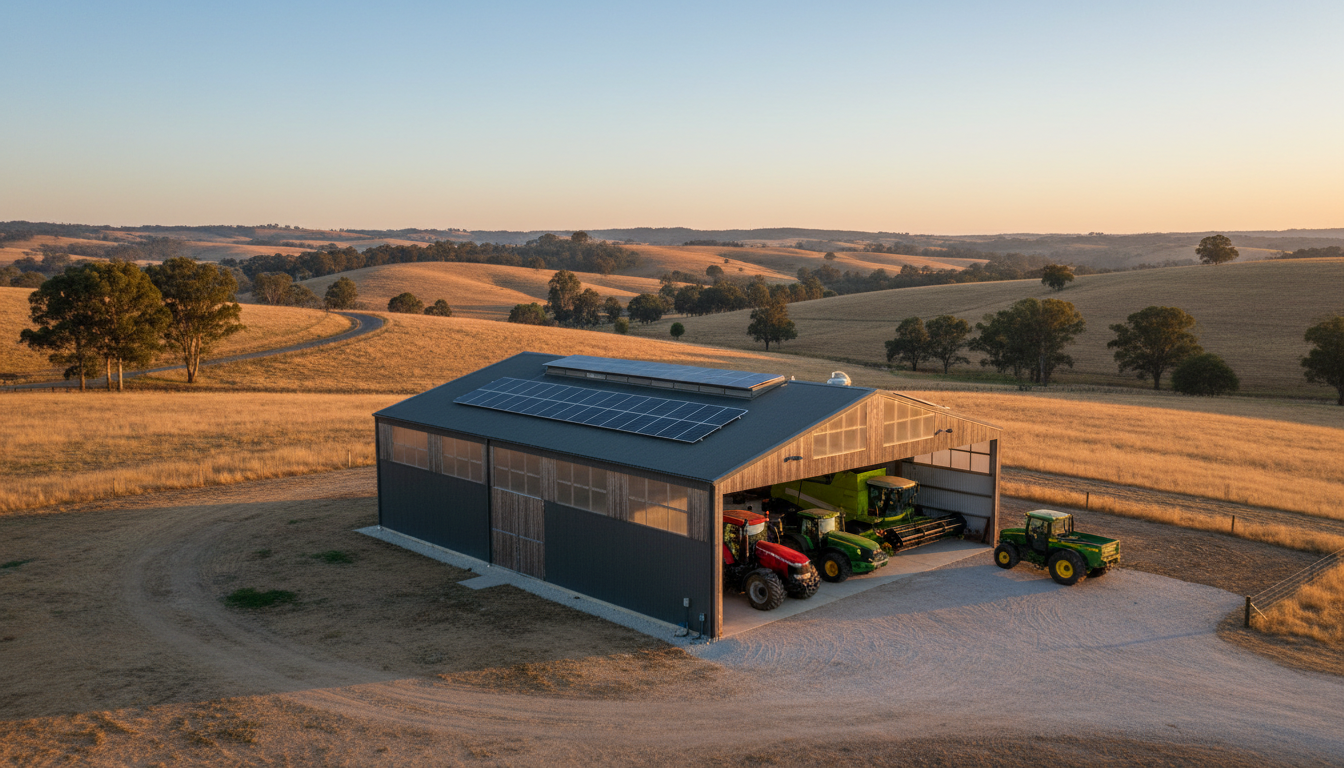
Whether you’re protecting a header in the WA Wheatbelt, parking a tractor in rural NSW, or building a cyclone-rated shed in North QLD, the right machinery shed (also called a machine shed or farm machinery shed) is about smart engineering, local compliance, and durable materials such as Colorbond steel. This guide distils industry best practice for Australian homeowners, renovators, and property investors seeking premium-quality steel sheds, garages and carports. Get the latest data in the Farm Shed Kit Prices in Australia 2025: Costs, Materials, Wind Ratings & Buying Guide.
LSI keywords you’ll see in-context: steel sheds Perth, custom carports Melbourne, rural sheds NSW, farm machinery storage, implement sheds, hay and machinery combo, portal frame sheds, clearspan sheds, gable roof sheds, skillion roof sheds, wind-rated sheds for cyclonic areas, DIY shed kits, shed kit prices, affordable carports for Australian homes, garage and workshop combo, Colorbond vs Zincalume comparison, council approvals, custom Colorbond garages Perth, council-approved sheds WA, cyclone-rated sheds QLD.
What Is a Machinery Shed?
A machinery shed is a portal-frame steel building designed for farm machinery storage and workshop use. Typical spans range from 12–30 m clearspan with 6–8 m bays, eave heights of 4.5–6.0 m, and either open-front bays or enclosed walls with sliding or roller doors. Most premium builds use BlueScope Colorbond cladding over galvanised, cold-formed frames engineered to AS/NZS standards and the National Construction Code (NCC) Class 10a.
What Are the Best Shed Materials for Perth’s Climate?
Perth’s hot, dry summers and sea breeze exposure demand heat-reflective roofing, robust corrosion resistance, and low-maintenance coatings. Colorbond steel in lighter colours (e.g., Surfmist) reduces heat gain, while Zincalume offers excellent base durability in low-to-moderate corrosion zones. Along the WA coast, a higher corrosion category (C3–C4) and quality detailing (e.g., sealed laps, vermin flashing, gutter guards) are essential.
Colorbond vs Zincalume — Which Is Better for WA Conditions?
| Feature | Colorbond | Zincalume | Better for WA coastal/Perth? |
|---|---|---|---|
| Heat performance | Lighter colours reflect more heat; reduced internal temps | Highly reflective bare finish; can glare | Colorbond (light colours) for comfort |
| Corrosion resistance | Painted top coat adds barrier protection | Excellent base metallic coating durability | Tie — detailing and environment matter |
| Maintenance | Low; washdown in coastal areas | Low; shows patina more readily | Colorbond (aesthetics hold longer) |
| Appearance | Large colour range; premium look | Industrial silver | Colorbond for residential/rural homesteads |
| Cost | Generally higher | Generally lower | Zincalume for budget-only builds |
For most machinery sheds near Perth and the WA coast, we specify Colorbond cladding on a galvanised frame, with Zincalume often used for internal purlins and girts. Inland, Zincalume cladding can be a suitable cost-saver if appearance is secondary.
Pro Tip: Did you know using insulated roof panels or anticon blanket can reduce internal shed temperatures by up to 10°C in summer? It also helps with condensation control in winter.
How Big Should Your Farm Machinery Shed Be?
Start with your biggest machine and turning arcs. Common specs:
- Headers/combines: eave height 5.0–6.0 m; allow for augers and chaser bins.
- Air seeders and planters: wider bays (7.5–8.0 m) and drive-through layouts.
- Tractors/implements: 6.0 m bays, 4.5–5.0 m eaves; lean-to for small gear.
- Doors: sliding doors >5.0 m high for plant; roller shutters for security on garages/workshops.
Plan for future kit: allocate a service bay with 3-phase provision, LED high-bays, and a mezzanine for parts storage. Many owners pair a garage and workshop combo on one gable end, or add a lean-to carport for utes. This is popular for custom Colorbond garages Perth and affordable carports for Australian homes.
Design Options That Add Real-World Value
Roof Styles: Skillion (Flat/Mono) vs Gable
| Roof Style | Pros | Cons | Best For |
|---|---|---|---|
| Skillion (mono) | Simple drainage, modern look, easy solar array orientation | Less clearance mid-span vs gable | Workshops, side-lean-tos, urban blocks |
| Gable | Max headroom, classic farm aesthetic, better airflow to ridge | Slightly more steel in some spans | Large clearspans, hot inland regions |
Open-Front vs Enclosed
- Open-front: rapid access, ideal for implements and hay and machinery combo bays.
- Partial enclosure: weather protection on prevailing-wind side, save on doors.
- Fully enclosed: security, dust control, workshop fitout readiness.
Compare hay versus machinery storage with Hay Shed Prices, Kits and Design in Australia.
Access and Security
- Sliding doors for wide farm openings (lower maintenance in dusty sites).
- Industrial roller shutters for sealed security on garages and workshops.
- Drive-through layouts reduce reversing incidents and time on task.
For smaller equipment, see our mower shed guide (2025) covering sizes and security. Or for a distinctively Australian design, see Aussie Sheds and Barns.
Ventilation, Light and Comfort
- Ridge vents, rotary vents, or powered fans sized to the shed volume.
- Anticon blanket or insulated panels to cut heat and condensation.
- Polycarb skylights (limited and UV-stable) and LED high-bay lighting.
Slabs, Footings and Drainage
- 150 mm slab with thickened edge beams for plant; N12 bars and SL82 mesh typical, final design by engineer.
- Pier footings with M16–M24 hold-downs sized to wind region and uplift.
- Gutters, downpipes and stormwater to AS/NZS 3500, with silt arrestors on rural blocks.
Engineering, Wind Ratings and Compliance
Every machinery shed should be site-specific engineered. Wind classification drives frame sizing, connections and hold-downs. Coastal and cyclonic regions require additional bracing and fixings; alpine areas require snow load checks.
Added 2024 WA wind-rating compliance notes: Greater Perth typically falls in Region A (AS/NZS 1170.2), but coastal exposure, terrain category, and topographic acceleration can push design pressures higher. Always obtain engineering tied to your exact site address and terrain.
Relevant Australian Standards and Codes
- AS/NZS 1170.2 Wind actions
- AS/NZS 4600 Cold-formed steel structures
- AS 4100 Steel structures
- AS/NZS 1562.1 Sheet roof and wall cladding
- AS 1397 and AS/NZS 2728 Steel coating and paint systems
- AS 3959 Construction in bushfire-prone areas (BAL)
- National Construction Code (NCC) Class 10a
Cyclone Regions and Snow Loads
- North QLD and parts of coastal WA (Regions C/D): specify cyclone-rated sheds QLD with increased fixings, strap bracing, and higher strength fasteners.
- Alpine NSW/VIC/TAS: check snow load to AS/NZS 1170.3; increase purlin spacing or section sizes as needed.
Useful references: BOM cyclone and wind region information, Australian Steel Institute guidance, CSIRO bushfire resources.
Council Approvals and Permits
Most machinery sheds are assessable developments. Councils typically require engineered plans, site plans, specifications, and drainage details. In bushfire-prone areas, include BAL assessment. For heritage or overlays, expect extra steps.
How to Get Council Approval for Your Custom Shed in WA
- Confirm zoning and setbacks in your LGA (rural/residential). Ask about outbuilding limits.
- Order site-specific engineering (Region A/B/C/D, terrain, topography) and slab/footing designs.
- Prepare a site plan with levels, stormwater routing, and driveway access.
- Submit a Building Permit application (Class 10a) with NCC-compliant documentation.
- On approval, book inspections (footings, slab, final). Keep certificates of compliance.
We specialise in council-approved sheds WA and can package engineering, plans and documentation for a smoother process.
DIY Shed Kits vs Custom-Built Installations
Both pathways can yield premium results if engineered properly. Choose based on time, skills and site complexity.
| Option | Pros | Cons | Best For |
|---|---|---|---|
| DIY shed kits | Lower cost, faster delivery, owner-builder flexibility | Time commitment, equipment hire, responsibility for QA | Simple sites, non-cyclonic, experienced owner-builders |
| Custom-built (supply & install) | Professional crew, faster construction, warranty-backed | Higher upfront cost | Complex sites, cyclonic/snow, tight timelines |
Tip for DIY: Book a telehandler, set out bays precisely, and stage purlins/girts by bay. Always follow the engineering and erection manual.
Costs in 2025: What to Budget
Indicative ranges only (ex-GST; site-dependent):
- Open-front implement/hay + machinery sheds: $130–$220 per m² (kit), $220–$350 per m² (installed).
- Enclosed machinery sheds/workshops: $180–$280 per m² (kit), $300–$500 per m² (installed).
- Doors, insulation, vents, mezzanines and concrete can add 10–35% to totals.
Steel prices have stabilised compared with pandemic peaks but remain sensitive to global supply. See market context via the HIA 2025 Outdoor Structures & Home Improvement insights and the 2025 Australian Steel Market Outlook summaries through industry bodies.
Case Studies: Built for Australian Conditions
WA Wheatbelt — Open-Front Machinery Shed (24 × 12 × 5 m)
- Four 6 m bays, 5.0 m eave height, gable roof 10°.
- Colorbond cladding (0.42 BMT walls, 0.48 TCT roofing), galvanised cold-formed frame.
- Region A2, terrain category 2; M20 hold-downs; vermin flashing, gutter guards.
- Anticon blanket + rotary vents; slab 150 mm with thickened edges under service bay.
Burdekin QLD — Cyclone-Rated Enclosed Shed (18 × 9 × 5 m)
- Region C; increased screw patterns, additional strap bracing, heavier knee/haunch plates.
- Sliding doors 5.0 m high with wind locks; ridge vent and louvres.
- Zincalume roof, Colorbond walls; hot-dip galvanised brackets.
NSW Riverina — Drive-Through Farm Machinery Shed (30 × 15 × 5.5 m)
- Five 6 m bays; central drive-through with double sliding door sets each end.
- Mix of open and enclosed bays for farm machinery storage and parts workshop.
- Dust seals, LED high-bays, 3-phase conduit cast in slab.
5-Step Buying Guide for Custom Sheds in Australia
- Scope: List machines, clearances, door heights, and future gear. Decide open-front vs enclosed.
- Site: Mark setbacks, allow truck/crane access, and consider prevailing wind and drainage fall.
- Spec: Choose Colorbond vs Zincalume, roof style, insulation, doors, vents, gutters and downpipes.
- Engineer: Obtain site-specific plans to AS/NZS 1170.2, AS/NZS 4600 and NCC Class 10a.
- Approve & Build: Lodge with council, book slab, then erection. Keep compliance certificates.
Need pet or bird housing near your machine shed? Review sheds and aviaries for ventilation and placement.
Frequently Asked Questions
What wind rating do I need?
It depends on your address, terrain and topography. Perth is usually Region A; North QLD and parts of coastal WA are Region C/D and need wind-rated sheds for cyclonic areas. Always request site-specific engineering.
Do I need a slab?
Open-front machinery sheds can use piers only; enclosed workshops benefit from a 100–150 mm slab. Heavy plant areas often require thickened pads. Engineer to soil report where possible.
Colorbond vs Zincalume — which should I choose?
Colorbond for premium appearance, extra barrier protection and cooler light colours; Zincalume for budget and non-prominent locations. See the comparison above for WA conditions.
How long does it take?
Lead times vary. Allow 2–4 weeks for engineering/docs, 2–6 weeks for manufacturing, and 3–10 days for erection depending on size and weather.
Can I add solar?
Yes. Skillion roofs make array layout easy. Ask for purlin spacing and extra fixing points. Confirm structural capacity for ballast or additional loads.
What about carports and garages?
We design matching custom carports Melbourne to regional council rules and custom Colorbond garages Perth for seamless homestead aesthetics.
Standards, Industry and Energy References
- Housing Industry Association (HIA) — market insights
- Master Builders Australia — economics & policy
- Australian Steel Institute — design resources
- Energy.gov.au — insulation guidance
- Bureau of Meteorology — climate data
These sources align with industry practice and the 2025 outlook for steel and outdoor structures. Always verify current council requirements and the latest NCC/AS/NZS editions before building.