
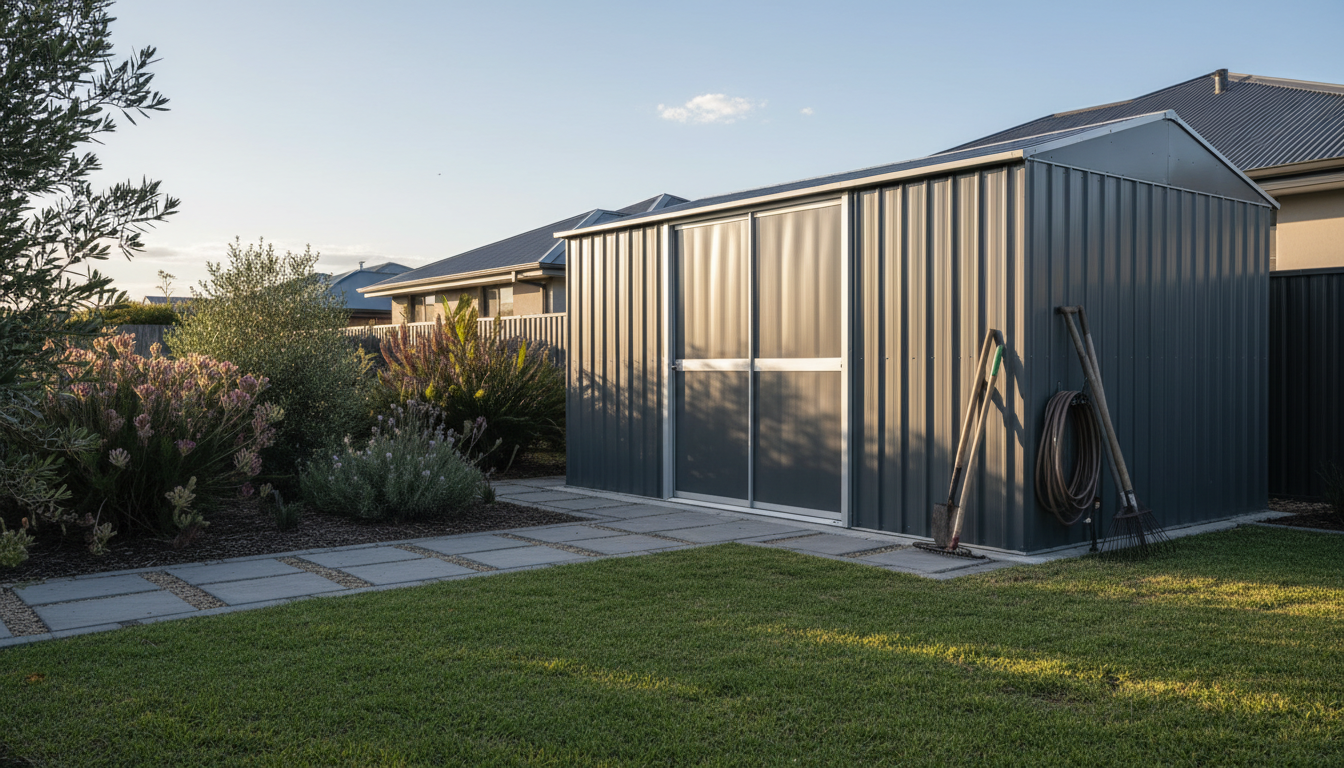
Looking for a premium metal garden storage shed that stands up to Australian conditions? This guide distils what matters—materials, wind ratings, council approvals, installation, and costs—so you can choose the right steel garden shed for Perth heat, Queensland cyclones, coastal corrosion, and everything in between.
Why choose a metal garden storage shed in Australia?
- Durability: Galvanised steel and Colorbond finishes resist rust, UV and hail better than timber or vinyl.
- Bushfire readiness: Steel is non-combustible and suitable for many BAL zones with correct detailing.
- Low maintenance: No termites, minimal repainting, easier to clean after storms and dust.
- Security: Rigid steel panels and quality locks protect tools, mowers, bikes and pool gear.
- Value: Proven buyer appeal for rentals and flips—neat storage helps rental inspections go smoothly.
From compact garden sheds metal for tools to larger steel frame storage sheds for workshops and farm machinery storage, steel ticks the boxes for longevity and compliance.
What Are the Best Shed Materials for Perth’s Climate?
Perth summers are hot, dry and UV-heavy. In coastal suburbs, salt spray accelerates corrosion. Two trusted options dominate: Colorbond and Zincalume.
Colorbond vs Zincalume — Which is better for WA conditions?
| Feature | Colorbond Steel | Zincalume Steel |
|---|---|---|
| Finish | Pre-painted colour topcoat, baked-on | Metallic coating (zinc/aluminium), silvery |
| UV Resistance | Excellent long-term colour stability | Excellent substrate durability, can dull over time |
| Thermal performance | Lighter colours reduce heat gain; pair with insulation | Reflective but can heat up; insulation recommended |
| Coastal performance | Strong; best practice is rinse-down and correct fasteners | Strong; requires diligent maintenance near surf coasts |
| Price point | Higher (premium look and colour options) | More affordable |
| Best for Perth | Urban/suburban, aesthetic builds, heat management | Budget builds, utility spaces, inland/regional |
Definition: Colorbond is a pre-painted steel product designed for harsh Australian conditions. Zincalume is an alloy-coated steel (zinc/aluminium) offering strong corrosion resistance without colour.
Love a rustic look? Wood Shed Kits in Australia prove that timber is still a top shed material.
Related: Colorbond vs Zincalume comparison, galvanised garden sheds, galvanised sheds, steel sheds for sale.
Design options and use-cases for steel garden sheds
- Backyard storage: 3×3 m sheds for tools and bikes; 3×1.5 m for narrow side yards.
- Workshop sheds: 4.5×3 m with power, benches, ventilation, and insulation.
- Pool equipment enclosures: Chlorine-safe ventilation, louvre doors, drip trays.
- Custom garages and carports: custom Colorbond garages Perth, custom carports Melbourne, affordable carports for Australian homes.
- Rural sheds: rural sheds NSW with wider bays for ride-ons and small tractors.
For sheds that maximise side space, look up our Lean-To Shed Australia Guide.
Common configurations
- Roof: Flat, skillion (single-slope), gable. Skillion is popular for easy water run-off to one side. Need sleek drainage and simple lines? The Skillion Shed Guide (Australia) is essential reading.
- Doors: Single/Double hinged, sliding doors, roller doors for wider access.
- Frame: Galvanised RHS or C/Z purlin portal frames on larger builds; heavy-duty channels for garden sizes.
- Upgrades: Whirlybirds, skylights, anti-condensation blanket, full insulation, guttering and downpipes, vermin-proofing seals.
Engineering, wind ratings, and Australian Standards
Quality metal shed designs reference the National Construction Code (NCC) and key Australian Standards for structural adequacy and durability.
Definition box
- Wind Regions (A, B, C, D): NCC maps Australia; C/D are cyclonic (e.g., coastal QLD, NT).
- AS/NZS 1170: Structural design actions (loads like wind).
- AS/NZS 4600: Cold-formed steel structures (light-gauge framing).
- AS 4100: Steel structures (hot-rolled/structural steel).
- AS 1397: Steel sheet—coating classes (e.g., AZ150) and grades (e.g., G550).
- AS 1562: Design and installation of metal roofing.
Added 2024 WA wind-rating compliance notes For Perth and coastal WA, ask for site-specific wind classification (e.g., N1–N3 non-cyclonic; C1–C4 cyclonic in the north). Correct anchoring, hold-down brackets, and cyclone kits are essential where required.
If you’re in North QLD or NT, specify cyclone-rated sheds QLD with engineering to Region C/D. In Perth Metro and Southwest WA, non-cyclonic designs often apply but verify terrain category and shielding.
How to Get Council Approval for Your Custom Shed in WA
- Check local planning scheme: Height, setbacks, lot coverage, and streetscape rules.
- Gather documents: Site plan, elevations, engineering certificates (wind rating), colour schedule.
- Apply via your council portal: Some small sheds may be exempt; others need building permits.
- Footing/slab details: Provide slab thickness, mesh, edge beams, and anchor layout as specified.
- Inspections: Footing/slab and final as required.
Council-approved sheds WA are more straightforward when you provide certified engineering and clear drainage plans.
Approval snapshots by state
- NSW: Exempt or complying development possible for small garden sheds if size and setbacks comply.
- VIC: Many small sheds can be exempt from a building permit but still require planning compliance.
- QLD: Some councils allow self-assessable works; cyclone regions require strict engineering and tie-downs.
DIY shed kits vs custom-built installations
DIY shed kits from brands like Absco, EasyShed and SteelChief suit standard sizes, quick shipping and budget installs. Custom-built sheds suit sloping sites, tight access, non-standard sizes, higher wind ratings and premium finishes.
- DIY kits: Fast, affordable, popular for steel sheds Perth, garden shed frame, and quick weekend projects.
- Custom builds: Engineered to site, integrated with house colours, power, and drainage; ideal for metal shed storage building upgrades.
Cost guide (2025)
Prices vary by size, finish and wind rating. Expect entry-level DIY kits in Zincalume to be more affordable than Colorbond, with costs increasing for larger footprints, cyclone kits, roller doors, insulation, and on-site installation. Concrete slabs, electrical, and drainage are separate line items.
Case studies and real-world builds
Perth (non-cyclonic): 3.0 × 3.0 m Colorbond garden shed
- Finish: Colorbond Monument walls/roof
- Base: 100 mm 25 MPa slab, F72 mesh, M12 sleeve anchors
- Add-ons: Whirlybird, anti-con blanket, vermin seal
- Use: Garden tools, bikes, camping gear
Townsville (cyclonic): 4.5 × 3.0 m workshop
- Wind: Region C with cyclone kit, extra hold-downs
- Frame: Heavier gauge channels, additional bracing
- Doors: Reinforced double doors with upgraded locks
- Use: DIY workspace with shelving and 15 A outlet
Sydney Inner West (narrow access): 3.0 × 1.5 m skillion shed
- Custom depth to fit easement
- Skillion fall away from boundary, gutter to tank
- Sliding door to save space
Installation and slab requirements
- Slab: Commonly 100 mm thick, 25 MPa concrete with F72 mesh, SL82 for larger footprint or edge beams as engineered.
- Anchors: M10–M12 screw-bolts or chemset anchors; follow engineer’s edge distance and embedment.
- Alternative bases: Rebated pavers or bearer/joist subfloor with ant-caps for drainage where slabs aren’t feasible.
- Drainage: Gutters, downpipes, and stormwater connection; avoid ponding around footings.
- Dissimilar metals: Use compatible fasteners and avoid copper run-off onto steel sheets.
Maintenance and longevity
- Hose down sea-salt deposits in coastal zones, especially within 1 km of surf.
- Keep gutters clear; add leaf-guards near eucalypts.
- Touch up scratches promptly with approved paints.
- Inspect anchors and brackets annually—particularly in cyclonic areas.
5-Step Buying Guide for Custom Sheds in Australia
- Define use and size: Tools only, or light workshop? Measure clearances for doors and mowers.
- Choose materials: Decide Colorbond vs Zincalume; add insulation for hot climates.
- Confirm wind rating: Request site-specific engineering (Region A–D). Wind-rated sheds for cyclonic areas need certified details.
- Plan the base: Slab design, drainage, and set-downs (rebates) for water control.
- Sort approvals and install: Provide drawings, engineering, and colour schedules for faster council sign-off.
FAQs about steel garden sheds
Do I need council approval?
Many small sheds are exempt if they meet size/height/setback rules. Larger or cyclonic-region sheds need a permit. Check local council rules and the NCC.
What wind rating do I need?
Depends on your location and site exposure. Most metro areas are non-cyclonic; North QLD/NT are cyclonic. Ask for engineering to AS/NZS 1170 with your wind region and terrain category.
What slab thickness is best?
Typically 100 mm, 25 MPa with F72 mesh. Larger or heavily loaded sheds may need thicker edges or beams as per engineering.
Is Colorbond worth the extra?
Yes if you want a premium look, heat-reflective lighter colours, and better long-term appearance. Zincalume is great for budget utility spaces.
How long does installation take?
DIY 3×3 m kits can go up in a day or weekend. Custom installs vary based on slab cure time, weather, and access.
What about coastal corrosion?
Use marine-appropriate fasteners, rinse regularly, and follow manufacturer coastal guidelines. Consider higher-grade coatings if very close to surf.
Can I power and insulate my shed?
Yes. Use anti-condensation blanket or rigid insulation panels. Get a licensed electrician to run GPOs and lighting.
Where to find steel sheds for sale
We supply and install steel storage sheds for sale, steel garden sheds for sale, and custom garages across WA, NSW, VIC and QLD. Whether you want a fast DIY kit or a fully engineered, council-ready metal shed, our team can help specify the right solution for your site.