
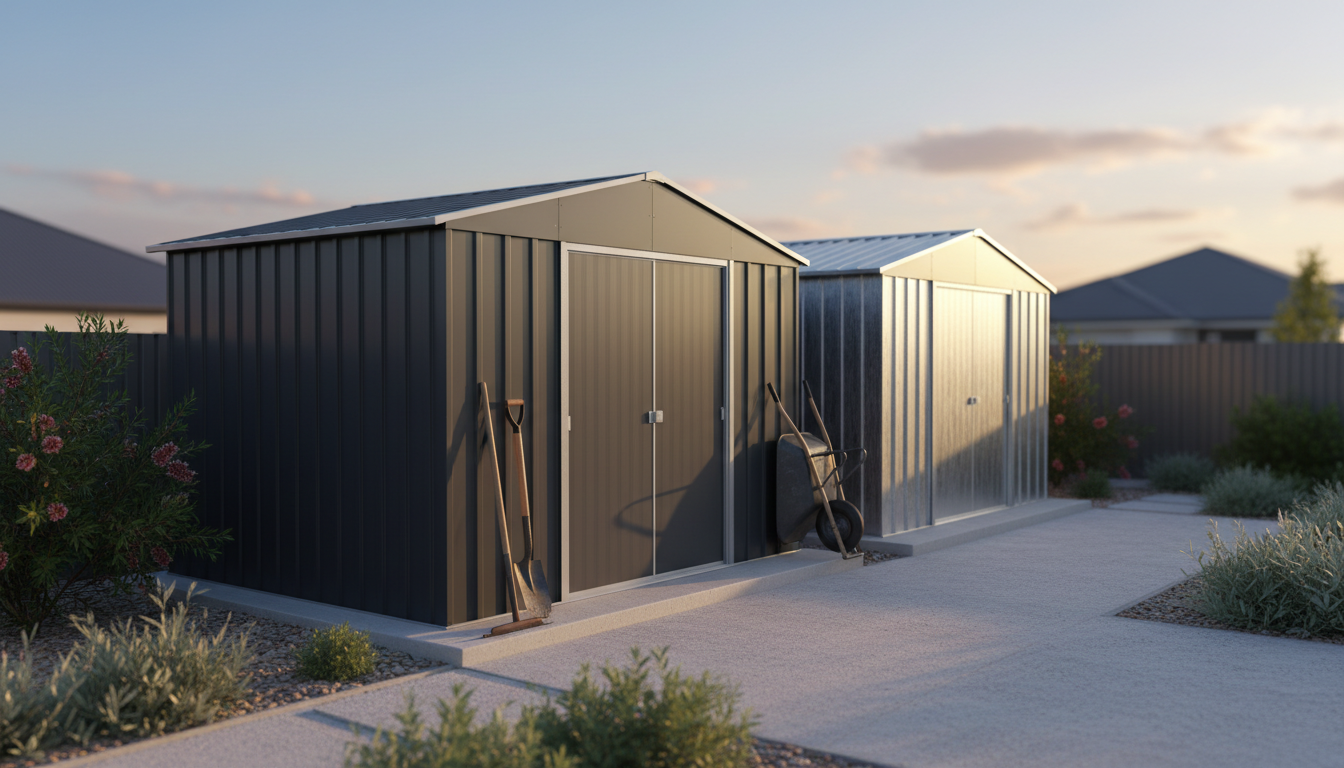
Your Australian guide to metal garden storage sheds
If you’re comparing steel garden sheds, steel frame storage sheds, or a fully custom metal shed storage building, this guide gives you the local knowledge to choose the right specification for Australian conditions—from Perth’s summer heat to QLD’s cyclonic winds and Tasmanian salt air. We cover garden sheds metal options, galvanised sheds, Colorbond finishes, council approvals, and wind ratings to AS/NZS standards.
What are the best shed materials for Perth’s climate?
For steel sheds Perth homeowners face high UV, summer heat, sea breezes, and occasional storms. A Colorbond steel shed with an insulated skillion or gable roof is the most popular choice thanks to UV stability and low maintenance. Zincalume can be ideal inland where you want value and don’t need colour. Coastal sites benefit from marine-grade fasteners and additional washing maintenance.
Those wanting a traditional look may prefer a Corrugated Garden Shed.
| Colorbond vs Zincalume — Which is better for WA conditions? | Colorbond | Zincalume |
|---|---|---|
| Heat resistance | Excellent UV stability; Solar Absorptance colours reduce heat gain | Reflective finish helps, but can be glary; paint if colour control needed |
| Corrosion (coastal) | Strong with correct maintenance and marine fasteners | Very good base corrosion resistance; still needs correct fasteners |
| Aesthetics | Wide colour range; matches custom Colorbond garages Perth | Metallic look; paintable if desired |
| Cost | $$–$$$ | $–$$ |
| Warranty | Typically strong, brand-backed when installed to spec | Strong base steel warranty; check installer details |
How durable are galvanised garden sheds versus Colorbond steel sheds?
Galvanised garden sheds (galvanised garden sheds, galvanised sheds) use zinc-coated steel that’s tough and budget-friendly. For premium aesthetics and UV performance, Colorbond steel garden sheds win. In coastal or high-moisture areas (e.g., Northern NSW, Tassie’s Derwent estuary), use marine-grade fixings, sealed flashings, and avoid unwashed salt zones under eaves.
- Best budget choice: galvanised steel shed kits
- Best long-term finish: Colorbond roof/walls with matching flashings
- High-moisture sites: consider hot-dip galvanised frames and sealed slab edges
Which size, roof style, and frame suits your backyard?
For a metal garden storage shed, start with what you’ll store now and in three years. Common sizes:
- Small (1.5 x 3 m): tools, bikes, bins
- Medium (3 x 3 m to 3 x 6 m): mowers, kayaks, workshop bench
- Large (6 x 6 m): hobby workshop or custom-built double garage in Perth
Another versatile option is the 10×6 Shed in Australia.
Roof styles:
- Skillion (mono-pitch): modern look; easy water runoff; great for solar
- Gable: classic look; central ridge ventilation; spans larger bays well
- Flat (low pitch): sleek, but ensure compliant drainage and box gutters
For steel frame storage sheds, look for:
- Rolled Z purlins and girts for strength-to-weight efficiency
- Wider bays (3–4 m) to reduce internal posts and maximise floor space
- Vermin flashing at slab edges and door thresholds
- High-tensile screws, cyclone plates or hold-downs where required
What wind rating does your shed need?
Australia’s wind regions and terrain categories determine your connection details, frame size, and sheet fixings. Non-cyclonic areas use N1–N5 ratings; cyclonic areas use C1–C4. In QLD’s coastal north and WA’s Pilbara, cyclone tie-downs and additional bracing are essential.
- AS/NZS 1170.2 governs wind actions; AS 4100 and AS/NZS 4600 cover steel design
- AS 1684 and local council design notes guide connections for ancillary structures
- Ask for site-specific certification from an RPEQ/RPEng or NER engineer
Added 2024 WA wind-rating compliance notes: For coastal and hilltop Perth sites, request terrain category assessment and shielding verification. Upgrade hold-down bolts and edge fixings per engineer’s schedule. This ensures council-approved sheds WA that pass inspections first time.
Do I need council approval for a garden shed in Australia?
Rules vary by state, size, and setbacks. Many small garden sheds are exempt or fast-tracked if under certain heights and areas, but wind region, bushfire overlays (BAL), flood, and easements can trigger approvals.
How to get council approval for your custom shed in WA
- Confirm exemption: In many WA councils, small sheds (e.g., under 10 m² and under height limits) may be exempt—check your LGA.
- Prepare documents: Site plan, slab details, elevations, engineering certification to AS/NZS 1170.2 and relevant standards.
- Check R-Codes setbacks: Ensure boundary offsets and open space compliance.
- Lodge BA submission: Include energy/insulation notes if required and a site-specific wind report.
- Book inspection: Footings/slab pre-pour, final fix, and possible stormwater inspection.
NSW, VIC, QLD quick notes
- NSW: Complying development may apply for small steel garden sheds for sale; check bushfire (BAL) mapping.
- VIC: Building permit often needed above 10 m² or near boundaries; check stormwater discharge rules.
- QLD: In cyclonic regions, cyclone-rated sheds QLD need engineer-certified tie-downs and door bracing; check local wind region maps.
Helpful resources: Housing Industry Association, Master Builders Australia, Bureau of Meteorology, Australian Steel Institute, CSIRO.
Metal garden storage shed options and pricing in Australia (2025)
- DIY shed kits (small, galvanised): $600–$1,500 installed by owner; add $800–$2,000 for a simple slab depending on size and site.
- Premium Colorbond garden sheds (3 x 3 m to 3 x 6 m): $2,500–$6,500 supply; $1,500–$4,000 install and slab depending on complexity.
- Portal-frame workshop or custom steel shed (6 x 6 m+): $9,000–$25,000+ supply; engineering, doors, glass, and electrical extra.
- Cyclone upgrades (C regions): +10–25% for stronger frames, more fixings, and wind-rated roller doors.
Concrete slabs typically $120–$180/m² (flat, easy access). Add for cut-and-fill, piers, or waffle pods. Prices depend on steel market conditions (see the “2025 Australian Steel Market Outlook”) and local labour availability (see the “2025 HIA Outdoor Structures and Home Improvement Report”).
DIY shed kits vs custom-built steel garden sheds
DIY shed kits are fast and economical for weekend warriors. Custom-built steel garden sheds for sale deliver better longevity, wind performance, and convenience—especially on sloping or tight-access sites.
- DIY shed kits: quick delivery, budget-friendly, ideal for small storage
- Custom-built: engineered to site, council handled, premium finishes, better resale
Use-cases and keyword clusters (so you find the right product)
- Backyard storage: metal garden storage shed, steel shed, garden sheds metal, garden shed frame
- Garages and carports: custom Colorbond garages Perth, affordable carports for Australian homes, custom carports Melbourne
- Rural and farm: rural sheds NSW, farm machinery storage, industrial sheds Brisbane
- Kits and deals: DIY shed kits, steel garden sheds for sale, steel storage sheds for sale, steel sheds for sale
- Technical: Colorbond vs Zincalume comparison, wind-rated sheds for cyclonic areas, council-approved sheds WA
Real-world examples (Australian conditions)
Perth, WA — Heat-ready 3 x 4.5 m Colorbond shed
Skillion roof to the south, light-colour Colorbond, anticon blanket, whirlybird, vermin flashing, and a 100 mm slab with mesh. Result: cooler summer temps and zero dust ingress.
Cairns, QLD — Cyclone-rated 3 x 3 m garden shed
C2 wind region design, extra roof and wall bracing, wind-rated roller door, upgraded hold-down bolts, and wider eaves. Passed council and insurance inspections without issue.
Central West NSW — Rural workshop 6 x 6 m Zincalume
Value-focused Zincalume cladding, Colorbond gutters for colour match, ample natural lighting with polycarbonate roof sheets, and 15A power for tools. Great bang-for-buck.
5-Step Buying Guide for Custom Sheds in Australia
- Define purpose: tools, bikes, hobby space, or farm machinery storage.
- Pick materials: Colorbond vs Zincalume based on climate, coastal exposure, and budget.
- Get wind rating: request N/C classification and engineering to AS/NZS 1170.2.
- Plan approvals: confirm exemptions or lodge plans for council-approved sheds WA or your state equivalent.
- Lock in build: choose DIY shed kits for simple jobs or a custom installer for turn-key delivery.
Installation tips from Australian shed pros
- Orient doors away from prevailing winds; add a concrete nib for door seals.
- Specify sarking or anticon to prevent condensation dripping onto tools.
- Use hot-dip galvanised post bases and M12–M16 anchors per engineering.
- Seal slab edges and install vermin flashing to keep pests out.
- For coastal sites, rinse cladding periodically to remove salt (unwashed areas).
Frequently asked questions
What thickness steel should I choose?
Cladding commonly ranges around 0.35–0.42 mm BMT for domestic sheds. Frames may use cold-formed C/Z sections sized by engineering. Ask for BMT (base metal thickness), not just TCT.
Is a flat roof okay in heavy rain?
Yes, if engineered. Ensure minimum pitch per manufacturer, adequate box gutters, and overflow provisions to AS/NZS 3500. Poor drainage voids warranties.
Can I add solar or water tanks?
Absolutely. Skillion roofs suit solar. Ensure the frame is checked for additional loads. For water, add first-flush diverters and leaf guards.
What about energy and sustainability?
Steel is recyclable. Light-colour Colorbond reduces heat gain. Consider roof insulation, LED lighting, and motion sensors. See Energy.gov.au for tips.
How long will it last?
With correct material choice, installation, and maintenance, a premium steel garden shed can easily deliver decades of service, even in high-UV or coastal locations.
Specifications checklist (what to put in your quote request)
- Dimensions (L x W x H), roof style (skillion, gable, or flat)
- Cladding: Colorbond or Zincalume; BMT and profile
- Frame: cold-formed C/Z purlins or RHS; portal frame spacing
- Wind rating (N/C), terrain category, shielding
- Doors/windows: wind-rated roller doors if in cyclonic regions
- Insulation: anticon or insulated panels; vents/fans
- Slab: thickness, reinforcement, termite management if required
- Gutters/downpipes and stormwater connection
- Coastal upgrades: fasteners, sealants, maintenance plan
For weather data and wind regions, check the Bureau of Meteorology. For design and compliance, consult the Australian Steel Institute and HIA. The latest market and demand insights are available in the 2025 Australian Steel Market Outlook and the 2025 HIA Outdoor Structures and Home Improvement Report.