
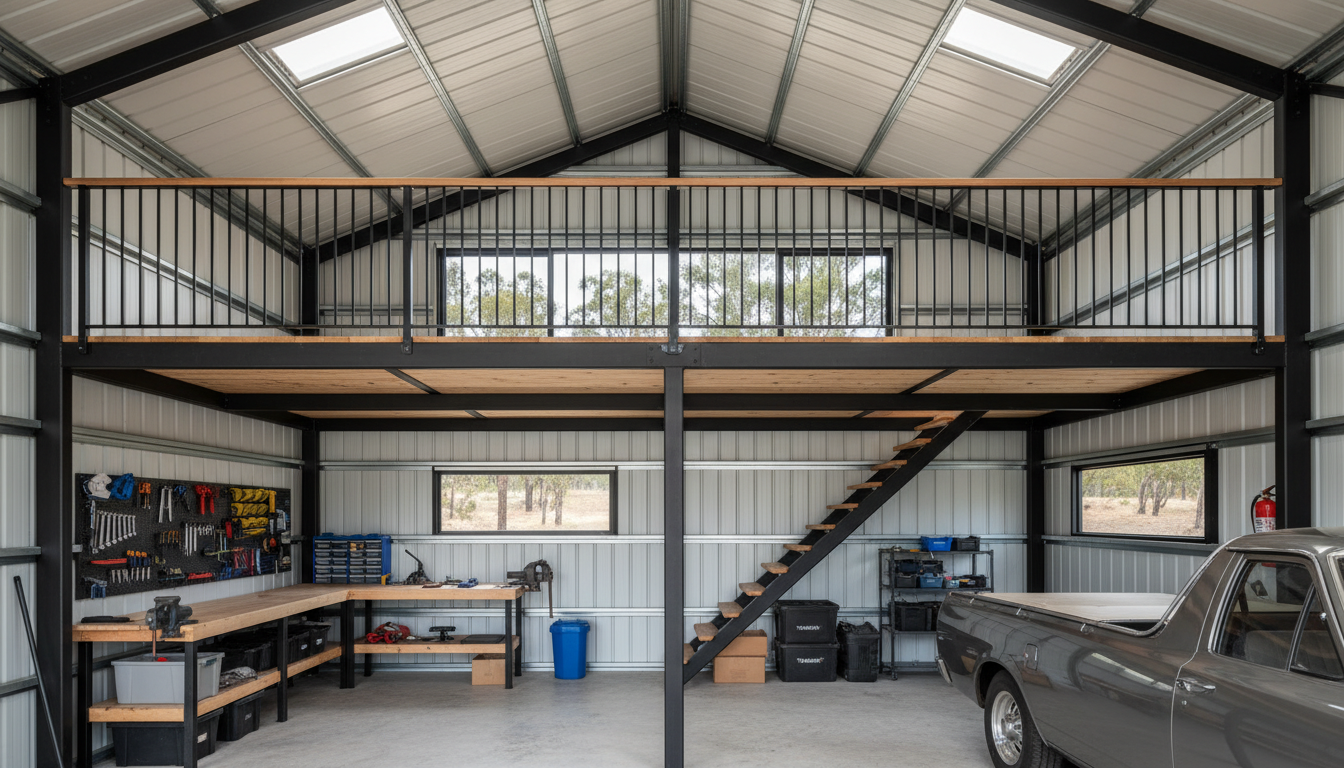
Whether you’re planning a custom-built double garage in Perth, a rural shed in NSW, or cyclone-rated sheds in QLD, a well-engineered mezzanine floor is the smartest way to double usable space without upsizing your footprint. Below, we cut through the noise with local, code-aware guidance you can act on.
Why add a mezzanine floor in a shed?
- Maximise cubic volume: Double the storage in the same Colorbond steel shed.
- Flexible use: Home office, farm machinery storage mezz, hobby loft, or archive platform.
- Future-proof: Build the portal frame for today, add the mezzanine when budget allows.
- Value uplift: Premium sheds with engineered mezzanines attract investors and buyers.
What are the best shed materials for Perth’s climate?
In hot, dry summers with coastal corrosion risk, most clients compare Colorbond and Zincalume cladding for steel sheds in Perth.
| Feature | Colorbond steel | Zincalume steel |
|---|---|---|
| Coating | Pre-painted, thermally efficient colours | Al-Zn alloy coating, unpainted |
| Heat performance | Excellent with light colours (solar reflectance) | Good bare, can be hot under peak sun |
| Coastal resistance | Very good with correct grade and detailing | Good, but frequent washing near coast is vital |
| Aesthetics | Premium look, matches house Colorbond roof | Industrial look, duller patina over time |
| Price | Typically higher | Typically lower |
| Best fit | Custom Colorbond garages Perth; urban/residential | Agricultural/rural sheds WA |
How much height do you need for a shed mezzanine?
Plan your wall height first. Comfortable “two-level” use generally needs:
- Clearance under mezzanine: 2.1–2.4 m for workshop use
- Clearance on mezzanine: 2.0–2.4 m (more if for office/“shed with mezzanine living” use)
- Structural depth (joists + flooring): 200–350 mm typical
Most garage with mezzanine projects end up with 4.5–5.4 m eave height and a portal frame designed for future mezz loads.
Do you need council approval for a mezzanine in a shed?
Usually, yes. A mezzanine can change classification, loads, and egress. You’ll need certified engineering, plans, and often a building permit. “Livable barn sheds with mezzanine floors” introduce fire, ventilation, and energy efficiency requirements under the NCC.
How to Get Council Approval for Your Custom Shed in WA
- Confirm classification: Most sheds are Class 10a. Adding office/studio can trigger Class 1a/5 issues.
- Engineering: Obtain certified drawings to AS/NZS 1170.0/1 (loads), 1170.2 (wind), AS 4100/AS/NZS 4600 (steel), and slab design to AS 2870.
- Site wind rating: Added 2024 WA wind-rating compliance notes — Coastal and northern WA may require Region C/D design; Perth metro is typically Region A (N2/N3 non-cyclonic). Confirm via your engineer and local council.
- LOD pack: Submit site plan, elevations, sections, connection details, and manufacturer specs (e.g., shed mezzanine kit data).
- Build permit: Coordinate inspections and final certification via a registered building surveyor.
QLD and cyclonic areas
For cyclone-rated sheds QLD (Regions C/D), expect upgraded fixings, tighter portal frame spacing, and specific cladding fasteners. Verify tie-down, hold-down bolts, and sheeting to suit C2/C3 categories.
NSW, VIC and other states
Rural sheds NSW often allow larger footprints, but mezzanines for “shed with mezzanine living” face energy, fire and egress rules. In Victoria, check bushfire (BAL) overlays and setback distances for outbuildings before committing to design.
What codes, loads and engineering apply to shed mezzanines?
Live loads (AS/NZS 1170.1)
- Light storage and access: around 2.0–2.5 kPa
- Office on mezzanine: around 3.0 kPa
- Heavy storage / archive: 4.0–5.0 kPa or more
Your engineer will select purlin/joist sizes, RHS beams, and post spacing based on loads and span.
Wind actions (AS/NZS 1170.2)
- Regions A/B: Non‑cyclonic (most of southern Australia)
- Regions C/D: Cyclonic (QLD coast, NT, north-west WA)
- Importance Level 1–2 typically applies for sheds; confirm site terrain and shielding.
Stairs, handrails and balustrades (NCC)
- Balustrade height: generally ≥ 1.0 m; openings under 125 mm
- Stair risers 115–190 mm; goings 240–355 mm; consistent across flight
- Minimum headroom, landings and slip resistance apply to habitable use
Fire and egress
- Habitable mezzanine may require smoke alarms, escape route widths, and fire separation to boundaries
- Non-habitable storage platforms still require safe access and guarding
What are my options: shed mezzanine kit vs custom-built?
| Option | Pros | Cons | Best For |
|---|---|---|---|
| Shed mezzanine kit (DIY shed kits) | Fast, cost-effective, standard spans; simple bolted connections | Fixed sizes; limited load ratings; less flexible for openings and stairs | Homeowners adding light storage to steel sheds Perth |
| Custom-engineered mezzanine | Tailored spans, higher UDLs, integrates with portal frame and bracing | Higher design cost; longer lead time | Council-approved sheds WA, custom carports Melbourne with integrated lofts |
| Retrofitting a mezzanine | Uses existing structure; staged budgeting | Frame may need strengthening; slab checks required | Existing rural sheds NSW and American barn sheds |
Shed mezzanine ideas Australians love
- Raised farm machinery storage platform with pallet gate
- Studio office with insulated walls in a Colorbond skillion, south-facing window strip
- Surfboard/gear loft in a coastal Zincalume garage (salt-mist rinsing regime)
- American barn shed with central high bay and side mezzanine wings
- Garage with mezzanine and hoist clearance under for track car projects
Flooring and finishes that perform
- Floor sheets: Structural plywood, yellow-tongue particleboard, or CFC for wet areas
- Steelwork: Hot-dip galvanised posts and stair stringers in coastal zones
- Lighting: LED high-bays below; batten lights above; sensor option on stairs
- Insulation: Roof blanket + anticon; wall batts where office use is planned
- Access: Straight flight, L-shaped, or compact spiral (check NCC compliance)
Case studies (real-world build types)
Bunbury, WA — custom-built double garage with mezzanine
Brief: Park two vehicles with a 20 m² mezzanine for camping gear. Solution: Colorbond Ultra cladding for coastal proximity, portal frames predrilled for future extension, stair with mid-landing to maintain headroom. Outcome: Tidy storage above, clear 2.3 m under for bonnet-up access.
Central West NSW — rural shed with mezz and tractor bay
Brief: Farm machinery storage with seasonal archive loft. Solution: Zincalume exterior, heavy-duty UDL mezzanine over workshop side only, pallet-lift opening with lockable gate, ventilation louvres. Outcome: Flexible layout that keeps the wide-span shed clear for the tractor.
Only need short-term cover before you build? Compare tents vs steel options in our portable garage buyer’s guide to decide what fits your timeline and wind rating.
5-Step Buying Guide for Custom Sheds in Australia
- Pick the right shell: Gable vs skillion, bay spacing, roller door heights to suit your vehicles and future mezz height.
- Decide the mezz purpose: Light storage, office, or potential “shed with mezzanine living” — load ratings and services follow.
- Engineer early: Design portal frames, bracing and slab thickening for mezz loads even if you stage the build.
- Check wind and corrosion: Wind-rated sheds for cyclonic areas and coastal material upgrades protect your investment.
- Approval and delivery: Line up council-approved drawings, lead times, and installation schedule around weather windows.
Planning the shell and roof style goes hand in hand with your mezz layout—see our modern garage in Australia guide for roof forms, door choices and approvals that pair neatly with future mezzanines.
Common FAQs about mezzanines in sheds
Will my existing slab take a mezzanine?
Possibly. Engineers check thickness, reinforcement, loads at posts and footings. Many retrofits add pad footings or spreaders.
Can I live in my shed mezzanine?
“Shed with mezzanine living” triggers NCC energy, fire, light/ventilation, and plumbing rules. Discuss with your certifier before design freeze.
What about termites and corrosion?
Use termite management where required (especially QLD/NSW). In coastal areas, specify hot-dip galvanised steel, sealed cut edges, and regular wash-downs to prevent galvanic corrosion.
Do I need stairs or can I use a ladder?
For anything beyond occasional access, a compliant stair with balustrade is recommended and often required. Ladders are for infrequent maintenance access only.
Local factors that matter to performance and compliance
- Perth heat: Light Colorbond colours, ridge/whirly ventilation, and insulation improve comfort and energy efficiency.
- QLD cyclones: Specify cyclone-rated sheds QLD with certified fixings and cladding patterns; consider enclosed vs partially enclosed design per AS/NZS 1170.2.
- Southern states: Condensation control with vapour-permeable wraps and adequate airflow reduces mould risk in enclosed mezzanines.
Technical term quick references
Planning checklist (before you order)
- Confirm site wind region and terrain category
- Choose cladding system (Colorbond vs Zincalume comparison)
- Nominate mezzanine UDL and intended use
- Set stair position and headroom zones early
- Coordinate power, data, and lighting both under and over the mezz
Keyword clusters (to help you find the right product)
- Local builds: steel sheds Perth, custom Colorbond garages Perth, council-approved sheds WA
- Climate designs: wind-rated sheds for cyclonic areas, cyclone-rated sheds QLD, coastal sheds with galvanised frames
- Use-cases: barn style shed, American barn sheds, farm machinery storage, garage with mezzanine, shed mezzanine ideas
- Procurement: DIY shed kits, shed mezzanine kit, affordable carports for Australian homes, custom carports Melbourne, rural sheds NSW
- Technical: Colorbond vs Zincalume comparison, portal frame design, bolted connections, insulated roof panels
What the industry says (resources)
For up-to-date guidance on loads, wind, and materials, consult:
- Housing Industry Association (HIA) for building practice and approvals
- Master Builders Australia for local compliance and training
- Bureau of Meteorology for regional wind and climate insights
- Australian Steel Institute for steel design references
- Energy.gov.au for insulation and thermal performance basics
Note: Industry outlooks (e.g., “2025 Australian Steel Market Outlook”, “2025 HIA Outdoor Structures and Home Improvement Report”) indicate steady demand for engineered steel sheds and outdoor structures. Confirm specifics with your supplier or consultant.