
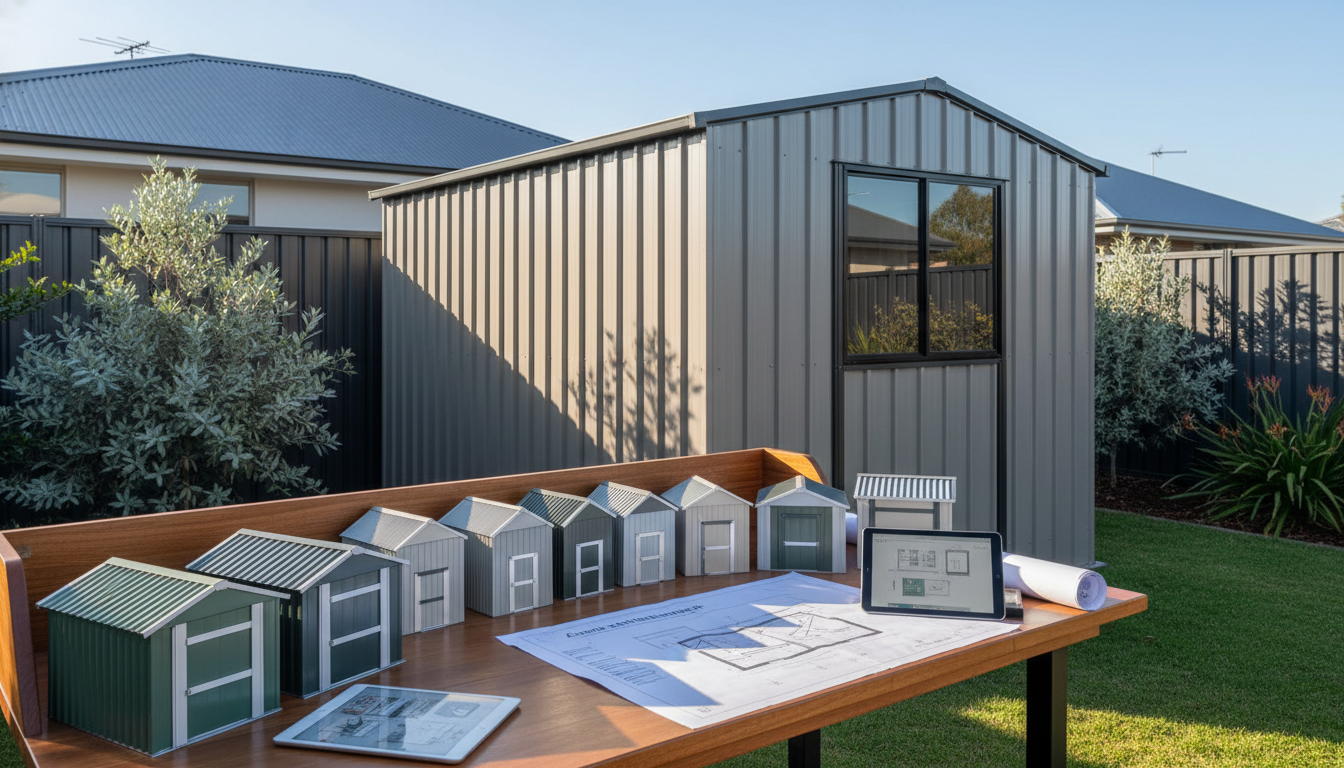
Premium miniature shed options for Australian homes and gardens
A compact, well-engineered miniature shed (typically 1.2–3.0 m wide) can declutter your home, protect tools, and lift street appeal. This guide compares materials, wind ratings, council rules, and design choices—so you get a durable, neat, and compliant miniature garden shed that suits your site and budget.
- Colorbond: Pre-painted steel by BlueScope, engineered for Australian conditions and available in a wide colour palette.
- Zincalume: Aluminium/zinc coated steel, unpainted, known for corrosion resistance and value.
- Wind Region (AS/NZS 1170.2): A, B (non-cyclonic), C, D (cyclonic). Determines tie-downs and frame design.
- Terrain Category: Surroundings that affect wind speed at your site (open country vs suburban).
- Importance Level: Building risk class that influences design loads. Small domestic sheds are typically IL 1–2.
What exactly is a miniature shed and why choose one?
Miniature sheds maximise storage on tight blocks, courtyards, and strata lots. Popular uses include lawn gear, bikes, pool equipment, bins, camping gear, and as a discrete pump or meter enclosure. A custom Colorbond steel shed for regional WA or metro Brisbane resists sun, rain, and pests while keeping gear tidy and secure.
- Typical footprints: 1.5 x 0.8 m, 2.3 x 1.2 m, 3.0 x 1.5 m
- Heights: 1.8–2.4 m (check boundary height limits and overshadowing)
- Form factors: slimline against a fence, corner units, low-profile pump covers
What Are the Best Shed Materials for Perth’s Climate?
Perth’s hot summers, coastal salt exposure, and high UV punish poor coatings. For a miniature garden shed in WA, most homeowners choose Colorbond for colour stability and heat-reflective options, or Zincalume for a value-first finish in inland suburbs.
Colorbond vs Zincalume — Which Is Better for WA Conditions?
| Factor | Colorbond Steel | Zincalume Steel |
|---|---|---|
| Coating/Finish | Pre-painted; multiple layers for UV and corrosion resistance | Aluminium/Zinc alloy metallic coating; unpainted |
| Heat/UV Performance | Cooler colours reduce heat gain; stable colour over time | Reflective when new; may dull; can be hotter internally |
| Coastal Suitability | Good with standard maintenance; upgrade to Ultra near surf | Good general corrosion resistance; still needs washdowns |
| Aesthetics | Colour-matched to home (Monument, Surfmist, etc.) | Industrial look; can be painted later if desired |
| Cost | Higher upfront; strong resale appeal | Lower upfront; great value for utility areas |
| Best For | Street-facing, design-led installs; harsh sun | Hidden service yards; budget-driven installs |
How do wind ratings and building codes affect your miniature shed?
Even small sheds must be engineered for local wind loads and tie-downs. In Australia, wind design follows AS/NZS 1170.2; steel members and connections follow AS 4100 or AS/NZS 4600; sheeting follows AS 1562.1; base steel grade is covered by AS 1397. In metro areas, expect non-cyclonic ratings (N2–N3). In North QLD and parts of WA, cyclonic (C2–C3) applies.
Added 2024 WA wind-rating compliance notes Ensure your shed supplier provides site-specific engineering for WA regions (Geraldton, Karratha, Broome). Ask for wind region, terrain category, shielding, and topography effects on your certificate. Proper anchor details (chem-set bolts, embedment depth) are critical for paving or slab installs.
How to Get Council Approval for Your Custom Shed in WA
- Confirm zoning and R-Codes setbacks on your lot. Many miniature sheds under set size/height may be exempt, but check local planning policies.
- Collect documents: site plan with distances to boundaries, shed elevations, colour schedule, and engineering.
- Lodge a Building Permit (BA2/BA1) if required; some councils fast-track minor structures within 10–20 working days.
- Coastal or bushfire areas: provide corrosion notes and BAL compliance where applicable.
- Strata or estate covenants may require prior written approval.
Not in WA? NSW Exempt Development and Victorian building regulations have similar thresholds—always verify your dimensions and location before ordering.
Does a miniature garden shed need a slab and footings?
- Best practice: 100 mm reinforced slab-on-ground with thickened edges and galvanised hold-downs.
- Alternatives: Chem-set anchors into existing concrete or engineered piers for soft soils.
- Add vermin-proof flashing and damp-proof membranes, especially for food or linen storage.
What custom features add value on compact sites?
- Roof profiles: skillion (low profile), gable (classic look), or flat with slight fall to the rear.
- Doors: double swing, single hinged PA door, or compact roller door for bikes and prams.
- Security: key-locks, concealed rivets, internal bracing, and anti-jemmy door hardware.
- Weathering: scribed flashings, quality sealants, and oversized gutters with 90 mm downpipes to rain barrels.
- Comfort: insulated roof/walls, anticon blanket, whirlybirds, louvres, and polycarbonate skylights with UV protection.
- Finishes: Colorbond colour matching to fences and facias; powder-coated trims for coastal zones.
Flat roof vs gable vs skillion — which suits a miniature shed?
| Roof Type | Pros | Considerations | Best Use |
|---|---|---|---|
| Flat/Low Fall | Lowest visual bulk; easy near fences | Needs good waterproofing and fall | Narrow side yards |
| Skillion | Modern look; simple drainage; easy solar orientation | Taller on high side; check boundary height | Court yards; contemporary homes |
| Gable | Classic profile; more headroom | Higher ridge; more visible | Street-facing installs |
DIY shed kits vs custom-built: what’s better for a miniature shed?
| Aspect | DIY Shed Kits | Custom-Built (Supply & Install) |
|---|---|---|
| Cost | Lowest upfront; great for simple pads | Higher, includes labour and compliance support |
| Speed | Weekend-friendly if you’re handy | Fast; pro crew handles tricky sites |
| Quality Control | Depends on your tools and accuracy | Factory-cut, square, plumb, and warranted |
| Compliance | May need to source your own engineering | Site-specific engineering and permits handled |
| Best For | Flat sites; non-cyclonic; simple layouts | Sloped/coastal/cyclonic sites; zero-boundary work |
Real Australian builds and pricing snapshots (2024–2025)
Pricing varies by region, wind rating, access, and footing design. The 2025 HIA Outdoor Structures and Home Improvement Report notes steady demand for small steel structures despite material volatility. Use these as ballpark guides only.
- Perth metro (non-cyclonic N2): 2.4 m x 1.2 m skillion, Colorbond Monument, slab-on-ground with vermin flashing, PA door. Supply-only: ~$1,250–$1,650; Installed with slab: ~$2,800–$3,800.
- Cairns (cyclonic C2): 2.4 m x 1.5 m gable, heavy-duty frame, cyclonic screw patterns, upgraded anchors. Supply-only: ~$1,950–$2,450; Installed with engineered slab: ~$4,200–$5,600.
- Wollongong coastal: 3.0 m x 1.5 m skillion, Zincalume with coastal maintenance plan, whirlybird. Supply-only: ~$1,450–$1,900; Installed: ~$3,300–$4,300.
For value-adding projects, investors often coordinate matching finishes across custom Colorbond garages Perth, council-approved sheds WA, and small garden storage for a cohesive look.
How to maintain a Colorbond miniature shed in Aussie conditions
- Hose down quarterly; coastal sites: fortnightly wash for sea spray.
- Check anchor bolts annually; re-tension if needed.
- Clean gutters; fit leaf guards if under trees.
- Lubricate door hinges/rollers; replace worn seals.
- Inspect for ground contact and install a perimeter termite barrier where required.
5-Step Buying Guide for Custom Sheds in Australia
- Confirm site rules: height, boundary offsets, and services routes. Photograph the area and measure accurately.
- Choose materials: Colorbond for looks and heat control; Zincalume for budget utility. Select roof profile and colour early.
- Engineer for wind: get N/C wind rating, terrain, and tie-down details in writing. Request AS/NZS-compliant drawings.
- Decide install path: DIY shed kits for simple sites; supply-and-install for cyclonic, coastal, or zero-lot boundaries.
- Lodge approvals if needed: attach site plan, elevations, engineering certificate, and neighbour consent if required.
FAQs about miniature sheds in Australia
Do I need council approval? Many miniature sheds are exempt if they meet size, height, and boundary rules. However, heritage, coastal, flood, or bushfire overlays can trigger permits. Always check with your local council.
What wind rating should I ask for? Ask for your site’s AS/NZS 1170.2 wind region (A/B/C/D) and category (N2, N3, C2, etc.). Suppliers should provide a site-specific certificate, not a generic brochure.
Are sheds OK in BAL zones? Yes, with BAL-aware materials and detailing (metal mesh vents, ember seals). Confirm with your certifier.
Can I put a shed against a fence? Usually you need setbacks and height limits. Waterproofing and roof fall must not discharge to neighbours.
How long does installation take? Simple kits: 3–6 hours once the slab cures. Custom installs: 1–2 days including fit-off.
What about warranties? Typical sheet warranty 10–20 years (environment-dependent). Keep maintenance records to preserve coverage.
Use-cases and keyword clusters to guide your choice
- Metro upgrades: steel sheds Perth; council-approved sheds WA; custom Colorbond garages Perth.
- East coast options: custom carports Melbourne; metal garages Sydney; DIY shed kits; affordable carports for Australian homes.
- Regional/rural: rural sheds NSW; farm machinery storage add-ons; wind-rated sheds for cyclonic areas; cyclone-rated sheds QLD.
- Technical: Colorbond vs Zincalume comparison; insulated panel roofing; anti-condensation blankets; vermin-proofing; rainwater harvesting from shed roofs.
Standards, climate data, and further reading
- AS/NZS 1170.2, AS 4100, AS/NZS 4600, AS 1562.1, AS 1397 — request these on your engineering certificate.
- Bureau of Meteorology climate and wind region maps: see official resources for cyclonic zones (external) BOM maps.
- Housing Industry Association guidance on small structures (external) HIA advice.
- CSIRO research on corrosion and coastal exposure (external) CSIRO materials.
- Australian Steel Institute for material specifications (external) ASI resources.
- Energy.gov.au on cool roofs and heat management (external) Energy efficiency.
Market context: “2025 Australian Steel Market Outlook” and “2025 HIA Outdoor Structures and Home Improvement Report” indicate stable small-structure demand, with coastal and cyclonic upgrades growing in share.