
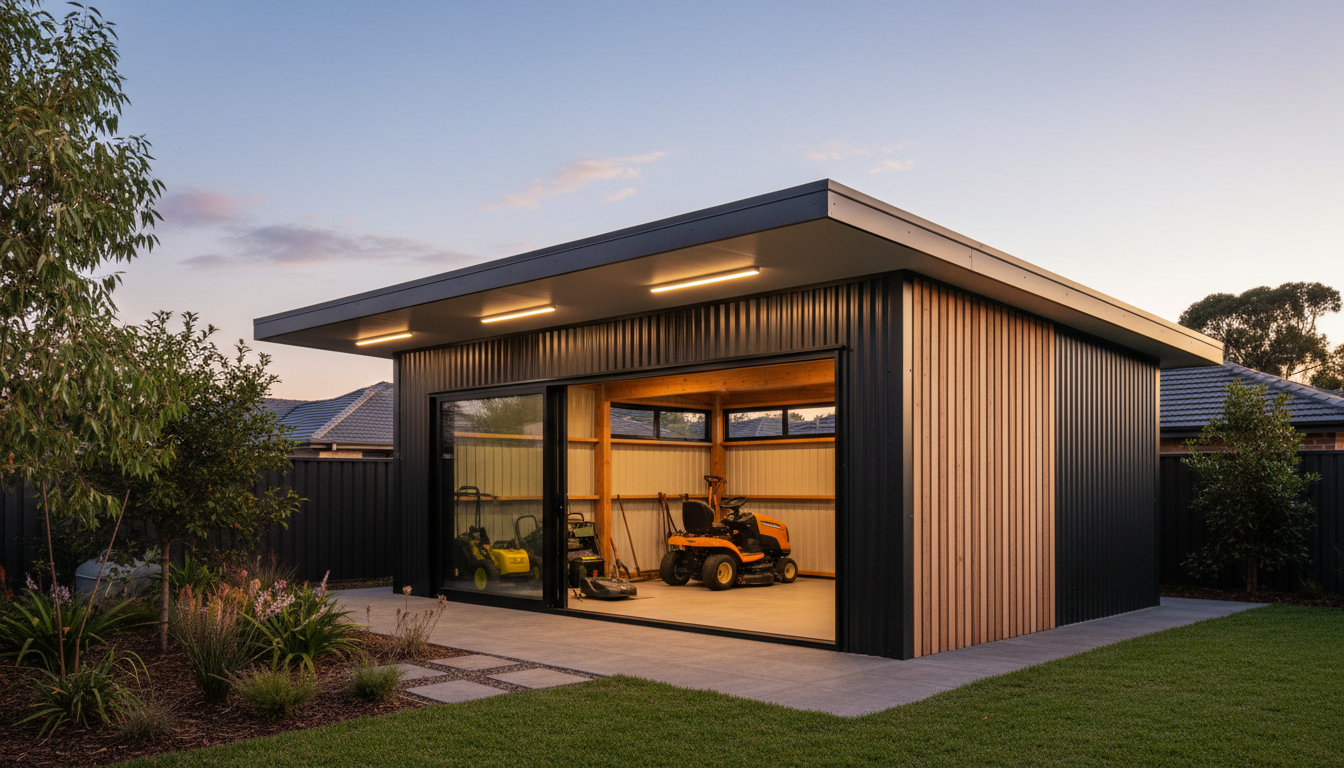
Aussie Buyer’s Guide to Premium Mower Sheds and Lawn Locker Storage
Need a mower shed that’s tough, compliant, and built for Australian conditions? This guide distils what busy homeowners, renovators, and property investors need to know—materials that survive WA heat and salt, cyclone ratings for QLD, council approvals, and smart layouts for safe, tidy outdoor lawn mower storage. If you’re also comparing larger garages, carports and workshop sheds, see our Industrial Buildings in Australia: 2025 guide.
What Are the Best Shed Materials for Perth’s Climate?
For Perth and coastal WA, the industry standard is a Colorbond steel shed with galvanised cold-formed framing (C-sections and Z-purlins). Colorbond resists fade, chalking, and corrosion better than generic cladding, and comes in popular colours like Monument, Surfmist, and Woodland Grey. Zincalume (aluminium-zinc coated) is very cost-effective for inland sites, but coastal spray and windborne salt can shorten its life compared with Colorbond Ultra or Stainless near surf.
Colorbond vs Zincalume — Which Is Better for WA Conditions?
| Criteria | Colorbond (incl. Ultra) | Zincalume |
|---|---|---|
| Coastal corrosion resistance | Excellent (choose Ultra/Stainless within a few hundred metres of surf) | Good inland; fair to poor very close to marine |
| Heat reflectance (summer) | High with light colours; Thermatech solar reflectance helps | Moderate (unpainted finish can get hot) |
| Colour range | Wide (Classic, Matt, Ultra) | None (metallic grey) |
| Warranty | Strong warranties when installed to spec | Strong for inland uses to spec |
| Price | Higher upfront | Lower upfront |
| Best fit | Coastal suburbs, premium homes, visible locations | Rural inland, budget builds, hidden locations |
Related: See the Australian Steel Institute for local guidance and the latest “Australian Steel Market Outlook”. Also compare the coating performance statements from BlueScope and independent testing via CSIRO.
How Big Should Your Mower Shed Be?
Right-size your lawn mower storage shed by measuring the machine with catcher/attachments, plus safe walking and turning clearance. Common formats:
- Lawn locker shed (little shed): 1.5 × 0.8 m to 2.3 × 0.9 m for push mowers and hand tools. Slim and low profile.
- Mower storage shed (standard): 3 × 2.3 m to 3 × 3 m for a mower, fuel locker, trimmer rack, and shelves.
- Ride-on mower shed: 3.6 × 3 m to 6 × 4 m with double doors, 2.1–2.4 m opening height, and a ramp.
Allow a 1:8 to 1:10 ramp gradient for ride-ons. Add wall racks for trimmers, blowers, and PPE. Specify a ventilated, lockable mower shed to safely store fuel and batteries (segregate flammables in a cabinet).
Which Roof Style Works Best in Your Area?
- Skillion (mono-pitch): Clean look, fast water run-off, ideal for boundary setbacks. Great for steel sheds Perth where space is tight.
- Gable: Classic look, better cross-ventilation, often more headroom for racking.
- Flat: Only for small little sheds and lockers; ensure adequate falls to gutters.
In high-wind or cyclonic areas, higher pitches and additional bracing may be required. Ask for engineering to AS/NZS 1170.2 (Wind Actions).
Do You Need Council Approval or Engineering?
Most mower sheds are Class 10a structures under the NCC. Small lawn locker sheds may be exempt in some LGAs, but larger structures or anything near boundaries typically need approval. Always check setbacks, site coverage, height limits, and stormwater requirements.
How to Get Council Approval for Your Custom Shed in WA
- Confirm zoning and exemptions: Check your LGA website for outbuilding rules (size, height, cladding). Search for council-approved sheds WA.
- Engineering: Request site-specific wind design to AS/NZS 1170.2 and footing design to AS 2870. Include frame layout, hold-downs, and slab details.
- Documentation: Provide site plan, elevations, specs, and stormwater plan. In WA, building permit is via BA1 (certified) or BA2 (uncertified).
- Submission & inspections: Your builder or certifier lodges, organizes inspections if required, and supplies certificates on completion.
Added 2024 WA wind-rating compliance notes — New estates around the coastal fringe may trigger higher wind pressures; engineers increasingly specify extra roof battens, closer screw spacing, Class 4 fasteners, and upgraded door bracing.
Reference planning/building resources and typical approval timelines via HIA and your local council portal.
Fast-Track Tips for QLD and NSW
- QLD: In Regions C/D, insist on cyclone-rated sheds QLD with certified tie-downs, bracing, and wind locks for roller doors.
- NSW: Check exempt development thresholds for rural sheds NSW; bushfire overlays may apply (see AS 3959 BAL ratings).
What Wind Rating and Footings Do You Need?
Wind design uses AS/NZS 1170.2 (Wind Regions A, B, C, D), considering terrain, shielding, and topography. Many suburban sites are Region A/B; coastal north QLD and parts of WA are Region C/D. Housing wind classes (N2–N4, C1–C4) under AS 4055 guide comparable pressures.
Footings and Slabs that Pass Inspection
- Slab-on-ground: Typically 100–120 mm thick with edge thickenings; MPA per engineer; to AS 2870. Include damp-proof membrane and termite management (AS 3660) where required.
- Piers/post footings: For sloping or reactive sites. Engineer will specify depth/diameter and hold-down rods.
- Anchors: M12–M16 galvanised chemical anchors or cast-in bolts with washers/plates as per design.
- Fasteners: Use Class 4 roofing screws near coast; stainless in severe marine zones.
Cyclone-Rated Sheds: What Changes in QLD and WA North?
- Closer purlin/batten spacing and heavier gauge sheeting.
- Extra diagonal bracing to walls and roof planes.
- Door wind-locks, stronger jambs, and mullions.
- Upgraded hold-downs and strap bracing from rafters to slab/pier.
Check current wind maps via the Bureau of Meteorology and confirm design via a structural engineer or shed manufacturer.
DIY Shed Kit or Custom-Built — Which Is Better?
Both can be compliant if engineered and installed correctly. Choose based on budget, time, and complexity.
| Factor | DIY Shed Kits | Custom-Built Installation |
|---|---|---|
| Upfront cost | Lower (good for DIY shed kits, shed kits Brisbane) | Higher, but includes labour and project management |
| Time | Weekend to multi-day build | Professional crew: fast, clean handover |
| Risk | Incorrect fixings or square can void warranty | Backed by installer warranty and compliance checks |
| Complexity | Best for small lawn mower sheds/lockers | Ideal for cyclonic, sloped sites, or add-ons |
| Customisation | Limited options | High: doors, windows, insulation, vermin seals |
Need more space later? Consider a lean-to bay for tools or a custom carport extension for trailers—popular in custom carports Melbourne and suburban Perth.
How Much Does a Quality Mower Shed Cost in 2025?
Budgets vary with size, wind rating, slab, and finishes. Recent Australian steel pricing and demand trends (see HIA and ASI 2024–2025 updates) influence final costs.
- Lawn locker shed: From approx. $450–$1,100 supplied; add anchoring.
- 3 × 2.3 m mower shed kit: From approx. $1,600–$3,200 supplied; $1,000–$2,500 install depending on slab and access.
- Ride-on mower shed (e.g., 6 × 4 m): From approx. $4,500–$9,000 supplied; $3,000–$6,000 installed and slab, subject to wind rating.
Note: Prices are indicative only. Always request a fixed, itemised quote that references engineering and wind region. The Energy.gov.au site has useful content on passive cooling and insulation that can influence long-term running comfort.
Where Have We Built Mower Sheds Lately? (Case Studies)
Perth, WA — Compact Skillion Mower Shed in Colorbond Matt
Joondalup homeowner with a small side setback. We supplied a 3 × 2.3 m skillion lawn mower shed in Colorbond Matt Monument, vermin seals, and a 1.2 m hinged door. Engineered to Region B; slab by client. The same client later commissioned custom Colorbond garages Perth for a double-bay upgrade.
Townsville, QLD — Cyclone-Rated Ride-On Storage
6 × 4 m mower storage shed for a zero-turn ride-on. Region C engineering, door wind-lock kit, Class 4 fixings, and extra bracing. The ramp was poured with broom finish for grip. A simple whirlybird plus eave vents keep fumes moving.
Dubbo, NSW — Rural Workshop Bay + Mower Niche
Rural client wanted farm machinery storage with a dedicated mower bay. We added a 3 m lean-to, sliding doors, and a fuel cabinet enclosure. Designed for BAL-12.5 using Colorbond; gutters directed to existing tanks. For farm‑scale layouts, wind ratings and access planning, see our machinery shed guide.
What Are the Must-Have Options for a Mower Shed?
- Doors: 1.2 m hinged or 2.4 m double; roller door with wind-locks in higher wind regions.
- Security: Quality lockset, anti-jemmy jambs, internal sheeting around locks.
- Ventilation: Louver or eave vents; whirlybird for ride-ons and fuel storage.
- Flooring: Sealed concrete slab with falls to doorway; sump if storing fuels.
- Electrical: Weatherproof GPOs and LED batten; RCDs to AS/NZS 3000 by a licensed electrician.
- Gutters & drainage: Proper falls to downpipes; connect to stormwater or tanks.
Pro Tip: Did you know using insulated roof panels can reduce internal shed temperatures by up to 10°C in summer? Combine light-colour roofing (e.g., Surfmist) with ridge/soffit ventilation for best results.
5-Step Buying Guide for Custom Sheds in Australia
- Define use and size: Measure your mower with attachments; plan shelves, racks, and fuel cabinet.
- Choose materials: Colorbond for coastal/visible sites; Zincalume for inland budgets.
- Confirm compliance: Get site-specific engineering to AS/NZS 1170.2, footing design to AS 2870, and check BAL, flood, and overlays.
- Get quotes: Compare a DIY kit vs turnkey install, warranty terms, and lead times. Ask about wind-rated sheds for cyclonic areas if relevant.
- Plan delivery and install: Clear access, slab curing, and book licensed tradies. Keep manuals and certificates for resale value.
FAQs About Mower Sheds
Do I need a slab, or can I go with pavers?
A reinforced concrete slab is best for ride-ons and safe anchoring. Anchored pavers can work for small lawn locker sheds, but may not meet engineering in higher winds.
What about storing fuel and lithium batteries?
Use a ventilated space and a metal flammable storage cabinet for petrol. Store lithium mower batteries per manufacturer guidance, away from heat and direct sun.
What colours stay cooler?
Lighter Colorbond colours with high solar reflectance (e.g., Surfmist) reduce heat load. Include roof insulation and vents for the biggest gains.
How long does installation take?
Lockers: half a day. 3 × 3 m sheds: 1–2 days. Larger or cyclonic jobs: 2–4 days, plus slab cure time.
Do you handle council approvals?
Yes—ask for a turnkey package with engineering, plans, and submissions. That’s the quickest way to a compliant result in WA, QLD, NSW, and VIC.
What if I live near the beach?
Specify Colorbond Ultra or Stainless, upgrade fasteners to Class 4 or stainless, and rinse the shed periodically to remove salt.
Can you match other structures?
Yes. We regularly match house roofs and install complementary structures such as affordable carports for Australian homes, custom-built double garage in Perth, or custom carports Melbourne.
Keyword Clusters We Specialise In
Mower shed; lawn mower shed; lawn mower storage shed; mower storage shed; outdoor lawn mower storage; lawn locker shed; steel sheds Perth; custom Colorbond garages Perth; rural sheds NSW; shed kits Brisbane; wind-rated sheds for cyclonic areas; Colorbond vs Zincalume comparison; farm machinery storage; DIY shed kits; custom carports Melbourne; gable roof shed; skillion roof shed; cyclone-rated sheds QLD; council-approved sheds WA.
Standards, Climate, and Industry References
- Housing Industry Association (HIA) — Outdoor structures guidance
- Bureau of Meteorology — Local wind and climate data
- CSIRO — Bushfire Attack Level (BAL) information
- Australian Standards — AS/NZS 1170.2, AS 2870, AS 3959, AS 4100, AS/NZS 4600
Recent national commentary from the “2025 HIA Outdoor Structures and Home Improvement Report” and the “2025 Australian Steel Market Outlook” indicate ongoing demand for durable, engineered steel sheds and carports. Always confirm site-specific requirements with your engineer and council.