
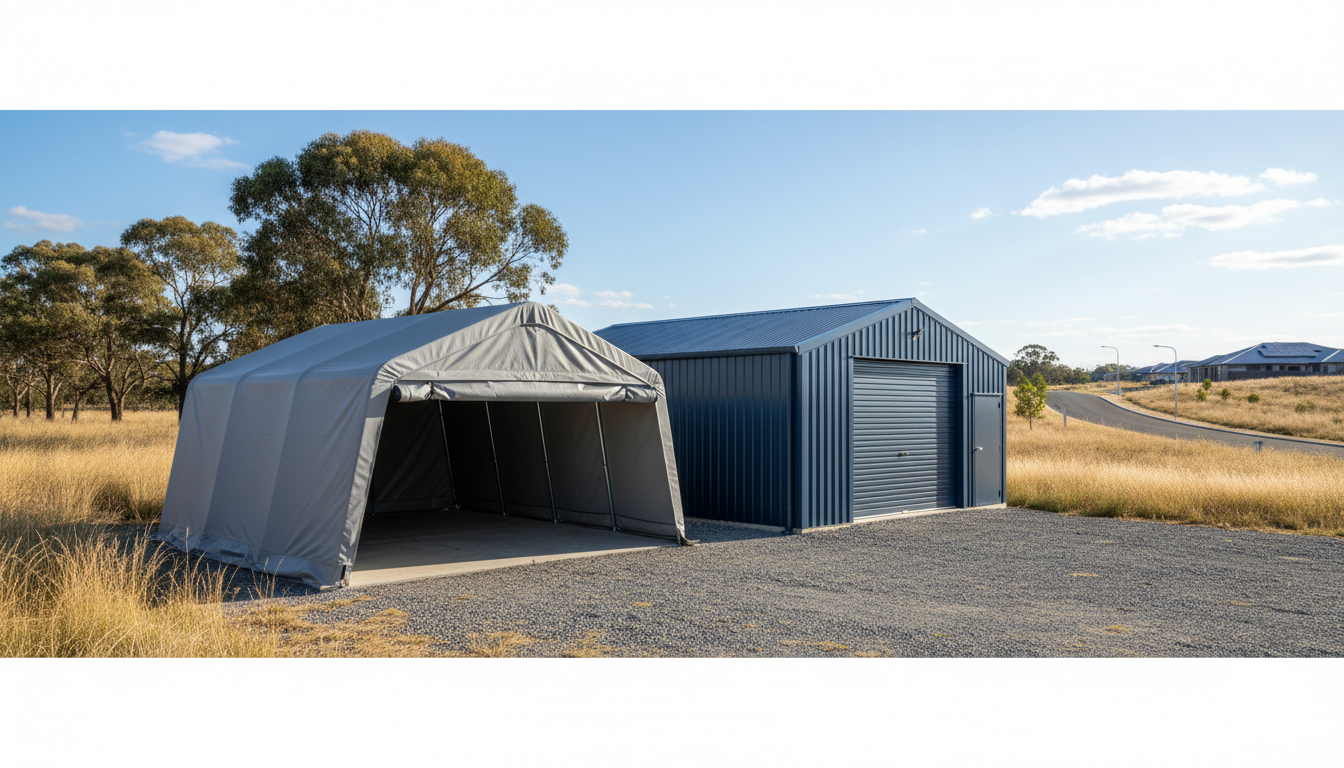
What is a “portable garage” in Australia?
In Australia, “portable garage” usually means one of two things:
- Garage tent (fabric shelter): A steel-tube frame with a heavy-duty PE/PVC cover. Quick to assemble, commonly used for cars, boats and site storage.
- Portable steel garage on skids/modular base: A prefabricated steel shed that can be moved by forklift or tilt-tray, sometimes used as interim cover before a permanent slab is poured.
Both solve immediate cover needs. If you want a long-term asset that adds value and passes council checks, a custom Colorbond steel garage (single, double or triple) is the benchmark across Australia.
Portable garage vs garage tent: Which is best for Australian conditions?
Choose based on your site, wind region, and how long you need it.
- Garage tent: Fast, affordable, no slab. Best for low-wind suburban sites or short-term cover. Check tie-downs and UV stability.
- Portable steel garage: Stronger, better security, potential to re-site. Needs engineered anchors, may still require council approval.
- Custom Colorbond garage: Council-approved, engineered to AS/NZS standards, higher capital value. Ideal for “forever” homes or investment properties.
What are the best shed materials for Perth’s climate?
Perth’s hot summers and coastal air favour baked-on paint systems and corrosion-resistant coatings.
For more detailed portable options, see our comprehensive Carport Portable Garage guide.
- Colorbond steel (including Ultra/Steel Matt): Excellent UV resistance and long-term colour retention in WA heat; wide colour range to match roof and fence palettes.
- Zincalume: Highly corrosion-resistant alloy coating; cost-effective for internal framing and non-visual walls in inland sites.
- Hot-dip galvanised frames: Great for coastal and rural sheds in WA and SA where dust and salt can be harsh.
- High-tenacity fabric for garage tents: Choose 350–610 gsm UV-stabilised PVC with heat-welded seams for better WA sun performance.
Colorbond vs Zincalume — Which is better for WA conditions?
| Criteria | Colorbond (incl. Ultra) | Zincalume |
|---|---|---|
| Coating & finish | Painted steel with baked-on finish; colour-stable | Alloy coating (aluminium-zinc); silvery appearance |
| Heat & UV resistance | Excellent in Perth heat; wide solar reflectance options | Good, but can be hotter to touch; no colour choice |
| Coastal suitability | Use Colorbond Ultra near surf coasts | Prefer inland/low-salt sites; consider protective distance |
| Cost | Slight premium | Generally cheaper |
| Aesthetics | Matches fence/roof palettes | Industrial look |
Tip: Many custom Colorbond garages Perth projects use Colorbond walls with Zincalume internal purlins for value.
Do portable garages need council approval in Australia?
Often yes. Even “temporary” structures can trigger permits depending on size, height, setbacks and anchoring. Rules vary by council and state. Expect checks against AS/NZS 1170.2 (Wind Actions) and relevant cyclone categories in QLD/WA.
How to get council approval for your custom shed in WA
Added 2024 WA wind-rating compliance notes WA councils typically ask for:
- Site wind region report and N rating (e.g., N1–N4) or cyclonic C rating (C1–C4)
- Certified engineering to AS/NZS 1170.2, AS/NZS 4600 (cold-formed steel), and connections details
- Site plan with setbacks, heights, gutters/downpipes and stormwater plan
- Footing/slab design (piers, screw piles, or slab) per soil class (AS 2870)
Ask your supplier for council-approved sheds WA documentation upfront to avoid delays.
Are garage tents and portable garages suitable for cyclonic and coastal areas?
In cyclone-prone QLD, NT and northern WA, choose cyclone-rated sheds QLD with engineered tie-downs, heavier sections and certified doors. Most off-the-shelf garage tents are not engineered for C1–C4 winds; use only in sheltered locations with robust anchors, and remove covers before severe weather.
- Coastal corrosion: Choose Colorbond Ultra or hot-dip galvanised frames; rinse salt monthly.
- Door wind-locks: Wind-rated roller doors and wind-lock guides prevent blow-in during storms.
- Vermin and water: Add vermin-proofing and scribed flashings; ensure guttering and downpipes connect to soakwell/rainwater tanks.
How big should your portable garage be?
Common footprints:
- Single car: 3.0 m (W) x 6.0 m (L), 2.4–2.7 m eave
- Double car: 6.0 m x 6.0 m or 6.0 m x 7.0 m, 2.7–3.0 m eave
- Boat/caravan: 3.5–4.0 m eave height; consider 3.0 m wide roller doors
Adding a side mini roller door to a steel portable garage improves access without swing clearance—check headroom, guide depth and wind-locks here.
For farm machinery storage or rural sheds NSW, consider wider bays (3–4 m) and open-front designs.
Roof choices: Flat, skillion or gable?
| Roof type | Pros | Considerations |
|---|---|---|
| Flat | Low profile, simple | Not ideal for high rainfall; check min fall for drainage |
| Skillion (mono) | Modern look, easy solar panel layout | Mind prevailing winds; gutter capacity in QLD downpours |
| Gable | Classic look, better airflow | Slightly higher material cost |
DIY shed kits vs custom-built installation
Australian DIY shed kits are popular for time-savvy owners. If you’re time-poor, engage a licensed installer.
| Option | Best for | Pros | Watch-outs |
|---|---|---|---|
| DIY kit | Handy owners, smaller garages | Save labour, flexible timing | Permit paperwork, accuracy of set-out, lifting equipment |
| Custom-built | Premium homes, larger spans | Turnkey, smoother council process | Higher upfront cost |
Real-world examples across Australia
- Custom Colorbond double garage in Perth: 6 x 7 m, skillion roof, Colorbond Ultra walls near coast, anti-condensation blanket, motorised 3.0 m roller door. Engineered for N3. Outcome: Cooler summer temps and zero salt staining after first season.
- Cyclone-rated garage in Townsville: 7 x 7 m gable, C2 design, wind-lock roller doors, extra hold-down bolts and strap bracing. Outcome: Insurer accepted engineering certificate; peace of mind each wet season.
- Portable steel garage on skids in regional NSW: 3.5 m eave for tractor, Zincalume internal purlins, screw piles due to reactive clay (AS 2870). Outcome: Quick install; future relocation possible.
How much does a portable garage cost in 2025?
- Garage tent: ~$400–$1,500 depending on size and PVC/PE weight.
- Portable steel garage (moveable base): ~$4,000–$12,000 supply, more with engineered anchors.
- Custom Colorbond garage: Single from ~$9,000–$18,000 (kit); double from ~$14,000–$35,000 (kit). Installed turnkey varies by slab, wind rating and region.
Allow for slab, earthworks, permits, delivery to remote areas, and upgrades (insulation, windows, power, drainage). Supply times can be affected by steel lead times; monitor the Australian Steel Institute for industry updates and the “2025 Australian Steel Market Outlook”.
Still torn between renting and building? See self storage units vs custom sheds for a cost‑over‑time comparison with approvals and wind ratings.
Buying checklist: 5-Step Guide for Custom Sheds in Australia
- Confirm wind region (N or C) and exposure via a site-specific report.
- Pick materials: Colorbond vs Zincalume, galvanised frame, insulation level.
- Decide the layout: Span, bay spacing, eave height, door sizes, windows.
- Paperwork: Engineering to AS/NZS, site plan, stormwater, bushfire BAL if applicable.
- Install plan: DIY vs builder, slab vs screw piles, power/water run-ins.
Frequently asked questions about portable garages and garage tents
Do I need a slab?
Garage tents don’t require a slab but need solid anchors. Portable steel garages can sit on skids with ground anchors. Permanent Colorbond garages typically use a concrete slab engineered to site soil class.
Will a garage tent survive a storm?
In non-cyclonic suburbs with good tie-downs, many do fine in moderate winds. For exposed or cyclonic regions, choose an engineered steel garage with certified wind ratings. Always follow the manufacturer’s removal/securement advice before severe weather.
Is Colorbond worth the extra cost?
For most Australian homes—yes. The finish resists Perth UV, looks better long-term, and increases resale value. Use Colorbond Ultra close to surf coasts.
What about bushfire zones?
Local, technical and compliance notes for Australian sites
- Perth & coastal WA: UV, heat and salt exposure — prioritise Colorbond Ultra, ventilation, and insulation. Seek council-approved sheds WA with N3 designs minimum in exposed suburbs.
- Queensland (cyclonic): Specify cyclone-rated sheds QLD with C1–C4 engineering, wind-lock roller doors, and deeper hold-downs.
- Melbourne and regional VIC: Custom carports Melbourne and garages often fit heritage/streetscape overlays—check planning permit triggers.
- NSW rural: Rural sheds NSW may need increased bay spacing and higher eaves for machinery; dust sealing and extra ventilation help.
Sustainability and comfort
- Cool roofs and insulation cut heat load and improve solar performance. See guidance from Energy.gov.au.
- Rainwater harvesting: Gutters + tanks reduce stormwater issues and can supply garden use.
- Local climate design: Check Bureau of Meteorology climate data for rainfall and wind patterns relevant to your site.
Where to from here?
Decide whether you need a fast, temporary garage tent or a long-term, engineered solution like a custom Colorbond double garage in Perth, a wind-rated garage for Brisbane bayside, or an affordable carport for Australian homes. Ask for engineering, wind ratings and a clear inclusions list before you buy.
For classic, permanent storage, our Weatherboard Shed Guide (Australia) provides expert recommendations.
Useful Australian references
- Housing Industry Association (HIA) — permits and building guidance; see the “2025 HIA Outdoor Structures and Home Improvement Report”.
- Master Builders Australia — contractor selection and building tips.
- CSIRO — research on building materials, insulation and bushfire.