
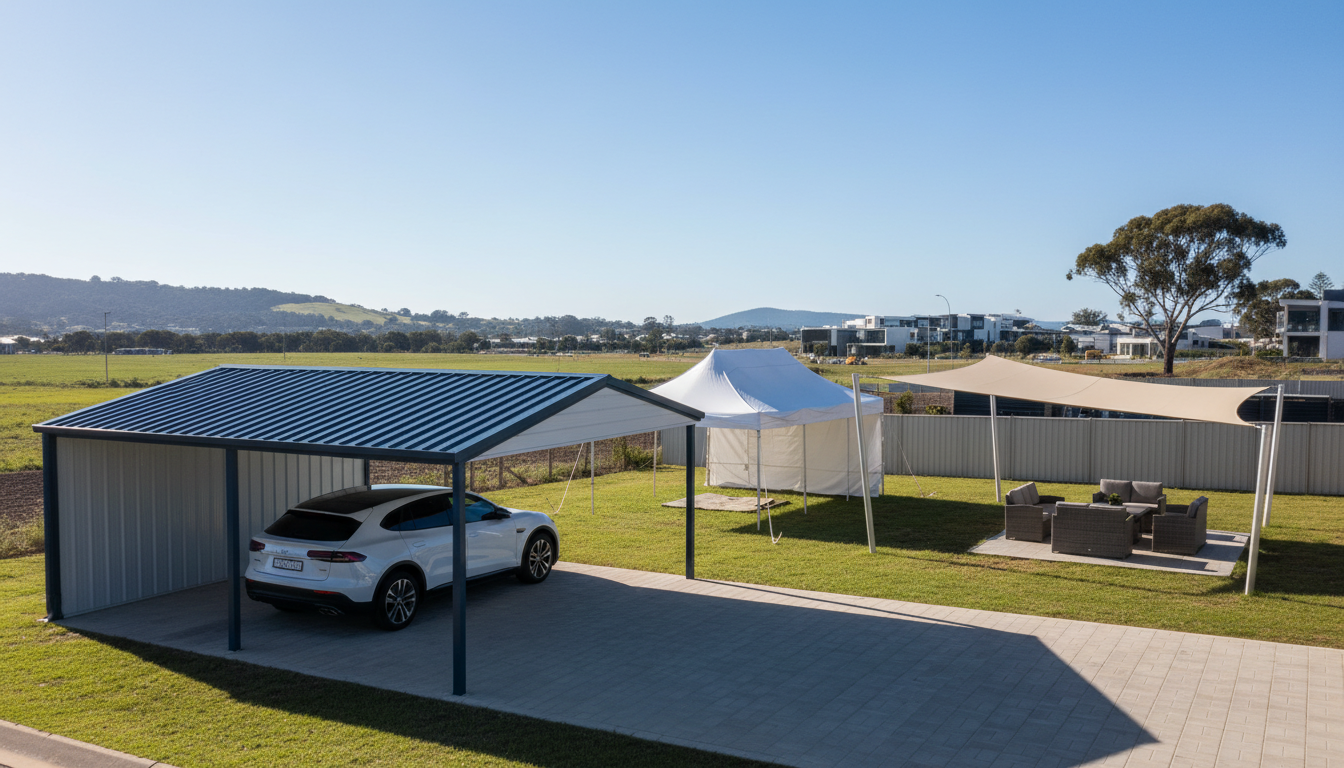
Premium portable shade and temporary structures for Australian homes
Need fast, durable shade that can move with your plans? From custom-built double carports in Perth to temporary shade structures for farm machinery storage in regional Queensland, this guide distils the essentials—materials, wind ratings, council approvals, costs, and real builds—so you can buy once and buy right.
What are portable shade structures and where do they make sense in Australia?
Portable shade structures are demountable or modular systems designed to protect vehicles, outdoor living areas, boats, caravans and workspaces from sun, rain and hail—without committing to a full masonry build. Typical options include:
- Modular steel carports (single, double, triple bays)
- Cantilever carports for tight driveways
- Shade sails and demountable fabric canopies
- Container shelters and hoop structures for farm machinery storage
- DIY shed kits and patio roofs for alfresco shade
- Boat and caravan shelters for coastal or rural sites
- Pop-up gazebos for temporary events (short-term only)
If you want instant car or tool protection, see our Portable Shelter Australia temp shed range.
In the Australian shed and carport industry, “portable” usually means bolt-down or screw-pier footings with the ability to relocate, not “no footings at all”. The key is matching engineering to your wind region and soil conditions.
A pre-painted, baked-on finish over high-tensile steel (typically to AS 1397/2728). Popular for roofs and wall cladding due to UV resistance, colour range and low maintenance.
A zinc/aluminium-magnesium alloy–coated steel (e.g., AZ150 coating) known for bare-metal corrosion resistance and value. Often used on rural sheds and industrial roofs.
Australia uses AS/NZS 1170.2 to classify wind actions. Non-cyclonic: N1–N6. Cyclonic: C1–C4. Your engineer designs your structure to the site’s classification.
A measure of potential bushfire risk. Cladding and ember protection may be required for BAL-rated sites per NCC 2022 and AS 3959.
What are the best shed materials for Perth’s climate?
Perth’s harsh UV, hot summers and sea breeze demand materials that balance heat management with corrosion resistance:
- Roof and walling: Colorbond steel in lighter solar-reflective colours, or Zincalume where a bare-metal look is preferred.
- Frames: Hot-dip galvanised RHS columns and C-section purlins to AS/NZS 4680 for long-term protection.
- Fasteners and flashings: Cyclone-rated screws and compatible flashings to prevent galvanic corrosion.
- Optional: Insulated roof panels for patios and carports to reduce heat buildup.
Pro Tip: Did you know using insulated roof panels can reduce internal shed or patio temperatures by up to 10°C in summer?
Colorbond vs Zincalume — Which is better for WA conditions?
| Feature | Colorbond | Zincalume | Best for WA |
|---|---|---|---|
| Heat/UV performance | Excellent; light colours reflect heat | Good; reflective bare finish | Colorbond (for colour + heat balance) |
| Coastal corrosion resistance | Very good with correct grade and maintenance | Very good on non-breaking surf coasts; washdowns matter | Tie — specify correct grade and maintenance |
| Aesthetics | Broad colour range (classic + contemporary) | Industrial, metallic look | Colorbond for residential streetscapes |
| Price | $$ (premium) | $ (value) | Zincalume for budget builds |
| Warranty and availability | Strong supplier network and warranties | Strong, especially in rural supply chains | Both, check supplier specifics |
For “steel sheds Perth” and patio roofs where aesthetics matter, Colorbond often wins. For rural kit sheds, Zincalume remains popular.
How do wind ratings and Australian Standards affect temporary shade structures?
Every portable or temporary shade structure must be engineered to your site’s wind classification under AS/NZS 1170.2 and designed using AS/NZS 4600 (cold-formed steel) or AS 4100 (steel structures). In cyclonic North QLD, specify “wind-rated sheds for cyclonic areas” (C2–C3 typical). In southern capitals, N3–N4 is common, but coastal headlands and escarpments can push higher.
- Footings: Screw piers or concrete pads engineered to soil classification (AS 2870). Temporary doesn’t mean “no footings.”
- Connections: Through-bolted baseplates, M12/M16 anchors, and bracing designed for uplift.
- Cladding and fixings: Fasteners with pull-out capacity for your wind region.
Added 2024 WA wind-rating compliance notes: Many Perth councils now require site-specific engineering for “bolt-down” carports and patio roofs, even on existing slabs. Expect requests for wind region (often N2–N3), terrain category, and shielding assessments on the engineering certificate.
Which portable shade structure should you choose for your property?
- Protecting two cars in suburban Perth: A custom-built double carport in Colorbond with insulated roof panels and guttering.
- Alfresco shade in Melbourne: A flat roof patio with powder-coated posts, or a modern cantilever carport for style and driveway clearance.
- Rural equipment in NSW: A container shelter or open-front rural shed (Zincalume) for tractors and farm machinery storage.
- Boats and caravans on the coast: High-clearance steel frames with wider bay spacing, anti-corrosion fasteners, and frequent washdowns.
- Rental property quick-upgrade: A freestanding carport with bolt-down footings that can be relocated later—an affordable carport for Australian homes.
Outdoor Entertaining
For dedicated grilling and entertaining, check our BBQ Sheds in Australia for approved options.
Shade Structures for Businesses
For region-specific solutions, such as Garden Sheds Campbellfield, we detail local supplier options.
DIY kit vs custom-built — what’s right for you?
- DIY shed kits: Lowest cost, fast delivery, ideal for standard sizes. You’ll still need engineering, suitable footings and, often, approval.
- Custom-built: Perfect for sloping blocks, tricky boundaries, or matching house aesthetics. Easier council process with a turnkey installer.
What are the council rules for portable shade and carports?
How to Get Council Approval for Your Custom Shed in WA
- Check local planning rules: setbacks, open space and height under R-Codes.
- Obtain site-specific engineering (wind classification, footings, connections).
- Prepare drawings: site plan, elevations, slab/footing details, stormwater.
- Lodge for BA or DA as required. Many councils accept “certified” applications.
- Book inspections if specified (footings, final). Keep documentation for future sale.
Searching for “council-approved sheds WA”? Most councils allow carports and patios as ancillary structures, but setbacks, streetscape and corner-lot rules can apply. In QLD, the planning framework varies by council—cyclone regions will scrutinise engineering. In VIC, many “custom carports Melbourne” installs proceed via building surveyors with a building permit and compliance with setbacks/overshadowing.
Real-world builds: three Australian case studies
- Perth, WA — custom Colorbond double carport: 6.0 x 6.0 m skillion with insulated roof panels, galvanised RHS posts, and stormwater connection. Matched the house roof colour. Keywords: custom Colorbond garages Perth, steel sheds Perth.
- Townsville, QLD — cyclone-rated farm shade: 12.0 x 8.0 m open-front shelter for machinery. Designed to C2 with extra roof bracing, through-bolted baseplates and screw piers. Keywords: cyclone-rated sheds QLD, wind-rated sheds for cyclonic areas.
- Mid-North Coast, NSW — boat and caravan shelter: 9.0 x 4.5 m high-clearance Zincalume roof on hot-dip galvanised frame, coastal washdowns, and anti-corrosion fasteners. Keywords: rural sheds NSW, boat cover, caravan shelter.
Frequently asked questions about portable and temporary shade structures
Are shade sails “temporary”? Yes, but tensioned sails still need engineered posts and footings sized to wind actions. Many councils treat large sails like structures requiring approval.
Do I need concrete footings? Usually yes. Even bolt-down systems need engineered anchorage to a slab or piers sized for uplift and shear.
Can I move a demountable carport? Yes. Unbolt connections, lift columns and reuse. You’ll need new footings at the next site.
Will insulation help? For patios and carports used as living spaces, insulated panels reduce radiant heat and drumming in rain.
What warranties should I expect? Steel cladding typically 10–20+ years depending on product and proximity to the coast; frames often 10 years; workmanship varies by installer.
What sizes are most popular? Single (3.0 x 6.0 m), double (6.0 x 6.0 m), and custom wider bays for utes or caravans.
5-Step Buying Guide for Custom Sheds in Australia
- Define use-case: car cover, alfresco, farm machinery storage, boat, or caravan shelter.
- Confirm site constraints: setbacks, easements, overhead power, drainage, slopes.
- Select materials: Colorbond vs Zincalume, galvanised frames, insulated roof panels, guttering.
- Engineering and approvals: wind classification (N or C), footings, and “council-approved sheds WA” style paperwork if in WA.
- Installation plan: DIY shed kits vs turnkey custom installer, lead times, and crane access.
Cost guide: what should you budget in 2025?
- Pop-up gazebo (event use): $250–$900 (short-term shade only, non-structural)
- Shade sail installed (two-post to four-post): $2,500–$6,500+ depending on fabric, spans and footings
- Single carport kit (Colorbond roof, galvanised frame): $3,800–$7,500
- Custom-built double carport with insulated roof: $9,500–$18,000+ installed
- Container/hoop shelter for machinery: $6,000–$25,000+ depending on width and wind rating
Allow for engineering, approvals, concrete or screw piers, stormwater and electrical (if adding lights/EV charging). Steel prices remain sensitive per the “2025 Australian Steel Market Outlook,” and outdoor projects continue to trend per the “2025 HIA Outdoor Structures and Home Improvement Report”.
Maintenance and lifespan in Australian conditions
- Coastal: Rinse cladding and frames with fresh water every 1–3 months; choose marine-grade fixings.
- Cyclonic: Inspect bracing and fixings pre-wet season; touch up coatings promptly.
- Inland/urban: Annual washdowns and gutter cleaning to maintain warranties.
Why steel beats timber or fabric-only for long-term shade
- Longevity: Galvanised steel frames to AS/NZS 4680 resist termites and rot.
- Structural reliability: Predictable performance to AS/NZS 1170.2 and AS 4100.
- Low maintenance: Especially with Colorbond coatings and compatible fasteners.
Popular searches we support
portable shade structures, temporary shade structures, steel sheds Perth, custom carports Melbourne, rural sheds NSW, Colorbond vs Zincalume comparison, wind-rated sheds for cyclonic areas, council-approved sheds WA, cyclone-rated sheds QLD, custom Colorbond garages Perth, farm machinery storage, DIY shed kits, affordable carports for Australian homes, freestanding carports, cantilever carport, shade sails Perth, caravan shelter, boat cover, patio roof, flat roof vs gable roof carport
What to bring to your quote
- Photos of the site and a rough sketch with dimensions
- Address for wind classification and planning check
- Preferred roof style (flat/skillion or gable) and colour
- Use-case (cars, boat, caravan, alfresco)
- Timeline and budget range
Standards, reports and helpful resources
- Bureau of Meteorology climate and wind resources
- Housing Industry Association (HIA) market insights
- Australian Steel Institute guidance
- Energy.gov.au tips on cool roofs and shading
- CSIRO building science and materials research
Gap filled: cyclone-rated sheds QLD, council-approved sheds WA, custom Colorbond garages Perth integrated with local engineering and approval steps.