
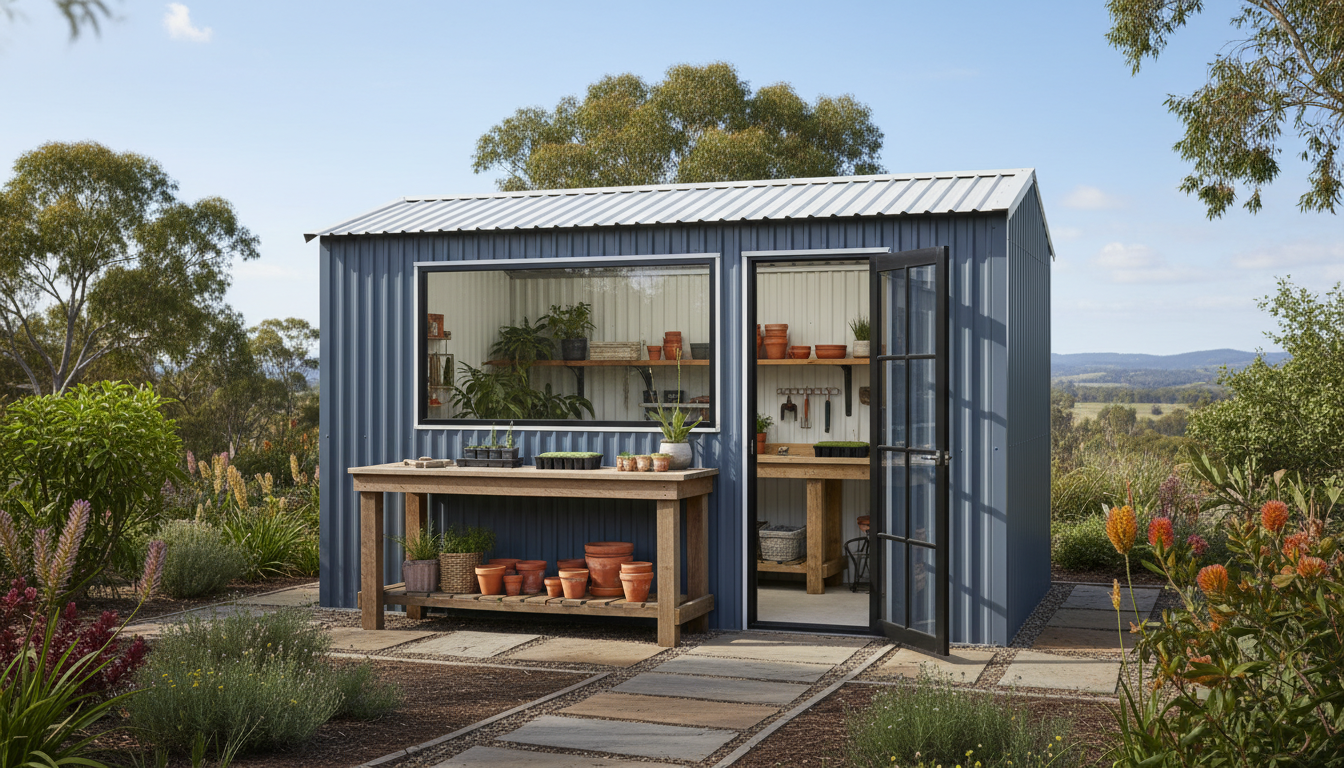
Your complete Australian guide to potting sheds
Potting sheds have gone from a nice-to-have to a must-have for Australian homes and hobby growers. Whether you’re in Perth battling summer heat, coastal NSW with salt-laden air, or North QLD in cyclonic regions, the right design and materials matter. This guide blends practical potting shed ideas with industry-grade specifics—Colorbond steel options, wind ratings, council approval, and build quality that would satisfy any tradie or property investor.
We’ll also cover smart upgrades like insulated roof panels, anti-condensation solutions, and ventilation that keeps plants—and people—happy year-round.
What are the best shed materials for Perth’s climate?
Perth’s UV, heat, and sea breeze demand high-performance cladding and roofing. For most residential potting sheds, Australian-made BlueScope steel cladding is the benchmark. The two most common finishes are Colorbond and Zincalume. Here’s a quick comparison for WA conditions:
| Feature | Colorbond Steel | Zincalume Steel |
|---|---|---|
| Finish | Pre-painted, multiple colours to match your home | Silver/metallic finish only |
| Heat/UV Performance | Excellent UV resistance; lighter colours reduce heat gain | Reflective but may glare; warms quickly in direct sun |
| Coastal Durability | Superior in coastal splash zones when properly maintained | Good, but needs more frequent washdowns near coast |
| Aesthetics | Matches Colorbond roofs, gutters, and fences | Industrial look; can weather unevenly |
| Typical Use | Premium potting sheds, custom gardens, architecturally visible areas | Budget shed kits, rural utility structures |
For Perth and coastal WA, we specify Colorbond cladding on galvanised steel frames, with anti-condensation blankets under the roof sheets, ridge vents or whirlybirds, and corrosion-resistant fasteners (class 4 where appropriate). This spec mirrors what we use for steel sheds Perth wide, not just garden structures.
How big should a potting shed be for Australian backyards?
For hobby gardeners, a 3.0 m x 2.4 m footprint is the sweet spot—space for a potting bench, storage, and walk-around access. Larger backyards or keen propagators often choose 3.6 m x 3.0 m with dual access doors. Make sure the slab extends at least 100 mm beyond wall lines for drip edge and cleaning.
Practical potting shed ideas to maximise productivity
Many gardeners pair their potting space with Outdoor Storage Cabinets in Australia, offering weatherproof organisation for tools and supplies next to traditional potting benches.
- North-facing polycarbonate skylight strips for winter light, with summer shade cloth to temper heat.
- Integrated potting bench, 900–950 mm high with a durable top and a lip to retain potting mix.
- Kick-proof storage for fertilisers and sharp tools; a galvanised pegboard above bench height.
- Passive crossflow ventilation (louvre vents low, ridge vent high) plus flyscreens to deter pests.
- 3000 K LED task lighting on a timer; RCD-protected circuits by a licensed electrician (AS/NZS 3000).
- Gutter and downpipe to a slimline rainwater tank; ball valve tap near bench.
- Vermin flashing at slab edges to block mice and leaves.
- Non-slip sealed concrete; set a fall of 1:100 toward the doorway or drain.
- For bush blocks, specify a BAL-compliant cladding and ember screens (AS 3959) as required.
Do you need council approval for a potting shed?
Most councils allow small garden sheds as exempt or complying development if they meet size, height, and setback rules. However, exemptions vary by state and local planning scheme. If in doubt, ask your council or engage a private certifier.
How to get council approval for your custom shed in WA
- Confirm planning exemptions with your local council (Residential Design Codes may apply).
- Obtain site plan, slab details (AS 2870), and certified engineering with wind rating per AS/NZS 1170.2.
- Submit a BA2 or BA3 application with Form BA1 as required; some shires accept certified applications for faster turnaround.
- Provide boundary setback evidence and a signed owner’s consent if strata.
- Book final inspection if conditions require it; keep your engineer’s certificate on file for any future property sale.
Added 2024 WA wind-rating compliance notes — New estates in coastal corridors may require higher terrain category assumptions and increased hold-downs. Ask for council-approved sheds WA level documentation with site-specific wind analysis.
Fast-track approvals in QLD and NSW
- QLD: For cyclonic regions (C/D), engineering must state Region, Terrain Category, Importance Level, and shielding. Many small sheds still need formal approval. Ask for cyclone-rated sheds QLD certification.
- NSW: Under Exempt Development, size and height caps apply; verify setbacks and easements. Rural properties (RU zones) often have more flexibility for rural sheds NSW.
What wind rating and engineering do potting sheds need?
Every quality shed must be engineered to your wind region and site exposure. Australia uses AS/NZS 1170.2 to determine wind actions, with regions A (mild) to D (severe cyclonic). The shed’s frame, cladding fixings, and hold-downs must all align to the design pressure.
For coastal QLD and WA north, specify cyclonic frames (thicker cold-formed C-sections), extra roof bracing, and high-capacity anchors. Non-cyclonic regions still need correct hold-downs and screw class selection to prevent tear-out during storms. If you’re adding a roller door to a combo garden/garage space, demand windlock guides rated to the site pressure—standard doors can blow in.
DIY shed kit or custom-built? What’s better in 2025?
Both can be excellent—choose based on complexity, time, and site conditions.
- DIY shed kits: Great for small, simple footprints; look for clear instructions, pre-punched holes, and labelled components. Consider DIY shed kits with Brisbane or Sydney depot pickup for savings.
- Custom-built: Best for sloped sites, BAL ratings, or cyclonic design. Professional installers in Victoria and WA can integrate concrete, drainage, and electrics in one program.
In either case, insist on Australian engineering, compliant anchor design, and a BlueScope warranty-backed cladding—common on custom Colorbond garages Perth and premium garden builds alike.
How much do potting sheds cost in Australia?
Indicative only—final pricing depends on wind rating, slab, and fit-out:
- Kit, 3.0 x 2.4 m, Colorbond roof/walls: typically mid four figures installed with slab.
- Custom, 3.6 x 3.0 m, skylights, insulation, power, and water: typically higher four to low five figures.
- Cyclonic upgrades (Region C/D): allow for heavier frames, extra bracing, and engineered anchors.
Tip: Bundling gutters, downpipes, and a small tank is cost-effective during install and beats retrofitting later.
Potting shed ideas that work in Australian conditions
- Skillion roof sloping south for rain harvesting; gable ends with screened gable vents for crossflow.
- Clear polycarbonate panel on the winter sun side; shade cloth track for summer.
- Anti-condensation blanket under roof sheets to reduce drips over your bench.
- Interior half-height lining board to tolerate bumps and hose-down cleaning.
- Raised staging shelves and a mobile trolley for heavy pots.
- Tool wall and magnetic strip for secateurs, snips, and dibbers.
- Smart storage: lidded tubs for potting mix and perlite; labelled bins for fertilisers.
- Insect-screened door inserts to keep airflow without inviting mosquitoes.
Case studies: built right for local conditions
Perth, WA — 3.0 x 2.4 m skillion potting shed
Colorbond surfmist walls, woodland grey roof, anti-condensation blanket, 300 mm eaves. Slab 100 mm with N12 bars, M class soil (AS 2870). Ridge vent plus two low louvres. Result: cooler workspace and no summer drip. Council exempt under height/area limits; engineering on file.
Townsville, QLD — 3.0 x 3.0 m cyclone-ready
Region C, Terrain Cat 2. Cold-formed galvanised C-section frame, upgraded roof bracing, cyclonic screws. Polycarbonate skylight bay with internal shade. Certified anchors to engineered design. Outcome: wind-rated sheds for cyclonic areas performance with excellent daylighting.
Southern Highlands, NSW — 3.6 x 3.0 m garden studio + potting zone
Gable roof with clear ridge section, insulated roof panel for thermal comfort, lined half-wall, and a corner potting bench with splashback. BAL considerations met with ember screen vents. Quiet, organised, and warm through winter mornings.
Roof style, ventilation, and thermal comfort
- Skillion roof: modern look, easy water harvesting, simple flashing.
- Gable roof: extra headroom and hot air escape via ridge vents.
- Ventilation: pair low inlets (louvres) with high outlets (ridge vent/whirlybird) for stack effect.
- Thermal control: anti-condensation blanket plus light-colour roofing reduces radiant heat.
Some property owners prefer Retro Garden Sheds Australia, which blend vintage aesthetics with modern performance, as an alternative to purpose-built potting sheds.
Maintenance and longevity in coastal and rural zones
- Quarterly hose-down for coastal sites to maintain coating warranty; focus on gutters and drip edges.
- Use class 4 screws and hot-dip galvanised anchors in marine zones.
- Keep soil and mulch off wall sheets; provide a 50 mm separation to avoid corrosion.
- Fit leaf guards and a first-flush diverter on tanks to keep debris out.
- Check seals, door tracks, and vermin flashing annually—cheap insurance for a long life.
5-step buying guide for custom sheds in Australia
- Define use and size: bench, storage, and access. Sketch door and window positions.
- Select materials: Colorbond vs Zincalume, insulation, ventilation, and fasteners for your zone.
- Engineering and wind rating: insist on AS/NZS 1170.2 and site-specific anchors; request a certificate.
- Approvals: verify local exemptions; if needed, lodge with plans, slab design (AS 2870), and elevations.
- Build and fit-out: engage licensed installers for slab, electrical (AS/NZS 3000), and plumbing (AS/NZS 3500) if adding water.
FAQ: potting sheds in Australia
What foundation is best?
A 100 mm reinforced concrete slab with thickened edges and correct anchors is standard. For reactive clays, follow AS 2870 and your engineer’s edge beam design.
Flat roof or gable for potting?
Skillion roofs are simple and good for harvesting; gables ventilate better and give headroom for tall shelving. Both can work—focus on vents and insulation.
Do steel sheds get too hot?
Untreated roofs can. Choose light-colour Colorbond, add anti-condensation blanket, vents, and consider insulated panels for serious summer comfort.
Can I attach to the fence?
Generally no—fences aren’t structural walls. Maintain setbacks and drainage clearances per your local planning rules.
Are termites a concern?
Steel framing is termite-resistant, but keep timber shelving off the slab and maintain site hygiene to deter pests.
Related builds and keyword clusters
- Custom-built double garage in Perth
- Custom carports Melbourne and affordable carports for Australian homes
- Rural sheds NSW for farm machinery storage
- Colorbond vs Zincalume comparison for sheds and garages
- Wind-rated sheds for cyclonic areas and shed kits Brisbane delivery
Standards, climate, and industry insights
Design to Australian Standards: AS/NZS 1170.2 (wind actions), AS 4100 and AS/NZS 4600 (steel structures), AS 1562.1 (roof and wall cladding), AS 2870 (residential slabs), AS 3959 (bushfire), AS/NZS 3000 (wiring), and AS/NZS 3500 (plumbing). Check your wind region and local weather patterns through the Bureau of Meteorology. Current market reports suggest steel supply and lead times stabilised through 2024–2025, improving project planning for outdoor structures.
References:
Bureau of Meteorology,
Housing Industry Association,
Master Builders Australia,
Australian Steel Institute,
CSIRO,
Energy.gov.au
Next steps
Ready to design your potting shed? Ask for engineered drawings matched to your address, a clear Colorbond vs Zincalume spec, and confirmation your build meets your local exemption—or help lodging plans for a council-approved sheds WA-level submission. If you’re in cyclone country, make sure the quote states cyclone-rated sheds QLD compliance by Region and Terrain Category.
For buyers in Victoria, Garden Sheds Mornington offers local expertise in both functional and stylish shed installations.