
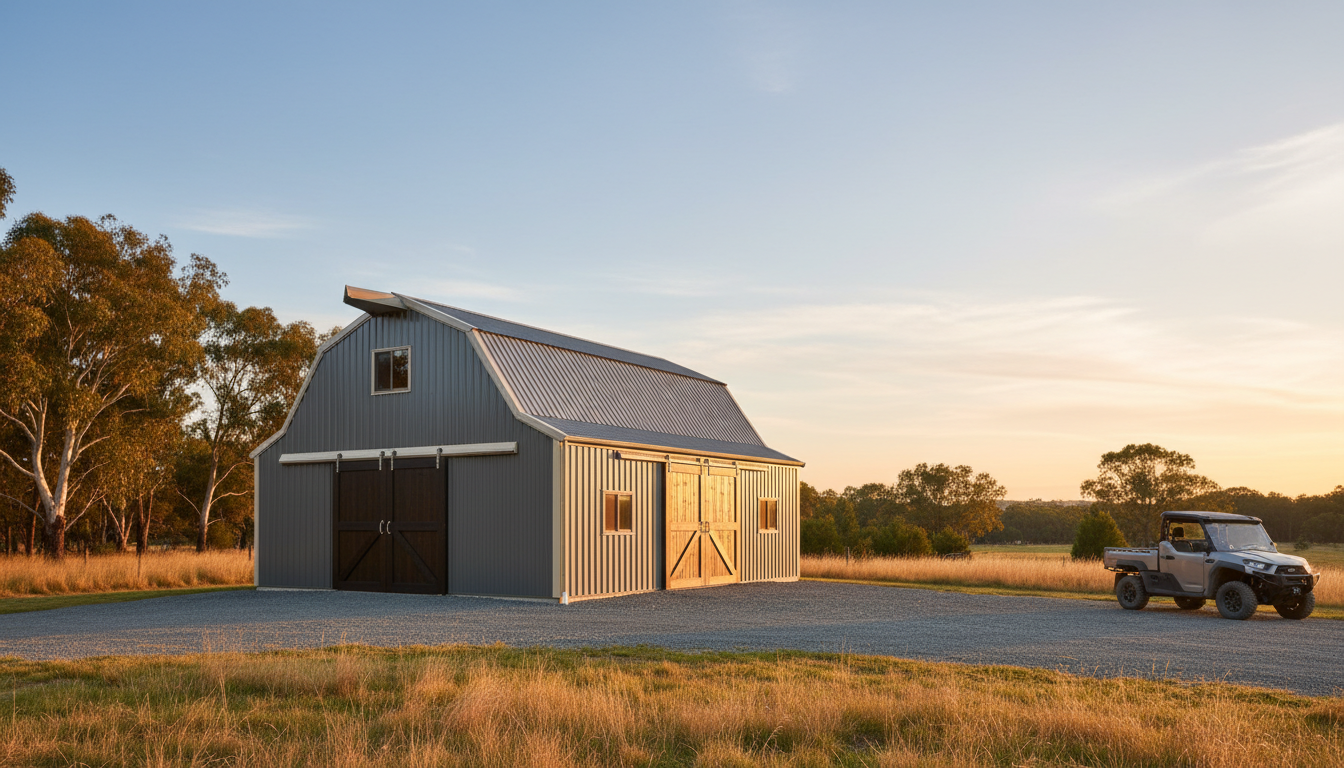
Excerpt: A complete Australian guide to Quaker barns—designs, pricing, WA council approvals, cyclone ratings for QLD, Colorbond vs Zincalume, and whether a barn house is right for you. Includes a buying checklist, local wind design notes, and examples from Perth, NSW and Queensland.
Quaker barns (often called American barns with a gambrel roof) deliver big-volume storage, a classic rural look, and an easy way to add a mezzanine for more floor space. This guide compares materials, pricing, wind ratings, and council rules across Australia—so you can choose a premium, engineered solution that adds value to your property.
What is a Quaker barn—and why choose one in Australia?
A Quaker barn is a multi-level steel building with a gambrel roof profile: a steep lower pitch and a shallower upper pitch. That geometry boosts headroom for a mezzanine or loft without blowing out overall height. They’re popular for farm machinery storage, equine fit-outs, workshop sheds, and barn-style homes.
Key design features you’ll see in quality builds
- Engineered cold-formed steel portal frames with bolted connections
- Gambrel roof using high-tensile purlins and girts for strength and span efficiency
- Colorbond or Zincalume cladding with anti-condensation options
- Mezzanine floors (ply over LVL/steel joists), stairs, safety balustrades. A mezzanine adds practical space—see various Mezzanine floor barn sheds suitable for Quaker designs (spans, loads and costs).
- Roller doors or sliding barn doors to suit caravans, boats, or tractors. Add authentic character with Sliding barn doors for barns.
- Optional awnings/garaports and lean-tos for extra covered space
- Vermin-proofing, guttering and downpipes, insulation and roof ventilation
Common Australian use-cases
- Farm machinery storage and hay storage (NSW and VIC rural blocks)
- Equine stables and tack rooms, or a combined workshop and feed area
- Custom-built double garage in Perth with extra height for 4WDs
- Boat or caravan shed with 3.0–3.6 m roller doors
- DIY shed kits for owner-builders wanting to save on labour
- Future-ready “quaker barn house”/barndominium layouts (see notes on habitable class)
What are the best shed materials for Perth’s climate?
Hot summers, coastal salt exposure, and occasional severe storms mean material selection matters. For most residential and rural sites around Perth and WA’s coast, pre-painted Colorbond steel with the right coating class (including Colorbond Ultra near surf) is the go-to. Zincalume is excellent value inland but needs care near marine exposure.
Colorbond vs Zincalume — Which is better for WA conditions?
| Criteria | Colorbond (including Ultra/Max variants) | Zincalume |
|---|---|---|
| Corrosion resistance (coastal WA) | Strong, with Colorbond Ultra recommended within ~100–200 m of breaking surf | Good inland; avoid very close coastal/salt-spray zones |
| Heat performance | Thermatech solar reflectance in selected colours reduces heat gain | Reflective but unpainted; can still get hot internally without insulation |
| Aesthetics | Large Colorbond palette to match modern Australian homes | Classic metallic look; paintable later if desired |
| Budget | Typically higher upfront | Usually lower upfront |
| Best fit | Coastal suburbs, premium residential, strict aesthetic requirements | Rural/regional inland, cost-conscious projects |
Pro Tip: Did you know using insulated roof panels or bulk insulation with a radiant barrier can reduce internal shed temperatures by up to 10°C in summer, depending on colour and R-value? Consider roof-only insulation if you’re on a budget.
How much does a Quaker barn cost in Australia (2025)?
Pricing varies by span, height, wind region, cladding, doors, mezzanine size, and installation location. As a guide:
- DIY shed kits (e.g., 9×9 m to 12×12 m, 3.0–3.6 m eave): roughly $18,000–$45,000 ex slab
- Installed barns (turnkey): roughly $35,000–$95,000+ depending on site works, slab, and fit-out
- Quaker barn house (habitable Class 1a): significantly higher due to code requirements (insulation, glazing, services, fire, energy). Allow a custom quote.
Note: Concrete slabs, site cuts, cranage, and remote/regional delivery can add materially to costs. Always request engineered drawings to AS/NZS standards and a detailed inclusions list.
Do you need cyclone rating or special wind design?
Yes—every Australian shed must be engineered for local wind speeds per AS/NZS 1170.2 and NCC 2022. Wind regions and terrain categories impact member sizes, hold-downs, and door selection.
- Wind Region A/B: Large parts of NSW, VIC, SA, and inland WA. Standard wind-rated barns are common here.
- Wind Region C: Tropical and sub-tropical coastal areas (e.g., much of QLD coast, parts of WA north). Requires cyclone-rated sheds with upgraded frames, connections, and doors.
- Wind Region D: Severe cyclonic (parts of WA’s northwest). Specialist engineering and detailing is required.
Added 2024 WA wind-rating compliance notes — In WA, council-approved sheds WA commonly require site-specific wind region confirmation and terrain/ shielding assessment. In QLD, cyclone-rated sheds QLD feature reinforced roller doors, tighter frame spacing, and additional tie-downs. Ask for region-specific certification.
How to get council approval for your custom shed in WA
Unsure about approvals? See our guide to council approval for barn sheds.
Approval steps for Perth and regional WA
- Confirm zoning, setbacks, and height envelopes with your local council
- Order engineered drawings to AS/NZS 1170.2, AS 4100/4600 and AS/NZS 1397 (steel sheet) with site-specific wind/terrain
- Submit a site plan, slab/footing design, stormwater plan, and manufacturer’s specs
- Address BAL if in a bushfire-prone area; include downpipe connections to soakwells as required
- Book final inspections/certification; ensure boundary clearances and gutter overflows meet local rules
Tip: WA private certifiers can streamline approvals. Many suppliers offer permit packs for faster turnarounds.
Quick notes for other states
- NSW: Complying Development (CDC) may be available for rural sheds NSW that meet codes; otherwise DA/CC
- VIC: Building Permit via a Registered Building Surveyor; planning permit may be needed; check overlays
- QLD: Private certifiers; ensure cyclone detailing for coastal areas
Quaker barn house: what to know before you build a barn-style home
Turning a Quaker barn into a quaker barn house (barndominium) requires reclassification from Class 10a (non-habitable) to Class 1a (habitable dwelling). That changes the ruleset:
- NCC 2022 energy efficiency (insulation, glazing, thermal breaks), ventilation, and damp-proofing
- Fire separation, egress, smoke alarms, and minimum room heights
- Plumbing/electrical, acoustic requirements (especially to mezzanine floors)
- BAL compliance in bushfire areas
Work with a designer experienced in barn-style homes. Many owners pair a barn shell with a custom fit-out builder to meet Class 1a requirements.
DIY shed kits vs custom-built — which suits you?
- DIY shed kits: Cheapest, fast delivery, ideal for experienced owner-builders or regional sites. Ensure you can handle slab tolerances, safe erection, and compliance paperwork.
- Custom-built barns: Turnkey supply-and-install, easier council navigation, professional slab/erection, fewer delays, warranty-backed workmanship.
Size and layout: getting bays, doors and mezzanine right
- Bay spacing: 3.0–4.0 m typical. Wider bays reduce columns but can require heavier steel.
- Roller door clearances: Allow 100–150 mm extra height for caravan A/C units; consider wind-lock cyclone doors in coastal QLD/WA.
- Mezzanine design: 2.1–2.4 m head height underneath for workshop use; confirm floor live loads (e.g., 1.5–2.0 kPa typical storage).
- Garaport/lean-to: Great for utes/boats; check setback impacts and stormwater.
- Ventilation: Ridge vents, whirlybirds, or eave vents to purge heat; add sarking or anti-condensation blankets.
Real Australian examples
Perth Hills: Custom Colorbond barn with mezzanine
9×12 m, 3.6 m eave, Monument walls/Surfmist roof, 6×4 m mezzanine, insulated roof blanket, custom Colorbond garages Perth style frontage, slab with thickened edge beams. Used as a workshop plus loft storage.
North QLD coastal: Cyclone-rated Quaker barn
10×10 m with wind region C engineering, cyclonic roller doors, upgraded hold-downs. Used for boat and farm gear. Proof that wind-rated sheds for cyclonic areas can still look great.
Rural NSW equine barn
American/Quaker configuration, central drive-through, side stables, sliding doors, and a hay loft. Colorbond Woodland Grey to match the homestead and rural sheds NSW aesthetic.
5-step buying guide for custom sheds in Australia
- Define the brief: Use-case, vehicle heights, future mezzanine, power/water plans
- Engineer it right: Confirm wind region, terrain category, and BAL before quoting
- Choose materials: Colorbond vs Zincalume, insulation, door types, vermin-proofing
- Plan approvals: Site plan, slab design, stormwater, certifications (council-approved sheds WA are smoother with a full permit pack)
- Lock in delivery/install: Coordinate slab cure times, lead times, and trades
FAQs: Quaker barns in Australia
Is a Quaker barn different from an American barn?
In Australia, the terms are often used interchangeably. Many “American barns” have the gambrel profile associated with “Quaker barns.”
What wind rating should I order?
Your engineer will design to AS/NZS 1170.2 based on wind region (A–D), terrain category, and shielding. Ask for site-specific certification and door compliance for design pressures.
What roof pitch suits a barn?
Gambrel roofs have two pitches; suppliers optimise angles for headroom and strength. If you prefer simpler lines, compare a gable or skillion—but gambrel wins for loft volume.
Flat roof vs gable vs gambrel—what’s best?
- Flat/skillion: Modern look, simple build, good for carports
- Gable: Classic, efficient structure, easy water shedding
- Gambrel (Quaker): Best loft space; the barn look many buyers want
How long does approval take?
2–8 weeks depending on council/certifier and completeness of documents. Private certification often speeds things up.
Can I add a mezzanine later?
Yes—if the frame is designed to carry it. Ask for pre-engineered mezz loads and connection points now to save later costs.
What about corrosion near the coast?
Specify Colorbond Ultra or suitable coating class, use stainless fixings where needed, and keep gutters/downpipes clear. Wash-down helps in severe salt exposure.
Keyword clusters you’ll encounter when planning
steel sheds Perth, custom carports Melbourne, rural sheds NSW, custom Colorbond garages Perth, council-approved sheds WA, cyclone-rated sheds QLD, wind-rated sheds for cyclonic areas, DIY shed kits, farm machinery storage, affordable carports for Australian homes, American barn, gambrel roof barn, mezzanine floor shed, workshop shed, boat and caravan storage, barndominium Australia, Colorbond vs Zincalume comparison, insulated panel roofing, portal frame sheds.
Standards, industry bodies and useful resources
- Housing Industry Association (HIA) — guidance on residential building trends and approvals
- Master Builders Australia — builder resources and contracts
- Australian Steel Institute — design notes and steel guidance
- Bureau of Meteorology — wind and cyclone climatology for design context
- CSIRO — building science and materials performance
- Energy.gov.au — energy efficiency guidance relevant to barn houses
For background data, see recent outlooks such as the “2025 Australian Steel Market Outlook” and “2025 HIA Outdoor Structures and Home Improvement Report” for demand and materials trends. These reinforce the shift toward engineered Colorbond steel sheds, especially in coastal markets.
Why choose a premium supplier?
- Site-specific engineering (not generic) with signed certifications
- Compliance with AS/NZS 1170.2, AS 4100/4600, AS/NZS 1397, and NCC 2022
- Quality cladding, compliant doors, insulation options, and vermin seals
- Permit packs and support through approvals
- After-sales support, spare parts, and documentation