
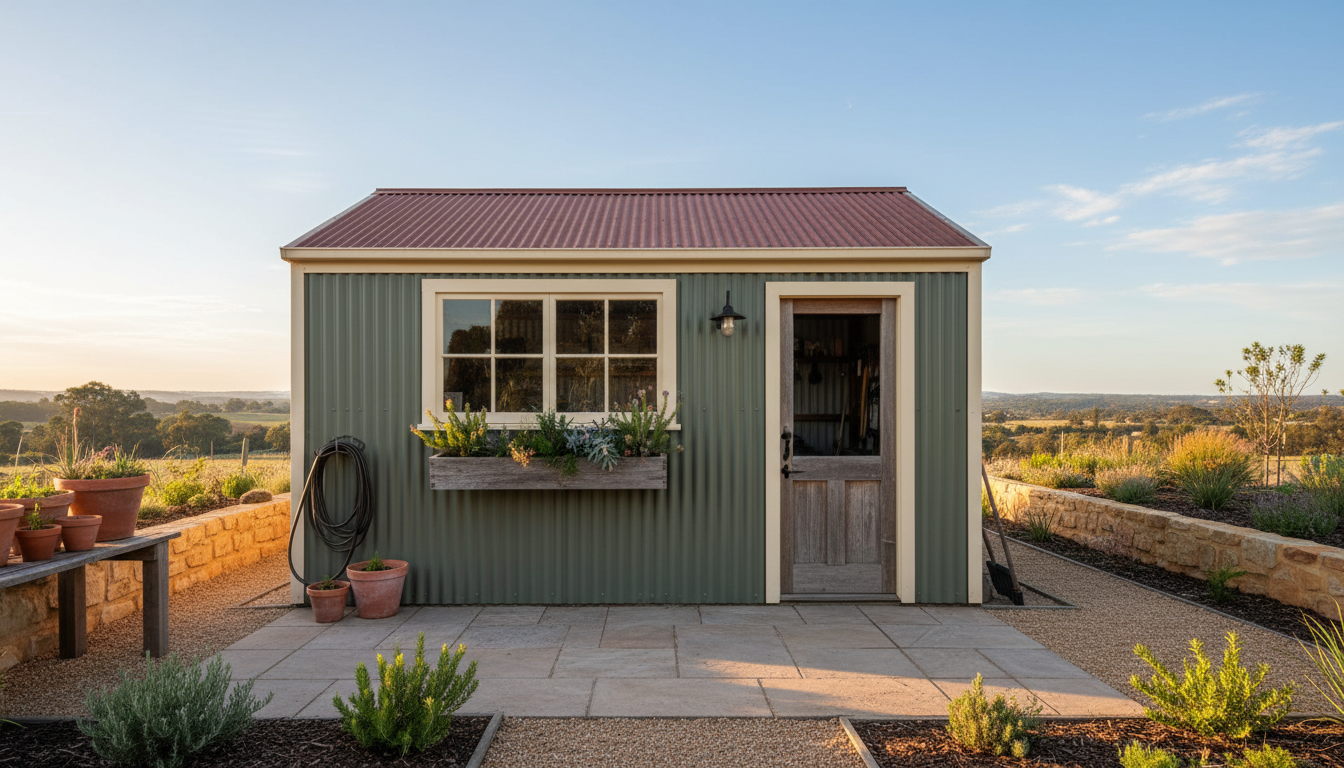
Love the look of a vintage garden shed, but want modern strength? This guide shows how to build a retro garden shed that suits Australian conditions—Perth heat, coastal corrosion, and QLD cyclones—while meeting engineering, council, and warranty requirements. Ideal for homeowners, renovators, and investors seeking premium finishes with old-school charm.
What makes a retro garden shed work in Australia?
A great retro garden shed blends heritage style with modern engineering. Think corrugated cladding, heritage colourways, and timber-look trims—wrapped around a galvanised steel frame, wind-rated doors, and compliant footings. Whether you want a federation-style garden shed for tools or a mid-century look for a backyard studio, go for a custom Colorbond steel shed designed to your site.
If curb appeal is your goal, Pretty Garden Sheds offer stylish alternatives with architecturally inspired Colorbond profiles to elevate your backyard’s appearance.
- Profiles: Classic corrugated or heritage weatherboard-style sheeting for a vintage garden shed vibe.
- Colours: Cottage Green, Manor Red, Classic Cream, Paperbark, or Surfmist for that retro palette.
- Details: Decorative gable vents, heritage door furniture, barn-style sliding doors, and window awnings.
- Structure: Galvanised RHS or C-section steel portal frames designed to AS/NZS 1170.2 wind actions.
- Use-cases: Tool storage, hobby space, home brewery, potting shed, or farm machinery storage in rural sheds NSW.
What Are the Best Shed Materials for Perth’s Climate?
Perth’s high UV, summer heat, and coastal air are tough on cladding and fasteners. Pair UV-stable paint systems with corrosion-resistant substrates and thermal design. Most premium builds in WA use Colorbond or Zincalume cladding on a galvanised frame, with sarking and insulation to reduce heat gain.
Colorbond vs Zincalume — Which Is Better for WA Conditions?
| Feature | Colorbond (incl. Ultra/Matte) | Zincalume |
|---|---|---|
| Coastal corrosion resistance | Excellent with Colorbond Ultra near marine zones | Good inland; additional care near surf/coastal spray |
| UV and colour stability | High—factory-painted, wide heritage colour range | Unpainted; can weather to a patina, not “retro colour” |
| Heat reflection | Light colours (e.g., Surfmist) reflect heat, lower internal temps | Moderate reflectance; can be hot to touch in summer |
| Cost | Higher upfront | Lower upfront |
| Aesthetics for retro look | Ideal—period colours and corrugated profiles | Industrial look; paint required for colour |
| Best use | Premium urban/coastal, heritage styling, warranties | Budget-friendly inland, utility/agricultural |
Pro Tip: Did you know using insulated roof panels can reduce internal shed temperatures by up to 10°C in summer? Combine light-coloured roofs, roof ventilation, and sarking for peak performance.
How do you choose the right retro shed design?
Start with the look you love, then engineer it to your site’s wind classification and use. Integrate heritage details without compromising structure, drainage, or ventilation.
Rooflines and drainage
| Roof type | Pros | Considerations | Best for |
|---|---|---|---|
| Gable roof shed | Classic retro silhouette, great airflow, easy to add gable vents | More ridge/flashings; height planning near boundaries | Vintage look, federation-style garden shed |
| Skillion/flat-look | Mid-century vibe, simple drainage to rear | Check overflow paths, gutter sizing per heavy rain events | Modern-retro aesthetics, tight spaces |
Doors, windows, and hardware
- Barn doors or heritage-style hinged doors with compliant wind locks.
- Roller doors with wind lock clips for wind-rated sheds for cyclonic areas.
- Powder-coated aluminium windows with colonial bars for period styling.
- Vermin proofing at the slab edge; security mesh if storing valuable tools.
- Skylight roof sheets or heritage-style glass louvres for daylighting.
Form and function
- Mezzanine storage platform for seasonal gear.
- Add Outdoor Shelves for Australian Sheds to create a flexible and organised space inside even the most character-filled retro shed.
- Concrete slab engineering with damp-proof membrane and rebates for doors.
- Termite-resistant steel framing eliminates timber pest risk.
- BAL-rated sheds for bushfire-prone zones with ember protection.
Do you need council approval for a vintage garden shed?
It depends on size, height, setbacks, and zoning. Small sheds can be exempt in many councils, but custom steel sheds Perth and across Australia usually need approvals when larger, closer to boundaries, or in overlays (bushfire, flood, heritage).
How to Get Council Approval for Your Custom Shed in WA
Added 2024 WA wind-rating compliance notes
- Obtain site-specific wind classification (AS 4055 or AS/NZS 1170.2) from an engineer.
- Prepare engineered drawings, slab details, and site plan with setbacks and stormwater.
- Check R-Codes heights and boundary rules; coastal sites may need Colorbond Ultra.
- Lodge Building Permit application with your local council or a private certifier.
- Book final inspection if required; keep warranties and compliance certificates.
Ask for council-approved sheds WA packages that include engineering, drawings, and certification to speed things up.
Permits in VIC and NSW
- VIC: A building permit Melbourne metro typically needs site plan, engineering, and energy/drainage notes.
- NSW: DA approval NSW may be required in heritage areas; Complying Development can fast-track eligible sheds.
What wind rating and engineering does your shed need?
Across Australia, shed frames and fixings must be designed for site wind speeds per AS/NZS 1170.2 and AS/NZS 4600 (cold-formed steel structures). In northern QLD, choose cyclone-rated sheds QLD engineered for Region C/D with appropriate hold-downs, door wind locks, and cladding fastener patterns. Inland NSW and VIC typically fall in N2–N3, while exposed coastal or ridge-top sites can push higher. Snow load checks apply in alpine areas.
- Engineering pack: Certified drawings, slab design, footing schedule, bracing layout.
- Doors: Tested roller doors with wind locks; hinged doors with three-point locking.
- Fixings: Cyclone washers, increased fastener density on edges and corners.
- Cladding: Heavier gauge or closer spacings in higher wind categories.
If you’re adding vehicle storage with period styling, ask for custom Colorbond garages Perth to match your retro shed aesthetic but with garage-rated door systems.
DIY shed kit or fully installed?
Both can deliver a great vintage look. The right choice depends on time, tools, and compliance confidence.
| Option | Pros | Considerations | Best for |
|---|---|---|---|
| DIY shed kits | Lower cost, fast delivery, satisfying build | Need tools, lifting help, and plan reading; council and slab by you | Confident DIYers, simple 3×3 to 3×6 designs |
| Custom-built (supply and install) | Turnkey: design, permits, slab, erection, warranties | Higher upfront cost; lead time for engineering/permits | Premium retro sheds, complex sites, investors |
Tip: If you’re time-poor, engage shed builders Brisbane or a local WA installer for shed installation Perth, especially for wind-exposed or sloping sites.
Real builds: retro garden sheds done right
- Perth (4.0m x 3.0m): Corrugated Colorbond in Cottage Green, gable roof, heritage vents, insulated roof panels, and vermin-proof slab rebate. Result: 1960s look, 21st-century performance.
- Townsville (6.0m x 3.0m): Cyclone-rated gable with roller door wind locks, Region C engineering, Colorbond Ultra cladding, and upgraded fasteners. Result: vintage style, cyclonic compliance.
- Melbourne laneway (6.0m x 6.0m): Retro double garage with barn doors street-side, roller door at rear, and concealed gutter overflows. Result: period façade, modern garage function.
How much does a retro garden shed cost in 2025?
Indicative pricing only—final quotes depend on site, wind rating, cladding, and fit-out.
- DIY 3×3 kit in Zincalume: roughly $2,500–$4,000.
- DIY 3×3 Colorbond heritage colours: roughly $3,500–$5,500.
- Installed 6×4 custom Colorbond with insulation and slab: roughly $10,000–$18,000.
- Coastal upgrades (Colorbond Ultra, stainless fixings): add 8–15%.
Material and labour conditions remain dynamic. Industry updates from the Housing Industry Association and Australian Steel Institute indicate steady demand for premium steel sheds and patios, with regional labour availability influencing install timelines.
What about carports and rural options with a retro look?
Match your shed with complementary structures:
- Custom carports Melbourne with heritage posts and trims.
- Affordable carports for Australian homes using Colorbond to match roof colours.
- Rural sheds NSW for tractors and farm machinery storage with retro façades at the homestead side.
5-Step Buying Guide for Custom Sheds in Australia
- Define style and use: Retro look, storage list, power/water needs, and whether it doubles as a hobby studio.
- Confirm site constraints: Setbacks, easements, drainage, and wind classification.
- Choose materials: Colorbond vs Zincalume comparison, insulation, and hardware (wind-rated doors and locks).
- Lock in compliance: Engineering, council pathway (exempt, CDC/VCAT equivalent, or full permit), and BAL if relevant.
- Decide delivery: DIY shed kits or supply-and-install with slab, electrical pre-wire, and final sign-off.
FAQs
Are small retro garden sheds exempt from approval?
Often, yes—if under size/height limits and away from boundaries. Check your council’s codes; heritage and bushfire overlays can change rules.
What wind rating should I ask for?
Your engineer will set it from AS 4055/AS 1170.2. Typical inland suburban sites are N2–N3. Coastal headlands or QLD north may need C ratings.
Is Colorbond Ultra worth it near the coast?
Yes. In marine environments, Colorbond Ultra plus stainless or class 4 fasteners help manage corrosion and protect warranties.
Can I get a retro look with a modern roller door?
Absolutely—use a roller or sectional door with heritage battens or barn-door cladding, ensuring wind locks for compliance.
What about insulation and condensation?
Use roof sarking, insulated roof/wall blankets, and cross-ventilation. Perth summers benefit from light roofs, vents, and insulated panels.
How long does installation take?
DIY 3×3: a weekend with two people. Custom 6×4 installed: typically 2–5 days on site after slab cure and permit approval.
Do you deliver to regional areas?
Most suppliers ship Australia-wide. Ask about delivery windows and unload requirements for remote sites.
Technical notes, standards, and local climate
- Standards: AS/NZS 1170.2 (wind actions), AS/NZS 4600 (cold-formed steel), AS 4100 (steel structures), AS/NZS 3500 (drainage), NCC/BCA compliance, and AS 3959 for BAL-rated sheds.
- Climate: Perth heat and UV, QLD cyclones, NSW alpine snow loads—design accordingly.
- Drainage: Sized gutters/downpipes and overflow paths for intense rain events; on-site stormwater design may be required.
Where to research more
- Housing Industry Association (HIA) guidance for permits and trends, including the 2025 HIA Outdoor Structures and Home Improvement Report.
- Bureau of Meteorology for wind regions and severe weather info.
- Australian Steel Institute on steel performance and coatings.
- CSIRO for bushfire and building performance research.
- Energy.gov.au for insulation and heat management guidance.
Some shed enthusiasts go a step further and are Living in a Shed in Australia—learn how legal, safe, and creative this lifestyle can be.