
Premium Colorbond steel sheds, garages and carports — Australia-wide
Build a durable, council-compliant shed base that lasts in Australian conditions
Choosing the right shed foundation is the difference between a rock-solid Colorbond workshop and a leaky, out-of-square headache. This guide covers concrete shed foundations, timber shed bases, and smart alternatives for garden sheds, custom-built double garages, and rural machinery storage — with local advice for Perth heat, QLD cyclones, and regional corrosion.
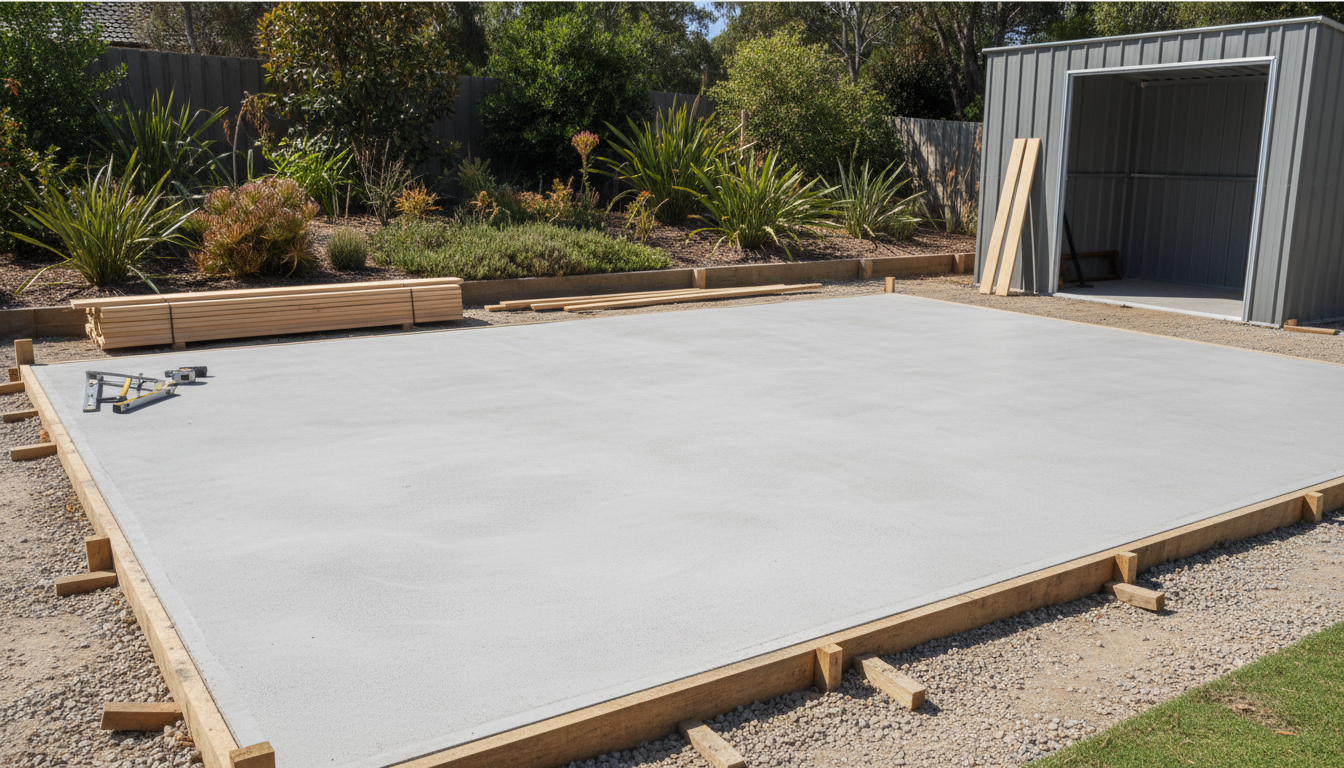
A concrete floor for garden sheds adds durability and is often a requirement for larger builds.
Quick definitions
What shed foundation do I need for my site and wind region?
Start with site and wind data. In Australia, shed footing design is governed by the NCC, AS 2870 (slabs and footings), and AS/NZS 1170.2 (wind actions). A geotechnical check or soil test is recommended for large or high-wind builds.
- Soils and slopes: Class A sand (Perth) is generally easy to compact. Class M/H reactive clays (Adelaide plains, Western Sydney) require thicker slabs, stiffer beams, or piers.
- Wind: Non-cyclonic Region A/B (Melbourne, Sydney, inland NSW) vs cyclonic Region C/D (North QLD, coastal Pilbara). Cyclone-rated sheds QLD require engineered tie-downs, increased anchorage and bracing.
- Usage: Heavy loads (4-post hoists, farm machinery storage) favour a concrete slab. Light garden sheds can sit on timber or engineered grids.
Ask for certified drawings with wind rating, hold-down schedule, and footing details. We supply wind-rated sheds for cyclonic areas, council-ready drawings, and engineering sign-off for council-approved sheds WA and across Australia. For extra peace of mind in severe weather zones, consider cyclone rated garden sheds.
Is a concrete shed foundation worth it?
A concrete slab remains the gold standard for garages, workshop sheds Brisbane-wide, and rural sheds NSW where vehicles and equipment are stored.
Pros
- Flat, durable, vermin-resistant surface
- Excellent racking resistance when chemset to shed columns
- Best for point loads, vehicle jacks, and hoists
Cons
- Higher upfront cost and curing time
- Harder to modify services later
Typical specs for a concrete shed foundation
- Base thickness: 100–120 mm for garden sheds; 120–150 mm for garages; thicker thickened edge or ribs on reactive clay per AS 2870
- Reinforcement: SL72 or SL82 mesh on 40–50 mm bar chairs; N12 at edges; control joints at 3–4 m centres
- Subgrade: 100–150 mm compacted road base to >95% MDD; proof-roll before pour
- Moisture: 200 μm vapour barrier lapped 200 mm and taped; upturn against edge formwork
- Drainage: Falls of 1:100 away from shed; spoon drain or strip drain at doorways
- Anchors: M12–M16 chemical anchors or cast-in bolts to engineer’s schedule
For coastal or industrial zones, specify 32–40 MPa concrete, adequate cover, and galvanised base plates to AS/NZS 2312 corrosion categories.
What’s the best timber shed base for a wooden shed?
A timber shed foundation suits small garden sheds, sloping blocks, or where you want airflow and easy services. Use H3/H4 CCA or ACQ-treated pine bearers and joists with ant caps and termite barriers.
Build approach
- Piers: 300 mm dia. concrete piers to engineer’s depth or galvanised screw piles; stumps at approx. 1.8–2.4 m centres
- Bearers/joists: 100 x 75 or 120 x 45 treated structural pine/galv RHS; joist spacing 450–600 mm
- Flooring: 17–19 mm structural ply or fibre-cement sheeting with waterproof membrane
- Tie-downs: Hot-dip galvanised brackets and cyclone tie-down kits in high-wind zones
Timber is fast and cost-effective; just plan termite management and splashback protection. For a base for a wooden shed in tropical QLD, elevate the floor and vent well to combat humidity.
Are there alternatives to a concrete slab for a shed?
Yes — ideal when you want speed, lower cost, or minimal excavation.
- Interlocking plastic grid systems on compacted crushed rock — a clean, permeable base for garden shed foundations
- Compacted road base with pavers — budget option for DIY shed kits and small base for storage sheds
- Galvanised steel subfloor on screw piles — excellent on reactive clays or flood-prone sites
- Hybrid: Perimeter strip footing with internal compacted fill — reduces concrete volume while maintaining edge anchorage
Each alternative needs correct anchorage to the shed frame, vermin-proof flashing, and drainage detailing to perform like a concrete shed foundation.
How to choose the right base for a storage shed
- Size and loads: Garden tools vs ride-on mower vs 4×4 and hoist
- Soil and slope: Sand, clay, or fill; need for piers or screw piles
- Wind rating: Region A–D, terrain category, shielding; design anchorage accordingly
- Climate and corrosion: Coastal (Zincalume vs Colorbond), humidity, frost
- Budget and speed: Slab for longevity; grids/timber for faster installs
We design and supply steel sheds Perth to Port Hedland with certified hold-downs. Ask about custom Colorbond garages Perth and custom carports Melbourne with matching foundations.
What Are the Best Shed Materials for Perth’s Climate?
Perth’s hot, dry summers and coastal salt mean heat reflection and corrosion resistance matter.
- Roof colours: Lighter Colorbond (Surfmist, Shale Grey) reduces heat load
- Insulation: Roof blanket or insulated sandwich panels cut internal temps and condensation
- Coatings: Colorbond steel resists chalking and salt better than bare Zincalume near the coast
How to Get Council Approval for Your Custom Shed in WA
Most sheds need a building permit. In bushfire areas (BAL), coastal zones, or larger footprints, approvals can extend. Here’s the fast path.
Action steps
- Check R-Codes and local planning overlays (setbacks, height, open space)
- Order site plan, slab/foundation plan, frame elevations, and engineering certificates (Form BA3 in WA)
- Confirm wind region (often Region A for metro Perth) and terrain category; include tie-down schedule
- Submit permit with owner-builder or builder details and specifications (foundations, drainage, stormwater)
- Book inspections: footing/slab pre-pour and final
Added 2024 WA wind-rating compliance notes: Councils now commonly request AS/NZS 1170.2 worksheets and anchor capacities. We supply these with every engineered kit.
Drainage, moisture and vermin-proofing best practice
- Grade soil away from slab at 1:20 for 1 m and add spoon or strip drains at doorways
- Use vermin seals, foam closures and flashings at wall/floor junctions
- Install damp-proof membranes and seal slab edges to reduce rising damp
Anchoring and tie-downs for wind-rated sheds
Anchorage resists uplift and racking. In cyclonic regions C/D, uplift is significant even on small sheds.
- Concrete slabs: M12–M16 chemset anchors, proof load to engineer’s spec
- Strip footings/pads: Cast-in hold-down bolts and strap bracing
- Timber floors: Through-bolted brackets to bearers and piles, cyclone-rated connectors
We engineer wind-rated sheds for cyclonic areas with full tie-down schedules, bracing layouts, and purlin/girt sizing to AS/NZS 4600.
What does a shed foundation cost in 2025?
Use these ballparks as a planning guide; always obtain site-specific quotes.
- Small garden shed (3 x 3 m) compacted base + pavers/grids: $800–$1,800
- Garden shed 100 mm concrete slab with SL72: $1,600–$2,600
- Double garage (6 x 6 m) 120–125 mm slab, SL82, thickened edge, saw cuts: $5,500–$8,500
- Timber subfloor on screw piles (6 x 3 m): $3,500–$6,000
Factors: access, excavation, cart-away, reactive soils, coastal concrete cover, engineer’s details, and cyclone upgrades.
Case studies: Shed foundations that work
Perth North (Joondalup) — 6 x 9 m Colorbond workshop
Site Class A sand. 120 mm slab, SL82, 32 MPa concrete, 200 μm vapour barrier. M12 chemical anchors at every column. Result: cool, clean, and square — perfect for a custom bench and compressor bay.
Melbourne East — 3 x 3 m garden shed on timber base
Reactive clay backyard with trees. Screw piles at 1.8 m centres; H4 bearers and H3 joists; ant caps and stainless mesh vermin proofing. Zero cracking and quick install without heavy excavation.
Townsville (Region C) — 9 x 7 m rural shed
Edge thickened slab with N16 starter bars and cast-in M16 hold-downs; additional strap bracing and door mullion upgrades. Certified as cyclone-rated sheds QLD for insurance compliance.
Colorbond vs Zincalume — Which is better for WA conditions?
| Feature | Colorbond | Zincalume |
|---|---|---|
| Coating | Pre-painted, baked-on finish over alloy-coated steel | Aluminium/zinc alloy-coated steel (no paint) |
| Heat performance | Lighter colours reflect heat better — ideal for Perth summers | Reflective, but can heat up; lacks colour choice benefits |
| Coastal resistance | Excellent with correct grade and maintenance | Good inland; caution in marine splash zones |
| Aesthetics | Matches home palettes (Monument, Surfmist, Basalt) | Industrial silver finish only |
| Cost | Higher upfront | More affordable |
| Best use | Premium homes, coastal, heat-prone regions | Budget builds, inland rural sheds |
We can supply both and advise on Colorbond vs Zincalume comparison for your microclimate.
5-Step Buying Guide for custom sheds in Australia
- Confirm purpose and loads: parking, workshop, storage, farm machinery
- Pick cladding and roof: Colorbond for coastal/heat; choose roof pitch (gable vs skillion) and insulation
- Select the foundation: slab, timber, or engineered alternative — matched to soil and wind region
- Engineering and approvals: request certified drawings, wind calcs, and footing design for your council
- Install and anchor: book pre-pour inspections, correct tie-downs, vermin and moisture control
If you plan to use professionals, check our garden shed installation experts guide.
FAQs
Do I always need a concrete slab for a shed?
No. Small garden sheds work on compacted base with pavers or on timber/steel subfloors. Garages and heavy workshops are best on a slab.
How thick should a concrete shed foundation be?
100–120 mm for light sheds; 120–150 mm for garages, with thicker edges or ribs on reactive clays per AS 2870.
What about cyclone areas?
In Regions C/D, use engineered tie-downs, upgraded bracing, and increased anchorage. We design wind-rated sheds for cyclonic areas with full certification.
Can I put a shed on pavers?
Yes for small sheds, if pavers are on a compacted, level base and the frame is anchored to piers or ground anchors as specified.
Do I need a vapour barrier?
Yes under concrete slabs — 200 μm polyethylene membrane per AS 2870 helps manage moisture and improves durability.
What roof is better — flat or gable?
Gable roofs shed water better and give usable height. Skillion can maximise boundary setbacks. Both need correct tie-downs in high winds.
Local standards, research and helpful resources
- Bureau of Meteorology climate maps — check rainfall, wind and cyclones
- Housing Industry Association (HIA) — building guidance and reports
- Australian Steel Institute — steel selection and corrosion guidance
- CSIRO — research on building materials and condensation
- Energy.gov.au insulation — reduce heat load in sheds
We track the “2025 Australian Steel Market Outlook” and the “2025 HIA Outdoor Structures and Home Improvement Report” to keep our shed kits and engineering current with market and regulatory changes.
Why choose us for your shed foundation and structure?
- Premium Bluescope Colorbond and Zincalume sheeting with engineered frames
- Design-to-site matching: soil class, wind region, terrain and shielding
- Complete permit pack: plans, calcs, and footing details for fast approvals
- Australia-wide delivery: steel sheds Perth, custom carports Melbourne, industrial sheds Adelaide, rural sheds NSW
- Options: DIY shed kits or turnkey install — affordable carports for Australian homes to bespoke workshops