
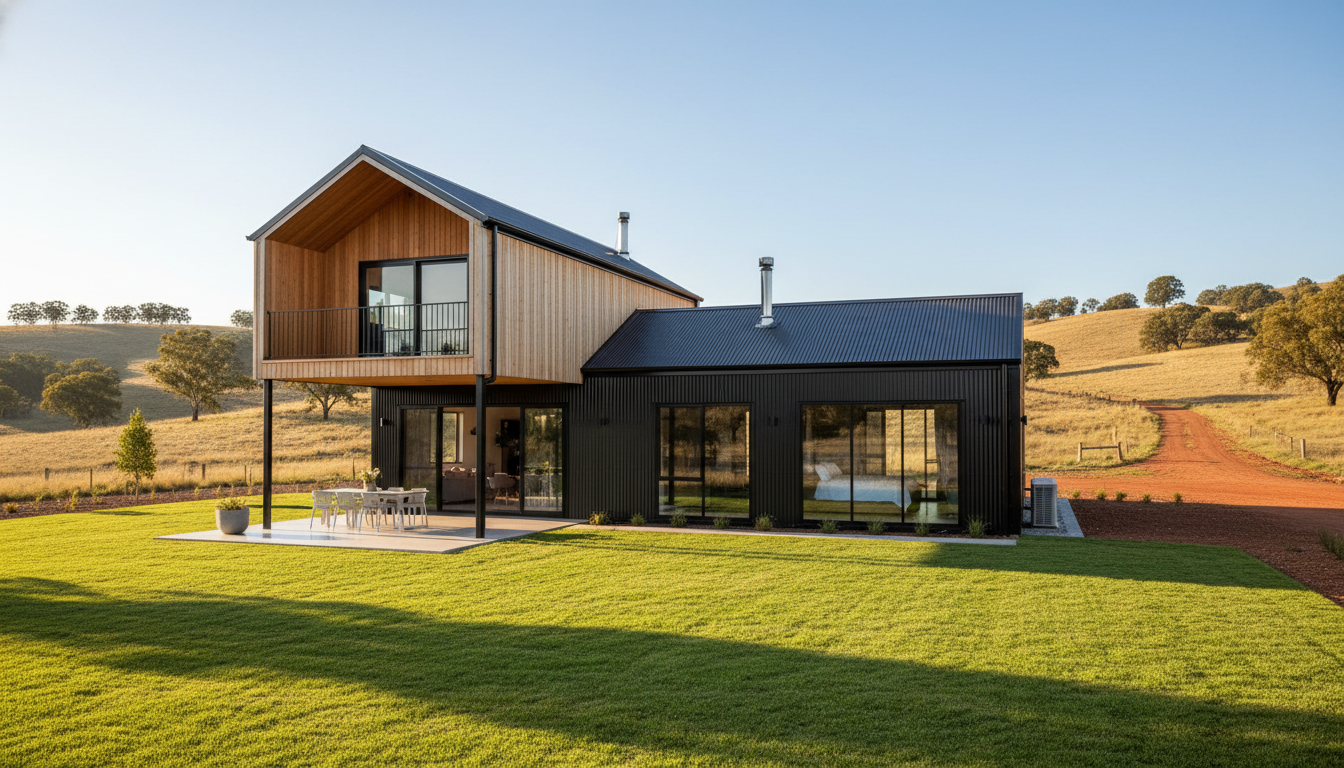
Build a compliant, comfortable shed home in Australia
Shed homes—also called house sheds, residential sheds or barn shed homes—let you combine the value of steel construction with smart, energy‑efficient living. Whether you’re planning a two storey shed with a loft in regional WA, a liveable shed in QLD’s cyclonic zones, or a compact modular shed house in Victoria, this 2025 guide explains costs, approvals, materials and design choices in plain English.
Added 2024 WA wind-rating compliance notes and updates from the 2025 Australian Steel Market Outlook and the 2025 HIA Outdoor Structures and Home Improvement Report.
Are “livable sheds” legal in Australia?
Yes—if they’re certified as Class 1a dwellings under the National Construction Code (NCC), not Class 10a outbuildings. “Livable sheds” marketed as easy conversions still need to be designed, engineered and inspected to meet dwelling standards.
- Structure: AS/NZS 1170.2 wind loads (including cyclonic Regions C and D), AS 4100 steel design, AS 1684 timber framing (if timber), AS 2870 slabs.
- Energy: Most states moving to 7‑star NatHERS and Whole‑of‑Home; check your state’s 2024–2025 adoption.
- Bushfire: AS 3959 BAL rating where applicable.
- Services: AS/NZS 3000 (wiring rules), AS/NZS 3500 (plumbing and drainage).
- Termites and moisture: AS 3660.1 termite management; sarking, vapour control and condensation detailing per NCC condensation provisions.
If your design stays as a residential shed (Class 1a) from day one, approvals are cleaner and resale value is stronger than “retro-fitting” a Class 10a.
What Are the Best Shed Materials for Perth’s Climate?
Greater Perth faces high UV, summer heat, afternoon sea breezes and coastal corrosion. For a Colorbond steel shed in regional WA or a custom Colorbond garage in Perth, prioritise corrosion resistance, thermal performance and wind rating.
| Feature | Colorbond Steel | Zincalume Steel |
|---|---|---|
| Coating | Painted alloy coating with baked finish | Aluminium-Zinc alloy coating (no paint) |
| Corrosion resistance (coastal) | Excellent with correct grade; select Ultra for severe C4–C5 zones | Good inland; increased risk near surf coasts without extra protection |
| Heat reflectance | High in lighter colours; helps reduce heat gain | Reflective initially; can dull over time |
| Aesthetics | Large colour range to match modern homes | Metallic silver-grey only |
| Price | Higher upfront | More economical |
| Best use | Custom dwellings, coastal builds, architecturally exposed facades | Budget builds inland; farm machinery storage |
For coastal or estuary sites (AS 4312 corrosivity C3–C5), specify marine-grade fasteners, cavity battens to ventilate cladding, and heavy-duty sarking. WA builds should also consider wind classifications up to Region D in the northwest—get engineered tie-downs, purlins and knee/haunch plates sized accordingly.
Pro Tip: Using insulated roof panels or anti‑condensation blanket with rigid insulation can reduce internal shed temperatures by up to 10°C in summer and prevent condensation drip.
Design Ideas
Explore simple façades, mixed-material cladding and internal mezzanine concepts to match your lifestyle and council requirements. Browse more inspiration in our Shed Pictures gallery.
Multi-Use Sheds
If you want livable units, a Shed with Granny Flat is popular for extended families.
How much do shed homes cost in 2025?
Costs vary by region, wind rating, BAL, insulation, finishes and whether you choose a DIY shed kit or a custom turnkey build.
- Shell-only (engineered steel frame, roof and wall cladding, doors/windows): from $1,200–$1,800/m² for simple single-storey in non-cyclonic areas.
- Lock‑up (plus slab, insulation, internal framing): from $1,800–$2,600/m².
- Turnkey Class 1a (kitchen, bathrooms, electrical, plumbing, lining): commonly $2,600–$3,800+/m² depending on region and spec.
- Two storey shed homes or barn loft designs: add 10–20% for stair, floor systems and bracing.
- Cyclone-rated sheds QLD (Region C/D), remote WA or BAL-29+: allow 15–30% uplift for engineering and materials.
According to recent industry commentary in the 2025 Australian Steel Market Outlook and HIA home improvement reporting, steel input prices have stabilised, but labour and logistics remain the main drivers. Design early, lock in quotes, and allow realistic contingencies (10–15%).
Which shed home layout suits my block and lifestyle?
Align your plan with site conditions and council requirements while using industry-specific design language that speeds approvals and quoting.
Barn, gable or skillion? Roof styles explained
| Roof Style | Strengths | Considerations | Great for |
|---|---|---|---|
| Gable | Classic look, good water shedding, easy mezzanine/loft | Higher ridge height may trigger planning overlays | Two storey shed homes, storage shed with loft |
| Skillion (mono) | Modern aesthetic, ideal for solar PV pitch, simple gutters | Careful with uplift on windward edge; flashing detailing key | Compact shed homes, carport integration |
| American Barn | Central high bay with lean-tos, striking façade | More flashing and junctions to detail in cyclonic regions | Barn shed homes Australia, rural sheds NSW |
2 storey shed, mezzanine or full upper floor?
- Mezzanine/loft: economical extra space; ideal for bedrooms or home office.
- Two storey shed (full second level): maximum floor area; needs engineered floor system, fire separation to garage bays and robust lateral bracing.
- Double storey shed with “drive-thru” central bay: popular in barn shed homes; provides undercover boat/van storage.
How do I make a shed comfortable year‑round?
- Thermal: Bulk wall insulation (R2.5–R4.0), roof R5.0–R6.0, insulated slab edge; sarking plus thermal break (minimum 20 mm) behind metal cladding.
- Acoustics: Resilient channels, acoustic batts in party walls (if attached garage).
- Moisture: Vapour‑permeable sarking outside, smart membrane inside in alpine or humid climates; ventilated cavities.
- Windows: Double glazing for energy and acoustic performance; appropriate BAL-rated windows in bushfire areas.
- Services: Whole‑of‑Home compliance—efficient hot water, lighting, HVAC, solar PV and battery where feasible.
What approvals do I need for a shed home?
Every state has a different pathway, but the core steps are similar: planning consent (if required), building permit, inspections, and occupancy certificate.
How to Get Council Approval for Your Custom Shed in WA
- Check your LPS/R-Codes setbacks, height, and any design review triggers.
- Obtain a site‑specific wind classification (non‑cyclonic or cyclonic) and corrosion mapping.
- Prepare Class 1a drawings: architectural plans, engineering certification (AS/NZS 1170.2, AS 4100), energy report, BAL assessment where relevant.
- Lodge for planning (if needed) then a certified building permit with a registered building surveyor.
- Book footing, frame and final inspections; secure occupancy permit.
If you’re comparing council-approved sheds WA providers, ask who supplies the certified documentation and coordinates the surveyor.
Queensland cyclonic areas (Regions C & D)
- Specify cyclone-rated sheds QLD with region-appropriate pressures, connections and cladding fasteners.
- Mezzanines and two storey shed homes require additional tie-down and diaphragm design—demand sealed calculations from the RPEQ engineer.
Victoria and NSW considerations
- Check overlays (bushfire, flood, heritage). Shed homes Victoria in BAL-29 or higher must detail ember protection, metal screens and non-combustible external walls where specified by AS 3959.
- Rural sheds NSW sited in agricultural zones may have different planning triggers but still require Class 1a compliance for habitable use.
DIY shed kits vs custom-built shed homes
| Option | Pros | Cons | Best for |
|---|---|---|---|
| DIY shed kits | Lower cost, fast supply, owner-builder friendly | You must manage engineering to Class 1a, trades, defects and inspections | Experienced owner-builders; simpler single-storey plans |
| Shed house kits Australia (pre‑engineered) | Bundled documentation; predictable finishes | Less design flexibility; site conditions can force changes | Budget-conscious builds on standard blocks |
| Custom-built (design and construct) | Tailored to site, wind/BAL, energy, and aesthetics; single point of accountability | Higher upfront price; longer design phase | Architectural outcomes; two storey shed homes; coastal or cyclonic regions |
Real Australian build examples
- Two storey shed home, Swan Valley WA: 220 m² gable roof with loft, Colorbond Ultra cladding, Region A N3 wind, BAL-12.5. 7‑star NatHERS with R6.0 roof batts and heat pump hot water. Practical completion in 22 weeks.
- Barn shed homes Australia, Townsville QLD: Central high bay with two lean-tos, cyclone-rated Region C, screw-fixed sheeting, increased hold-downs and cyclone washers. Whole‑of‑Home compliant with 6.6 kW solar.
- Livable sheds Tasmania (Huon Valley): Skillion roof with high‑performance double glazing, condensation management with vapour‑permeable wrap and ventilated cavity per cold‑climate detailing.
Common shed home configurations and keyword clusters
Popular searches we service include: shed homes AU, Australian shed homes, shed homes plans, modular shed dwellings, residential sheds, liveable sheds QLD, livable sheds Australia, liveable sheds QLD, livable sheds Tasmania, shed homes Brisbane, shed homes Victoria, shed house kits Australia, two story shed homes, two storey shed homes, double story shed, 2 storey shed homes, 2 storey shed, 2 story shed, two floor shed, 2 floor sheds, two storey shed, storage shed with loft, custom Colorbond garages Perth, steel sheds Perth, custom carports Melbourne, rural sheds NSW, affordable carports for Australian homes, DIY shed kits, wind-rated sheds for cyclonic areas, Colorbond vs Zincalume comparison.
5‑Step Buying Guide for Custom Sheds in Australia
- Site and zoning check: Identify wind region, BAL, flood, easements and height limits.
- Scope and budget: Decide shell vs lock‑up vs turnkey; choose Colorbond grade and insulation.
- Engineering and energy: Obtain certified structural design and a 7‑star pathway.
- Approvals: Secure planning (if triggered) and building permit. Confirm who handles inspections.
- Build quality: Demand a detailed inclusions list, corrosion specification, and warranty terms in writing.
Frequently asked questions about shed homes
Can I convert my existing shed into a house?
Yes, but it’s often cheaper to design as Class 1a from day one. Conversions require slab upgrades, bracing, insulation, energy compliance, glazing changes and full services certification.
Do two storey shed homes need extra engineering?
Absolutely. Expect engineered floor systems (LVL/steel joists), shear walls or portal frames, and robust stair, fire and balustrade compliance.
What wind rating do I need?
Your engineer will classify the site (e.g., N2–N4 non-cyclonic, C1–C4 cyclonic). Per AS/NZS 1170.2, tie-downs, cladding fasteners and member sizes are designed for your region and terrain category.
Is a carport part of a shed home?
Yes—many designs integrate custom carports or garages. We supply custom carports Melbourne to match façade colours, and council-approved sheds WA with attached carports as a single application, where planning allows.
What to look for in a shed home builder
- Proven Class 1a experience with steel‑framed dwellings, not just Class 10a sheds.
- Engineered designs stamped by appropriately registered practitioners (RPEQ/RPEng).
- Transparent inclusions: frame gauge, purlin size, fastener specification, sarking type, insulation R‑values.
- Local references in your climate—cyclone, alpine, coastal or bushfire.
- Clear warranty and aftercare; access to spare sheets and matching Colorbond colours for future repairs.
Local compliance quick references
- Standards: AS/NZS 1170.2 (wind), AS 4100 (steel), AS 2870 (slabs), AS 3959 (bushfire), AS 3660.1 (termites), AS/NZS 3000 (electrical), AS/NZS 3500 (plumbing), AS 4312 (corrosivity).
- Climate data: Use Bureau of Meteorology wind and temperature records for engineering assumptions.
- Energy: Check state adoption of 7‑star NatHERS and Whole‑of‑Home via your building surveyor or energy assessor.
Helpful resources:
Recommended Suppliers
Check top sellers in our Best Sheds Ad buyer’s guide to premium Colorbond options.