
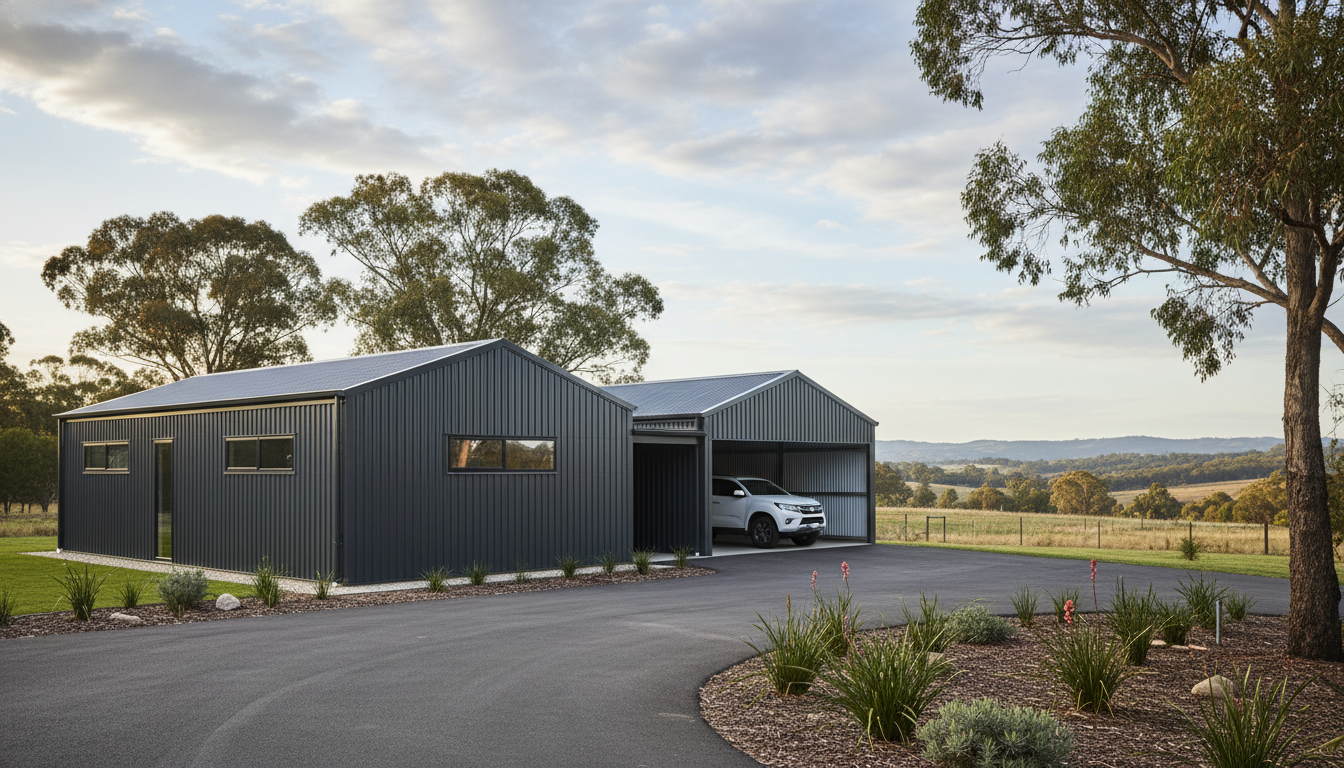
Smart shed storage solutions for Australian homes, rentals and upgrades
Building a shed isn’t just about four walls and a roller door. It’s about compliance, capacity, climate, and total cost of ownership. Whether you’re planning a rack shed for tools and pallets, a custom-built double garage in Perth, or rural sheds in NSW for farm machinery storage, this guide covers materials, wind ratings, council approvals, storage layouts, and what it really costs in 2025.
We reference Australian Standards and local conditions so you can compare DIY shed kits, custom Colorbond garages in Perth, cyclone-rated sheds in QLD, and affordable carports for Australian homes with confidence.
What are the best shed materials for Perth’s climate?
Perth’s hot summers, high UV, coastal air, and occasional storm fronts are tough on cladding and fixings. Two proven options dominate: Colorbond steel and Zincalume. Both are backed by BlueScope substrates and engineered for Australian conditions.
| Factor | Colorbond steel | Zincalume | Best for |
|---|---|---|---|
| UV resistance & colour stability | High. Painted finish resists chalking/fade; contemporary colours suit Perth builds. | Unpainted. Can weather to a dull patina; no colour options. | Homes where appearance matters (e.g., custom Colorbond garages Perth) |
| Coastal corrosion | Excellent with correct grade and maintenance; consider marine exposure limits. | Good but check distance from breaking surf; edges vulnerable if cut on-site. | Metro/suburban sites; coastal sites with correct specification |
| Thermal performance | Light colours reflect heat; pairs well with roof insulation and sarking. | Similar base performance; relies on insulation choice. | Hot roofs in WA/SA |
| Cost | Typically higher | Typically lower | Budget-driven builds and sheds not visible from street |
| Warranty | Long warranties when installed to spec; check terms. | Long warranties when installed to spec; check terms. | Both, provided compliance |
Tip: In coastal or industrial zones (corrosion categories C3–C4), specify marine-grade fasteners and flashings, and avoid field-cutting where possible. Consult CSIRO guidance on corrosion and durability, and local wind/salt maps from the Bureau of Meteorology.
How to design shed storage solutions that actually fit your gear
Start from what you need to store, then work back to a compliant design. This applies whether it’s a garden shed storage solution for bikes and mowers, a storage garage with 3.0 m clearance for a 4WD with racks, or a small warehouse garage for tradie stock. For a combination of large storage and accessibility, the 6m x 3m Shed is a versatile solution.
The 10×6 footprint remains a very popular compromise between capacity and footprint. The 10×6 Shed in Australia is ideal for storing bulky gear without taking up excessive yard space.
Clearances and door sizing
- Roller doors: 2.1–3.6 m high common; allow 100–150 mm headroom for the drum.
- Caravans/boats: Often require 2.7–3.1 m clear; allow towball height and aerials.
- Forklift access (rack shed): Check mast height; consider 3.6–4.5 m clear to underside of haunch.
- Bay spacing: 3–4 m for domestic; 6 m for wider vehicle access and future mezzanines.
Loads, slabs and racking
- Slab: 100–150 mm for domestic; thickened edge beams and N-class reinforcement as engineered.
- Racking: Comply with AS 4084 for pallet racking. Document design loads and seismic/impact protection.
- Mezzanine: Cold-formed steel mezzanines sized for 2.5–5.0 kPa live load depending on use.
- Drainage: Spoon drains and falls to manage Perth storm cells and protect footings.
What wind rating do you need? Australia‑wide compliance guide
Wind design is not optional. The National Construction Code (NCC 2022) and AS/NZS 1170.2 require every shed to be wind-rated for its location, terrain, shielding, and topography. In cyclonic areas (Regions C and D), portal frames, purlins, cladding and hold‑downs are upgraded and doors must be wind‑locked.
- Regions A/B (e.g., VIC, SA, much of NSW): Non-cyclonic N1–N4 ratings common; specify proper edge fasteners and door bracing.
- Regions C/D (e.g., coastal QLD, NW WA): Cyclonic C1–C4. Use cyclonic screws, extra cladding fasteners, heavier purlins, and certified wind‑rated roller doors.
- Terrain category: TC2 suburban, TC2.5 open edges; affects design pressure.
- Topography: Ridges/escarpments attract multipliers—often missed in DIY plans.
Added 2024 WA wind-rating compliance notes: In WA, many metro sites are Region A but exposed coastal or hill sites can uplift pressures significantly. For council‑approved sheds WA-wide, expect engineers to specify hold-down bolts, embedment depths, and slab edge thickenings beyond “standard” details.
How to get council approval for your custom shed in WA
- Confirm planning rules: Check setbacks, site coverage, and height with your local council or a private planner.
- Engineering: Obtain certified drawings to AS/NZS 1170.2 (wind), AS/NZS 4600 (cold‑formed steel), AS/NZS 4100 (steel structures).
- Site plan & stormwater: Nominate downpipes, soakwells or legal discharge points.
- BAL assessment (if applicable): For bushfire-prone areas per AS 3959; detail ember seals/vermin flashing.
- Building permit: Submit forms, fee, and owner/installer details. Allow 10–25 business days depending on council load.
Outside WA, processes vary, but the principles are similar. See guidance from HIA and Master Builders Australia.
Roof style, ventilation and insulation
| Roof type | Pros | Considerations | Use cases |
|---|---|---|---|
| Gable | Classic look, good airflow with ridge vent; efficient spanning. | Higher apex can trigger height limits; check setbacks. | Custom carports Melbourne; double garages; rural sheds NSW |
| Skillion | Modern aesthetic; easy solar panel orientation. | Windward uplift on high pitch; ensure purlin sizing. | Side-access storage garages; laneway builds |
| Flat (low pitch) | Low overall height; simple gutters. | Watch ponding; requires correct fall and box gutters. | Close boundary sites; garden shed storage solutions |
Add whirlybirds or ridge vents, plus wall louvres. In humid QLD, prioritise cross‑flow ventilation to manage condensation; in colder TAS/ACT, include vapour‑permeable sarking.
Storage solutions inside the shed: racking, shelving, and layouts
- Rack shed layouts: 2.4–2.7 m aisle for pallet jacks; 3.0 m+ for small forklifts. Install backstops and column guards.
- Garden shed storage solutions: Use wall‑mounted rails, mower bays, bike hooks, and sealed chemical cabinets with bunding.
- Mezzanine floors: Add 15–25 m² per bay for seasonal storage; include stair compliance and handrails.
- Workbenches and power: 20 A GPO near welders/compressors; LED high-bays with motion sensors.
- Vermin and weather: Vermin flashing, threshold seals, and cavity baffles reduce dust, snakes and mice—critical for rural sheds.
DIY shed kits vs custom-built installation
| Aspect | DIY shed kits | Custom-built (supply & install) |
|---|---|---|
| Cost | Lower upfront; you handle slab, erection, and permits. | Higher upfront; turnkey option often faster overall. |
| Compliance | Engineering supplied, but you must build exactly to plans. | Builder manages permits, inspections, QA, and certifications. |
| Customisation | Module-based; add-ons available. | Full custom: eave height, bay spacing, door mix, colours. |
| Time | Flexible, but DIY build can run over if weather or help falls through. | Scheduled crew; shorter on-site time for complex builds. |
| Best for | Smaller garden sheds, basic storage garages, remote sites. | Custom Colorbond garages in Perth, warehouse garage fitouts, cyclone-rated sheds QLD. |
Real Australian build examples
Case study A — Custom-built double garage in Perth
- Spec: 7.0 m x 7.0 m, 2 bays, 2.7 m eave, Colorbond Matt roof/walls, 2x wind‑rated roller doors, vermin flashing.
- Fitout: 20 m² mezzanine, bike rails, 15 A compressor circuit, polycarbonate skylight sheets.
- Compliance: Region A, TC2, N2 design, slab 120 mm with thickened edge beams. Added 2024 WA wind-rating compliance notes incorporated in engineering.
- Outcome: Storage for two vehicles plus racks and a workbench; heat drop with insulation/vents noticeable in summer.
Case study B — Cyclone-rated boat and caravan shed, QLD
- Spec: 10 m x 6 m, 3.3 m clearance, C2 cyclonic design, wind‑locked roller, extra cladding fasteners, heavier purlins.
- Fitout: Skillion roof for solar, large louvres for cross‑ventilation, corrosion‑resistant fixings.
- Outcome: Passed council wind certification; remains serviceable after summer storm season.
How much does a custom shed cost in Australia in 2025?
Actual pricing depends on size, wind region, access, finishes, and approvals. Indicative ranges to help budget:
- Garden shed kits (quality steel): Roughly $1,200–$3,500 supplied; add slab and anchors.
- Single steel garage kits: Roughly $5,500–$12,000; installed turnkey can land $12,000–$22,000+.
- Double garages/custom Colorbond garages: Roughly $9,000–$18,000 kit; $18,000–$35,000+ installed depending on doors, height, and slab.
- Rural sheds/warehouse garage: From $35,000 for small spans to $120,000+ for large enclosed spans with doors, mezzanine and services.
Lead times: Steel supply has stabilised, but according to the 2025 Australian Steel Market Outlook and the 2025 HIA Outdoor Structures and Home Improvement Report, demand remains solid. Allow 4–10 weeks for manufacturing and 2–8 weeks for approvals, varying by council and season.
5‑Step Buying Guide for Custom Sheds in Australia
- Define the load: Vehicles, racking, machinery. Set door sizes, eave height, bay spacing.
- Pick materials: Colorbond for looks and UV; Zincalume for cost‑effective function; specify marine fasteners if coastal.
- Engineer for wind: Confirm region (A–D), importance level, terrain category; ensure wind‑rated doors and tie‑downs.
- Secure approvals: Submit engineered drawings, site plan, drainage, and BAL details where required.
- Fitout smart: Insulation, ventilation, power, lighting, and storage systems tailored to use.
Common FAQs about shed storage solutions
Do I need a permit for a shed?
Nearly always for structures with fixed footings, especially storage garages. Size thresholds and setbacks vary by council. Plan for engineering to AS/NZS 1170.2 and the NCC.
Colorbond or Zincalume?
For street‑facing structures or hot WA roofs, Colorbond often wins. For hidden or budget builds, Zincalume is fine. See the comparison above and verify warranty conditions for your exposure category.
What slab do I need?
Domestic 100–120 mm is common; heavy point loads (racks, hoists) may require thickened beams or pads. Get site‑specific engineering.
Can I add a mezzanine later?
Yes, if the portal frames and slab can take it. Plan bay spacing, stair location, and loads during design.
What about bushfire areas?
Nominate BAL, then select ember seals, metal screens, and non‑combustible cladding per AS 3959 and local planning overlays.
How do cyclonic sheds differ?
Heavier members, closer fastener spacing, wind‑locked doors, and more robust hold‑downs. Ask for documented C‑class engineering (C1–C4).
Key shed types and keyword clusters to consider
Optimise for local searches and use‑cases:
steel sheds Perth
custom carports Melbourne
rural sheds NSW
cyclone-rated sheds QLD
council-approved sheds WA
custom Colorbond garages Perth
DIY shed kits
affordable carports for Australian homes
farm machinery storage
storage garages
warehouse garage
rack shed
garden shed storage solutions
wind-rated sheds for cyclonic areas
Colorbond vs Zincalume comparison
shed builders Adelaide
garage kits Sydney
double garage Perth
bushfire BAL-rated sheds
boat and caravan covers
For local installation and customization, see Garden Sheds Campbellfield.
Specifications checklist you can copy into your brief
- Span x length x eave height; roof: gable/skillion, pitch.
- Wind region (A–D), terrain category, Importance Level; BAL if applicable.
- Cladding: Color and finish (Colorbond), or Zincalume; marine fasteners if coastal.
- Doors: Roller (wind‑rated), PA doors, glass sliders; clearances.
- Slab: Thickness, edge beams; hold‑down anchors.
- Ventilation: Ridge vent/whirlybirds; louvres; insulation and sarking.
- Fitout: Racking/mounting points, mezzanine, lighting, GPOs, compressor/EV outlet.
- Drainage: Gutters, downpipes, soakwells or legal discharge.
- Compliance documentation: Certified engineering, plans, warranties, O&M manuals.
Local context, standards and further reading
- Australian Steel Institute — technical notes on steel durability and design.
- Bureau of Meteorology — check local wind and climate data.
- Standards Australia — overview of AS/NZS 1170.2, AS/NZS 4600, AS/NZS 4100, AS 3959, AS 4084.
- HIA resources — permitting and building advice for outbuildings.
- CSIRO factsheets — building performance and materials guidance.
Ready to plan your shed?
From garden shed storage solutions to large storage garages and rack sheds, we engineer for your wind region, submit council packs, and install in line with Australian Standards. Ask about council‑approved sheds WA, cyclone-rated sheds QLD, and custom Colorbond garages in Perth to suit your site, budget and timeline.