
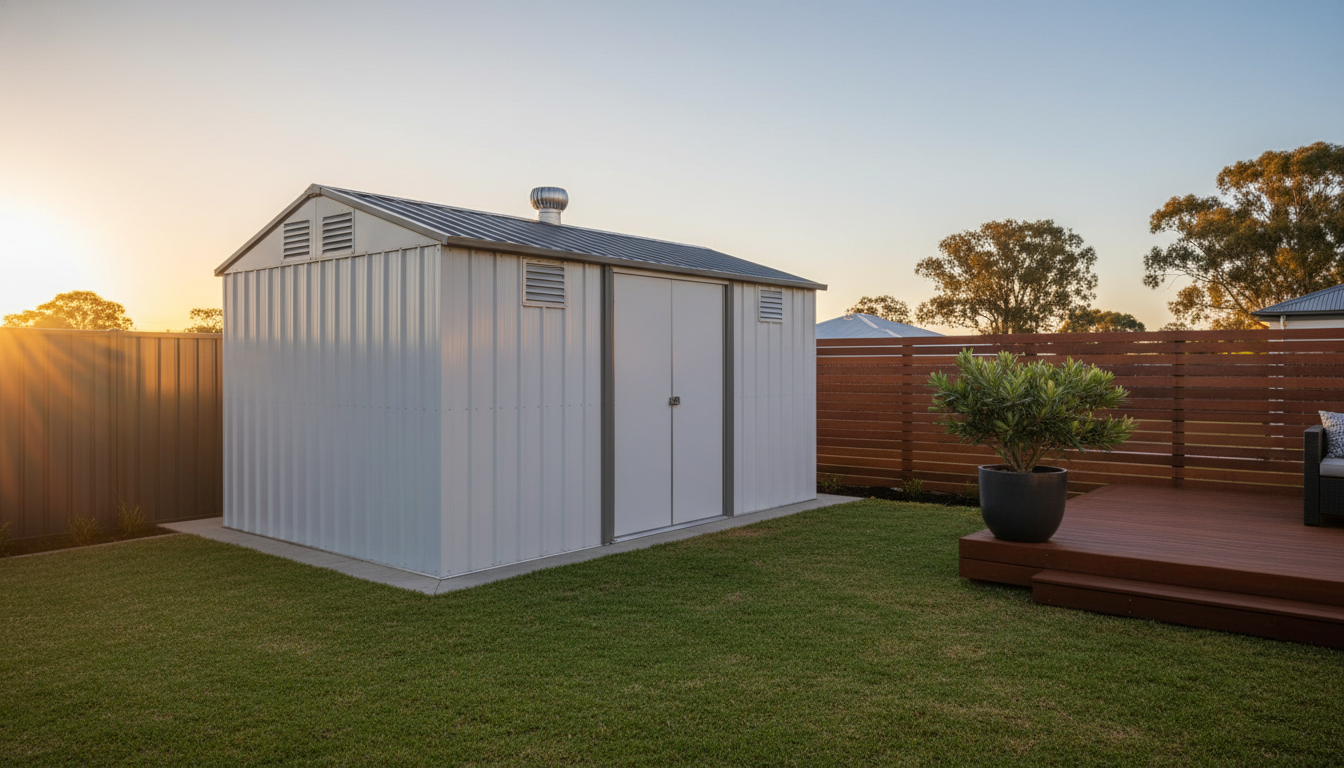
Pro tip: Did you know using insulated roof panels or an anticon blanket can reduce internal shed temperatures by up to 10°C in summer and slash condensation in winter? Pair insulation with well-positioned shed air vents for the best result.
Why shed ventilation matters in Australia
- Heat management: Perth and inland WA routinely see 35–45°C. Hot, trapped air accelerates roof-sheet aging and ruins stored goods.
- Condensation control: Humid QLD and cool Tasmanian mornings can cause dripping roofs. Correct garden shed ventilation avoids mould, rust and swollen cabinetry.
- Fume and moisture removal: Paints, fuels, mowers and pressure cleaners emit vapour. Storage shed vents keep the air safer.
- Material longevity: Proper airflow helps Colorbond or Zincalume coatings last longer, especially in coastal C4–C5 corrosivity zones.
- NCC/standards alignment: The National Construction Code (NCC 2022) and condensation guidance recognise ventilation as a key moisture management strategy.
What are the best shed ventilation options?
Passive wall and roof vents (low maintenance)
- Louvre wall vents: Durable, high free-air area. Great as garden shed air vents near the floor for intake. Add insect mesh and, in bushfire zones, ember screens.
- Eave/soffit vents: Continuous intake along eaves to feed ridge or roof vents. Works well on gable and skillion roof sheds.
- Ridge vents: Run along the ridge to exhaust hot air. Look for purpose-designed ridge-cap vents compatible with Colorbond profiles (e.g., Trimdek, Corrugated).
- Gable vents: Simple retrofit on gable ends; pair one high exhaust vent with low-level intake on the opposite wall for crossflow.
Wind-driven roof ventilators (“whirlybirds”)
- Move hot air without power. Choose models with sealed bearings and UV-stable caps.
- For cyclonic regions, select a wind-rated ventilator tested to AS/NZS 1170.2 loads and install with a cyclonic fix kit.
Powered exhaust and solar vents
- Solar roof vents: Ideal for remote or rural sheds. Auto-ramp with sun intensity.
- 240V fans: Best for large workshops or farm machinery storage. Use corrosion-resistant housings and weatherproof (IP) ratings.
Doors, windows and controlled crossflow
- Venting works best when you combine low intake and high exhaust on opposite sides to sweep heat and moisture out.
- Add door grilles or trickle vents if your shed is tightly sealed.
How much vent area does my shed need?
For most non-habitable Colorbond steel sheds, a practical rule of thumb is:
Target NFVA ≈ 1/250 of floor area, split roughly 50% intake (low) and 50% exhaust (high).
Always check manufacturer requirements and local engineer notes, especially in cyclone or bushfire areas.
Worked examples
- 3 × 3 m garden shed (9 m²): NFVA target ≈ 0.036 m² (360 cm²). Use two 200 × 200 mm louvre vents low on one wall (intake) and one 300 mm circular eave vent or a small ridge vent (exhaust).
- 6 × 9 m workshop (54 m²): NFVA target ≈ 0.216 m² (2,160 cm²). Use four 300 × 300 mm wall louvres as intake and 1–2 wind-driven roof ventilators or a continuous ridge vent as exhaust.
Colorbond vs Zincalume — Which is better for WA conditions?
Both are premium BlueScope steel coatings used across Australia. Choice depends on location, budget, and appearance.
| Feature | Colorbond Steel | Zincalume |
|---|---|---|
| Finish | Pre-painted with durable colour topcoat (many Colorbond colours) | Metallic alloy finish (silvery) |
| Heat reflectivity | High with light colours; helps reduce heat load | Good reflectivity; can glare in strong sun |
| Coastal performance | Choose Colorbond Ultra/SS for C4–C5 marine zones | Good, but generally less resistant in heavy marine spray |
| Aesthetics | Colour-matched vents, flashings and gutters | Industrial look; fewer colour-match options |
| Cost | Higher upfront | More affordable |
| Best fit (WA) | Urban Perth, coastal towns, premium custom Colorbond garages Perth | Regional WA farm sheds, machinery storage where budget matters |
Tip: If you’re comparing coatings, ask for a Colorbond vs Zincalume comparison warranty statement and specify vent flashings in the same finish to avoid galvanic mismatch.
Climate-specific ventilation advice across Australia
- Perth & regional WA: Prioritise high exhaust (ridge vents or whirlybirds) and light-colour roofs. Added 2024 WA wind-rating compliance notes: Region A non-cyclonic for Perth; ensure fixings meet AS/NZS 1170.2 for local site wind speed. Consider Colorbond Ultra near the coast.
- North QLD, NT, WA Pilbara (cyclonic Regions C & D): Use cyclone-rated sheds QLD hardware and engineer-certified fixings. Select wind-rated roof ventilators and low-profile ridge vents with high pull-out resistance. Sealants and screws must meet cyclonic specs.
- Coastal NSW & SE QLD: Combine eave intake with ridge exhaust; specify stainless or class 4 fasteners for salt exposure. Integrate vents with sarking to manage wind-driven rain.
- VIC high country & TAS: Focus on condensation control: anticon blanket + controlled ventilation. Position low-level intake away from prevailing winter winds.
- SA & inland NSW: Thermal load is high in summer; add solar roof vents for workshops that store paints and adhesives.
How to get council approval for your custom shed ventilation and design
How to get council approval for your custom shed in WA
- Check planning: Site setbacks, height, and roof form. Many councils allow compliant outbuildings via a Building Permit with certified plans.
- Provide certified drawings: Include vent types, positions, BAL screening, and fixings. Engineer to AS/NZS 1170.2 wind loads; note Region A or cyclonic where applicable.
- Specify materials: Colorbond grade, corrosion category (AS 4312), insulation/anticon, and any powered fans.
- Document drainage/overflow: Eave venting must not compromise gutter performance. Show overflows and downpipes per NCC and local codes.
- Submit: Apply for a council-approved shed WA Building Permit (BA2/BA3) with site plan, engineering, and energy/condensation notes if requested.
For other states, your shed company should handle council or private certifier approvals and provide RPEQ/RPEng certification for wind-rated sheds for cyclonic areas and BAL compliance where needed.
Installation: retrofitting garden shed vents to an existing Colorbond shed
- Choose vent type and tally NFVA. Plan low intake and high exhaust on opposite faces.
- Mark and cut openings with aviation snips or a nibbler. Use edge protection paint.
- Fit vents with butyl tape or foam gaskets. Fix using class 3/4 roofing screws with neoprene washers.
- Seal around penetrations with neutral-cure sealant. Avoid acidic silicone on coated steel.
- For whirlybirds: fit the correct base to your roof profile; secure to purlins; add cyclonic kit if required.
- Finish with BAL-compliant ember screens (2 mm mesh) where applicable.
5-Step Buying Guide for Custom Sheds in Australia
- Define use: Garden tools, DIY workshop, farm machinery storage, or custom Colorbond garages Perth for vehicles? Ventilation levels vary.
- Pick materials: Compare Colorbond vs Zincalume; match vents and flashings. Consider anticondensation blankets and insulation.
- Engineer for site: Wind region (A–D), terrain category, BAL rating, and corrosion category. Select wind-rated vents if in cyclonic zones.
- Ventilation plan: Size NFVA ≈ 1/250 floor area. Combine intake (eave/wall) with exhaust (ridge/roof fans).
- Approvals & install: Aim for a council-approved shed. Use licensed installers; keep warranties and maintenance schedules.
Case studies: real Australian shed ventilation setups
Perth, WA — 6 × 9 m Colorbond workshop
- Use: DIY and lawn equipment.
- Spec: Colorbond Surfmist roof/walls, anticon blanket, two 300 mm wind-driven roof ventilators, four 300 × 300 mm wall louvres low on south wall.
- Outcome: Peak internal temps dropped ~7–9°C on 38°C days; no condensation drips in winter.
Townsville, QLD — 7.5 × 12 m cyclone-rated shed
- Use: Boat and trailer storage.
- Spec: Region C wind design, cyclonic fixings, low-profile ridge vent, wind-rated roof ventilator with tie-down kit, BAL not applicable.
- Outcome: Strong crossflow with secure fixings; approved by private certifier with AS/NZS 1170.2 documentation.
FAQs: garden shed ventilation and storage shed vents
Do small garden sheds really need vents?
Yes. Even a 3 × 3 m shed benefits from one low intake and one high exhaust shed vent to reduce heat, moisture and smells.
Will a whirlybird make my shed dusty or leaky?
Quality units with proper bases and gaskets do not leak. Dust issues usually come from unsealed wall laps and door gaps—seal those and add insect mesh.
What about bushfire areas?
In BAL zones per AS 3959, all garden shed vents must be screened with 2 mm corrosion-resistant mesh. Some areas may require closable vents—confirm with your certifier.
How do I stop condensation?
Combine ventilation with an anticon blanket or insulated roof panels, install sarking, and avoid moisture sources on the slab. Good crossflow is essential.
Do I need powered fans?
For large workshops, powered or solar fans help. For small garden sheds, passive intake plus ridge or whirlybird exhaust is usually enough.
Can vents void my roof warranty?
No, if installed per the vent and roof manufacturer’s instructions with compatible fixings and sealants.
Related searches we serve across Australia
steel sheds Perth, custom carports Melbourne, rural sheds NSW, industrial sheds Brisbane, American barns Victoria, skillion roof sheds Adelaide, double garage shed Sydney, DIY shed kits, affordable carports for Australian homes, farm machinery storage, cyclone-rated sheds QLD, council-approved sheds WA, custom Colorbond garages Perth, Colorbond vs Zincalume comparison, wind-rated sheds for cyclonic areas, shed condensation control, garden shed vent options, shed ridge cap vent, shed air vents.
Standards, data and further reading
- Australian Building Codes Board (NCC 2022 and condensation guidance)
- Bureau of Meteorology climate zones and cyclones
- Energy.gov.au — insulation and building guidance
- Australian Steel Institute
- Housing Industry Association (HIA) — Outdoor structures insights
Industry reports referenced: “2025 Australian Steel Market Outlook” and “2025 HIA Outdoor Structures and Home Improvement Report”. Applicable standards include AS/NZS 1170.2 (wind actions), AS 3959 (BAL), and AS 4312 (atmospheric corrosivity categories).