
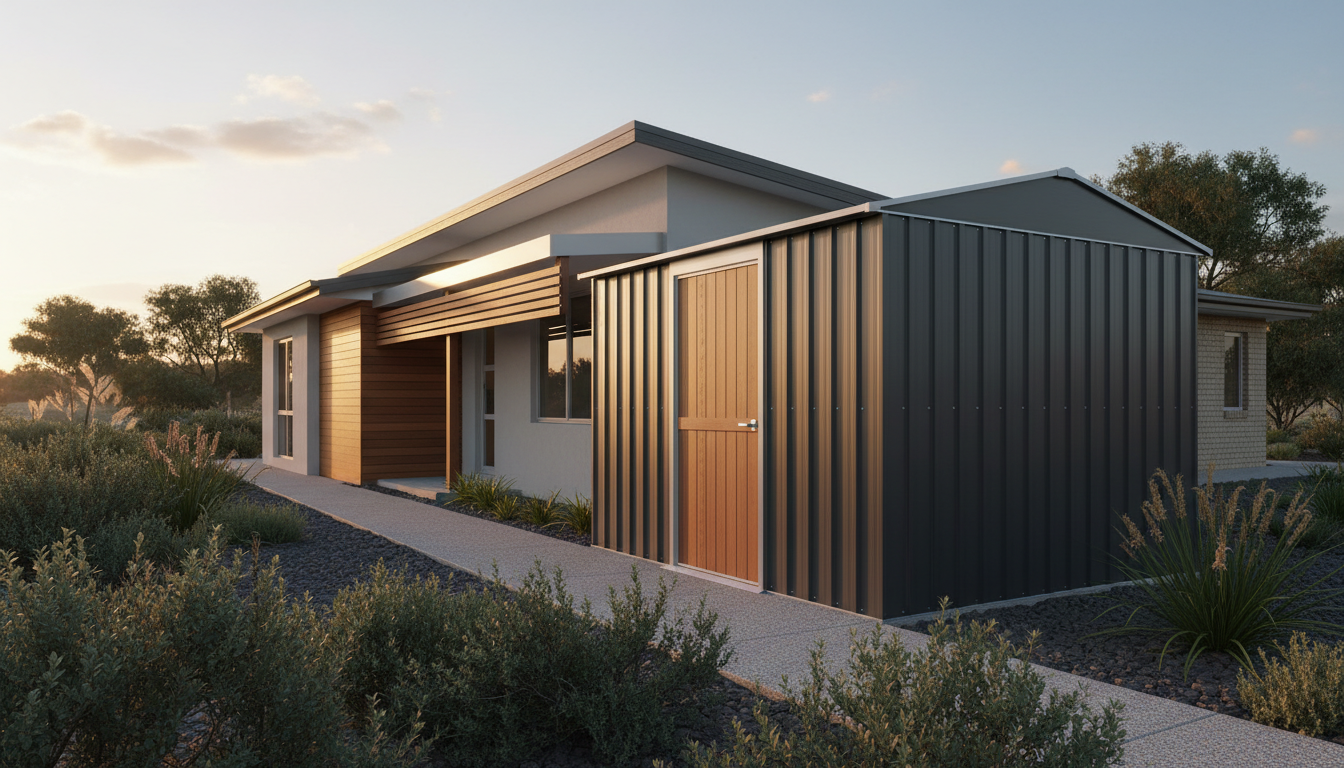
Looking to turn that narrow strip down the side of your house into real storage? A purpose-built, side of house shed—often called a slimline or space‑saver shed—adds secure storage without sacrificing backyard space. Below, you’ll find everything from material selection and wind ratings to council-approved sheds WA, cyclone design for QLD, and smart door options for tight access.
What is a “side of house shed” and why it’s different
A side of house shed is a slimline structure designed to fit narrow setbacks—typically 0.8–1.5 m between dwelling and boundary. It prioritises:
- Compact widths and longer lengths
- Skillion (mono) or flat roofs to meet height/setback rules
- Side entrance (door on the long side) to suit tight pathways
- Enhanced drainage and vermin/leaf control in confined spaces
Why side-of-house installs need extra attention
- Setbacks and fire separation: Local rules may require a setback to boundary or fire-rated construction if closer. Always check NCC 2022/your council’s planning scheme.
- Drainage: Tight corridors trap water and leaf litter—plan gutters to stormwater, leaf-guarding and splashback protection for walls.
- Access during construction: Allow 600–900 mm working space or plan a panel-by-panel build if access is tighter.
- Maintenance clearance: Many councils require clear access for maintenance along a side boundary.
What Are the Best Shed Materials for Perth’s Climate?
Perth’s hot summers and coastal exposure mean your shed cladding and roof need heat resistance and corrosion performance. Colorbond steel in lighter solar-reflective colours generally runs cooler and resists fading. For coastal or industrial zones, specify marine-grade fasteners and extra corrosion protection.
Colorbond vs Zincalume — Which Is Better for WA Conditions?
| Feature | Colorbond Steel | Zincalume Steel |
|---|---|---|
| Coating/Finish | Painted, pre-finished colour over zinc/aluminium/magnesium base | Zinc/aluminium/magnesium alloy coating, silvery finish |
| Heat Performance | Light colours reflect more heat; Thermatech pigments available in many colours | Good reflectivity initially; can dull over time |
| Coastal Resistance | Strong, but specify correct grade and maintain wash-down zones near surf coasts | Capable, but more prone to aesthetic spotting near marine air if not maintained |
| Aesthetics | Modern palette, matches gutters/fascia; premium look | Industrial look; can be painted later |
| Cost | Higher upfront | More affordable |
| Best For | Homes seeking a premium, colour-matched finish (Perth metro and coastal) | Budget-friendly installs, out-of-sight utility areas |
Pro Tip: Did you know using insulated roof panels can reduce internal shed temperatures by up to 10°C in summer? Pair with whirlybirds or slot vents for airflow.
Choosing sizes, doors and layouts for a side entrance shed
- Common slim widths: 0.8 m, 1.0 m, 1.2 m, 1.5 m; lengths from 2–12 m+
- Side entrance: Sliding doors save swing space; hinged doors need at least 1 m clear opening arc
- Roof pitch: 2–5° skillion sheds keep low profiles; fall the roof away from neighbour fences if possible
- Gutters/downpipes: Direct to legal stormwater; avoid discharging to neighbours
- Security: Deadbolts and concealed fixings for laneway-accessed sheds
Engineering, wind ratings and Australian Standards
Every shed in Australia must be designed to site wind conditions and terrain per AS/NZS 1170.2. For cold‑formed framing, AS/NZS 4600 applies. Cyclone regions (QLD north, WA north) require specific detailing and fixings.
- Non-cyclonic metro (e.g., Perth, Melbourne, Sydney): typically N2–N3
- QLD and WA cyclone-prone: C1–C2 or higher; specify cyclone-rated sheds QLD with engineer-certified plans
- BAL (bushfire) sites: BAL‑12.5 to BAL‑FZ may require metal cladding, ember-sealing, and non-combustible eaves
Added 2024 WA wind-rating compliance notes
Western Australia local governments often request proof of wind classification and fixings. Ensure your supplier provides a WA-registered engineer’s certificate, slab/anchor specs, and tie-down schedules scaled for your address (Region A vs cyclonic North West).
How to Get Council Approval for Your Custom Shed in WA
Many slimline sheds are exempt or “deemed-to-comply” if they meet size, height, and setback rules, but always confirm. For council-approved sheds WA:
- Call your local council planning desk with your site address and proposed dimensions
- Check setbacks, maximum wall height at boundary, stormwater connection and materials
- Obtain site-specific engineering (wind class, footing/anchors, framing certs)
- Submit plans (site plan, elevations, engineering certs) for building permit if required
- Book inspections for slab (if applicable) and final installation when mandated
Other States at a Glance
- QLD: Cyclonic zones demand certified wind-rated sheds for cyclonic areas; councils scrutinise tie-downs and door ratings
- NSW: Check for easements and stormwater rules; gutters cannot discharge onto neighbours
- VIC: Inner suburbs often limit wall height on boundary—low-pitch skillion helps compliance
Foundations, drainage and corrosion control
- Base: 100–120 mm concrete slab with mesh for most sizes; or engineered piers with formply floor for tight sites
- Moisture: Install plastic vapour barrier under slabs; add step downs or thresholds to keep water out
- Gutters: Fit leaf guards; pipe downpipes to legal discharge points
- Corrosion: Use hot-dip galvanised or stainless fixings near coast; specify Bluescope base steel where possible
- Vermin: Flashings and door seals stop leaves, dust and pests in narrow corridors
DIY shed kits vs custom-built installation
DIY shed kits are budget-friendly and fast to deliver, but tight sites and compliance can favour a custom-built install.
- DIY shed kits: Great for straight runs, level bases, simple N2 sites; look for Australian-made, Bluescope steel, and 20-year warranties
- Custom-built: Best for side entrance doors, stepped slabs, BAL or cyclone regions, or when seeking a custom Colorbond garages Perth aesthetic match
Real Australian build examples
Perth, WA — 4.5 m x 0.9 m Side Entrance Slimline
- Cladding: Colorbond Surfmist with matching gutter
- Roof: 3° skillion falling to garden side; leaf-guarded gutter
- Wind class: N2; engineer-certified tie-down to slab chemset anchors
- Door: 1.2 m sliding side entrance to avoid door swing
- Outcome: Bin storage + bikes; zero impact on backyard lawn
Townsville, QLD — 6.0 m x 1.2 m Cyclone‑Rated Narrow Shed
- Wind region: C; door and frame upgraded to C2 rating
- Fixings: Heavier purlins, cyclone washers, and additional hold‑downs
- Result: Safe storage for tools and fishing gear without encroaching on patio
Melbourne, VIC — 5.4 m x 1.5 m Slimline with Side Door
- Planning: Kept wall height to meet boundary controls
- Thermal: Anticon to reduce summer heat under Colorbond roof
- Access: Side entrance sliding door clears 900 mm pathway
Estimated costs in 2025 (guide only)
- DIY slimline kits (Colorbond): $900–$2,800 depending on size and wind class
- Custom side entrance sheds, installed: $3,500–$9,000+ (engineering, slab, drainage can add $1,500–$4,000)
- Cyclone upgrades (QLD/WA North): +10–25% for heavier framing and doors
Note: Pricing varies with steel markets and labour. See the Australian Steel Institute and the “2025 Australian Steel Market Outlook” for context.
5-Step Buying Guide for Custom Sheds in Australia
- Measure your corridor: width, length, eave heights, and any taps or meters in the way
- Confirm compliance: setbacks, height limits, stormwater, BAL, and wind class
- Choose materials: Colorbond vs Zincalume, roof pitch, insulation, and door style
- Engineer and quote: demand site-specific engineering and a clear inclusions list (gutters, seals, anchors)
- Plan install: prepare base, book delivery, allow access for panels, and schedule inspections if required
Keyword clusters to help you plan
- Local/Service: steel sheds Perth, rural sheds NSW, custom carports Melbourne, affordable carports for Australian homes
- Technical: Colorbond vs Zincalume comparison, wind-rated sheds for cyclonic areas, BAL-rated sheds, engineer-certified shed kits
- Usage: slimline shed, narrow garden sheds, space-saver sheds, side access shed, DIY shed kits, farm machinery storage (for larger rural blocks)
FAQs: Side of house sheds in Australia
How close can I build to the fence?
Rules vary. Many councils allow walls on boundary up to a set height and length, or require setbacks. Always confirm your local planning scheme and NCC fire separation rules.
Do I need council approval?
Small sheds may be exempt, but height, boundary walls, cyclonic or BAL sites usually need approval. Get written confirmation and keep your engineer’s certificate.
What’s the best door type in a narrow corridor?
Sliding doors or roller doors reduce swing space. For cyclone zones, ensure the door is wind-rated.
Will a flat roof leak?
Use a low-pitch skillion (2–5°) with correct sheet laps, sealed penetrations, and gutters to stormwater. Regularly clear leaves in tight corridors.
What colours perform best in heat?
Lighter Colorbond colours reflect more heat. Combine with Anticon or insulated roof panels for comfort.
Can I install on pavers?
Anchoring to a properly engineered slab is best. Pavers can shift; if not using a slab, use engineered footings and a framed floor.
What warranties should I expect?
Look for Australian-made steel and up to 20-year manufacturer warranties on cladding. Keep maintenance and wash-down per the warranty terms.
Get it done right
Whether you want a simple DIY slimline kit or a fully engineered, cyclone-rated side entrance shed, specify Australian Standards compliance, site wind class, stormwater, and proper fixings. Want help designing a premium Colorbond steel shed for regional WA or metro Perth? Ask for engineered drawings, council assistance, and an installation plan that suits your site.
Citations and further reading
- Housing Industry Association (HIA)
- Master Builders Australia
- Standards Australia (AS/NZS references: 1170.2, 4600)
- Bureau of Meteorology — wind regions and climate
- CSIRO — bushfire and building research
- Energy.gov.au — insulation guidance
- Australian Steel Institute — market and specification
- 2025 HIA Outdoor Structures and Home Improvement Report
- 2025 Australian Steel Market Outlook