
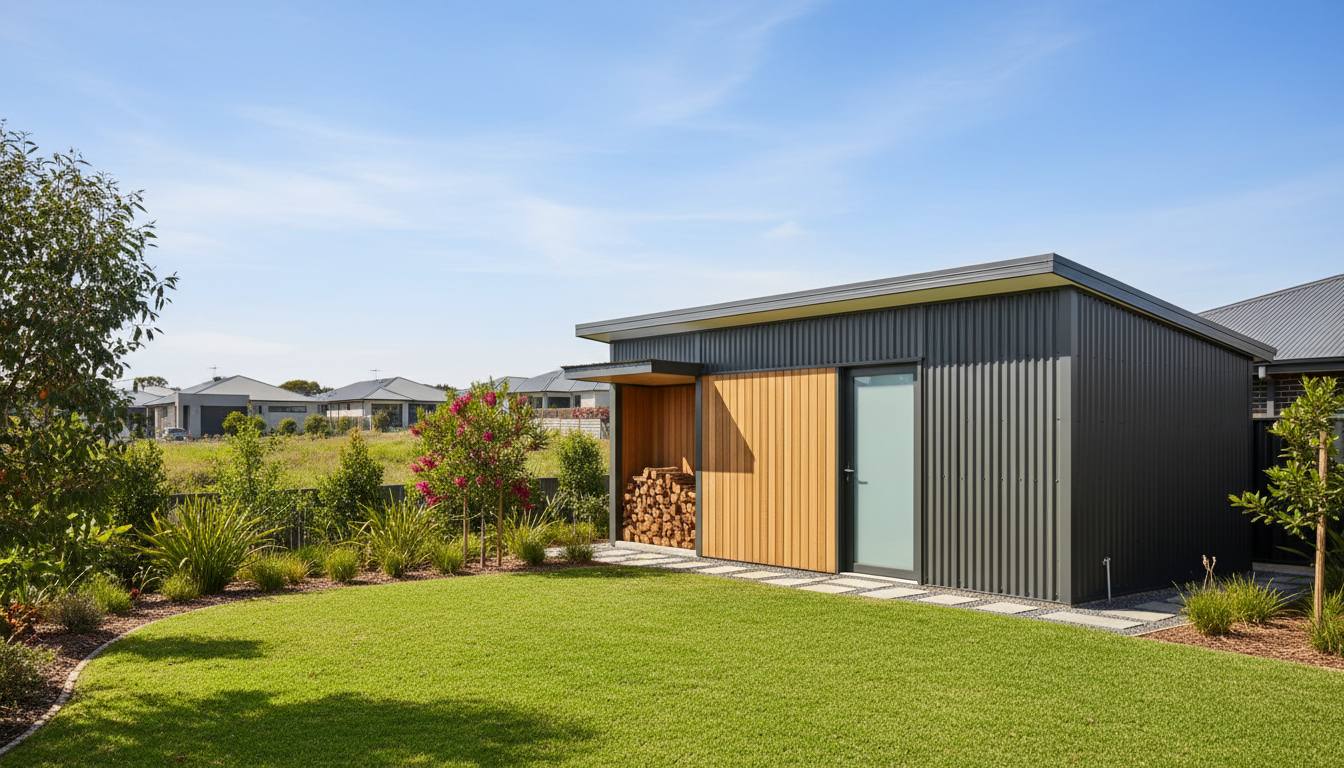
This independent guide is written for Australian homeowners, renovators, and property investors comparing “simply sheds” options. It blends a practical review of what to look for in 2025 with a step-by-step process for choosing the right Colorbond steel shed, custom carport, rural shed, or double garage—engineered for Australian Standards and local council requirements.
We benchmark the top-ranking pages by covering what they do well (custom design options, Colorbond quality, council approvals, durability) and fill the gaps with deeper technical detail: wind ratings (non‑cyclonic and cyclonic), WA/QLD/NSW council processes, corrosion zones, and roof/door selections that actually change performance and longevity.
Added 2024 WA wind-rating compliance notes and council-approved sheds WA guidance. We also cover cyclone-rated sheds QLD and custom Colorbond garages Perth.
What Does “Simply Sheds” Mean in Australia?
People search “simply sheds” either as a brand phrase or shorthand for straightforward, affordable, high-quality steel sheds. This review-style guide isn’t tied to a single retailer—use it to compare any supplier on materials, engineering, and service. If your brief is a “simple shed” for storage or a “custom-built double garage in Perth,” the same fundamentals apply: compliant design, the right steel, correct wind classification, and dependable installation.
What Are the Best Shed Materials for Perth’s Climate?
Perth’s hot summers, sea-breeze salt, and high UV punish cheap cladding. For coastal and metro WA, most informed buyers choose Colorbond steel cladding and Zincalume or galvanised structural members, with insulation and sarking to combat heat gain and condensation.
Colorbond vs Zincalume — Which Is Better for WA Conditions?
| Feature | Colorbond | Zincalume |
|---|---|---|
| Coating | Painted, baked-on finish over alloy-coated steel | Aluminium-zinc alloy coated steel (no paint) |
| Heat & UV | Good UV resistance; lighter colours reflect heat well | Reflective but can glare; can be hotter inside without insulation |
| Coastal performance | Colorbond Ultra recommended within harsh coastal zones | Solid, but may mark/stain sooner near surf air |
| Aesthetics | Wide colour range (e.g., Surfmist, Monument) | Classic metallic look only |
| Typical use | Residential sheds, garages, custom carports | Rural sheds, internal framing, budget kits |
| Price point | Higher | Lower |
Are Colorbond Steel Sheds Worth It?
Yes—if you value longevity, warranty support, and consistent finish. Look for genuine BlueScope Colorbond (check branding on the back of sheets), not “Colorbond-like” imports. In marine or industrial zones, specify Colorbond Ultra, stainless fixings, and proper wash-down detailing to maintain warranty eligibility.
- Complies with AS/NZS 2728 (pre-painted metal) when genuine
- Structural steel design to AS/NZS 4600 (cold-formed) and AS 4100 (steel structures)
- Cladding installation to AS 1562.1 and fasteners to AS 3566
- Corrosion protection per AS/NZS 2312.2 recommendations
How Do I Choose the Right Shed for My Property in Australia?
1) Define use-case and size early
Match spans, bay widths, and eave height to your gear and vehicles. Examples:
- Farm machinery storage (broad-span rural sheds NSW and VIC)
- Custom carports Melbourne with architectural posts and integrated gutters
- Steel sheds Perth for backyard workshops with noise insulation
- Boat/caravan storage with 3.0–3.6 m clearance and wind-locked roller doors
- Custom Colorbond garages Perth with double-width openings and mezzanine storage
- Affordable carports for Australian homes as DA-exempt structures (site dependent)
2) Confirm wind region and terrain
QLD coastal and far north require cyclone-rated sheds (Regions C/D). Much of WA is Region A/B, with Region C along parts of the coast and north. Always request site-specific engineering, not generic “one-size-fits-all” certs. Added 2024 WA wind-rating compliance notes: for WA, ensure your drawings cite AS/NZS 1170.2:2021 wind actions, terrain category, topographic multiplier, and hold‑down schedule.
3) Choose roof form
| Roof type | Pros | Considerations |
|---|---|---|
| Gable roof | Classic look, strong drainage, good headroom | More ridge/valley detailing; cost can be higher |
| Skillion (mono) | Modern look, easy solar placement | Higher wind suction on leading edge—check fixings |
| Flat (low pitch) | Budget carports, simple spans | Drainage and ponding checks are critical |
4) Doors, openings, and access
- Roller doors with wind-locks and heavier drums for cyclonic areas
- PA doors with sub-sills, threshold ramps, and keyed alike locks
- High-bay clearance for caravans/boats; consider custom lintel beams
5) Slab, footings, and hold-downs
Ask for an engineered slab with thickened edge beams and specified anchor layout. In reactive clay sites, allow for extra depth and crack control per engineer’s design. For coastal piers, hot-dip galvanised posts and m12–m16 anchors are common.
6) Condensation and bushfire (BAL)
Add roof sarking or insulated panels to meet NCC condensation management guidance and reduce drips in winter. In bushfire-prone areas, request a BAL assessment; opt for non-combustible cladding, ember guards to AS 3959, and metal leaf guards.
How to Get Council Approval for Your Custom Shed in WA
Step-by-step (WA)
- Confirm planning requirements with your local council (setbacks, height, streetscape).
- Obtain site-specific engineering (AS/NZS 1170.2 wind actions) and certified drawings.
- Prepare a site plan with contours, drainage, and stormwater connection.
- Lodge a building permit application (BA2/BA3) with a registered builder or as an owner-builder.
- Book mandatory inspections (footings/slab, frame if required, final).
Quick notes for other states
- QLD: Check if exempt under local planning; cyclonic design (Regions C/D) is strict—ask for “cyclone-rated sheds QLD” engineering.
- NSW: Complying Development may apply; otherwise DA + CC. Bushfire (BAL) often applies in rural sheds NSW.
- VIC: Building Permit via RBS; titles and siting check; BAL and overlooking rules near boundaries.
DIY Shed Kits vs Fully Installed Builds
| Factor | DIY Shed Kits | Supply & Install |
|---|---|---|
| Upfront cost | Lower | Higher |
| Time & tools | Requires skill, lifting gear, and several weekends | Fast, managed by licensed installers |
| Warranty convenience | Material warranty only; workmanship is on you | Material + workmanship coverage |
| Council handling | Owner manages permits and engineering | Builder manages approvals and inspections |
| Best for | Simple backyard sheds, experienced DIYers | Custom designs, cyclonic, sloping sites |
Real-World Examples and Case Studies
Case Study 1 — Custom-built double garage in Perth
- 6 x 7 m, 2.7 m eave, Colorbond Surfmist cladding, Zincalume framing
- Skillion roof 3°, insulated panel roof, whirly vents
- Region A, Terrain Cat 2, engineered hold-downs; council-approved sheds WA pathway
Case Study 2 — Cyclone-rated farm shed, North QLD
- 9 x 18 m, 3.6 m eave, open bays for machinery
- Region C design, wind-locked roller doors, heavier purlins
- Hot-dip galvanised columns; cyclone washers and extra roof fasteners
Case Study 3 — Backyard workshop, Western Sydney
- 4.5 x 6 m, gable roof, Colorbond Monument
- Complying Development, slab with thickened edges
- Sarking + wall wrap, acoustic batts on shared boundary side
Simply Sheds Review: What Buyers Should Look for in 2025
- Steel provenance: Genuine BlueScope Colorbond/Zincalume vs imports
- Engineering: Site-specific certs to AS/NZS 1170.2 with hold-down schedule
- Wind rating: Non-cyclonic vs cyclone-rated sheds QLD (Regions C/D)
- Coastal detailing: Colorbond Ultra, stainless fasteners, wash-down zones
- Doors: Wind-locked rollers, wider mullions, rated motors
- Installers: Licensed crew, safety gear, and documented QA sign-offs
- After-sales: Clear warranty process and spare parts availability
- Lead times: Transparent ETAs and staging (engineering, slab, delivery, install)
5-Step Buying Guide for Custom Sheds in Australia
- Scope: List vehicles, machinery, and future storage. Choose roof form and eave height.
- Site & wind: Get your wind region, terrain category, and BAL if relevant.
- Materials: Pick Colorbond colour, consider Colorbond Ultra in coastal zones; choose insulated roof.
- Engineering & approvals: Request site-specific certs and a council pack for your state.
- Build plan: Decide DIY vs installed; confirm slab design, lead time, and warranty details.
Popular Shed Types and Use-Cases (Keyword Clusters)
- Steel sheds Perth
- Custom carports Melbourne
- Rural sheds NSW
- Farm machinery storage
- DIY shed kits
- Boat and caravan shelters
- Cyclone-rated sheds QLD
- Commercial workshops and warehouses
- Custom Colorbond garages Perth
- Affordable carports for Australian homes
- Colorbond vs Zincalume comparison
- Wind-rated sheds for cyclonic areas
- Skillion vs gable roof sheds
- Garage door wind locks and automation
- Insulated panel roofing
- NCC condensation management
- Coastal corrosion protection
- Owner-builder sheds
- Council-approved sheds WA
- Engineered shed footings
FAQs: Simply Sheds in Australia
Do I always need council approval?
Not always. Small sheds may be exempt, but larger or boundary-adjacent structures usually need approval. Check with your local council—rules vary by state.
What wind rating should I choose?
Your engineer specifies it per AS/NZS 1170.2. Never guess—Region C/D areas need cyclone-rated sheds with upgraded frames and fixings.
Is Colorbond better than Zincalume?
For most homes, Colorbond wins for durability, colour, and UV resistance. Zincalume is cost-effective for rural/internal framing. In coastal zones, specify Colorbond Ultra.
How long do sheds take to install?
Typical timeline: engineering (1–2 weeks), permits (2–6+ weeks), slab cure (1–2 weeks), kit delivery (1–3 weeks), install (2–10 days depending on size and weather).
Will insulation stop condensation?
Insulated roof panels or sarking with ventilation dramatically reduce condensation. Follow NCC condensation guidance for your climate zone.
What about termites?
Steel sheds resist termites, but slab penetrations and adjoining timber elements still need termite management appropriate to your region.
Can I add solar?
Yes. Skillion roofs oriented north are ideal. Confirm purlin capacity and penetration detailing with your installer.
Are gutters and stormwater included?
Often yes, but confirm downpipe sizes, overflow paths, and connection to lawful point of discharge with your builder.
Referenced Standards, Climate and Industry Guidance
- Bureau of Meteorology climate insights for heat, wind, and rainfall patterns
- Australian Steel Institute design and durability resources
- Housing Industry Association (HIA) building and approvals guidance
- CSIRO condensation guidance for NCC compliance
- Energy.gov.au: cool roofs for heat reduction strategies
- Standards Australia (AS/NZS 1170.2, AS/NZS 4600, AS 4100, AS 1562.1, AS 3959, AS/NZS 2312.2)
- Master Builders Australia for building best practice
Also consider recent market and industry commentary such as the 2025 Australian Steel Market Outlook and the 2025 HIA Outdoor Structures and Home Improvement Report for trends in steel availability and homeowner demand.