
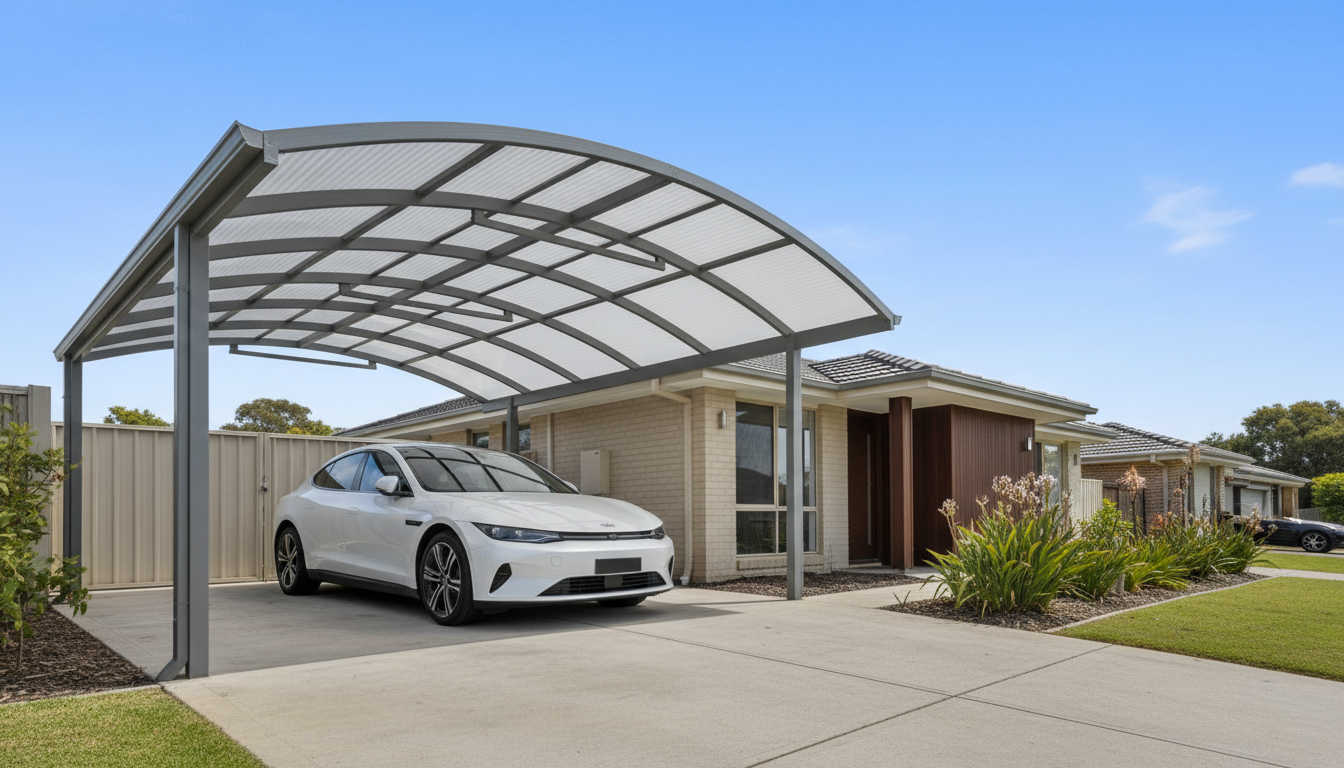
Excerpt: Choosing the right single car carport dimensions isn’t just about fitting the car—it’s about wind ratings, setbacks, and materials that survive Aussie weather. This guide shows standard sizes, engineering for cyclonic regions, Colorbond vs Zincalume, costs, approvals, and a 5‑step buying checklist for a stress‑free install.
Your guide to single car carport dimensions in Australia
Short on time? Here’s the quick answer: most Australian homes use a single-bay carport between 3.0–3.6 m wide and 5.4–6.6 m long, with a 2.4–3.0 m clearance height. But the best size depends on your vehicle (hatch vs dual-cab ute), site access, roof style, and local wind rating (AS/NZS 1170.2). Below you’ll find the exact numbers, plus council, material and budget decisions made easy.
What is the standard size for a single car carport in Australia?
For a typical suburban driveway, these are the standard carport dimensions used by Australian builders and kit manufacturers.
| Use case | Internal width | Internal length | Clear height (min) | Notes |
|---|---|---|---|---|
| Minimum single carport (sedans/hatches) | 3.0 m | 5.4 m | 2.4 m | Meets most small to mid-size cars; tight for SUVs with tow bars |
| Comfort single (most SUVs) | 3.2 m | 6.0 m | 2.4–2.7 m | Extra door clearance and storage at front |
| Ute/4WD or roof racks | 3.6 m | 6.6 m | 2.7–3.0 m | Room for bull bar, canopy, tow hitch and lift kits |
| Boat/trailer ready | 3.6–4.0 m | 7.2 m+ | 3.0 m | Consider “drive-through” access and higher gutters |
For a deeper dive into materials, engineering and approvals, see the steel carport buyers guide.
- Typical bay spacing: 3.0 m modules for cost-effective C-purlins and SHS/RHS posts.
- Edge clearance: Allow 600–800 mm each side for door swing and mirrors if next to walls or fences.
- Gutter/eave allowance: Keep 100–150 mm for fascia, gutters and fall to downpipes.
- Skillion roof: Single-slope flat/pitched roof, economical and fast to install.
- Gable roof: Triangular pitch both sides; better airflow and headroom.
- Bay: Standard structural module (often 3.0 m) used for carport spans.
How do I choose the right carport size for my vehicle and site?
Measure your current and future vehicles
- Small hatch: ~1.75–1.8 m wide, 4.0–4.3 m long.
- Mid SUV: ~1.9–2.0 m wide, 4.8–5.0 m long.
- Dual-cab ute: ~2.0 m wide (mirrors folded), 5.3–5.7 m long.
- Roof racks/lifts: Add 100–250 mm height; consider 2.7–3.0 m clear.
Plan for doors, posts and turning
- Side clearance: ≥700 mm on driver’s side for comfortable door swing.
- Post placement: Move posts to rear corners or use cantilever designs if turning is tight.
- Driveway fall: Steep slopes reduce effective height at the eaves—check bonnet and roof-rack clearances.
Think beyond the car
- Storage: Add 0.6–1.2 m length for bins, bikes or a workbench.
- Future-proofing: If there’s any chance of an EV SUV or a dual-cab, choose 3.2 x 6.0 m minimum.
- Stormwater: Plan downpipe locations and soakwell/silt pit capacity to avoid driveway flooding.
Upgrading from single to double? See Double Garage Sizes, Costs and Custom Options in Australia for the latest information.
What roof style and steel finish suits your climate?
Colorbond vs Zincalume — Which is better for WA conditions?
| Feature | Colorbond | Zincalume |
|---|---|---|
| Coating | Pre-painted polymer over zinc/aluminium/magnesium | Metallic zinc/aluminium/magnesium |
| Heat performance | Cooler with lighter colours (e.g., Surfmist) | Reflective when new; warms as it ages |
| Coastal resistance | Excellent with correct grade; avoid within surf zones without additional spec | Good, but more care needed very close to coast |
| Aesthetics | Colour-matched to home (Monument, Shale Grey, etc.) | Industrial silver-grey |
| Cost | Higher | Lower |
| Best for | Premium look, urban homes, heat management | Budget-friendly, rural or utility applications |
For coastal WA and hot inland areas, Colorbond in lighter colours reduces heat and glare. In rural sheds NSW or farm machinery storage areas inland, Zincalume can be an economical choice with a rugged look.
Flat (skillion) vs gable roof for single bays
| Roof style | Pros | Cons | Typical pitch |
|---|---|---|---|
| Skillion (flat) | Cheaper, faster install, easier under eaves | Lower headroom; managing water run-off critical | 2–5° |
| Gable | Extra height in centre, better airflow, classic look | More steel and flashings; slightly higher cost | 10–22.5° |
DIY kit vs custom-built by a registered builder
| Option | What you get | Who it suits | Watch-outs |
|---|---|---|---|
| DIY shed kits | Pre-cut steel, fixings, drawings | Handy owners, regional installs | Permit navigation, slab/footings, cyclonic tie-downs |
| Custom-built | Design, engineering, permits, install | Time-poor owners, complex sites | Higher upfront cost; choose licensed/insured installer |
- Colorbond steel: Painted, durable steel sheet popular for premium carports and custom Colorbond garages Perth.
- Zincalume: Corrosion-resistant metallic coating on steel, often used for affordable carports for Australian homes.
If you only need short-term cover, our temporary carport guide compares portable and semi-permanent options.
What wind rating and engineering do I need for a compliant carport?
Australian carports must be engineered for your wind region per AS/NZS 1170.2 and designed using AS/NZS 4600 (cold-formed steel) or AS 4100 (steel structures). Wind regions A–D apply, with Regions C–D for cyclonic Northern Australia.
- Region A (most metro areas): Brisbane, Melbourne, Adelaide, Perth (non-cyclonic)
- Region B: Higher winds inland/coastal fringe
- Region C: Cyclonic (e.g., Townsville, Mackay)
- Region D: Severe cyclonic (e.g., Port Hedland)
Added 2024 WA wind-rating compliance notes: Many councils across WA now require site-specific wind classification (e.g., A3–A7) and terrain category confirmation on drawings. Ensure your supplier provides engineer-certified tie-down details for posts, rafters and purlins, and footing sizes suitable for your soil class (AS 2870).
- Terrain Category: Surrounding roughness (open country vs suburban) that changes wind pressures.
- Importance Level: Structural reliability level; most residential carports are IL1–IL2.
- Tie-downs: Bolts/straps/anchors that resist uplift in storms—critical for cyclone-rated sheds QLD and wind-rated sheds for cyclonic areas.
Engineering checkpoints:
- Columns: SHS/RHS posts sized for bending + uplift; hot-dip galvanised posts near coast (AS/NZS 4680).
- Roof members: C-purlins and rafters braced to prevent roll; adequate screw class and spacing (AS 3566).
- Connections: Cyclone washers, anti-rotation brackets, and moment bases for free-standing carports.
- Footings: Deeper piers or screw piles in sand; larger diameters in expansive clays (AS 2870 site classes M–H).
Do I need council approval for a single car carport?
Rules vary by state and council. Many single-bay carports qualify for fast-track or exempt pathways if they meet size, height, and setback controls, but always confirm locally.
- WA: Building permit typically required; planning may be exempt if behind the front setback under R-Codes. See “council-approved sheds WA” guidelines.
- NSW: Complying Development may apply if size/height/setbacks are met.
- VIC: Building Permit via a registered building surveyor; check front setback and easements.
- QLD: Private certifier can approve; cyclonic regions require certified tie-downs.
- SA: Check PlanSA for low-risk development pathways.
How to get council approval for your custom shed in WA
- Site plan: Mark boundaries, existing structures, and proposed carport size (e.g., 3.2 x 6.0 m).
- Engineering: Obtain AS-compliant drawings and a wind report (Region A, Terrain TC2–TC3 typical in suburbs).
- Neighbours: If near a boundary, prepare for potential consultation and fire-rating checks.
- Stormwater: Include gutters, downpipes, and soakwell sizing.
- Lodge: Submit to your local council with fees; standard turnaround 10–25 working days.
Helpful references:
Real build examples: single car carports across Australia
- Perth, WA (non-cyclonic): 3.2 x 6.0 m skillion in Colorbond Monument with 2.7 m clearance, SHS posts on concrete piers, integrated soakwell. Outcome: Shade and heat reduction with a light-coloured underside for brightness.
- Cairns, QLD (cyclonic Region C): 3.6 x 6.6 m gable, 3.0 m ridge height, cyclone tie-downs and upgraded fixings, hot-dip galvanised base plates, wider footings. Outcome: Certified cyclone-rated carport that also fits a boat trailer.
- Melbourne, VIC (heritage streetscape): 3.0 x 5.4 m timber-look steel posts, Colorbond Surfmist roof to match eaves, set behind front setback. Outcome: Planning-friendly design with minimal visual bulk.
Cost guide for single-bay carports in 2025
- DIY kit (3.0 x 5.4 m, non-cyclonic): $2,200–$4,500
- Custom supply & install (3.2 x 6.0 m): $5,500–$10,000
- Cyclone-rated (3.6 x 6.6 m, Region C/D): $8,000–$14,000
- Concrete slab (optional): $120–$180/m² depending on thickness and mesh
- Insulated roof panels: +$60–$120/m²
- Powder-coated posts/beams upgrade: +$400–$1,000
Price drivers in 2025 include steel coil pricing and logistics. The 2025 Australian Steel Market Outlook and the 2025 HIA Outdoor Structures and Home Improvement Report note steady demand and regional price variations. Always get itemised quotes for apples-to-apples comparisons.
If affordability and flexibility is your focus, read Temporary Carport Australia for pricing and permit tips.
5-step buying guide for custom sheds and carports in Australia
- Define size and use: Start with 3.2 x 6.0 m unless you own a ute/4WD or boat—then consider 3.6 x 6.6 m or longer.
- Pick materials: Choose Colorbond for premium look/heat control; Zincalume for budget. Consider insulated panels in hot zones.
- Check wind rating: Confirm region (A–D), terrain, and required tie-downs for council/engineer sign-off.
- Permits & services: Confirm setbacks, easements, stormwater, and whether you need a building/planning permit.
- Get 2–3 quotes: Compare steel gauge, coatings, engineering, inclusions (gutters, downpipes, flashings) and warranty.
Technical checklist before you order
- Exact internal dimensions (width x length x clear height)
- Post locations vs. driveway turning circle
- Roof pitch and fall to stormwater
- Coastal exposure category; hot-dip galvanised posts if near surf
- Soil classification (AS 2870) and footing schedule
- Wind region and terrain category per AS/NZS 1170.2
- Compliance with NCC 2022/State adoption and relevant AS/NZS
- Warranty terms on Colorbond/Zincalume and workmanship
FAQs: standard carport dimensions and approvals
What is the standard carport size for a single car?
Common standard carport size is 3.0 x 5.4 m. For modern SUVs and easier access, 3.2 x 6.0 m is the sweet spot.
Will 3.0 x 5.4 m fit a large SUV or dual-cab ute?
It will fit many SUVs but is tight with tow bars and bull bars. For utes and 4WDs, use 3.6 x 6.6 m where space allows.
What is the minimum height for a single carport?
2.4 m clear is typical. Choose 2.7–3.0 m clear if you have roof racks, lift kits, or plan for a camper trailer/boat.
Do freestanding carports need footings?
Yes. Engineer-designed concrete piers or screw piles are required, sized for wind uplift and soil class.
Do I need gutters on a carport?
Most councils require stormwater management. Gutters and downpipes to soakwells or existing system are standard.
Can I attach a carport to my house?
Yes, but connections to the dwelling must be engineered and may trigger bushfire or fire-rating provisions near boundaries.
Is Colorbond better than Zincalume?
For urban homes and heat management, Colorbond is usually better. Zincalume suits budget or rural utility builds.
What about cyclonic areas?
Choose certified cyclone-rated sheds QLD designs (Region C/D) with upgraded fixings, bracing and footings. Expect higher costs and lead times.
Are DIY shed kits worth it?
Great for experienced DIYers on simple, non-cyclonic sites. If you need approvals, custom carports Melbourne installers or local shed builders can streamline the process.
Keyword clusters that match your project
- Metro: steel sheds Perth, custom Colorbond garages Perth, patio and carport builders
- Regional/rural: rural sheds NSW, farm machinery storage, wind-rated sheds for cyclonic areas
- Budget/DIY: DIY shed kits, affordable carports for Australian homes, standard carport dimensions
- Compliance: council-approved sheds WA, cyclone-rated sheds QLD, Colorbond vs Zincalume comparison
Citations and useful resources
- Bureau of Meteorology climate data for rainfall and wind patterns
- CSIRO research on building materials and corrosion
- Energy.gov.au guidance on cool roofs and heat reduction
Standards referenced: AS/NZS 1170.2 (Wind actions), AS/NZS 4600 (Cold-formed steel structures), AS 4100 (Steel structures), AS 2870 (Residential slabs and footings), AS 1397 (Steel sheet), AS/NZS 4680 (Hot-dip galvanizing), AS/NZS 2312 (Protective coatings), AS 3566 (Self-drilling screws).