
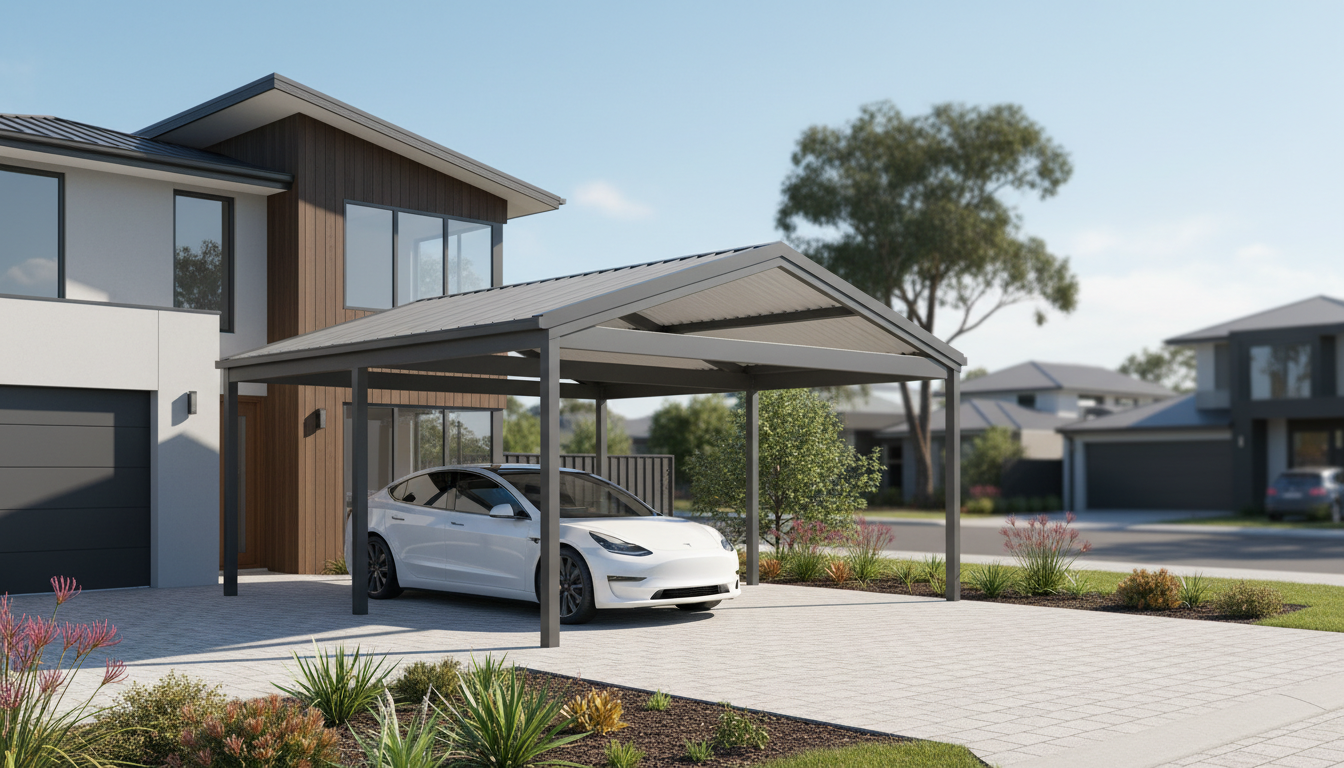
What is a Single Carport Kit and Who Is It For?
A single carport kit is a pre-engineered steel structure—posts, carport frame, roof sheets, gutters and fixings—packaged for DIY or installer assembly. It’s ideal for a driveway carport or a small carport beside a home, investment property or beach shack. Popular uses include protecting daily drivers, utes, small boats or as a shade extension to a single garage carport.
How Much Do Single Carport Kits Cost in Australia (2025)?
Expect the following carport kits prices for a typical 3.0–3.6 m wide single carport:
- Non-cyclonic (Region A/B), flat roof, Zincalume: approx. $1,850–$2,900
- Non-cyclonic (Region A/B), flat roof, Colorbond: approx. $2,100–$3,400
- Non-cyclonic, gable roof, Colorbond: approx. $2,800–$4,800
- Cyclone-rated (Region C/D), flat or gable: approx. $3,800–$6,500
Allow for extras: concrete piers/slab ($600–$2,000), council fees ($0–$1,200), gutters/downpipes, anti-condensation blanket, powder coating, or insulated roof panels. Lead times in 2025 are typically 2–5 weeks, per the “2025 Australian Steel Market Outlook”.
What Size Single Carport Do I Need?
Common carport sizes for a single carport:
- 3.0 m (W) x 5.4 m (L) x 2.4 m (H): small sedans and hatches
- 3.2–3.6 m (W) x 6.0 m (L) x 2.4–2.7 m (H): SUVs and dual-cabs
- 3.6 m (W) x 7.2 m (L): longer utes or add storage at the rear
If you plan to enclose later, check single garage dimensions in Australia to future‑proof eave heights and door openings.
Add height for roof fall and guttering, and length if you want a workbench or enclosed storage at the back. In coastal or bushfire zones, check local planning setbacks and BAL requirements.
What Are the Best Shed Materials for Perth’s Climate?
Perth’s hot, dry summers and coastal corrosion call for robust finishes. Most premium kits use Colorbond or Zincalume roof and walling, and galvanised RHS or C-section posts and beams (typically G450–G550 steel).
| Feature | Colorbond | Zincalume |
|---|---|---|
| Corrosion resistance (coastal) | Excellent with correct grade; better near surf when using appropriate product and maintenance | Good inland; more caution needed close to marine influence |
| Heat reflectivity | High with lighter colours; can lower roof temps | High in raw finish; aesthetics limited |
| Aesthetics | Wide Colorbond palette to match houses and custom Colorbond garages Perth | Industrial silver-grey only |
| Warranty | Up to 20–25 years (conditions apply) | Up to 15–20 years (conditions apply) |
| Cost | $$ (premium) | $ (budget/“cheap carports kits” option) |
For very hot roofs or patios, add an anti-condensation blanket or insulated roof panels.
Pro Tip: Did you know using insulated roof panels can reduce internal shed temperatures by up to 10°C in summer? This is supported by passive cooling guidance from Energy.gov.au.
Which Roof Style: Flat or Gable?
- Flat (skillion): Lowest cost, clean lines for modern homes, easier under eaves. Ensure adequate fall (≈2–5°) for drainage.
- Gable: Better headroom and airflow; suits heritage or coastal styles; higher material/labour and more bracing.
How to Choose a Wind-Rated Single Carport Kit
Australian carports are engineered to AS/NZS 1170.2 (wind actions) and installed under the NCC. Select a kit matched to your site’s wind region and terrain category.
- Non-cyclonic: Regions A/B, typical suburban sites. Look for N2–N3 equivalent capacity.
- Cyclonic: Regions C/D. Choose cyclone-rated sheds QLD specifications with heavier posts, thicker purlins, extra hold-downs and cyclonic detailing.
- Coastal corrosion: Upgrade to hot-dip galvanised posts or marine-grade coatings; check ISO 9223 C3–C4 zones.
To find your wind region, use the Bureau of Meteorology wind region map and confirm with a local engineer or supplier.
Do I Need Council Approval for a Driveway Carport?
Most councils require approval for new carports, especially in front setbacks or heritage areas. Requirements vary by state and local planning scheme.
How to Get Council Approval for Your Custom Shed in WA
- Check planning: Front setback rules, easements, and driveway sightlines with your local council.
- Confirm engineering: AS/NZS 1170.2 wind loads; AS/NZS 4600 for cold-formed steel. Many suppliers offer council-approved sheds WA engineering packs.
- Documentation: Site plan, elevations, footing detail, drainage. NCC 2022 compliance statement.
- Lodge building permit: Some small carports may be exempt; always verify locally.
- Inspection: Footings and final inspection as required.
Building in Northern NSW? See our Grafton sheds and garages guide for local wind classes, approvals and coastal detailing.
Guidance is available via Housing Industry Association (HIA) and Master Builders Australia.
DIY Kit vs Installed: What’s Right For You?
- DIY single carport kit: Best for confident renovators with tools, chasing budget and fast lead times.
- Installed: Use licensed installers—recommended for cyclonic regions, complex sites, or attachment to existing buildings.
Carport Frame and Steel Specs That Matter
- Posts: 75–100 mm galvanised SHS/RHS, wall thickness 2.5–3.0 mm for non‑cyclonic; heavier for cyclonic.
- Beams/Purlins: C/Z purlins (G450–G550); check spans and serviceability deflection limits.
- Connections: M12+ high-tensile bolts or compliant self-drilling screws with cyclonic washers where required.
- Footings: Engineer-designed concrete piers sized to soil class. Edge restraints for slabs if used.
- Roofing: Colorbond or Zincalume sheeting; add anti-con blankets to control condensation and noise.
For technical design support, see the Australian Steel Institute resources.
Real-World Build Examples
Perth Metro — Heat and Coastal Air
- Size: 3.2 m x 6.0 m flat roof single carport
- Spec: Colorbond Surfmist roof, galvanised 100 SHS posts, anti-con blanket, gutters and DP tied to stormwater