
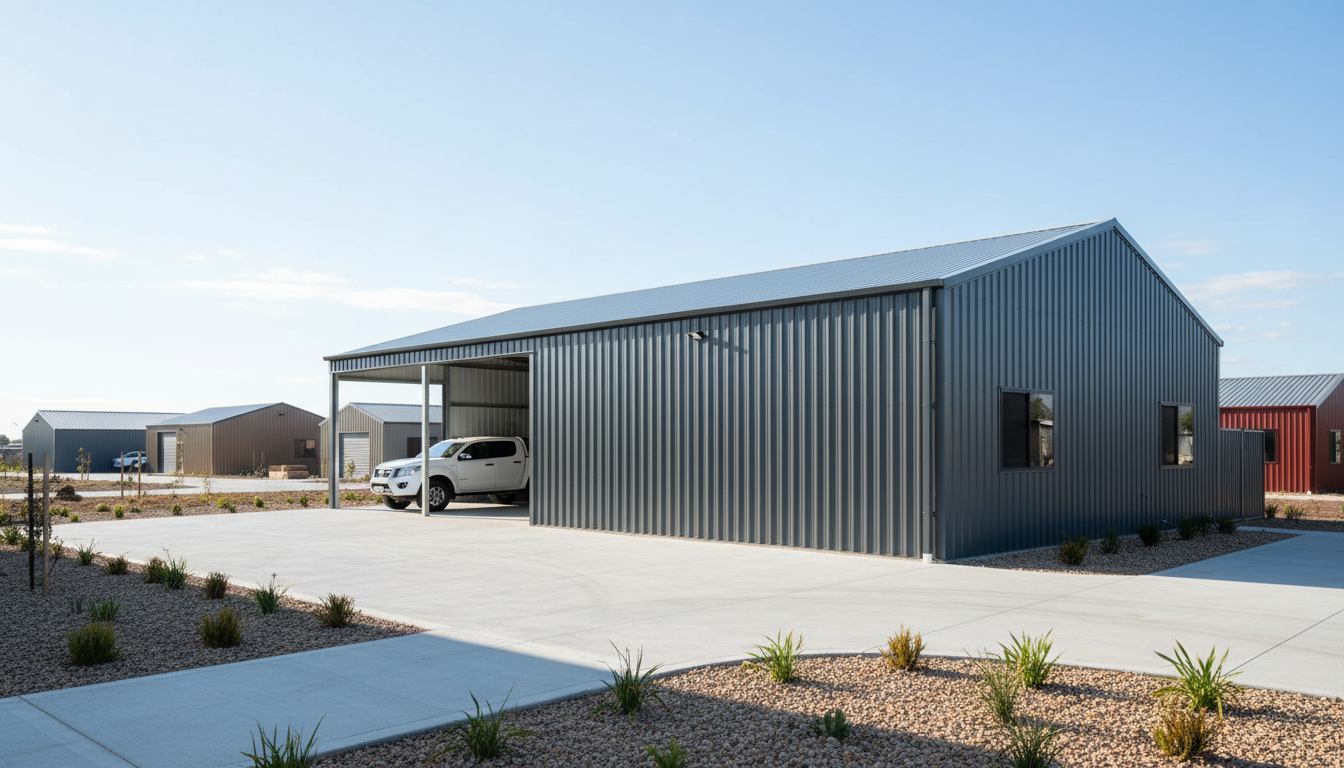
Whether you’re renovating and need a site shed now, or planning a custom Colorbond garage for long-term storage, this guide shows you how to choose, permit, and build the right steel structure for Australian conditions. We compare Colorbond vs Zincalume, explain wind ratings, and share real build examples from Perth to Brisbane.
What Australians Mean by “Site Shed” (and Why It Matters)
In Australia, “site shed” usually refers to portable buildings used as site offices, lunchrooms or secure storage during construction. Top-ranking pages focus on hire or site sheds for sale with quick delivery, basic fit-outs, and compliance. They’re great during renos—or as a temporary office—while your permanent Colorbond steel shed, garage or carport is being designed and approved.
Competitor insights and what this guide adds
- Common selling points: custom sizes, Colorbond cladding, fast delivery, council compliance, and affordability.
- Typical gaps: limited detail on Australian Standards, local wind regions, corrosion zones, slab design, or state-by-state permit steps.
- What we add: deeper guidance on council-approved sheds WA, cyclone-rated sheds QLD, corrosion categories, and heat mitigation for Perth and northern Australia. Added 2024 WA wind-rating compliance notes.
What Are the Best Shed Materials for Perth’s Climate?
Perth’s hot summers and coastal air demand UV-stable paint systems and smart heat management. Here’s how Colorbond and Zincalume compare in WA.
- Colorbond: Pre-painted, corrosion-resistant steel with baked-on paint system designed for Australian conditions.
- Zincalume: Alloy-coated (zinc/aluminium/magnesium) bare metal finish known for corrosion resistance and value.
Colorbond vs Zincalume — Which Is Better for WA Conditions?
| Factor | Colorbond Steel | Zincalume Steel |
|---|---|---|
| Heat reflection | Excellent in lighter colours; reduces heat gain. | Good reflectivity as a bare metal; can glare. |
| Coastal durability | Excellent with correct grade; choose Ultra near surf. | Strong but may mark near marine spray without extra care. |
| Aesthetics | Large modern palette; matches Aussie homes. | Industrial look; paint required for colour. |
| Maintenance | Low; periodic wash-down recommended. | Low; watch for tea-staining near coast. |
| Cost | Typically higher upfront. | Usually more affordable. |
| Best fit (Perth) | Premium look; hot climates; coastal suburbs. | Value option; inland WA and regional settings. |
Which Site Shed Type Fits Your Property?
- Portable site sheds and site offices: Perfect for renovation storage, temporary office, or pool build staging. Search terms: site sheds for sale, temporary site shed hire, portable site amenities.
- Custom garages and workshops: Think custom-built double garage in Perth, workshop sheds Brisbane, and custom Colorbond garages Perth with wind-lock roller doors and vermin-proofing flashing.
- Carports: From affordable carports for Australian homes to custom carports Melbourne and skillion roof carports Sydney, engineered for wind and boundary setbacks.
- Rural and farm sheds: Rural sheds NSW, barn-style sheds Victoria, and farm machinery storage with oversized bays and high-tensile steel frames.
- Garden and lifestyle: Garden sheds Adelaide, hobby rooms, and pool pump enclosures with BAL-rated options in bushfire-prone zones.
Council Approval, Wind Ratings and Codes Across Australia
All quality sheds should be engineered to the National Construction Code (NCC 2022) and relevant Australian Standards, including AS/NZS 1170.2 (Wind Actions), AS/NZS 4600 (Cold-formed steel), AS 4100 (Steel structures), AS 1397 (steel sheet and strip), and AS/NZS 1562.1 (metal roofing). Tie-downs, fixings and cladding gauges must match the site’s wind region and terrain category.
How to Get Council Approval for Your Custom Shed in WA
- Confirm zoning, setbacks and maximum height with your local council.
- Obtain certified engineering with the Region A wind rating for most metro areas; coastal or hill sites may need higher pressures. Added 2024 WA wind-rating compliance notes
- Provide site plan, slab details, elevations, colour schedule (e.g., Colorbond), and stormwater plan.
- Check BAL (Bushfire Attack Level) if near bushland; specify BAL-rated doors, ember-seals and metal screens where required.
QLD Cyclone Regions (C and D)
- North and coastal QLD require wind-rated sheds for cyclonic areas. Specify cyclone-rated sheds QLD with certified connections, heavier cladding and wind-lock roller doors.
- Engineering must address local pressure coefficients, door loads and tie-downs to slab or piers.
VIC and NSW Notes
- Southern VIC may require snow load checks; NSW rural councils often require larger boundary setbacks for rural sheds NSW.
- Plan for drainage, gutter sizing and overflow paths in intense rain events (BOM guidelines).
Need a quick outcome? Ask for a “council-approved sheds WA” package or similar in your state—engineered drawings, energy compliance (if habitable), and a site plan bundle to speed approvals.
5-Step Buying Guide for Custom Sheds in Australia
- Define the brief: size, bay spacing, roof type (gable or skillion), access (roller/PA doors), power and lighting.
- Pick materials: Colorbond vs Zincalume, cladding gauge, hot-dip galvanised brackets, marine-grade fixings for coastal C5 zones (AS 4312).
- Engineer for wind: Region A–D per AS/NZS 1170.2; request certified design with connection schedule and anchor bolt plan.
- Permits and slab: Clarify slab-on-ground thickness, thickened edge beams, and termite or damp-proofing. Lodge your council application with full drawings.
- Build or install: Decide between DIY shed kits and licensed installers; confirm warranty, maintenance schedule and after-sales support.
DIY Shed Kits vs Custom-Built — What’s Right for You?
- DIY shed kits: budget-friendly; suited to straightforward garden sheds or small workshops; ensure the kit includes wind region engineering and a clear bolt/fixing schedule.
- Custom-built: best for complex sites, custom carports Melbourne with boundary constraints, or high-wind/cyclone regions requiring certified installers and inspections.
Specifications That Matter (And Save Headaches)
- Wind rating: Region A–D, terrain category, shielding and topography determine pressures.
- Frame: High-tensile cold-formed steel; check member sizes and spacing against loads.
- Connections: Specify anchor bolts, hold-down brackets, and screw types; upgrade to cyclone washers in Region C/D.
- Doors: Wind-lock roller doors in cyclonic areas; PA doors with proper sill flashing and weather seals.
- Thermal: Roof blanket or insulated panels; consider ventilators and sarking to manage condensation.
- Water: Gutters sized to intense rainfall; downpipes to legal stormwater; overflow provisions.
- Durability: Choose coatings for your corrosion category; maintain wash-down in coastal zones.
- Details: Vermin-proofing flashing, leaf-guard, and door thresholds keep interiors clean and dry.
Real Build Examples From Around Australia
Perth — Custom Colorbond Double Garage
6 x 7.5 m, gable roof, Colorbond Monument walls/Surfmist roof, ventilators, and insulated roof blanket. Engineered to Region A with higher local pressures due to hill topography. Outcome: cooler workspace and a council-approved garage matching the home facade.
North QLD — Cyclone-Rated Farm Machinery Storage
9 x 18 m rural shed, 4.2 m eave height, Region C engineering, wind-lock roller doors, upgraded purlins and tie-downs to piers. Outcome: secure farm machinery storage that sailed through inspections during wet season. Cyclone Region C/D checklist applied.
Melbourne — Skillion Carport on a Narrow Block
3.5 x 6 m custom carports Melbourne design, setback compliant, box gutter to boundary, and powder-coated posts. Fast permit with site-specific drainage notes. Outcome: an affordable carport for Australian homes in inner suburbs.
FAQs: Site Sheds and Steel Sheds in Australia
Are “site sheds” suitable for homeowners?
Yes. They’re ideal during renovations as temporary storage or a site office. Many suppliers offer site office sheds for sale or short-term hire, then you can switch to a permanent Colorbond shed later.
How long does council approval take?
Typically 2–8 weeks depending on council workload and completeness of your engineering pack. In WA, aim for a “council-approved sheds WA” bundle with wind calculations, site plan and slab details to cut delays.
What wind rating do I need?
It depends on your address, terrain and shielding. Metro Perth is often Region A; coastal QLD can be Region C/D. Ask for AS/NZS 1170.2 calculations.
Is Colorbond worth the extra cost?
For coastal areas, high sun, or where aesthetics matter, Colorbond’s paint system and colour range justify the spend. Zincalume is a strong value choice inland.
Flat roof or gable?
Gable sheds ventilate well and blend with homes. Skillion/flat designs suit tight sites and boundary builds, commonly seen in skillion roof carports Sydney.
Quick Comparisons at a Glance
Flat (Skillion) vs Gable Roof
- Skillion: modern look, easier near boundaries; ensure fall and box gutter sizing.
- Gable: better cross-ventilation and classic streetscape; more roof volume.
Portable Site Shed vs Permanent Steel Shed
- Portable: fast delivery, temporary use, flexible layouts.
- Permanent: engineered lifespan, higher security, adds value when designed to match the home.
Trends and Local Insights (2024–2025)
- Industry bodies indicate steady demand for outdoor structures, with homeowners investing in compliant sheds and carports to add utility and value.
- Lead times vary by state and season; plan early ahead of summer storms in QLD and heatwaves in WA.
- Consider energy-smart upgrades like insulation and light-coloured roofing to cut summer heat load.
Useful references:
Ready to Specify Your Shed?
Ask for an engineered package covering: wind region, cladding gauge, connection schedule, door wind ratings, slab detail, and corrosion category. Whether it’s steel sheds Perth, custom carports Melbourne, or rural sheds NSW, insist on Australian Standards compliance—and a warranty you can bank on.