
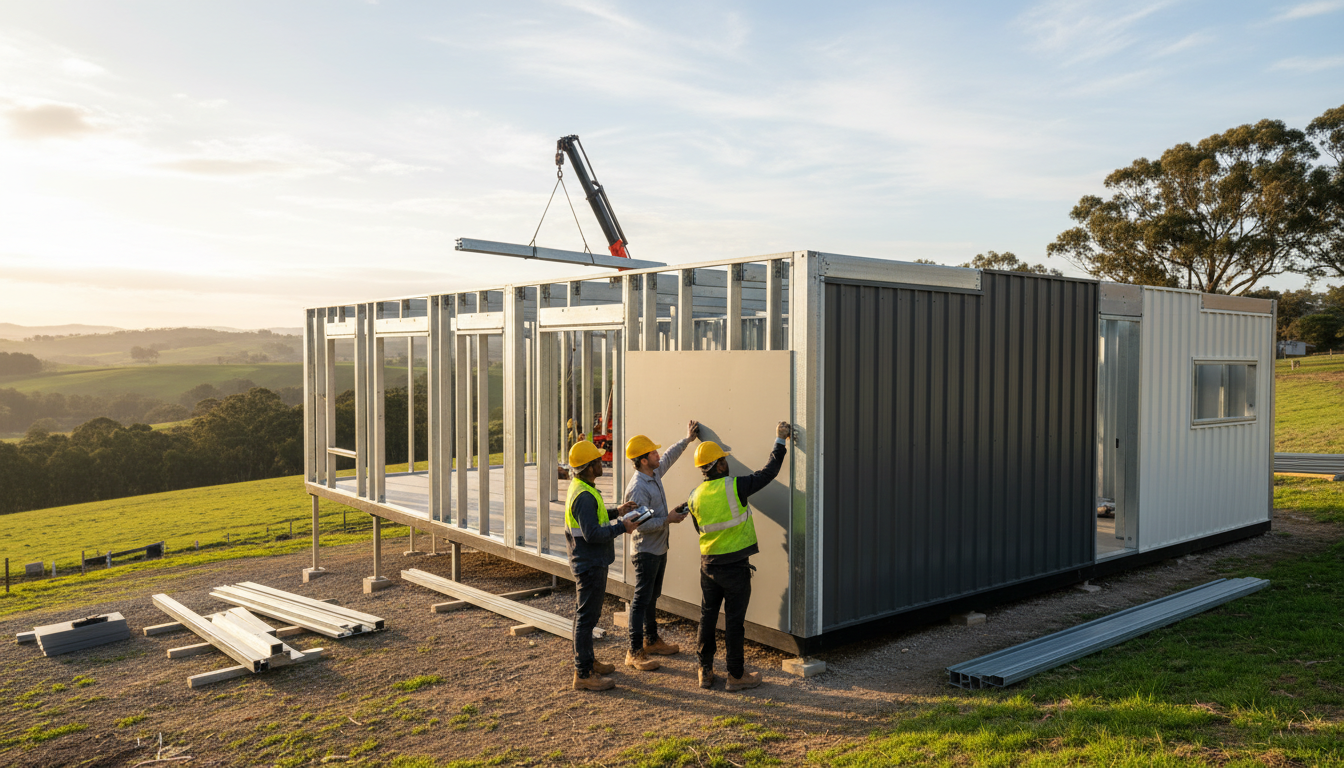
Whether you’re eyeing a compact granny flat in Perth, a steel A-frame house kit on the South Coast, or pairing a kit home with a custom Colorbond double garage in Melbourne, this guide distils what Australian homeowners, renovators and investors need in 2025. We combine shed-industry know‑how (wind, corrosion, council) with Class 1a home compliance, so you get the best of both worlds.
What exactly is a steel house kit—and who is it for?
Steel house kits (also called kit homes for sale, home building kits or house kits Australia) are pre-engineered dwelling packages that include the structural steel frame, roof and wall cladding (often Colorbond or Zincalume), engineering, and a bill of materials. Many builders pair them with house-adjacent structures like custom Colorbond garages, steel sheds Perth, custom carports Melbourne and rural sheds NSW for storage and staging during the build. Many people search bond kit homes when they mean steel/Colorbond kit homes—this primer compares prices, approvals and shed‑adjacent options.
Class 1a: A single dwelling (your kit home). Must meet NCC energy, structural, fire and amenity requirements.
Class 10a: Non-habitable (shed, carport, garage). Easier approvals, but different standards.
What are the best materials for Perth’s climate?
For WA’s hot summers, sea breeze corrosion zones and occasional severe storms, your two go-to coatings are below. Here’s the practical, site-based comparison many competitors skip.
Colorbond vs Zincalume — Which is better for WA conditions?
| Factor | Colorbond steel | Zincalume steel |
|---|---|---|
| Coastal corrosion resistance | Choose Ultra or Matt near surf coasts; best for C4–C5 if >100–200 m from breaking surf | Good inland; not ideal for harsh marine zones |
| Heat reflectivity | Lighter colours (e.g., Surfmist) reduce heat gain; helps with NCC energy targets | Highly reflective when new; can dull over time |
| Aesthetics and colour range | Extensive Colorbond palette and matching accessories | Metallic-grey only; paint required for colour schemes |
| Cost | Typically higher material cost | Generally cheaper upfront |
| Typical use on kit homes | Roofs, walls, gutters, fascia — premium, long-life finish | Roof or wall substrate where budget is tight and inland |
C1–C5 classify environments from very low (dry inland) to very high (surf coast/industrial). The closer to breaking surf, the higher the category and the more you should favour Colorbond Ultra/Marine-grade fixings.
Added 2024 WA wind-rating compliance notes For Perth Metro and coastal WA sites, ensure engineering for AS/NZS 1170.2 wind regions A or B (or S, for special cases) and request site-specific tie-down details. For exposed hilltops and near-coast builds, specify higher corrosion class fasteners and sarking/Anticon for condensation control.
Steel house kits vs traditional builds: what changes?
- Speed: Frames and home kits often deliver 4–10 weeks after approvals, with on-site assembly faster than timber equivalents.
- Strength: Steel is dimensionally stable, termite-proof and ideal for wind-rated sheds for cyclonic areas and steel building homes in storm belts.
- Design freedom: From minimalist skillion to steel A-frame house kits, two-storey, and hybrid layouts with integrated custom Colorbond garages Perth.
- Predictability: Pre-engineered components reduce waste and variations, especially for DIY shed kits and owner-builder pathways.
What will a steel home kit cost in 2025?
Indicative national averages (materials only; GST incl; site dependent):
- Compact 1–2 bed kit home: approx $1,200–$1,800 per m²
- Family-size kit home: approx $1,400–$2,100 per m²
- Turnkey build via licensed builder: commonly $2,300–$3,500+ per m² depending on region, BAL/cyclonic upgrades and finishes
Don’t forget allowances for slab/footings, transport, cranage, services, BAL upgrades (AS 3959), cyclone upgrades (Region C/D), energy compliance (NCC 2022 7‑Star), insulation, and internal fitout. Pairing a home with a house building kit garage or affordable carports for Australian homes adds value during the build and after.
Engineering, wind and bushfire compliance across Australia
- Wind actions: Engineer to AS/NZS 1170.2 for wind region, terrain category and shielding. For North QLD, specify cyclone-rated sheds QLD and kit homes with Region C/D tie-downs, door ratings and debris screening.
- BAL (bushfire): Design to AS 3959 with ember, radiant heat and flame zone provisions. Colorbond cladding and metal roofs often help, but doors/windows and vents are critical.
- Slabs and soil: AS 2870 footing design. Get a geotech report for site classification (M, H1, H2, P). Reactive clays need careful articulation joints and drainage.
- Termite management: Steel frame is termite-resistant; you still need perimeter and service penetrations treated to AS 3660.
- Condensation: Use vapour-permeable sarking, Anticon blankets and ventilated cavities, especially in cool climates and humid coasts.
How to get council approval for your custom shed in WA
Many kit-home clients lodge a Class 10a shed or garage first for storage, then proceed with the house. Here’s the WA path:
- Confirm zoning and setbacks via local planning.
- Obtain Form BA3 Certificate of Design Compliance (CDC) from a registered building surveyor.
- Lodge BA1 (certified) application with engineering, site plan, elevations, tie-down details and energy notes if conditioned.
- Specify wind region, terrain and importance level on drawings. council-approved sheds WA require compliant fixings and hold-downs.
- Book final inspection; keep manuals/warranties for Colorbond/Zincalume and fasteners.
Design choices for steel home kits
- Frame systems: Cold-formed steel stud walls or RHS portal frames for open spans.
- Roof shapes: Gable, skillion, mono-pitch and A‑frame. Gables suit regional snow loads; skillions simplify solar orientation.
- Cladding: Corrugated, Trimdek/Monoclad profiles; Colorbond Ultra near the coast; Zincalume inland.
- Insulation: Anticon under metal roofing; bulk wall batts; optional insulated roof panels to reduce heat gain.
- Energy: NCC 2022 7‑Star typical—specify light roof colours, eave shading, cross-ventilation, and ceiling fans.
A foil-faced glasswool layer installed under metal roofing to improve thermal performance and reduce condensation and rain drum.
Pro Tip: Using insulated roof panels can reduce internal shed or garage temperatures by up to 10°C in summer in many Australian regions—handy for attached garages to kit homes and for metal building homes. Pair with light Colorbond colours and ridge/soffit ventilation for best results.
Real-world examples
- WA coastal A‑frame weekender: Colorbond Ultra Surfmist roof/walls, stainless fasteners in a C4 zone, Anticon R2.5, engineered to Wind Region B with exposed terrain. Delivered in 7 weeks; lock‑up in 14.
- Townsville granny flat: Region C cyclonic kit, impact-rated roller doors on the adjoining steel building homes garage, extra tie-down brackets and debris screens; BAL‑Low; handover in 12 weeks.
- Central West NSW manager’s quarters + rural sheds NSW: Zincalume roof, Colorbond walls, slab on reactive clay (H1). Prevailing westerlies dictated skillion orientation for PV optimisation.
DIY kit, supplied-and-installed, or owner‑builder?
- DIY kit homes/garages: Lowest cost, but you need time, tools and trade support. Ideal for DIY shed kits and simpler home layouts.
- Supplied-and-installed: Preferred for most; vendor manages erection. You manage internal fitout or engage a builder.
- Owner‑builder: Obtain the state OB permit, line up licensed sparkies/plumbers, and schedule inspections. Great for investors with time and coordination skills.
Pairing a dwelling with a garage en kit simplifies storage during the build and adds long‑term value; compare wind ratings, doors and costs here.
Use-case and keyword clusters
- Urban: Compact house kits for sale, custom carports Melbourne, custom Colorbond garages Perth.
- Coastal: Colorbond kit homes, Ultra-grade fixings, ventilated roof spaces.
- Rural: home steel frames with attached rural sheds NSW for farm machinery storage and workshops.
- Cyclonic: cyclone-rated sheds QLD, debris-rated doors, Region C/D tie-downs.
- Lifestyle: steel A‑frame house kits, granny flats, studios, metal built homes with skillion PV roofs.
- Search terms we cover: steel home kits, house kits, kit homes for sale, home kits, house kits Australia, home building kits, steel building homes, metal building homes.
For compact studios or backyard offices alongside a kit home, see our flat pack cabin Australia guide covering wind, BAL and council paths.
5‑Step Buying Guide for Custom Sheds in Australia
- Define the job: kit home size, attached garage or house building kits add‑ons, storage needs, and BAL/wind region.
- Get site data: survey, soil test (AS 2870), bushfire assessment (AS 3959), and wind region (AS/NZS 1170.2).
- Choose materials: Colorbond vs Zincalume, insulation level, fastener and flashing specs for your corrosion category.
- Compliance pack: structural engineering, energy report (NCC 2022), drainage plan, and council/CDC documentation.
- Lock in delivery: confirm lead times, cranage access, slab cure time and trades. Ask for a fixed inclusions list and warranty terms.
Delivery and lead times in 2025
According to the 2025 Australian Steel Market Outlook, local supply has stabilised, with typical lead times:
- Engineering and drawings: 1–3 weeks
- Frames and cladding: 3–8 weeks (longer for Ultra/Marine grades and custom colours)
- Installation to lock‑up: 2–8 weeks depending on size and weather
Frequently asked questions
Do steel house kits meet 7‑Star energy targets?
Yes, when designed with suitable insulation, glazing and shading. NCC 2022 requires higher thermal performance—your energy report will set exact specs.
Are kit homes allowed in bushfire areas?
Yes. Engineer and detail to AS 3959 for your BAL rating. Metal cladding helps, but window/door systems, ember seals and sarking are crucial.
What about cyclones in QLD?
Specify Region C/D engineering, debris-rated doors and upgraded fixings. Ask for documentation noting cyclone-rated sheds QLD and dwellings—same wind science, different building class.
Do I need a slab?
Most kit homes use a concrete slab to AS 2870. Alternative floors (steel sub-floor on piers) suit sloping sites or flood overlays.
Can I combine a kit home with a large garage?
Absolutely. Many clients pair steel home kits with custom Colorbond garages Perth or metal building homes style workshops, engineered as Class 10a alongside the Class 1a dwelling.
What warranties should I expect?
Base metal warranties from steel mills (conditions apply), workmanship warranties from installers, and component warranties (doors, insulation, fasteners). Keep coastal maintenance schedules.
Citations, standards and helpful resources
- NCC 2022 overview (energy and livability)
- Bureau of Meteorology cyclone risks and tracks
- Housing Industry Association (HIA) — market updates and homeowner guides
- Australian Steel Institute — corrosion and durability guidance
- CSIRO bushfire science and building guidance
- Energy.gov.au — residential energy performance tips
- Master Builders Australia — building and contracts advice
If you’re in WA, QLD or coastal NSW, ask us to pinpoint corrosion class, council-approved sheds WA requirements, and wind region on your quote. For Perth:
custom Colorbond garages Perth
and
Added 2024 WA wind-rating compliance notes
are already included in our standard engineering pack.
Related terms we service across Australia: steel sheds Perth, custom carports Melbourne, rural sheds NSW, council-approved sheds WA, cyclone-rated sheds QLD, wind-rated sheds for cyclonic areas, Colorbond vs Zincalume comparison, DIY shed kits, affordable carports for Australian homes, house kits for sale, kit homes for sale, steel home kits, home building kits, house kits, house building kits, steel a frame house kits, home kits, colorbond kit homes, home steel, house kits australia, metal building homes, steel building homes, metal built homes.