
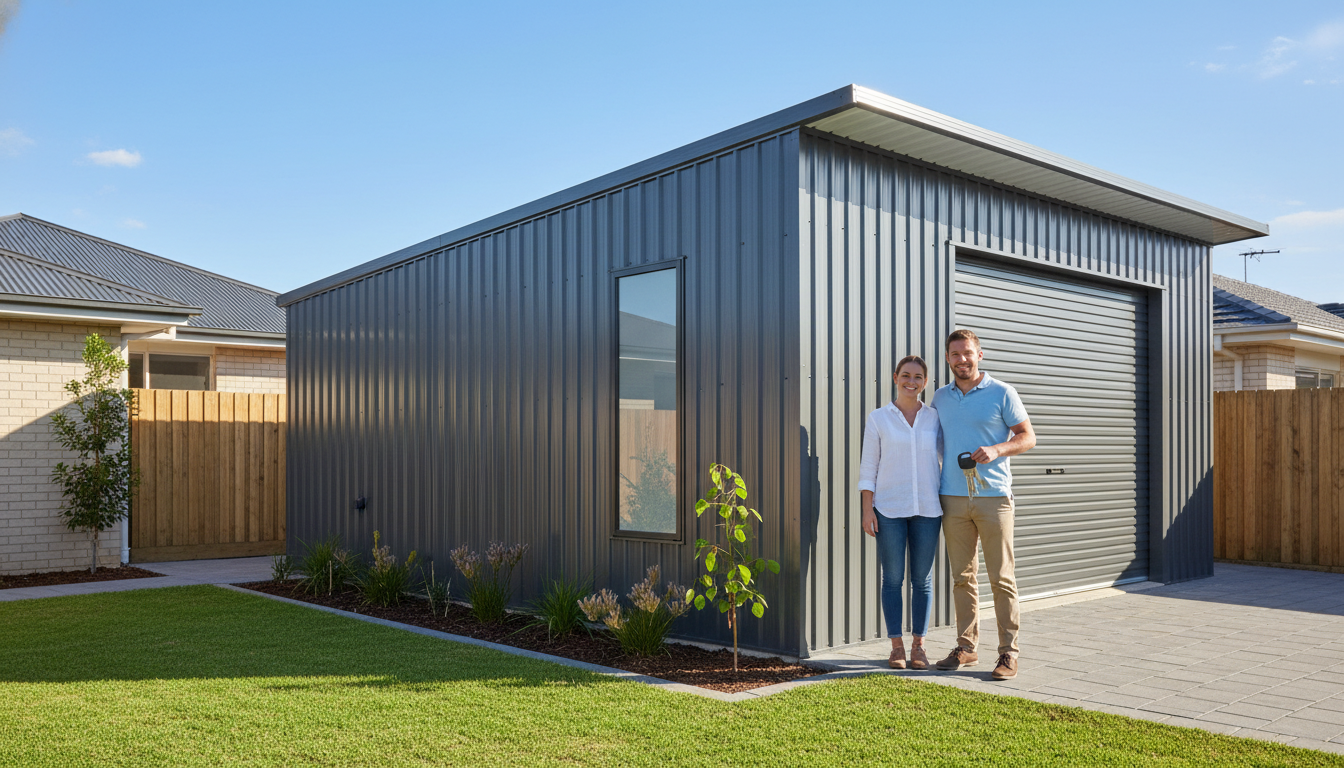
Excerpt: Looking at a storage locker or “small storage near me”? See why many Australians opt for a lock‑up Colorbond shed at home instead. Compare costs, materials, wind ratings, WA heat performance, QLD cyclone design, council approvals, and real build examples—plus a 5‑step buying checklist and pro tips.
If you’re weighing up a storage locker or “locker rental near me”, consider the long‑term value of a compact, lock‑up Colorbond steel shed on your own property. For Australian homeowners, renovators, and investors, a council‑approved, wind‑rated shed often beats ongoing storage unit fees—while adding utility and value to the home.
What’s the smartest “storage locker” option—rental unit or backyard lock‑up shed?
When Australians search “small storage near me” or “small storage lockers near me”, you’ll see two pathways:
- Self‑storage locker rental: flexible month‑to‑month, no upfront build, ongoing fees, travel required.
- On‑property lock‑up shed (Colorbond steel): one‑time investment, convenient access, custom sizes, potential value add to property.
3‑year cost snapshot (typical metro):
- Storage locker rental (2–3 m²): $120–$220/month ≈ $4,320–$7,920 over 3 years.
- Compact Colorbond lock‑up (e.g., 2.3×3.0 m) installed with slab: $4,500–$9,000 depending on site, engineering, and wind rating.
See the full Self Storage Units vs Custom Colorbond Sheds in Australia comparison for a detailed breakdown of pros and cons.
For many homeowners, a custom, council‑approved lock‑up delivers better long‑term utility, especially when matched to local wind region and coastal conditions.
What Are the Best Shed Materials for Perth’s Climate?
Perth’s hot summers, strong UV, coastal air, and sea breeze demand a resilient spec: high‑tensile G550 cold‑formed steel framing (C/Z sections), quality coatings, and effective heat and condensation control.
Colorbond vs Zincalume — Which is better for WA conditions?
Both are BlueScope products used widely in Western Australia. Here’s a practical comparison for coastal and hot‑dry conditions.
| Criteria | Colorbond steel | Zincalume steel | WA Take |
|---|---|---|---|
| UV resistance | Pre‑painted finish with superior UV durability | Metallic coating, no paint; can reflect glare | Colorbond preferred for long‑term colour and UV |
| Coastal performance | Certain grades suited to marine exposure; check distance to surf | Good, but shows patina faster near coast | Colorbond closer to coast; confirm warranty zone |
| Aesthetics | Wide Colorbond palette (e.g., Monument, Surfmist) | Industrial look, silvery | Colorbond wins for residential streetscapes |
| Heat management | Cool roof colours + insulation options | High reflectivity, still needs insulation | Either with Anticon or insulated panels |
| Typical warranty | Up to 20–25 yrs (conditions apply) | Up to 20–25 yrs (conditions apply) | Check BlueScope warranty by site |
| Best use | Premium residential sheds and garages | Rural, cost‑focused projects | Colorbond for Perth metro homes |
Pro Tip: Did you know using insulated roof panels can reduce internal shed temperatures by up to 10°C in summer?
How do I choose the right size and layout for a lock‑up shed?
- Small “storage locker” equivalents: 1.5×1.5 m, 2.3×2.3 m, 2.3×3.0 m for boxes, tools, bikes.
- Popular small storage sheds: 3×3 m or 3×4.5 m with roller door and PA door.
- Double garage kits: 6×6 m+ for vehicles and bulk storage—think custom Colorbond garages Perth.
For vertical volume without renting extra lockers, a shed with loft adds cubic storage on the same slab.
Enhance your shed with Garage Wall Storage in Colorbond Steel Sheds for smarter organisation.
Decide early on door type (roller vs sectional), headroom for racking, gable vs skillion roof, and ventilation (louvres, whirlybirds, eaves vents). Consider a 100 mm 25 MPa slab, SL72 mesh, and edge thickening per engineering.
How to get council approval for your custom shed in WA
Most lock‑up sheds fall under NCC Class 10a and need site‑specific engineering. Process overview for WA:
- Site check: Boundaries, easements, sewer lines, BAL (bushfire) rating, coastal corrosion zone.
- Wind region per AS/NZS 1170.2: Much of Perth is Region A (N1–N3). Coastal/foreshore sites may need higher tie‑downs.
- Engineering: Cold‑formed steel design to AS/NZS 4600; connections per AS 4100/AS/NZS 4600; concrete slab to AS 3600.
- Application: Drawings, Form BA, engineer’s certificate, site plan, and colour schedule to local council.
- Build and inspections: Footing/slab and final checks as required.
Added 2024 WA wind-rating compliance notes: Confirm terrain category (TC2/TC3), shielding, topography multipliers, and regional wind speeds from AS/NZS 1170.2:2021. For coastal suburbs, upgrade fixings (M12–M16 chemset anchors), door wind‑locks, and purlin spacing to suit N3 scenarios.
Helpful references: HIA guidance, Master Builders Australia, Australian Steel Institute.
Do I need a cyclone‑rated shed in QLD?
In North QLD (Regions C & D), you must use cyclone‑rated sheds designed to AS/NZS 1170.2 for C1–C2 and D1–D2 conditions. That means:
- Heavier cladding (e.g., 0.42 TCT), closer purlin spacing, reinforced frames
- Wind‑locked roller doors, upgraded door tracks, stronger jambs
- Hold‑down details, footing depth, and anchor design certified by an RPEQ engineer
This is essential for insurance and compliance. See the Bureau of Meteorology cyclone resources and check local council requirements. We supply cyclone‑rated sheds QLD with full engineering packs.
Local climate and code considerations across Australia
- Perth heat and UV: Choose lighter Colorbond colours (Surfmist, Shale Grey) plus Anticon or insulated panels; add vents.
- Coastal corrosion: Maintain distance from splash zones; specify marine‑grade fasteners and appropriate warranty grade.
- Rural sheds NSW: For farm machinery storage, confirm access widths, heavier slab design for point loads, and rural council overlays.
- Alpine areas (NSW/VIC): Snow actions per AS/NZS 1170.3; increase roof capacity and purlin depth.
- Bushfire: BAL per AS 3959. For Class 10a, ember protection for openings and non‑combustible cladding apply in many zones.
- Energy & condensation: Follow NCC condensation management; check Energy.gov.au and CSIRO guidance.
Build examples (2024–2025)
1) Joondalup, WA — 2.3×3.0 m lock‑up storage shed
- Spec: Colorbond Monument walls/roof, Anticon R1.3, PA door + window
- Engineering: Region A, N2, TC3 suburban; M12 anchors to 100 mm slab
- Use: Replaced off‑site storage locker; paid back in 26 months vs rental fees
2) Cairns, QLD — 3×4.5 m cyclone‑rated lock‑up
- Spec: 0.42 TCT cladding, wind‑locked roller door, upgraded jambs
- Engineering: Region C, C2; RPEQ‑certified hold‑downs and footings
- Use: Secure tools and camping gear—no more “small storage near me” fees
3) Mornington Peninsula, VIC — custom double garage + storage bay
- Spec: Gable roof, Colorbond Surfmist, whirlybirds, vermin‑proofing
- Use: Vehicle + seasonal storage; adds value for investors
5‑Step Buying Guide for Custom Sheds in Australia
- Define use: Locker‑style storage, garden gear, bikes, or a custom Colorbond garage.
- Measure site: Access, setbacks, drainage, slab level, power path.
- Select spec: Colorbond grade/colour, roof style (gable/skillion), doors, insulation, ventilation.
- Engineering & approvals: Wind region, terrain, NCC Class 10a, council‑approved sheds WA and other states; get certified drawings.
- Build & warranty: Licensed installer, QA check, maintenance and warranty registration.
Costs and lead times (guide)
- DIY shed kits (2.3×3.0 m): $1,900–$3,800 supply only; add slab and labour if needed.
- Custom built small lock‑up (≈3×3 m): $4,500–$9,000 installed incl. basic slab in non‑cyclonic metro.
- Double garage (6×6 m): $14,000–$30,000+ depending on doors, insulation, engineering, region.
- Lead times: Kits 2–6 weeks; approvals + install 6–10+ weeks depending on council and season.
Note: 2025 steel and logistics can shift pricing. See the “2025 Australian Steel Market Outlook” and 2025 HIA Outdoor Structures and Home Improvement Report for trends.
Common shed configurations and keyword clusters
- Urban lock‑ups: Compact Colorbond storage sheds replacing “locker rental near me”
- Steel sheds Perth: Heat‑smart colours, insulation, vermin‑seals
- Custom carports Melbourne: Skillion roof carport, affordable carports for Australian homes
- Rural sheds NSW: Farm machinery storage, barn‑style sheds, long bays
- Wind‑rated sheds for cyclonic areas: QLD, NT, WA north coast
- DIY shed kits: Owner‑builder friendly with engineering packs
FAQs
Do I always need a concrete slab?
For a secure lock‑up, a reinforced slab with proper hold‑downs is best. Some councils permit alternative footings, but slab improves security, performance, and resale.
Flat (skillion) or gable roof?
Skillion is modern and space‑efficient; gable improves headroom and ventilation. In high wind zones, engineering dictates purlin depth and spacing regardless of roof choice.
What about condensation?
Use Anticon or insulated roof panels, plus vents. Add sarking to walls in humid or coastal zones. Follow NCC condensation management and CSIRO guidance.
Are your sheds compliant with Australian Standards?
Yes—AS/NZS 1170 (actions), AS/NZS 4600 (cold‑formed steel), AS 4100/AS 3600 (steel and concrete), and AS 3959 (bushfire as applicable). Engineering certificates supplied for approvals and insurance.
Do you handle approvals?
We assist with drawings, engineering, and applications across WA, QLD, NSW, VIC. Local councils have unique overlays—ask us early for a compliant, fast pathway.
Further reading:
Ready to replace your storage locker? Talk to our team about a compact, council‑approved Colorbond lock‑up tailored to your site and wind region. From Perth heat to QLD cyclones—we’ve got your spec, engineering, and install covered. In Western Australia, consider Storage South Perth for premium local Colorbond solutions.