
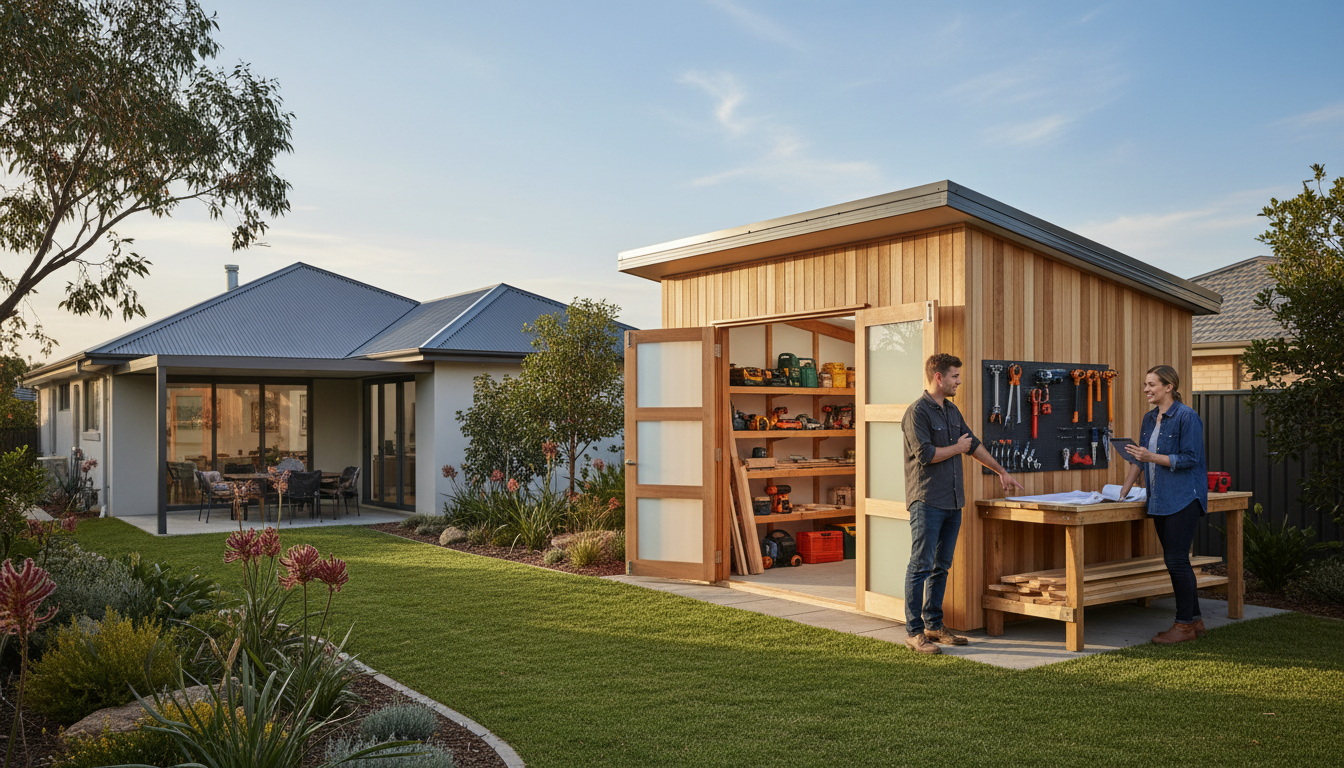
Plan, Price and Build a Quality DIY Shed in Australia
If you’re weighing up a storage sheds DIY project—whether a DIY garden shed kit for tools, a DIY storage shed kit for bikes and boxes, or a custom-built double garage in Perth—this guide distils what Aussie homeowners and investors need to know in 2025. We benchmark top competitors, add local council and wind-rating know‑how, and help you choose between kit and custom so your shed goes up fast, passes inspections, and lasts decades. If you love a timber‑look façade that still uses steel, see our weatherboard garden shed guide.
What Are the Best Shed Materials for Perth’s Climate?
Perth’s hot summers, high UV, and coastal air mean your cladding and fasteners matter. Most quality steel sheds Perth homeowners choose use Australian-made BlueScope steel in either Colorbond or Zincalume. Frames are typically high-tensile galvanised RHS or C-sections with galvanised purlins and girts.
Colorbond vs Zincalume — Which Is Better for WA Conditions?
| Feature | Colorbond | Zincalume |
|---|---|---|
| Heat & UV resistance (Perth) | Excellent; lighter colours reflect heat | Good; reflective but can glare |
| Coastal corrosion resistance | Very good with correct grade and care | Good; more frequent washing near coast |
| Aesthetic options | Wide Colorbond palette to match home | Limited (silver/grey) |
| Cost | Higher upfront | Lower upfront |
| Best use | Premium homes, hot/sunny sites | Budget rural or utility sheds |
For long-term performance and kerb appeal, Colorbond is the best all-rounder for WA. In coastal zones, choose marine-grade components, specify stainless screws where required, and rinse salt spray regularly.
CSIRO and the Australian Steel Institute report that correct specification and maintenance, not just material choice, determine lifespan—especially within a few kilometres of the ocean.
How Do Wind Ratings and Cyclone Design Affect DIY Shed Kits?
Australia uses AS/NZS 1170.2 for wind actions and classifies regions A–D (non-cyclonic to cyclonic). Your site’s wind region and terrain category determine required hold-downs, connections and sheeting spans for wind-rated sheds.
- WA southwest (Perth metro): typically Region A; many sites N2/N3 with local variations.
- QLD coastal north: Regions C/D; requires cyclone-rated sheds QLD buyers can insure.
- NSW/VIC inland: often N2 with exposure increases on ridgelines or open terrain.
Added 2024 WA wind-rating compliance notes Always obtain site-specific engineering for Region, Terrain Category and Topographic Multiplier. Ask for compliance to AS/NZS 1170.2, AS 4100 (steel structures), and connection design for your slab or piers.
For cyclonic areas, look for:
- Heavier base rails and portal frames; closer purlin spacing
- High-capacity hold-down anchors and cyclone washers
- Door bracing kits and wind-lock roller doors
Reference: Bureau of Meteorology cyclone risk maps and AS/NZS 1170.2.
Which Roof Style Suits Your Block: Gable vs Skillion vs Flat?
| Roof Type | Pros | Considerations | Best Fit |
|---|---|---|---|
| Gable | Classic look, good ventilation, strong in wind | Slightly higher cost | Backyard sheds, custom Colorbond garages Perth |
| Skillion (Monoslope) | Modern look, easy water runoff, panels suit solar | Check height at boundary, gutter capacity | Urban blocks, workshop sheds |
| Flat (Low pitch) | Budget-friendly, simple | Drainage critical; not ideal for heavy leaf areas | Small DIY garden shed kit |
DIY Shed Kits vs Custom-Built — What’s Better for Your Site?
DIY shed kits are fast and cost-effective, arriving with pre-cut steel, fasteners, and engineering drawings. Custom builds suit tricky sites, large spans, and premium finishes.
| Item | DIY Storage Shed Kit | Custom-Built Shed |
|---|---|---|
| Cost | Lowest upfront | Higher, scales with design |
| Speed | Fast dispatch, weekend build | Longer design/permit lead-time |
| Engineering | Standardised for common wind ratings | Site-specific, complex wind/snow/topography |
| Finish & options | Fixed sizes; options for doors, windows | Full custom: eaves, insulation, vermin seals |
| Best for | Backyard storage, mower/boxes | Garage workshop combos, farm machinery storage |
What Paperwork Do You Need for Council Approval?
Most Australian councils require building approval for sheds over a small threshold (often >10 m² or above certain heights). You’ll typically need engineered plans, site plan, slab detail (AS 2870 soil classification), and boundary setbacks.
How to Get Council Approval for Your Custom Shed in WA
- Check R-Codes and local planning overlays for height and boundary setbacks.
- Order engineering certified to AS/NZS 1170.2, AS 4100, and slab to AS 2870.
- Submit a certified or uncertified Building Permit application with drawings and specs.
- Book inspections (footings/slab and completion) if required.
- Keep evidence for insurance and resale: council-approved sheds WA.
QLD and Cyclone Regions
In QLD, ensure Region C/D engineering, wind-rated doors and fixings, and QBCC compliance where applicable. This protects insurance eligibility for cyclone-rated sheds QLD.
Helpful resources: HIA homeowner advice and Master Builders Australia.
How Much Do Storage Sheds Cost in Australia in 2025?
Indicative supply-only pricing (Colorbond cladding, N2–N3 rating):
- 3 x 3 m DIY garden shed kit: $900–$1,800
- 6 x 3 m DIY storage shed kit with single roller door: $3,500–$6,500
- 6 x 6 m custom-built double garage: $12,000–$22,000 (supply), add slab and install
- 9 x 6 m rural sheds NSW (open-bay): $10,000–$18,000 (supply)
Planning a garage or larger workshop next? Compare inclusions and price ranges in our prefab garage & modular shed kits guide.
Slabs vary widely by site and steel prices. The 2025 Australian Steel Market Outlook suggests stable-to-firm steel pricing versus 2024, while the 2025 HIA Outdoor Structures and Home Improvement Report notes sustained demand for premium outdoor structures, especially insulated workshops and garage conversions.
What Size and Layout Work for You?
- Backyard storage (mower, bikes): 3 x 3 m to 3 x 4.5 m, single access door, skylight, shelving.
- Garage workshop combo: 6 x 6 m to 7 x 7 m, 2.4–2.7 m eave height, roller door + PA door, power and insulation.
- Farm machinery storage: 9 x 6 m to 12 x 6 m open-front bays, 3.0–3.6 m eave height, heavy purlins, hot-dip brackets.
- Custom carports Melbourne: 6 x 6 m double, skillion roof, 75–90 mm posts, cyclone plate options for high wind corridors.
For fit‑out, bench layout and cooling tips specific to Aussie conditions, explore our garden shed workshop ideas.
What’s Included in a Quality DIY Storage Shed Kit?
- Galvanised steel frame (RHS/C-sections) and Colorbond or Zincalume sheeting
- Purlins, girts, flashings, barge and ridge caps, gutters and downpipes
- Fasteners, sealants, vermin-proofing, and door hardware
- Engineering drawings and bill of materials, installation manual
- Optional: windows, skylights, insulation blankets or PIR panels, mezzanine storage
Installation: Can You Build It Yourself or Hire a Tradie?
Competent DIYers with a mate and the right tools can assemble small to mid-size kits over a weekend. For larger spans, wind-exposed sites, or if time-poor, engage a licensed installer.
Typical DIY Steps
- Set out and pour slab (100 mm typical with thickened edges; AS 2870 soil class).
- Assemble portals on the ground, raise with temporary braces.
- Fix purlins and girts; check plumb and square.
- Install roof and wall sheeting; flashings and seals last.
- Fit roller doors and accessories; complete guttering and stormwater.
5-Step Buying Guide for Custom Sheds in Australia
- Define use-case: storage, garage workshop, farm machinery storage, or home business.
- Confirm site constraints: setbacks, easements, driveway width, overhead power, BAL rating.
- Pick materials: Colorbond vs Zincalume, insulation level, door types, vermin seals.
- Engineer for wind region and terrain; ask for N2/N3 or C2/C3 compliance as needed.
- Choose supplier/installer with Australian steel, clear lead times, and council support.
Case Studies: Real Australian Builds
Perth — Custom-Built Double Garage
6 x 6 m gable, Colorbond Surfmist roof/walls, 2 x roller doors, insulated roof blanket for heat. Engineered N3 with perimeter tiedowns for coastal breeze corridor. Council passed first go. A great example of custom Colorbond garages Perth.
North QLD — Cyclone-Rated Farm Shed
9 x 6 m two-bay, open-front, Region C design with heavier purlins and cyclone washers. Wind-lock roller door on enclosed bay. Insurable and compliant for sugarcane property near coast.
Melbourne — Skillion Carport and Storage Annex
6 x 6 m custom carport plus 3 x 3 m lock-up store. BAL-12.5 compliant cladding, concealed gutters, and powder-coated posts to match façade. Perfect for urban blocks.
FAQs
Do I need a permit for a small DIY shed? In most councils, yes if it exceeds a small area or height (often >10 m² or over 2.4 m high). Always confirm locally.
Can I put a shed on pavers? Not recommended. Use a reinforced concrete slab or engineered piers with bearers to meet wind hold-down requirements.
Which is cooler: Colorbond or Zincalume? Light Colorbond colours with insulation are cooler than dark colours; Zincalume reflects well but may glare.
Are DIY shed kits easy to build? With two people, basic tools and a flat slab, small to mid-size kits are very achievable over a weekend.
What about bushfire areas? Choose BAL-compliant cladding, ember seals and metal mesh to suit your BAL rating (AS 3959).
Local Standards, Climate and Industry References
- Standards: AS/NZS 1170.2 (wind), AS 4100 (steel), AS 2870 (slabs), AS 3959 (BAL)
- Climate data: Bureau of Meteorology
- Industry guidance: Australian Steel Institute, HIA
- Market trends: “2025 Australian Steel Market Outlook”; “2025 HIA Outdoor Structures and Home Improvement Report”
Keyword Clusters You Might Be Searching
- DIY shed, DIY shed kits, DIY garden shed kit, DIY storage shed kit
- Steel sheds Perth, rural sheds NSW, custom carports Melbourne
- Colorbond vs Zincalume comparison, wind-rated sheds for cyclonic areas
- Council-approved sheds WA, cyclone-rated sheds QLD, custom Colorbond garages Perth
- Garage workshop, gable roof shed, skillion roof shed, insulated steel sheds
Ready to plan your shed? Nail the materials, wind rating and council approval first, then choose the right kit or custom design. You’ll end up with a durable, compliant structure that adds value to your home or investment property.