
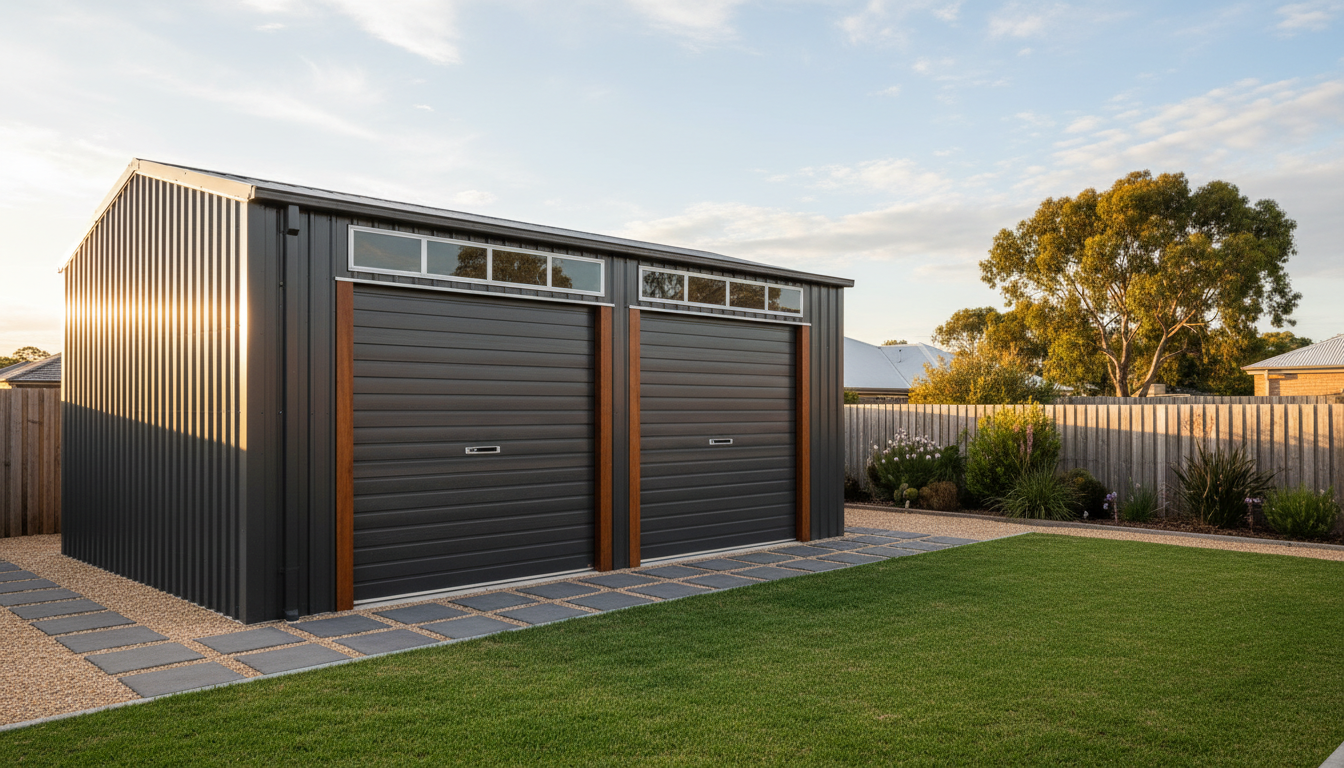
Whether you call it a two door shed, a double door shed, or a 2 door storage shed, getting the design, engineering, and approvals right is the difference between a shed that lasts decades and one that struggles through the first summer storm. This guide is built for Australian homeowners, renovators, and property investors who want premium quality without the headaches.
Related reading: If you need upstairs storage above your shed footprint, compare a Two‑storey garage in Australia with typical double‑door shed layouts.
Enhance your shed’s functionality by considering a Storage Shed with Loft for increased vertical storage and flexible design.
What is a two door shed, and why choose one?
A two door shed is a steel shed with a wide double opening—usually twin hinged doors, sliding doors, or dual roller doors—allowing easier access for ride-on mowers, motorbikes, farm machinery storage, or a compact custom-built double garage in Perth or any other capital city. Compared with a single-door garden shed, double doors improve usability, airflow, and flexibility for bulky items.
Common uses for a double door shed
-
– Workshop + storage combo for tradies and DIYers
– Boat or jetski bay next to garden equipment storage
– Home gym with separate access for bikes
– Rural sheds NSW properties: feed and tool storage
– Caravan annex or mower bay next to mower tools
– Small business stock room or clean equipment store
Learn more about effective Garden Shed Shelving in Australia to maximise the utility of your double door shed.
What are the best shed materials for Perth’s climate?
Australia’s climates vary wildly—Perth’s heat and sea breeze, Brisbane’s humidity, Tasmania’s cold, and QLD’s cyclones. Your two door shed should be engineered and specified for your wind region, corrosion category, and intended use.
Colorbond vs Zincalume — Which is better for WA conditions?
| Factor | Colorbond (pre-painted) | Zincalume (AZ coating) |
|---|---|---|
| Coastal performance | Excellent when specified to manufacturer coastal guidelines; consider marine-grade fasteners | Very good; keep >200–400 m from breaking surf for best life; rinse in high salt areas |
| Heat performance | Cooler colours and solar-reflective technology help reduce heat gain | High reflectivity when new; can heat up once weathered if uninsulated |
| Aesthetics | Wide Colorbond palette to match home facades | Industrial silver-grey finish as standard |
| Price | Higher upfront | Budget-friendly |
| Best for | Residential sites, premium looks, coastal suburbs | Rural and industrial, repaint later if desired |
| Warranty | Long manufacturer warranties when installed to spec | Strong warranties in non-marine conditions |
Either works across most of Australia when detailed correctly. For Perth’s heat and sea air, Colorbond is often preferred for thermal and aesthetic reasons; inland WA farms commonly choose Zincalume cladding with Colorbond doors and flashings.
For a classic Australian aesthetic, see our Weatherboard Shed Guide (Australia) for advice on design, approvals and costs.
How do wind ratings and cyclones affect a 2 door shed?
Wind rating determines the frame, connections, cladding gauge, and door systems. It’s mandated by AS/NZS 1170.2 (Wind Actions) and the NCC (BCA). In northern WA and QLD, cyclone-rated sheds (Regions C & D) require upgraded frames, door bracing, and certified hold-downs.
-
– Non-cyclonic metro (e.g., Adelaide, Melbourne, Sydney): N2–N3 typical, site-specific engineering still recommended
– Cyclonic areas (e.g., Cairns, Townsville, Karratha): C1–C2 common, with enhanced tie-downs and door systems
– Bushfire zones (NSW/VIC regional): Check BAL requirements per AS 3959 for ember protection and metal cladding
Added 2024 WA wind-rating compliance notes: Many Perth sites fall into Region A, but coastal and hilltop sites can push higher pressures. Ask for site-specific engineering and council-approved sheds WA documentation before ordering.
Which roof is right: flat, skillion, or gable?
| Roof Type | Pros | Cons | Best for |
|---|---|---|---|
| Flat (low pitch) | Low height profile, modern look, economical | Lower runoff; needs correct fall and gutters | Urban backyards with height limits |
| Skillion (single pitch) | Great water runoff, easy solar orientation | Wind uplift on high edges; needs proper bracing | Rainfall-prone regions; future solar |
| Gable | Classic style, good airflow via ridge vents | Taller ridgeline can require extra approvals | Workshops and double garage conversions |
Doors for a two door shed: hinged, sliding, or roller?
-
– Double hinged: Simple and secure; allow for wind stays in exposed sites.
– Double sliding: Great when driveway space is tight; ensure quality bottom rails and anti-lift guides.
– Twin roller doors: Premium feel; need headroom and power; choose wind-rated roller doors in cyclonic areas.
For cyclonic zones, select wind-rated doors with tested wind-locks and upgraded tracks, compliant with AS/NZS 4505 where applicable.
DIY shed kits vs custom-built: which is better for you?
| Factor | DIY Shed Kits | Custom-Built (Supply & Install) |
|---|---|---|
| Upfront cost | Lowest | Higher, includes labour and management |
| Approvals | You handle forms and engineering | Installer manages council and certificates |
| Speed | Depends on your time and weather | Faster with experienced erectors |
| Quality control | Varies by DIY skill; check squareness/tie-downs | Professional finish; warranty-backed |
| Complex sites | Challenging | Handled via site-specific engineering |
DIY shed kits are great for straightforward backyards. For cyclonic, bushfire-prone, sloping, or coastal sites, a custom Colorbond garage or two door shed installed by a licensed team is usually better value long term.
How to get council approval for your custom shed in WA
Step-by-step approvals in Western Australia
- Check planning rules: boundary setbacks, site coverage, and height limits on your local council website.
- Obtain site-specific engineering to AS/NZS 1170.2 and NCC, with footing and slab details.
- Prepare drawings: site plan, elevations, sections, drainage, and door schedule.
- Lodge building permit (BA2 or BA1) with your council; include engineering certificates and energy/insulation notes where required.
- Book inspections as requested; obtain Occupancy/Completion documentation.
For council-approved sheds WA, many installers will package approvals with soil testing and slab design, speeding up lead times. Always confirm boundary fire protection requirements if near lot lines.
Added tip for WA coastal zones: use marine-grade fasteners and consider higher coating categories for gutters and flashings within a few hundred metres of surf.
Are cyclone-rated sheds required in QLD and northern WA?
Yes—if you’re in Regions C or D. cyclone-rated sheds QLD and WA north of the Tropic must use engineered frames, door wind-locks, upgraded purlins, extra hold-down bolts, and specific cladding screw patterns. Ask for a Form 15/16 (QLD) or equivalent certification. This is essential for insurance compliance.
Insulation, condensation, and comfort
-
– Use roof anticon blanket or insulated panel systems to control condensation and noise.
– Add wall insulation batts or rigid boards if using the shed as a workshop or home gym.
– Ventilation: whirlybirds or ridge/soffit vent systems to improve airflow.
Compliance and standards to reference
-
– NCC (BCA) Volume Two — Class 10a buildings (sheds)
– AS/NZS 1170.2 — Wind actions
– AS/NZS 4600 — Cold-formed steel structures
– AS 4100 — Steel structures
– AS/NZS 1397 — Steel sheet and strip (Zincalume/galvanize base)
– AS/NZS 2312.2 — Corrosion protection of steel
– AS 1562 series — Sheet roof and wall cladding
– AS 3959 — Construction in bushfire-prone areas (BAL)
– AS/NZS 3500 — Plumbing and drainage (for downpipes)
Real-world examples: Australian two door sheds done right
Perth (metro, Region A): 6 × 4 m double door workshop
-
– Colorbond Surfmist walls/roof, contrasting Monument doors
– Skillion roof 5° pitch facing north for future solar
– Double sliding doors for driveway clearance
– Anticon roof blanket + vermin flashing
– Site-specific N3 wind design for coastal exposure
Cairns (Region C cyclonic): 7 × 5 m two door storage shed
-
– Zincalume cladding, Colorbond wind-rated twin roller doors
– Upgraded hold-down bolts, extra strap bracing and screw patterns
– Engineer’s cyclonic certification supplied for insurance
Central West NSW rural: 9 × 6 m farm machinery bay
-
– Zincalume walls/roof with large double hinged doors
– Gable roof with ridge vent; gravel floor first, slab later
– BAL-12.5 detailing with ember-proof mesh to eaves
How much does a two door shed cost in Australia?
Pricing varies by size, wind rating, cladding, doors, slab, and whether you choose DIY shed kits or installed solutions. Expect a quality 6 × 4 m two door shed to start in the low-to-mid thousands for a kit, with installed, council-approved options scaling higher—especially for cyclonic or coastal specs. The HIA and industry updates note continuing demand for outdoor structures, while the Australian Steel Institute tracks steel market movements that can influence lead times and price.
5-step buying guide for custom sheds in Australia
- Confirm site constraints: services, setbacks, easements, and vehicle access.
- Pick your spec: Colorbond vs Zincalume, roof type, door style, insulation, gutters.
- Get engineering for your wind region and terrain; request a site-specific certificate.
- Sort approvals: planning/building permits, bushfire and stormwater notes, slab design.
- Select installer: check licences, insurances, references, and warranty terms.
FAQs: two door sheds in Australia
Do I need council approval for a 2 door shed?
Often yes—size, height, and placement trigger permits. Many councils offer fast-track for compliant Class 10a structures. Always check your local rules.
Can I DIY the slab?
Yes, but follow the engineer’s footing/slab detail. Poor slabs lead to door misalignment and water ingress.
What’s better for coastal homes—Colorbond or Zincalume?
Colorbond is commonly chosen for looks and coastal performance, paired with marine-grade fasteners and regular washdowns.
What about condensation?
Use anticon blanket or insulated roof panels, plus vents. Consider wall wraps in humid or cold climates.
What warranties should I expect?
Steel cladding warranties (conditions apply), structural warranties from the shed company, and workmanship warranties from the installer.
Local climate and energy notes that matter
-
– Perth summers: choose lighter Colorbond colours, insulated roofs, and vents for comfort.
– QLD humidity: ensure sarking/wraps manage condensation; choose cyclone-rated doors and frames.
– Southern states: consider BAL requirements and downpipe sizing for heavy rain events.
See climate and energy guidance at the Energy.gov.au portal, and local weather data at the Bureau of Meteorology.
Semantic checklist: have you covered these essentials?
-
– steel sheds Perth
– custom Colorbond garages Perth
– custom carports Melbourne
– rural sheds NSW
– Brisbane shed builders
– Adelaide shed installers
– Sydney council shed permit
– Darwin cyclonic sheds
– Hobart corrosion-resistant sheds
– Gold Coast carports
– Colorbond vs Zincalume comparison
– wind-rated sheds for cyclonic areas
– site-specific engineering
– slab-on-ground and footings
– tie-downs and hold-down bolts
– vermin flashing and weatherproofing
– BAL bushfire compliance
– DIY shed kits
– affordable carports for Australian homes
– farm machinery storage
Get it right the first time
Your two door shed should be engineered, council-cleared, and built for your exact climate—whether that’s a coastal Colorbond double door shed in WA or a cyclone-ready 2 door shed in QLD. Ask for site-specific engineering, written warranties, and council paperwork up front to avoid delays.
For industry guidance and updates, also see the Housing Industry Association, CSIRO building research, and the Australian Steel Institute.