
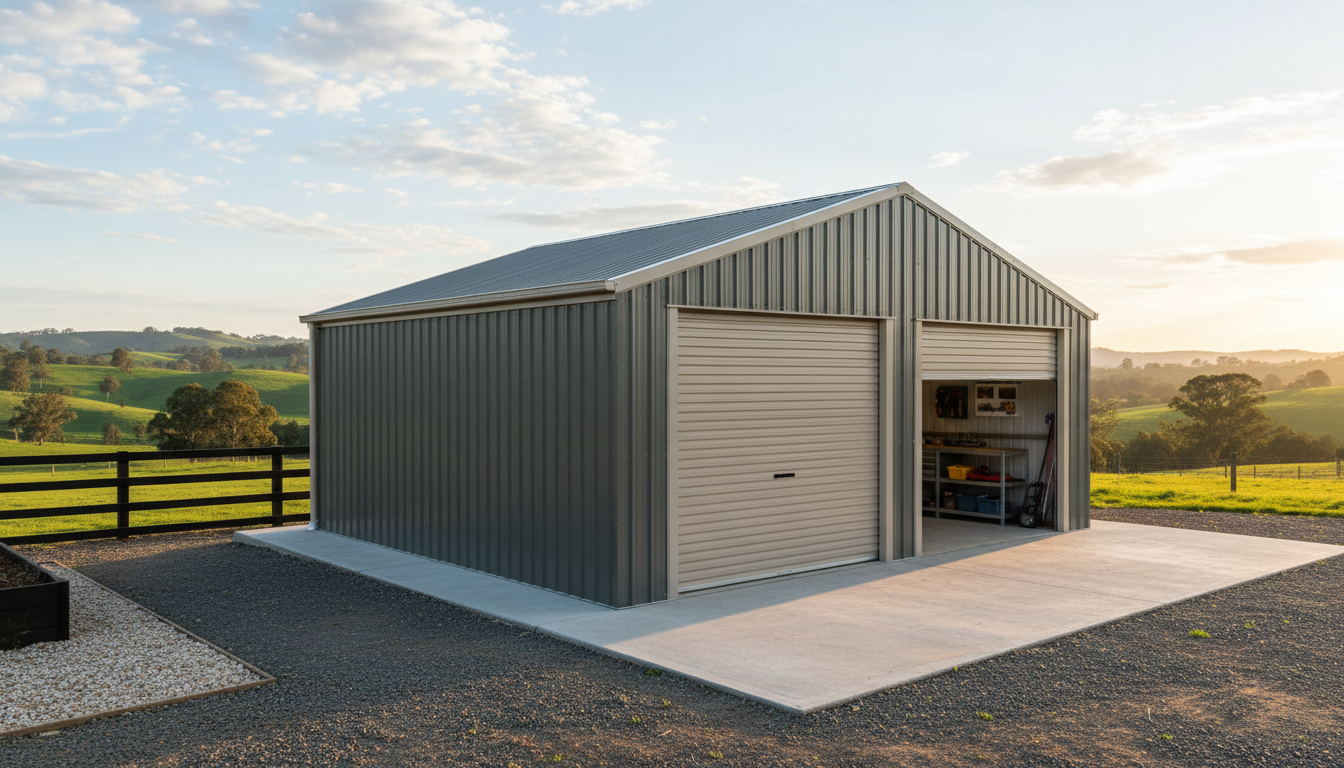
Designing a Double Door Shed that Lasts in Australian Conditions
A well-built two door shed (also called a double door shed, 2 door shed or 2 door storage shed) gives you wide, hassle-free access for mowers, bikes, boats and trade gear—and looks sharp next to your home. Below, we cover materials, wind ratings, council approvals, roofing, pricing, and smart design choices for Australian sites.
Why choose a two door shed over a single-door design?
- Better access: Move pallets, ride-on mowers and tool trolleys without scuffing jambs.
- Flexible layout: Separate “clean” storage from a workshop bay.
- Vehicle-friendly: Suits small utes, motorbikes and tinnies; can upgrade to twin roller doors.
- Future-proof: Add shelving or a bench between doors for efficient circulation.
What Are the Best Shed Materials for Perth’s Climate?
In hot, coastal conditions like Perth, a Colorbond steel shed with marine-grade fasteners resists fading and corrosion. Inland or rural sites across WA, SA and NSW may also consider Zincalume for a cost-effective shell with high reflectivity.
| Feature | Colorbond | Zincalume |
|---|---|---|
| Coastal corrosion resistance | Excellent with correct grade and fasteners | Good inland; additional care near surf |
| Heat performance | Cooler colours reduce heat gain; Thermatech options | High reflectivity but can glare |
| Aesthetics | Wide Colorbond palette to match roofs and fences | Industrial look; paint later if desired |
| Price (shell) | $$ | $ |
| Resale appeal | High for premium suburbs | Good for rural/utility builds |
Helpful references: Australian Steel Institute, CSIRO building science, Energy.gov.au residential cooling.
How big should a two door shed be?
Start with what needs to pass through the doors. For ride-on mowers and wheelbarrows, allow a clear opening of 1,600–2,400 mm. For small boats or a project car, twin openings of 2,400–3,000 mm with 2,400–2,700 mm height are typical.
- Door types: Hinged double doors (budget), sliding barn doors (wide, low headroom), twin roller doors (secure, motorisable).
- Structure: Use galvanised purlins and cold‑formed steel frames compliant with AS/NZS 4600.
- Slab: 100–120 mm reinforced concrete with M10/M12 anchor bolts; confirm edge distances per engineer’s detail.
- Security: Add internal drop bolts, deadlocks, and tamper-proof hinges.
Flat, gable or skillion roof — which suits your site?
| Roof Type | Pros | Considerations | Best For |
|---|---|---|---|
| Gable | Classic look, good airflow, easy guttering | Slightly taller ridge height | Suburban blocks, matching house roofs |
| Skillion | Modern, simple, easy solar orientation | Check height on boundary rules | Narrow sites, rainwater harvesting |
| Flat (low pitch) | Low visual impact, simple install | Strict to drainage detail in heavy rain | Under eaves, carport conversions |
Do you need council approval for a two door shed?
Most Australian councils require approval above certain sizes or near boundaries. Check the National Construction Code (NCC) and your local planning scheme.
How to Get Council Approval for Your Custom Shed in WA
Added 2024 WA wind-rating compliance notes WA sheds must meet AS/NZS 1170.2 wind loads and, where relevant, bushfire BAL requirements under AS 3959. For council-approved sheds WA you’ll typically need:
- Site plan with setbacks and stormwater disposal.
- Certified engineering drawings (Region A or B for Perth metro; higher in coastal fronts).
- Specifications: Colorbond grade, fasteners, slab detail, vermin flashing.
- Energy and drainage notes if collecting rainwater.
- Building permit application via your local council or private certifier.
QLD and cyclonic regions
North QLD sites may fall in Regions C or D. Choose cyclone-rated sheds QLD with upgraded connections, door wind locks, and additional hold-downs designed per AS/NZS 1170.2 and AS/NZS 4600.
NSW and rural zones
Many rural sheds NSW are exempt or complying if within size limits, but engineered certification and boundary controls still apply—especially in bushfire-prone areas (BAL-Low to BAL-FZ).
Approvals help: Housing Industry Association (HIA), Master Builders Australia, Bureau of Meteorology climate data.
What wind rating does your shed need?
- AS/NZS 1170.2 defines regions and terrain categories. Perth metro is typically Region A/B; Townsville/Cairns often Region C; exposed coastal headlands may push higher design pressures.
- Specify wind-rated doors: roller doors with wind locks, reinforced tracks, and adequate mullions between doors.
- Detail fixings: cyclonic roof battens, extra screws at edges, and uplift-rated anchor bolts.
While larger two-door sheds may require higher wind strength ratings, if you’re seeking truly expansive options, visit our Large Sheds for Sale in Australia guide.
Thermal comfort, condensation and corrosion control
- Insulation: R1.3–R2.2 blankets under roof sheets; add wall sisalation for condensation control.
- Ventilation: Ridge vents or whirlybirds, louvres opposite door openings to promote crossflow.
- Coastal detailing: Marine-grade fasteners, compatible gutters/downpipes, wash-down accessibility.
How much does a two door shed cost in 2025?
Indicative installed pricing (AUD, metro areas):
- Small 2 door storage shed (3 x 3 to 3 x 4 m, hinged doors): $2,800–$5,500 DIY; $5,500–$9,000 installed.
- Mid-size double door shed (6 x 4 to 6 x 6 m, twin roller doors): $7,500–$12,500 DIY; $12,000–$19,000 installed.
- Larger workshop (7 x 7 to 9 x 7 m, reinforced mullion, motorised doors): $15,000–$28,000 DIY; $22,000–$38,000 installed.
Drivers: Colorbond vs Zincalume, wind region, concrete slab, electrical fit-out, insulation, and site access. Sources: “2025 HIA Outdoor Structures and Home Improvement Report” and “2025 Australian Steel Market Outlook” (industry summaries based on Australian Steel Institute trends and supplier indexes). Consider the shed size, materials, and intended use to estimate your outlay. For those considering timber constructions, our comprehensive guide to Wood Shed Kits in Australia offers detailed advice on timber and Colorbond options.
DIY shed kit vs custom-built — which is better?
| Factor | DIY Shed Kits | Custom-Built |
|---|---|---|
| Cost | Lower upfront | Higher but turnkey |
| Approvals | You lodge plans | Builder/engineer handles |
| Wind/cyclone detailing | Check kit certification and upgrades | Tailored to site and soil class |
| Timeline | Faster to delivery | Smoother installation |
| Finish | Basic trims and hardware | Premium doors, flashings, insulation |
Real-world examples (Australian builds)
Perth, WA — 6 x 6 m two door shed
- Spec: Colorbond Monument, twin 2,400 mm wind-locked roller doors, skillion roof, anti‑condensation blanket.
- Compliance: Region A/B design, BAL-12.5. Local stormwater connection to soakwells.
- Use: Motorbike workshop plus garden gear. Result: 20–30% cooler after adding roof insulation and ridge vent.
Townsville, QLD — 7 x 6 m cyclone-rated shed
- Spec: Region C engineering, upgraded mullions, cyclonic battens, door wind locks, extra hold-downs.
- Outcome: Passed final inspection with no variations; insurer-approved for contents cover.
Dubbo, NSW — 9 x 7 m rural two door shed
- Spec: Zincalume shell, powder-coated doors, gable roof, whirlybirds, water tank connection.
- Use: Farm machinery storage and a bay for a working dog wash area.
5-Step Buying Guide for Custom Sheds in Australia
- Define use and clearances: List everything that must pass through your doors (include tow-ball height, roof racks).
- Choose materials: Colorbond for coastal and premium looks; Zincalume for budget utility; confirm compatible fasteners.
- Engineer for wind region and soil class: AS/NZS 1170.2 for wind; slab and footings by an Australian engineer.
- Plan drainage and power: Gutters/downpipes to legal discharge; allow circuits for motors, lights and tools.
- Get approvals and build: Lodge plans, order kit or engage a licensed installer; book final inspection.
Frequently asked questions
What’s the best door type for a two door shed?
Twin roller doors suit vehicles and windy sites; hinged double doors are cost-effective for smaller openings; sliding barn doors shine where headroom is tight.
Do I need insulation?
Yes for most Australian climates. Roof blankets or insulated panels reduce summer heat and stop condensation drips over tools and timber.
What about bushfire zones?
In BAL areas, specify non-combustible cladding, ember-proof vents and steel frames. Check AS 3959 and local rules.
How thick should the slab be?
Commonly 100–120 mm with mesh reinforcement, thickened edges at door openings, and anchor bolts sized by the engineer.
Can I match my house colour?
Yes—Colorbond colours let you align with fences and roof. Many homeowners opt for Monument, Surfmist or Woodland Grey.
Is Zincalume okay near the beach?
It’s serviceable with extra care, but Colorbond marine grades plus the right fixings are generally preferred within a few kilometres of surf.
Can I add a carport to a two door shed?
Yes. Many clients pair sheds with affordable carports for Australian homes or custom carports Melbourne style lean-tos for extra covered space.
Maintenance tips for long life
- Rinse coastal salt monthly; keep gutters clear and downpipes connected to stormwater or tanks.
- Lubricate roller door tracks and check wind locks annually.
- Inspect fasteners for corrosion; replace with compatible, coated screws if needed.
- Maintain vermin flashing and door seals to keep the interior dry and clean.
Design notes and industry context
- Colour and coatings: Refer to manufacturer tech sheets for Colorbond vs Zincalume comparison and care.
- Structural codes: AS/NZS 1170.2 (wind), AS/NZS 4600 (cold-formed steel), NCC Volume Two for Class 10a structures.
- Climate: Use BoM rainfall and wind roses to orient doors away from prevailing weather and to plan cross-ventilation.
- Market: The 2025 Australian Steel Market Outlook suggests stable supply with modest price movements; factor lead times into projects.
Related projects and upgrades
- If a freestanding two-door shed doesn’t fit your space, you might consider an Off the Wall Garden Shed as a practical wall-mounted solution.
- Solar-ready skillion roofs, rainwater harvesting, and gutter guards.
- Tool-safe internal fitouts: plywood lining to hang tools, LED task lighting, and 15A GPOs for welders.
- Matching builds: custom Colorbond garages Perth, boat sheds with taller roller doors, and caravan-ready lean-tos.