
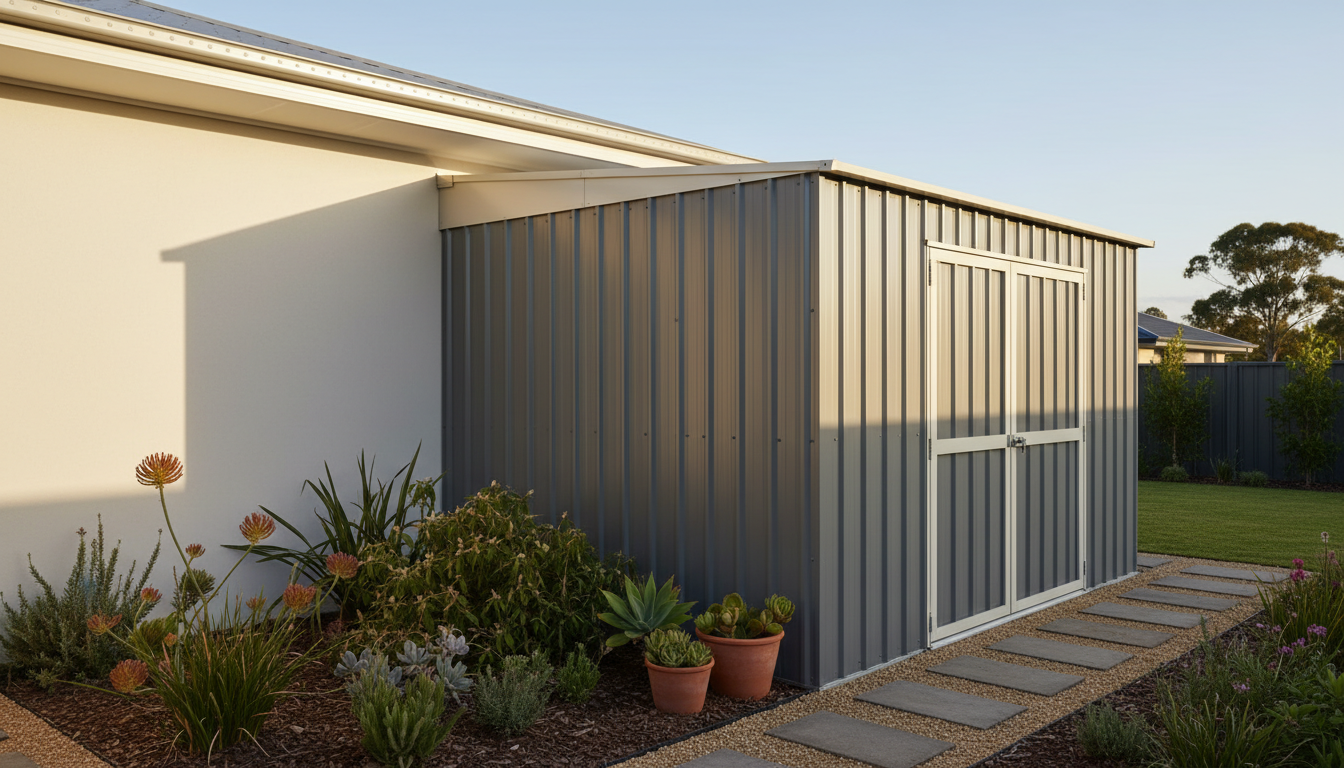
If you’re short on space, an under eave garden shed (often called an under eaves shed or slimline lean‑to) delivers discreet storage without eating into the backyard. This expert guide covers materials, wind ratings, council rules, waterproofing under the eaves, and whether a DIY shed kit or custom build suits your site.
What is an Under Eave Garden Shed?
An under eave garden shed is a low-profile, slimline shed that sits against a dwelling wall or beneath the roof overhang (eaves). It’s ideal for narrow side setbacks and utility storage like tools, bins, pool equipment, and bikes. Designs are usually skillion (mono‑pitch) or flat‑roof lean‑to in Colorbond steel.
What Are the Best Shed Materials for Perth’s Climate?
For hot summers, coastal air and occasional storms, Western Australians typically choose BlueScope Colorbond steel cladding over a galvanized frame. Where salt exposure is high, specify Colorbond Ultra or additional galvanic protection on frames and fixings.
Colorbond vs Zincalume — Which Is Better for WA Conditions?
| Feature | Colorbond (incl. Ultra) | Zincalume (AZ150) |
|---|---|---|
| Coating & finish | Painted, baked-on colour layer over alloy coat | Aluminium-zinc alloy metallic coating |
| Coastal performance | Strong, especially with Ultra in C4–C5 zones near surf | Good inland; more maintenance near salt/spray |
| Heat reflectance | High with lighter Thermatech colours, lowers heat load | Moderate; bright finish but heats up in sun |
| Warranty & brand | BlueScope warranty; broad colour palette | BlueScope warranty; mill finish only |
| Look on modern homes | Premium aesthetic, matches gutters/fascia | Utilitarian, suits rural/utility outbuildings |
| Typical choice | Urban/coastal WA homes, premium custom sheds | Budget DIY shed kits, rural sheds NSW inland |
Pro Tip: Did you know using insulated roof panels or an anti‑condensation blanket can reduce internal shed temperatures by up to 10°C in summer? Pair with light Colorbond colours and passive vents. See guidance from CSIRO building science and Energy.gov.au cooling advice.
Design Options: Slimline, Lean‑To and Custom Under‑Eaves Sheds
Most under eave garden sheds are 600–1200 mm deep to fit typical side setbacks. When space allows, 1500–1800 mm depth supports bikes and lawn gear. Consider these options:
- Skillion lean‑to with fall away from the house for drainage.
- Flat roof under the eaves with head flashing and sealed junctions.
- Low-height custom to clear windows, meters, or gas HWS.
- Integrated gutters and downpipes to the site stormwater system.
- Vermin flashing, sarking or vapour barrier, and anti‑condensation blanket.
- Security options: keyed doors, concealed fixings, roller door wind locks.
Roof Types: Flat vs Gable vs Skillion (Mono‑Pitch)
| Roof | Best for | Pros | Cons |
|---|---|---|---|
| Skillion (mono‑pitch) | Under eaves/side setbacks | Simple, ideal fall for drainage, tight against walls | Height varies across depth; watch window/obstacle clearances |
| Flat | Very low height constraints | Minimal visual impact | Requires careful waterproofing; ponding risk without falls |
| Gable | Freestanding or wider sheds | Good airflow and headroom | Usually unsuitable directly under eaves |
Popular use-cases
- Bin and recycling station with side access.
- Pool pump and chemical storage (vented doors, bunded floor).
- Bike and scooter bay with anti‑theft points.
- Garden tools and lawn mower caddy.
- Compact workshop nook with mezzanine storage shelf.
Do You Need Council Approval for an Under Eaves Shed?
Many councils permit small Class 10a sheds as exempt or fast‑tracked development, but rules vary. Key checks: footprint, height at boundary, setbacks, stormwater connection, and whether the shed is attached to the dwelling. If attached structurally, it may be treated like a home addition and trigger extra compliance.
How to Get Council Approval for Your Custom Shed in WA
- Confirm local planning scheme and R‑Codes side setback rules.
- Obtain site‑specific engineering to AS/NZS 1170.2 wind region (A, B, C, D).
- Prepare drawings: slab plan, elevations, sections, stormwater layout, fixing details.
- Apply for BA2 (certified) or BA1 (uncertified) with a registered building surveyor’s certificate if required.
- Coordinate Dial‑Before‑You‑Dig and service clearances (gas, electrical, NBN).
For forms and guidance, check the WA Building Commission and your local council. See the HIA homeowner approvals resources for Australia‑wide basics. council-approved sheds WA
NSW and QLD notes
- NSW: Many sheds qualify as exempt development if within size/height setbacks; otherwise, Complying Development via a certifier. Check BAL requirements under AS 3959.
- QLD: Stronger wind regions along the coast may require cyclone‑rated detailing (Region C/D). cyclone-rated sheds QLD
Wind Ratings, Bushfire and Coastal Considerations
Your shed must be engineered for the wind region and terrain category per AS/NZS 1170.2. In coastal QLD or WA’s north, cyclonic detailing (hold‑down capacity, sheeting laps, screw spacing, door wind locks) is essential. In bushfire‑prone NSW/VIC/WA, check BAL and ember protection. In coastal corrosion zones (C3–C5), specify galvanised or hot‑dip galvanised frames, stainless fixings near splash zones, and Colorbond Ultra cladding.
Added 2024 WA wind-rating compliance notes Verify wind classification and local topography (topographic acceleration near escarpments). See Bureau of Meteorology wind data and the Australian Steel Institute guidance on corrosion categories.
Drainage, Waterproofing and Termite Management Under Eaves
- Roof fall: Even “flat” roofs need 1–3 degrees fall. On skillion, fall away from the house.
- Flashing: Use head and side flashings with sealant tape at the wall junction; include anti‑ponding board under eaves.
- Stormwater: Connect gutters/downpipes to legal point of discharge—no discharge onto neighbours.
- Damp proofing: Raise slab or plinth above paving; fit damp‑proof course and weep holes unobstructed.
- Termites: Maintain visible termite barrier (AS 3660). Don’t bridge slab edge with soil or mulch.
- Ventilation: Add louvre vents or whirlybirds; consider sarking/vapour barrier to cut condensation.
DIY Shed Kits vs Custom-Built: What’s Right for You?
| Option | Pros | Cons | Best for |
|---|---|---|---|
| DIY shed kits | Fast delivery, affordable, pre‑engineered, good for standard sizes | Limited custom fit under tricky eaves; fewer colour/door options | Simple side yards, budget installs, weekend projects |
| Custom-built sheds | Exact fit to eaves, windows and services; premium finishes; engineered for site | Higher cost, longer lead time; council drawings needed | Irregular spaces, BAL areas, cyclone or coastal zones |
Real Build Examples
Case Study 1 — Perth inner suburb, 900 mm side setback
A 2.4 m long x 0.9 m deep Colorbond Ultra skillion under eave garden shed matched the home’s gutters. Features: anti‑condensation blanket, vermin flashing, concealed rivets, integrated downpipe to soakwell. Engineered to Region A, Terrain Category 3. Homeowner added epoxy floor coating and a mezzanine shelf. custom Colorbond garages Perth and steel sheds Perth expertise helped with trim colours.
Case Study 2 — Redlands, QLD coastal, Region C
Under‑eaves lean‑to beside the garage for pool gear. Cyclone‑rated screws, extra sheeting laps and door wind locks. Stainless fixings within 1 km of shore. BAL‑Low, but ember mesh vents were fitted for good measure. The result: a discreet, wind‑rated shed resisting coastal corrosion.
Costs in 2025: What to Budget in Australia
- DIY slimline kits: From ~$450–$1,200 for small Zincalume/Colorbond units (no slab).
- Custom under‑eaves shed supply: ~$1,400–$3,800 depending on size, Colorbond Ultra, doors and vents.
- Concrete works: 25–32 MPa slab or plinth, ~$120–$220/m² (site access, pump, falls, edge thickening impact costs).
- Installation & approvals: ~$600–$2,500 based on engineering, council, and complexity.
Indicative only—steel pricing and labour vary. The “2025 Australian Steel Market Outlook” and the “2025 HIA Outdoor Structures and Home Improvement Report” note steady demand and regional cost variance; check current rates via HIA resources and Master Builders industry updates.
5‑Step Buying Guide for Custom Sheds in Australia
- Measure and map: Confirm side setback width, eave depth, services (gas HWS, meters), and door swing. Photograph site.
- Choose materials: Colorbond vs Zincalume, consider Colorbond Ultra for coastal, anti‑condensation blanket, stainless or galvanised fixings.
- Engineer for wind and BAL: Site‑specific engineering to AS/NZS 1170.2; check BAL in bushfire areas (AS 3959).
- Plan drainage: Roof fall, gutters, downpipes to legal discharge; avoid ponding under eaves.
- Confirm approvals: Exempt vs fast‑track permit. Prepare drawings, slab design, and stormwater notes. Book an experienced installer.
Frequently Asked Questions
Can I attach the shed to my house under the eaves?
Often the shed is freestanding and flashed to the wall. If structurally connected to the dwelling, some councils may treat it as an addition requiring higher compliance. Get engineer advice and clarify with council early.
Do I need a slab for an under eaves shed?
Not always. Slimline units can sit on pavers with anchors, but a 25–32 MPa concrete plinth or slab improves durability, pest control, and watertightness. Include hold‑down anchors (cast‑in or chemical anchors) sized by engineering.
What wind rating do I need?
Your location’s wind region (A, B, C, or D) and site exposure set the design. QLD and WA north commonly require cyclonic detailing. Ask for “wind‑rated sheds for cyclonic areas” in quotes and include site‑specific engineering.
How close can I build to the boundary?
Rules vary. Some councils allow zero‑lot setbacks for small Class 10a structures with height limits; others need 600–900 mm clearance. Check planning overlays and fire separation requirements.
Will a shed under the eaves cause damp?
It shouldn’t if designed correctly: roof fall, head flashing, sealed wall junctions, and drainage to stormwater. Keep weep holes clear and avoid bridging termite barriers with soil or mulch.
Is Colorbond worth it over Zincalume?
For coastal or architectural homes, Colorbond (especially Ultra) is worth the premium for durability and appearance. Zincalume is fine inland for budget DIY shed kits or rural sheds NSW locations.
Technical Checklist and Specs to Consider
- Frame type: cold‑formed galvanised steel (AS/NZS 4600); heavy use may warrant hot‑dip galvanised posts.
- Cladding: Colorbond or Zincalume sheeting; consider skylight polycarbonate panels sparingly.
- Fixings: compliant self‑drillers; stainless near coast; cyclonic screws where required.
- Doors: hinged or sliding; wind‑locked roller doors for larger units.
- Ventilation: louvre vents, whirlybird roof ventilators.
- Flooring: concrete slab with falls or epoxy floor coatings; treat joint to wall for waterproofing.
- Add‑ons: vermin flashing, sarking and vapour barrier, lean‑to awning for bins, gutter and downpipe sizing to rainfall intensity.
Why Under‑Eave Sheds Are a Smart Upgrade for Australian Homes
An under eave garden shed maximises tight spaces, keeps gear dry, and blends with your facade. When engineered to AS/NZS 1170.2, detailed for your climate, and built with BlueScope steel, it will outlast cheap “storage boxes.” Whether you want steel sheds Perth, custom carports Melbourne, affordable carports for Australian homes, or custom Colorbond garages Perth, the same principles apply: right material, right detailing, right approvals.
Keyword & Use‑Case Clusters Covered
Included throughout: under eave garden shed, under eaves shed, steel sheds Perth, custom carports Melbourne, rural sheds NSW, Colorbond vs Zincalume comparison, wind‑rated sheds for cyclonic areas, farm machinery storage, DIY shed kits, affordable carports for Australian homes, council-approved sheds WA, cyclone-rated sheds QLD, custom Colorbond garages Perth, BAL-rated sheds, anti‑condensation roof blanket, insulated panel roofing, coastal corrosion protection, Region C/D wind classification, site-specific engineering, shed slab design, roller door wind locks, skylight polycarbonate sheeting, whirlybird roof ventilators, mezzanine storage, skillion roof, gable roof.
Standards, Codes and Resources
- NCC 2022/2025 and Class 10a requirements; AS/NZS 1170.2 (wind actions); AS/NZS 4600 (cold‑formed steel); AS 4100 (steel structures); AS 3959 (BAL).
- Industry guides: Housing Industry Association, Australian Steel Institute, Standards Australia.
- Climate data: Bureau of Meteorology rainfall/wind.