
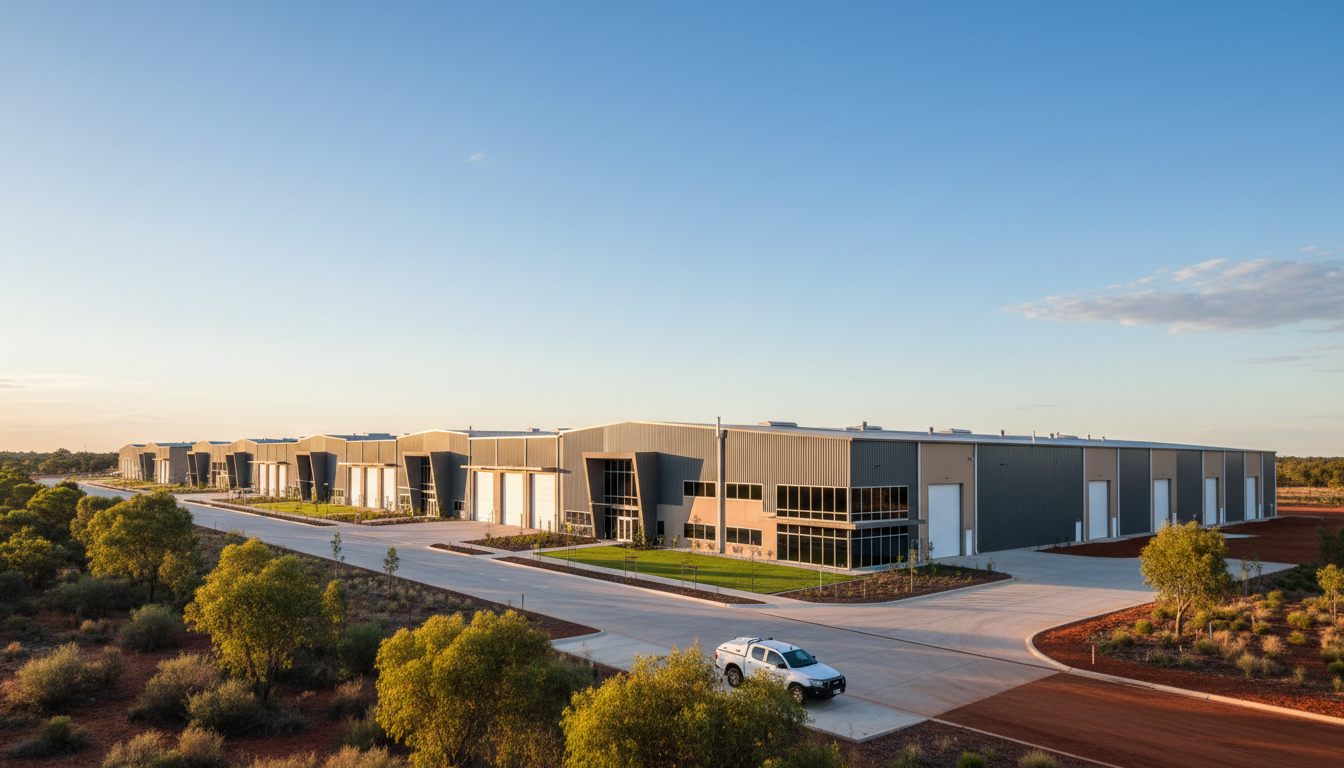
Whether you’re hunting for “warehouse real estate” or comparing “industrial properties for sale,” the smartest buyers in Australia do two things: they pick the right steel system for local conditions, and they line up approvals and engineering from day one. Here’s how to buy or build a commercial warehouse, factory for sale, or premium Colorbond steel shed that stands up to Aussie weather—and adds value to your site.
What Are the Best Shed Materials for Perth’s Climate?
Perth’s coastal air and high UV demand corrosion-resistant cladding, robust framing and heat-smart roofing. For most sites, BlueScope Colorbond steel on a cold-formed steel frame (engineered to AS/NZS 4600 and AS 4100) is the industry benchmark.
For WA site selection, pricing context and approvals, explore our industrial real estate Perth overview.
Colorbond vs Zincalume — Which Is Better for WA Conditions?
| Feature | Colorbond (pre-painted) | Zincalume (aluminium/zinc alloy) |
|---|---|---|
| Coastal corrosion resistance | Strong, with paint system barrier; check distance-to-coast and C4–C5 exposure | Good base metal performance; may weather-mark near coast |
| Heat reflectivity | High for lighter colours; reduces heat gain in Perth summers | Highly reflective when new; dulls over time |
| Aesthetics | Wide Colorbond palette to match industrial estate or home | Commercial metallic look; limited colour choice unless painted |
| Maintenance | Low; periodic washdown near marine | Low; watch for runoff staining and galvanic contact |
| Upfront cost | Typically higher than Zincalume | Generally lower material cost |
| Best use | Premium warehouses, custom Colorbond garages Perth, visible façades | Utility farm sheds, storage for sale, rural sheds NSW interiors |
For coastal WA (C4–C5 environments), upgrade fixings to Class 4 and specify appropriate flashings and wash-down zones. For inland or regional WA, Zincalume walls with a Colorbond roof can be a cost-savvy hybrid.
Definition: Colorbond steel — Pre-painted, corrosion-resistant steel sheet made to AS 1397 and AS/NZS 2728 standards, widely used in Australian sheds and industrial buildings.
Definition: Zincalume — Alloy-coated steel (aluminium/zinc) with excellent base corrosion resistance; typically unpainted silver finish.
How Much Does a Warehouse or Industrial Shed Cost in Australia in 2025?
Warehouse prices vary by size, wind region, terrain category, cladding, doors, insulation, and slab specification. As a quick orientation:
- Small factory units for sale or build (e.g., 9m × 12m × 4.5m) — entry-level kit to mid-tier custom depending on doors and mezzanines.
- Mid-size commercial warehouse (e.g., 15–24m span, 6–8m eave) — higher engineering, heavier frames, fire and access requirements if Class 7b.
- Large industrial buildings for sale or build (24–36m span, 8–12m eave) — crane beams, traffic management, and bespoke engineering.
Expect additional allowances for concrete slabs, stormwater, civil works, fire and accessibility if the building is classified as Class 7b (warehouse) under the NCC. Always obtain site-specific engineering and a detailed inclusions list before you buy a warehouse, buy industrial unit, or commission a custom build.
Which Industrial Property Type Fits Your Site?
Match the asset to your usage and zoning. Here are common options investors and owner-occupiers search for across Australia:
- Commercial warehouse — Class 7b storage/distribution hub with large roller shutters and PA doors.
- Factory for sale / factory units for sale — Light manufacturing, often in strata industrial estates.
- Industrial shop for sale — Showroom plus rear warehouse in mixed-use zones.
- Industrial space for sale / industrial unit — Versatile shell, ideal for tradies, e-commerce or storage.
- Storage property for sale / storage space for sale — Mini-warehouse or self-storage style units.
- Industrial land for sale — Buy industrial land first, then build a wind-rated shed tailored to your operations.
Tip: If you’re scanning “small factories for sale near me,” also run the numbers on a new engineered Colorbond steel shed on your own block—the build can be faster and better optimised for your workflow.
Who Should Buy a Warehouse?
Warehouses suit owner-occupiers, investors seeking yield, logistics operators or manufacturers needing large clearspan storage. For homeowners or hobbyists not seeking a full warehouse, our Work Shed Guide covers smaller, more flexible Colorbond shed solutions ideal for backyard or residential use.
5-Step Buying Guide for Custom Sheds in Australia
- Site check and measure: Confirm boundaries, easements, services, vehicle movement and turning circles. Note exposure (coast, escarpment), soil class, and flood overlays.
- Design and engineering: Engage an engineer to AS/NZS 1170 (structural actions), AS/NZS 1170.2 (wind), AS 4100/AS/NZS 4600 (steel), AS 1397/AS/NZS 2728 (cladding). Nominate wind region (A–D), terrain category and Importance Level. Consider fire separation and access (NCC).
- Council approvals: Determine if a Development Application (DA), Complying/Planning Permit, or Building Permit applies. Industrial premises for sale often have existing approvals; a new shed will need fresh certification.
- Quote and inclusions: Compare apples-to-apples: frame grade, bay spacing, purlin sizes, door clearances, insulation, gutters, downpipes, fixings class, flashing set, and delivery. Clarify slab and civil works scope.
- Build and handover: Book experienced shed erectors. Arrange compliance certificates, warranty packs and maintenance schedule.
What Wind Rating and Engineering Do You Need?
Wind design is non-negotiable for industrial real estate for sale or new builds. Australia uses AS/NZS 1170.2 wind regions:
- Region A: Most of southern Australia
- Region B: Higher winds in parts of WA/QLD
- Region C: Cyclonic (e.g., coastal QLD, parts of NT/WA)
- Region D: Severe cyclonic (northwest WA)
Also specify terrain category (open country to built-up), topographic multiplier (hills, escarpments), and building Importance Level. Coastal QLD and WA often require cyclone-rated sheds with reinforced portals, hold-downs, and door windlocks.
Added 2024 WA wind-rating compliance notes: For coastal WA sites, seek C-breeze or topographic assessments and upgrade to cyclone-rated shutters and fixings within designated coastal corridors.
Definition: Cyclone-rated shed — A building engineered for Regions C or D with enhanced cladding, fixings, and door systems to resist higher ultimate design wind speeds.
How to Get Council Approval for Your Custom Shed in WA
Action steps for council-approved sheds WA
- Confirm zoning and use (e.g., warehouse Class 7b vs ancillary Class 10a) with your local shire.
- Obtain site plan, elevations, engineering certification, and energy/condensation notes per NCC 2022.
- Demonstrate stormwater management, driveway crossover, and vehicle access for heavy rigid vehicles if applicable.
- Provide bushfire assessment if in a BAL area (AS 3959). Regional coastal sites may require corrosion notes.
- Lodge your Building Permit; some simple rural sheds in WA may be exempt or fast-tracked where ancillary.
DIY Shed Kits vs Custom-Built — Which Suits Your Site?
| Feature | DIY Shed Kits | Custom-Built Industrial Shed/Warehouse |
|---|---|---|
| Cost | Lower upfront | Higher, but tailored to site and operations |
| Approvals | You organise permits and engineering | Builder typically supplies full cert pack |
| Complexity | Best for small storage or rural sheds | Ideal for warehouses, crane bays, fire/access |
| Speed | Fast supply; DIY workload | Programmed build with pro erectors |
| Futureproofing | Limited customisation | Designed for expansion, mezzanines, solar |
Roof Styles: Flat, Gable or Skillion?
- Gable roof: Classic look, great water shedding, easy ventilation add-ons. Common for industrial units for sale.
- Skillion roof: Modern lines, simple structure, ideal for solar tilt and urban drainage controls.
- Flat/low-pitch: Clean façade line for commercial warehouse façades; watch drainage sizing and local minimum pitch rules.
Insulation, Condensation and Heat Control
- Use foil-faced blanket or roof panels compliant with NCC condensation provisions; add ventilation and thermal breaks.
- Perth and inland WA benefit from light Colorbond colours, whirlybirds or ridge vents, and wall wrap with taped seams.
- Coastal QLD/NT sheds: include vapour-permeable membranes and anti-condensation strategies in cyclone-rated sheds QLD.
Pro Tip: Did you know using insulated roof panels can reduce internal shed temperatures by up to 10°C in summer? Pair with light roof colours and ridge ventilation for best results.
Real-World Build Examples
- Custom Colorbond garages Perth (double + workshop): 7m × 10m × 3.2m, Colorbond Monument roof/walls, Region A, Terrain Cat 2.5, insulated roof blanket, 2 × 3.6m roller doors. Outcome: quiet, cool workspace and secure trade storage.
- Rural sheds NSW (machinery + feed): 12m × 24m × 4.8m, Zincalume walls with Colorbond roof, open bays plus lock-up. Wind Region A; snow check (NSW alpine) done via AS/NZS 1170.3. Outcome: lower cost per square metre; perfect for farm machinery storage.
- Cyclone-rated sheds QLD (distribution unit): 18m span, 6m eave, Region C with wind-locked shutters, enhanced hold-downs. Outcome: compliance and insurance acceptance in cyclonic zone.
How to Compare Listings When You See “Warehouse Building for Sale”
When you scan industrial sites for sale or an existing warehouse for sale, check:
- Wind rating and engineering certificates; proof of cyclone or non-cyclone design
- Frame type (cold-formed vs hot-rolled), bay spacing, and portal sizes
- Cladding type and finish (Colorbond vs Zincalume), corrosion exposure history
- Roller door clearances, slab thickness, floor loads, and pallet racking layout
- Fire services, exits, DDA access, and vehicle movement plans for Class 7b
- Service upgrades (three-phase power, water, NBN), drainage and stormwater
If you’re leaning toward a ground‑up build, our warehouse building in Australia guide explains engineering, approvals and cost drivers to help you plan with confidence.
Major Cities and Logistics Hubs
- Sydney – Port Botany and western Sydney distribution precincts
- Melbourne – West and north industrial corridors
- Brisbane – SEQ logistics and regional freight links
- Perth – Fremantle and Kewdale freight nodes
- Adelaide, Hobart and Darwin – regional distribution centres
If you’re focused on Queensland, be sure to explore our dedicated Brisbane Warehouse for Sale guide for regional insights, investment tips and current property listings.
Local Factors by State
- WA: Heat, UV and marine exposure—prefer Colorbond with Class 4 fasteners. council-approved sheds WA often require coastal corrosion notes.
- QLD/NT: Region C/D wind ratings; specify cyclone doors and service fixings. cyclone-rated sheds QLD are standard north of Tropic of Capricorn.
- Buying in SEQ? See our Brisbane warehouse for sale guide for suburb considerations, Region B wind design and step‑by‑step approvals.
- VIC/NSW: Check snow loads in alpine zones and BAL ratings in bushfire-prone areas.
- SA/TAS: Condensation management is critical in cooler climates; add vapour control layers.
Frequently Asked Questions
Do I need council approval? Yes, most warehouses and industrial sheds need planning/building approval. Ancillary farm sheds may have exemptions in some regional councils—always check first.
Colorbond or Zincalume? For coastal and urban façades, Colorbond wins on durability and looks. For lower-cost rural interiors, Zincalume works well. Many buyers mix both.
What wind rating do I need? It depends on wind region (A–D), terrain, topography and building importance. Your engineer will nominate the design wind speed per AS/NZS 1170.2.
What’s the difference between a Class 10a shed and a warehouse? Class 10a is ancillary, non-habitable (e.g., domestic shed). Warehouses are usually Class 7b with stricter fire and access requirements.
Can I DIY? Yes for small storage or farm sheds with council approval. For commercial warehouse projects, use licensed installers and certified engineers.
What about bushfire? In BAL areas, specify compliant cladding, ember protection and metal mesh per AS 3959.
Short Definitions You’ll See in Quotes
R-value: A measure of insulation performance—higher is better for heat control.
BAL (Bushfire Attack Level): A rating of bushfire risk that dictates construction measures per AS 3959.
Importance Level: A classification in structural design that sets reliability targets (NCC/AS/NZS 1170).
Keyword Clusters You Might Be Searching
- warehouse for sale, warehouse building for sale, warehouse real estate
- industrial properties for sale, industrial real estate for sale, industrial units for sale
- industrial space for sale, industrial premises for sale, industrial buildings for sale
- factory for sale, factory for sell, factory units for sale
- storage property for sale, storage space for sale, storage for sale
- industrial estate for sale, industrial land for sale, buy industrial land
- buy warehouse, buy industrial unit, industrial property, industrial land
- steel sheds Perth, custom carports Melbourne, rural sheds NSW
- DIY shed kits, affordable carports for Australian homes, farm machinery storage
- Colorbond vs Zincalume comparison, wind-rated sheds for cyclonic areas
- custom Colorbond garages Perth
What Are the Best Shed Materials for Perth’s Climate? (Quick Recap)
For WA heat and sea air, choose Colorbond cladding, insulated roofing, Class 4 fixings and engineered portals. In the southwest, add condensation control; in the northwest, confirm Region D wind requirements.
Compliance and References
- Housing Industry Association (HIA)
- Bureau of Meteorology – Cyclone and wind information
- Australian Steel Institute
- Energy.gov.au – Insulation basics
Standards and codes to discuss with your engineer: NCC 2022 (BCA), AS/NZS 1170 series (structural actions), AS/NZS 4600 (cold-formed steel), AS 4100 (steel structures), AS 1397 and AS/NZS 2728 (steel and coatings), AS 3959 (bushfire).
Note: Market conditions change. Consult your local council, a registered engineer and licensed builder before purchase.