
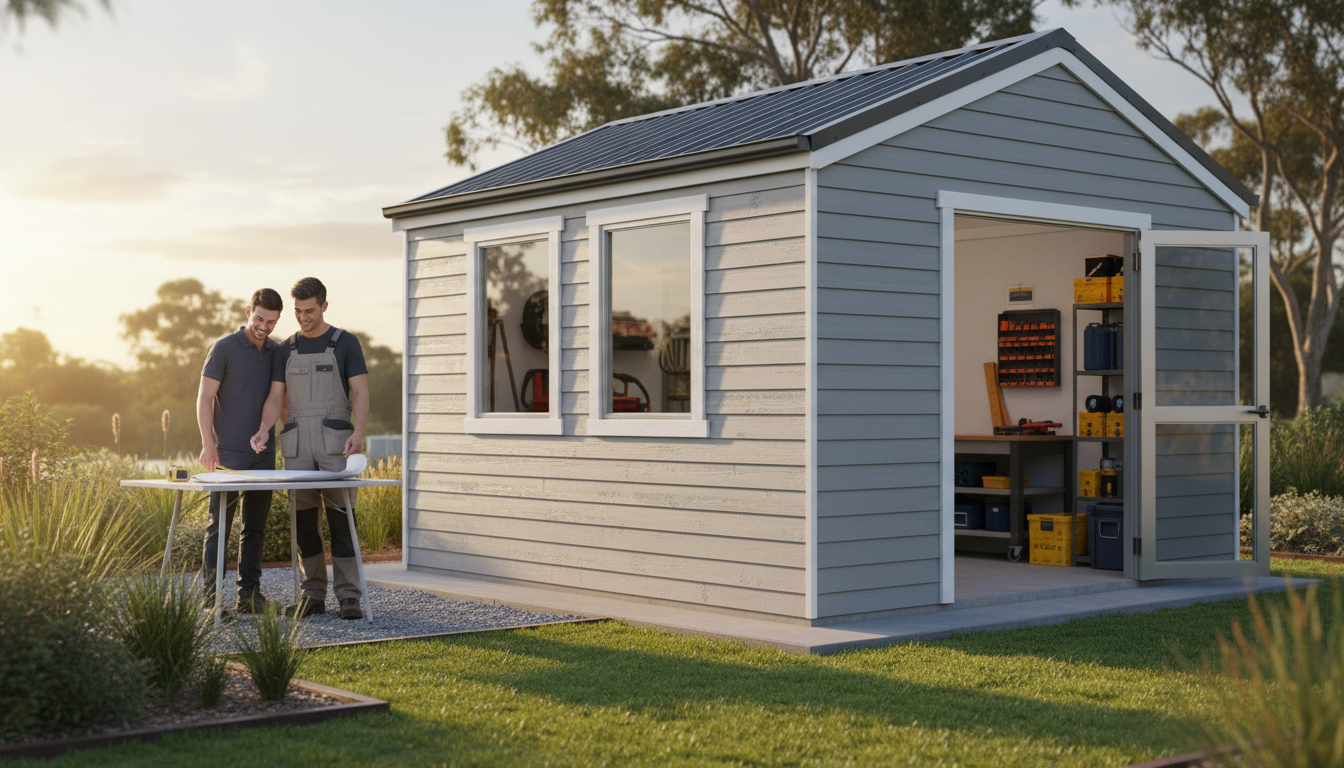
Whether you’re after a coastal-style weatherboard garden shed, a heritage-look weatherboard garage, or a hybrid steel-frame shed with feature cladding, this guide breaks down exactly what Australians need in 2025: durable materials, cyclonic wind compliance, council approvals, energy-smart insulation, and honest costings. Weatherboard sheds offer charm and flexibility for backyard storage. If you prefer flexibility, consider a Portable Garage in Australia, which can be moved or reassembled with ease. Looking for alternative shed living or workspace options? See our Storage Building Cabin in Australia guide for premium cabins and sheds.
What is a Weatherboard Shed?
A weatherboard shed is a steel or timber-framed structure clad in horizontal boards (timber, fibre cement, or composite) that delivers a classic, Hamptons or heritage look—popular for backyard studios, compliant granny flat ancillary storage, or a custom-built double garage in Perth with street appeal.
Key definitions
- Weatherboard
- Horizontal overlapping boards used as external cladding. Commonly timber, fibre cement, or composite.
- Colorbond
- Pre-painted, high-tensile steel sheeting by BlueScope, widely used for roofs and walls in Australian sheds.
- Zincalume
- Aluminium/Zinc/Magnesium-coated steel with a metallic finish; often used where paint finish isn’t required.
- Wind region (N, C, D)
- AS/NZS 1170.2 classification: N (non-cyclonic), C/D (cyclonic). Impacts design pressures and fixings.
- NCC
- National Construction Code (current 2022 amendments rolling into 2025), Australia’s building regulatory framework.
- AS/NZS 4600
- Standard for cold-formed steel structures used for most shed frames.
- BAL rating
- Bushfire Attack Level; determines cladding/ember protection in bushfire-prone areas.
What Are the Best Shed Materials for Perth’s Climate?
Perth’s summers are hot and dry with high UV; coastal suburbs face salt spray corrosion. A common approach is a galvanised/Colorbond steel frame and roof for strength and low maintenance, paired with fibre cement weatherboards on the street-facing elevation for style. This hybrid delivers the look of timber weatherboards without the upkeep.
Colorbond vs Zincalume — Which Is Better for WA Conditions?
| Factor | Colorbond | Zincalume |
|---|---|---|
| Coating | Pre-painted, baked-on finish over corrosion-resistant substrate | Al-Zn-Mg metallic coating, no paint |
| Heat reflectivity | High, with light colours reducing heat gain | Good reflectivity, but can glare and heat up internally |
| Coastal performance | Excellent with correct grade and maintenance | Strong, but may show patina near surf coasts without paint |
| Aesthetics | Wide colours; matches modern homes | Industrial look; can be painted later |
| Cost | Higher upfront | Lower upfront |
| Best use | Premium domestic sheds, coastal suburbs, visible elevations | Agricultural/rural, hidden elevations, budget builds |
For a weatherboard shed look in Perth, specify fibre cement weatherboards (low maintenance, non-combustible) on the façade, with Colorbond roof and the remaining walls to balance cost and resilience. This also suits steel sheds Perth builds targeting a coastal/Hamptons finish. If your garden shed sits near the driveway, our Woodland Grey garage door guide helps you coordinate Colorbond tones across buildings.
Weatherboard vs Colorbond Walls: Which Suits Your Property?
- Weatherboard (fibre cement): Non-combustible, paintable, great for BAL zones; periodic repainting every 10–15 years.
- Weatherboard (timber): Warm aesthetic, but higher maintenance; confirm termite management and BAL limits.
- Colorbond wall sheeting: Fast to install, low maintenance, extensive colours, excellent for side and rear elevations.
- Hybrid approach: Weatherboard street elevation + Colorbond sides/rear. Ideal for council-approved sheds WA that need to match house style.
Design Options and Customisation
Cladding and frame
- Frame: Galvanised cold-formed steel to AS/NZS 4600; termite-proof and straight.
- Cladding: Fibre cement weatherboards, composite weatherboards, or timber; mix with Colorbond for efficiencies.
- Roof: Colorbond in Monoclad/Custom Orb profiles; consider anti-condensation blanket.
Roof profiles and drainage
- Gable roof: Classic look; suits weatherboard garage aesthetics.
- Skillion roof: Modern look, simpler drainage; ideal for narrow side setbacks.
- Box gutters and overflow provisions per NCC; leaf-guard for eaves in leafy suburbs.
Openings and access
- Roller doors: Manual or motorised; cyclone locks for cyclone-rated sheds QLD.
- Glazing: Breezeway windows with flyscreens; consider low-e glass for studios.
- Personal access doors: Wide hinge doors for workshops and farm machinery storage.
Thermal and acoustic performance
- Insulation: R2.5–R3.5 walls/ceiling; insulated roof panels for hot climates.
- Ventilation: Ridge and eave vents; whirlybirds for passive cooling.
Foundations and floors
- Slab-on-ground with thickened edges per soil class; engineer to AS 2870.
- Termite management where required (physical barriers or treated zones).
- Bolted hold-downs and shear connections certified to AS/NZS 1170.2.
Other custom options: custom carports Melbourne to match, affordable carports for Australian homes, DIY shed kits for small garden jobs, and custom Colorbond garages Perth for high-wind coastal suburbs. Explore Kit Sheds Torquay for Colorbond shed and garage options available for local buyers.
Engineering, Wind Ratings, and Code Compliance
Australia’s winds, storms, and bushfire risks dictate shed engineering. Your weatherboard shed must be certified by a structural engineer to the NCC and relevant standards. Secure your workspace or storage area—consider a Single Garage with Roller Door for added durability and protection.
- AS/NZS 1170.2: Wind actions — defines pressures, local pressure factors, and importance levels.
- AS/NZS 4600: Cold-formed steel structures — for purlins, girts, and frames.
- AS 4100: Steel structures — for heavier members where applicable.
- BAL requirements — choose non-combustible cladding (fibre cement) in BAL-12.5 to BAL-40 zones.
Added 2024 WA wind-rating compliance notes WA coastal and regional areas can fall into Wind Region C. Specify higher design pressures, cyclone-rated roller doors, extra tie-downs, and compliant edge detailing. This applies to council-approved sheds WA across many coastal LGAs.
Cyclone-rated sheds in QLD
For North QLD (Region C/D), ensure certified wind-rated sheds for cyclonic areas with tested door systems, additional screw patterns, and purlin bracing. Many insurers prefer engineered documentation and photos of hold-downs for cyclonic zones.
Snow and alpine loads
Tasmania and alpine VIC/NSW may require snow actions (AS/NZS 1170.3). Increase roof pitch and frame sizes. Check local council overlays.
How Do Council Approvals Work for Weatherboard Sheds?
Approval pathways vary by state and council, but most domestic sheds require planning and building consent if they exceed small exempt thresholds or are near boundaries, easements, or overlays.
How to Get Council Approval for Your Custom Shed in WA
- Pre-check: Confirm if your project qualifies for R-Codes exemptions; assess boundary setbacks and height.
- Engineering: Obtain certified drawings and calculations (wind region, terrain, topography).
- Application: Lodge with your LGA or a private certifier, including site plan, elevations, and energy/deemed-to-satisfy details if required.
- Assessment: Typical 10–25 business days depending on completeness and LGA workload.
- Finals: Book inspections per permit conditions; keep compliance documents for insurance.
QLD and NSW/VIC notes
- QLD: Check Accepted Development vs Code Assessable; cyclonic hardware documentation is critical.
- NSW: Complying Development Certificates can speed up compliant rural sheds NSW and suburban builds.
- VIC: Siting variations and overlays (bushfire, heritage) often apply. Engage a registered building surveyor.
Tip: Many suppliers now offer “design–supply–install” packages for council-approved sheds WA and interstate equivalents to streamline permits and inspections.
Costs in 2025: Weatherboard Shed, Garden Shed, and Weatherboard Garage
Pricing varies with wind region, slab, finishes, and access. Indicative turnkey ranges (metro, flat site, engineering/certification included, excl. unusual services):
For price comparisons, refer to our 6×6 Shed Price in Australia cost guide.
- Weatherboard garden shed (3×3 to 3×6 m): $6,500–$16,000 (hybrid cladding, insulated roof optional)
- Workshop shed (6×6 to 7×9 m): $24,000–$48,000 (Colorbond walls + weatherboard façade)
- Weatherboard garage (double, 6×6 m with auto door): $32,000–$62,000 (add for BAL/cyclone upgrades)
See also: Compare Double garage pricing in Australia to understand budget trade-offs between sheds and garages.