
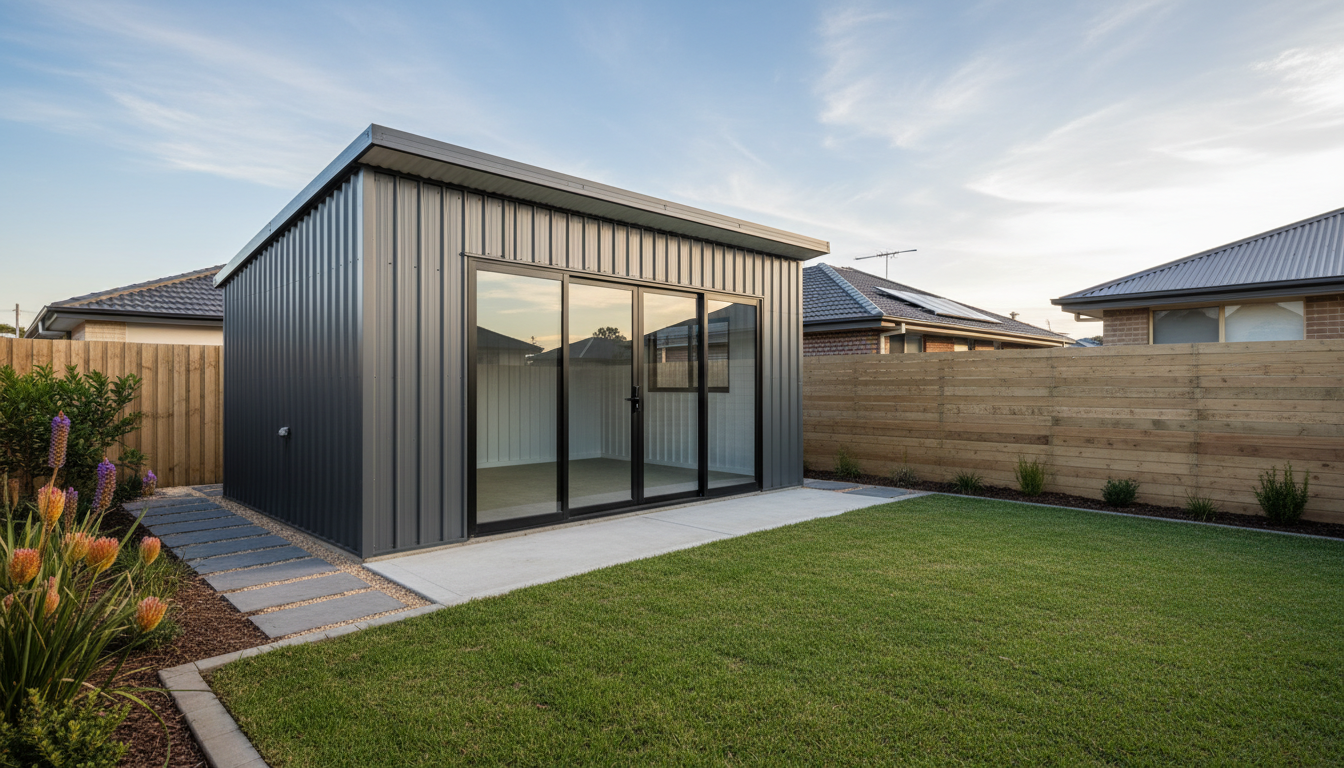
What Happens If You Build a Shed Without Council Approval in Australia? (2025 Guide)
Short answer: it can get expensive. Whether it’s a Colorbond steel shed in regional WA, a custom-built double garage in Perth, or a DIY garden shed kit in Sydney, building without the right planning or building approval can trigger fines, stop-work orders, demolition notices, and insurance headaches. This expert guide explains what really happens, how to fix it, and how to get your shed approved the smart way.
What actually happens if you build a shed without council approval?
- Show-cause or stop-work notice: Your local council or certifier can order you to stop immediately.
- Fines and fees: Penalties vary by state and council; expect hundreds to several thousands of dollars plus re-inspection fees.
- Rectification or demolition: Non-compliant sheds may need retro-engineering, relocation outside setbacks, or removal.
- Insurance and warranty risks: Insurers can reduce or refuse claims on unapproved structures, especially after storms, fire, or cyclones.
- Property sale delays: Conveyancers often flag unapproved outbuildings—your sale or refinance can stall until you obtain retrospective approval.
- Neighbour disputes: Encroachments over easements or boundary setbacks often trigger complaints and enforcement.
- Safety and liability: Unrated framing, inadequate footings, or non-compliant fixings can fail under wind loads (AS/NZS 1170.2), creating legal exposure.
Real-world examples (typical scenarios)
- NSW suburban block: 26 m² garden shed built 300 mm from boundary. Council issued a show-cause and required either a smaller shed under Exempt Development or a Complying Development Certificate with new setbacks. Outcome: relocation + engineer certificate + fee.
- Perth metro: Skillion roof garage built without BA approval. Retrospective certified permit required plus as-constructed engineering for Region A wind rating and slab design (AS 2870). Outcome: fee, engineer’s report, approved.
- North QLD coastal: Non-cyclone-rated shed suffered roof loss in a storm. Insurer requested proof of approval and compliance for Region C/D. Claim reduced pending evidence. Outcome: partial payout; owner upgraded to cyclone-rated shed.
Do I need council approval for a shed?
Often, yes. Some small, low-impact garden sheds are exempt, but larger or closer-to-boundary structures usually need approval. You must check:
- Planning controls (zoning, overlays like bushfire, flood, heritage)
- Building rules (NCC, wind region, footings, fire/setback)
- Site constraints (easements, building line, sewer, stormwater)
Quick self-check: exempt vs approval
- If your shed is very small, behind the front building line, not in a special overlay, and meets height/area/setback limits, it may be “Exempt Development” (NSW) or “Accepted/Exempt” in other states.
- Everything else usually needs approval—either a simplified code-assessed path (NSW Complying Development/CDC; VIC/QLD private certification) or a full council permit.
Shed size without council approval NSW (snapshot)
In NSW, many small garden sheds qualify as Exempt Development under the State Environmental Planning Policy (Exempt and Complying Development Codes) 2008. Typical limits include:
- Floor area: commonly up to 20 m² on standard lots (often 10 m² on very small lots)
- Height: up to 3.0 m overall, with lower height limits when closer to boundaries (e.g., 2.4 m)
- Location: behind the primary building line; setback to boundaries (often ≥ 0.9 m)
- Materials: non-reflective finishes; not in heritage/foreshore/bushfire-affected areas without extra checks
These are generalised rules only. Always confirm the latest criteria on the NSW Planning Portal and your LGA’s DCP before purchasing or building. See the official guidance: NSW Exempt Development Code.
How to get council approval for your custom shed in Australia
- Confirm planning: Check zoning and overlays (flood, bushfire BAL, heritage, environmental) and setbacks.
- Engineer the shed: Wind rating to AS/NZS 1170.2 for your wind region (A, B, C, D), framing to AS/NZS 4600 (cold-formed steel) or AS 4100 (steel structures), slab to AS 2870.
- Prepare documents: Site plan, elevations, anchor/fixing schedule, footing/slab details, rainwater/stormwater plan, bushfire measures if needed (AS 3959).
- Apply: Through your certifier/council with fees. In NSW, CDC via a PCA; in VIC/QLD, private building surveyor/certifier; in SA/WA/TAS, through local processes.
- Build and certify: Construct to the approved plans; arrange inspections and final certificate (occupation/approval of structure).
How to get council approval for your custom shed in WA (actionable)
WA uses the Building Act 2011 and Building Regulations 2012. Typical pathway:
- Planning check with your local shire/city (setbacks, height, streetscape).
- Certified or uncertified building permit application:
- BA1 (Certified) with a Certificate of Design Compliance from a registered building surveying contractor
- BA2 (Uncertified) where the permit authority obtains certification
- Provide engineering for wind region, connections, and slab; detail Colorbond/Zincalume cladding and corrosion categories.
- On approval, build and obtain the required inspections or statements of compliance.
Added 2024 WA wind-rating compliance notes: The Perth metro is typically Region A; coastal and north-west WA can be Region B, C or D. If you’re in cyclonic sub-regions (e.g., parts of Pilbara/Kimberley), specify cyclone-rated sheds and fixings to AS/NZS 1170.2 and AS 4055 where relevant. Seek council-approved sheds WA suppliers experienced with local conditions.
Helpful resources: WA Building approvals and ABCB NCC.
Technical compliance essentials for Australian sheds
- NCC 2022 (Volume 2) for housing/sheds, including structural reliability and condensation management
- AS/NZS 1170.2 Wind actions; AS 4100/AS/NZS 4600 for steel design; AS 1562.1 for roofing/walling
- AS/NZS 1397 and AS/NZS 2728 for coated steel; BlueScope Colorbond/Colorbond Ultra specs near coast
- AS 2870 slabs and footings; AS 3959 bushfire where BAL applies
- Corrosion: consult local category (C1–CX). Coastal WA/QLD may require upgraded coatings or stainless fixings
For northern QLD and WA cyclone zones, choose wind-rated sheds for cyclonic areas and ensure engineering certification. In QLD, Form 15/16 documentation may be requested by certifiers.
What Are the Best Shed Materials for Perth’s Climate?
Perth’s hot summers and sea breeze mean heat reflectivity and corrosion resistance matter. Here’s a quick comparison.
| Feature | Colorbond Steel | Zincalume Steel |
|---|---|---|
| Base material | AM-coated steel + baked-on paint system | AM-coated steel (aluminium/zinc/magnesium) |
| Heat performance | Cooler colours with high solar reflectance can reduce heat gain | Metallic finish; can run hotter than light Colorbond colours |
| Coastal resistance | Use Colorbond Ultra within ~100–200 m of surf; standard beyond that | Good general performance; not recommended in severe marine without extra measures |
| Aesthetics | Broad Colorbond palette to match Australian homes | Industrial silver finish |
| Cost | Generally higher upfront | Generally lower upfront |
| Best fit (Perth) | Premium residential sheds, custom Colorbond garages Perth, patios | Rural/utility sheds away from coast |
DIY shed kits vs custom-built: which should you choose?
| Option | Pros | Cons | Best for |
|---|---|---|---|
| DIY shed kits | Lower cost, quick delivery, weekend project | You manage approvals, wind ratings, slab, and inspections; risk of non-compliance | Small garden sheds, DIY shed kits on simple sites |
| Custom-built (turnkey) | Engineered for site, handled approvals, premium finishes, warranty | Higher upfront cost | Steel sheds Perth, custom carports Melbourne, cyclone-rated sheds QLD, rural sheds NSW |
5-Step Buying Guide for Custom Sheds in Australia
- Define use: farm machinery storage, boat and caravan shelters, workshop, or American barn.
- Pick form and roof: gable roof sheds vs skillion roof sheds; check height and door clearances.
- Choose materials: Colorbond vs Zincalume comparison; upgrade to Colorbond Ultra near coast.
- Engineer and certify: wind region, tie-downs, slab, drainage; pick a council-approved supplier.
- Plan approvals early: confirm exempt/compliant path, lead times, and inspection bookings.
State notes and local nuances
- NSW: “Shed size without council approval NSW” depends on Exempt Code criteria. If you exceed limits, consider a CDC with an accredited certifier. Check the NSW Planning Portal.
- QLD: Coastal and northern areas fall into higher wind regions (C/D). Always specify cyclone-rated sheds QLD and obtain engineering. Certification forms (e.g., Form 15/16) may apply.
- WA: Use BA1/BA2 pathways. For coastal and north-west towns, confirm Region B/C/D and corrosion category. Aim for council-approved sheds WA suppliers familiar with shire requirements.
- VIC/SA/TAS/ACT: Local planning overlays (heritage, bushfire) can trump general rules—check early.
FAQs
Do garden sheds need council approval?
Small garden sheds can be exempt if they meet strict rules (size, height, setbacks, location). If not, you’ll need approval. When in doubt, check with your council or a private certifier.
What size shed can I build without council approval in NSW?
Commonly up to around 20 m² (or 10 m² on very small lots), height limits around 3.0 m, setbacks, and placement behind the building line—subject to many conditions. Always confirm the exact current criteria on the NSW Planning Portal.
Can I get retrospective approval after building?
Often yes, but it’s not guaranteed. You may need engineering “as-built” certification, proof of slab design, fixing schedules, and you may have to modify or relocate the shed.
Will insurance cover an unapproved shed?
Insurers can limit or decline claims if a structure is illegal or non-compliant. Keep approvals and certificates on file.
How close can my shed be to the boundary?
Varies by state and council. A 0.9 m setback is common for exempt pathways, with lower height limits if closer. Fire separation rules may also apply.
Do I need an engineer?
For most approved sheds, yes—especially for wind actions, footings, and fixings. Engineer-certified designs help avoid compliance issues and ensure durability.
How long does approval take?
Exempt: immediate if you comply. CDC/private certification: often 1–3 weeks with full documents. Full council permit: 3–8+ weeks depending on complexity and workload.
How much does a shed permit cost?
From a few hundred for simple certification to a few thousand with full engineering, inspections, and council fees.
Why premium matters: durability, compliance, and resale
- Engineered to wind region and site class protects against storm loss—critical for northern WA and QLD.
- Better coatings and fasteners limit corrosion in coastal Australia, reducing lifecycle costs.
- Council-approved documentation helps property valuation, insurance, and a smooth sale.
Popular shed and carport solutions we deliver
We design and install:
- Steel sheds Perth and custom Colorbond garages Perth
- Rural sheds NSW and farm sheds Victoria
- Cyclone-rated sheds QLD and machinery sheds WA
- Industrial sheds Sydney, garage kits Adelaide, custom carports Melbourne
- American barns Australia, equine barns NSW, affordable carports for Australian homes