
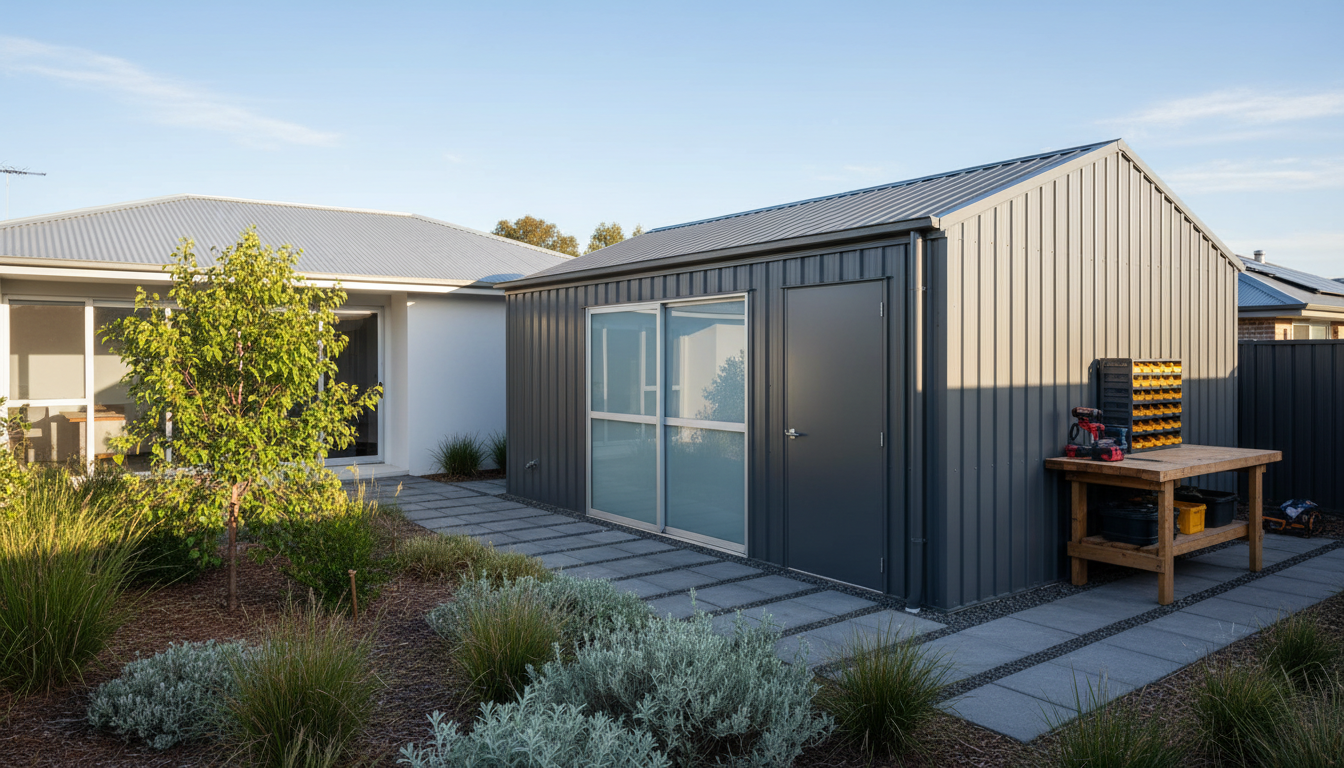
Whether you’re fitting out a backyard work shed for tools and tinkering, a garden shed workshop for weekend projects, or a storage shed workshop to keep gear organised, getting the design, materials and approvals right up‑front will save time, money and headaches.
This expert guide draws on Australian standards, local climate data and current market trends (2024–2025) to help you choose a shed that looks sharp, handles our sun, wind and rain, and adds value to your property.
What Is a Work Shed and Which Type Suits Australian Homes?
Planning heavier‑duty specs or a garage‑plus‑workshop? Jump to our industrial building guide for Australian homes.
A work shed is a small to medium steel building designed for hands-on tasks, storage and hobbies. Common formats include:
- Workshop shed (4.5 m–12 m span): Clear floor area for benches, tools and machinery.
- Garden shed workshop: Compact skillion or gable roof, often 3 x 3 m to 3 x 6 m, ideal for urban blocks.
- Storage shed workshop: Combines racking, roller doors and a bench zone for dual use.
- Workers shed: Site shed or amenities block for tradies, often transportable.
- Workshop shed kits: Pre-engineered DIY shed kits for straightforward assembly and fast delivery.
- Custom-built double garage in Perth with rear workshop bay: Mix of car storage and workspace.
Popular use-cases and related options:
- DIY shed kits for owner-builders with basic tools and a reliable mate to help.
- Custom Colorbond garages Perth with insulated walls for noise and heat control.
- Rural sheds NSW set up for farm machinery storage and workshop tasks.
- Custom carports Melbourne or a garaport attached to the workshop for extra covered space.
- Wind-rated sheds for cyclonic areas (e.g., North QLD and WA north of Tropic of Capricorn).
Why Choose a Steel Shed?
For those looking for comprehensive tips on construction and material choices, our Industrial Building Guide breaks down custom solutions for Colorbond sheds, garages, and carports.
What Are the Best Shed Materials for Perth’s Climate?
Perth’s hot summers, high UV index and coastal air mean material selection matters. Most premium workshop sheds use Australian-made, coated steel cladding and cold-formed framing.
Colorbond vs Zincalume — Which Is Better for WA Conditions?
| Criteria | Colorbond | Zincalume |
|---|---|---|
| Finish & aesthetics | Wide colour range; matches home trims and fences | Metallic silver-grey only |
| Heat & UV performance | Cooler colours with solar reflectance; resists chalking | Good base reflectance; can appear glarey |
| Coastal resistance | Use Colorbond Ultra near surf coasts; follow distance guidelines | Strong base coat but more prone to tea-staining near salt |
| Cost | Higher upfront | Generally lower |
| Best for | Residential work sheds, visible sites, harsh sun | Budget builds, inland or rural settings |
Added 2024 WA wind-rating compliance notes: In WA, ensure your shed is engineered to AS/NZS 1170.2 for Region A (most metro Perth), B (inland), or C/D (north-west coastal/cyclonic). Ask for site-specific design with correct Terrain Category, shielding and topographic multipliers. This is critical for council-approved sheds WA.
How Durable Are Modern Work Sheds?
- Framing: High-tensile, galvanised cold-formed steel (e.g., G450/G550, Z275) to AS/NZS 4600 with bolts/screws complying with AS 3566 for corrosion resistance.
- Cladding: Colorbond or Zincalume to AS 1397, profiled to AS 1562.1 for roofing and walling.
- Foundations: Engineer-designed slab (commonly 100 mm, 25–32 MPa) with thickened edges/footings to suit soil reactivity (AS 2870) and hold-downs per wind region.
- Condensation control: Anticon blanket or insulated roof panels; add sarking to walls where needed.
- Coastal and cyclonic: Consider heavier gauge members, closer purlin spacing, and upgraded fixings for cyclone-rated sheds QLD and WA Region C/D.
Will a Work Shed Add Value to My Property?
Well-designed sheds add utility and boost buyer appeal. The 2025 HIA outlook for outdoor structures indicates continued demand for functional additions that support working from home, storage, and lifestyle improvements. Real estate agents consistently report stronger enquiry for homes with compliant, neat outbuildings in good condition.
Always check planning rules first: illegal structures can reduce value and may need removal before sale.
Sources: Housing Industry Association, Master Builders Australia (WA), Australian Steel Institute.
How Do I Choose the Right Size, Layout and Features?
- Size: Common footprints: 6 x 6 m (single-bay workshop), 7 x 9 m (double garage + bench), 9 x 12 m (serious hobbyist). Allow 1.0 m minimum around benches for movement.
- Eave height: 2.4–3.6 m; choose 3.0 m+ for 4WD racks, car hoists or tall storage.
- Access: Roller door width 3.0–3.6 m; add a PA door; consider a garaport or awning for weather-protected work.
- Thermal comfort: Insulated roof panels or anticon + batts; whirlybirds or ridge vent; add ceiling fans; consider light-coloured Colorbond.
- Lighting: LED high-bays, task lights over benches, skylight strips (polycarbonate) with UV protection.
- Power and services: Dedicated circuits, RCDs, plenty of GPOs, 15A outlets for welders, data point for remote work.
- Flooring: Burnished concrete finish, epoxy coat for chemical resistance, level tolerance for equipment.
- Security: Cyclone-rated roller doors, keyed alike locks, mesh screens, alarm/cameras.
- Stormwater: Gutters, leaf-guard, charged system to tank or legal point of discharge.
How Much Does a Work Shed Cost in Australia in 2025?
Indicative supply and install ranges vary with wind region, access, finishes and foundation requirements:
- Garden workshop (3 x 3 to 3 x 6 m): DIY kits from $2,500–$4,500; installed from $4,500–$8,500.
- Workshop shed (6 x 6 m, non-cyclonic): Kit $9,000–$14,000; supplied and erected from $16,000–$26,000.
- Custom double garage + workshop (7 x 9 m): $18,000–$35,000+ depending on doors, insulation, glazing.
- Cyclonic designs (QLD/WA Region C/D): +10–25% for heavier frames, fixings and engineering.
- Regional freight/remote sites: Allow extra for transport and travel.
Prices are guides only. Seek written quotes with engineering, inclusions and warranties itemised.
What Approvals and Codes Apply to a Work Shed?
Most council areas require approval for sheds over a small exempt size. Your builder or certifier should supply full drawings and engineering.
- National Construction Code (NCC 2022): Volume Two applies to Class 10a buildings (non-habitable outbuildings).
- AS/NZS 1170.2: Wind actions; set correct design wind region and pressure coefficients.
- AS/NZS 4600 / AS 4100: Cold-formed and steel structures design.
- AS 1397 / AS 1562.1: Steel sheet and roof/wall cladding performance.
- BAL (Bushfire Attack Level): If applicable, ensure cladding and ember protection meet requirements.
How to Get Council Approval for Your Custom Shed in WA
- Check zoning and setbacks: Review your LGA’s Residential Design Codes and outbuilding policy for height, area and boundary setbacks.
- Obtain site wind classification: Confirm Region (A/B/C/D) and Terrain Category. Provide to your shed engineer. This underpins council-approved sheds WA.
- Prepare documents: Site plan, elevations, sections, slab details, drainage plan, energy and bushfire notes (if required), and certified engineering to AS/NZS 1170.2.
- Lodge BA2/CDC or development application: Some sheds are exempt from DA but still need a building permit. Ask your LGA.
- Inspections and compliance: Footing/slab inspection if required; final as-built photos or inspection for occupancy clearance.
Residents near Brisbane or Toowoomba can learn more in our Sheds Ipswich overview, which addresses the latest council rules and shed options for 2025.
For climate references and wind alerts, see the Bureau of Meteorology. For material guidance, review BlueScope’s technical bulletins or CSIRO building science notes at CSIRO.
Should I Choose a DIY Shed Kit or a Custom-Built Work Shed?
If your needs are outgrowing a domestic workshop, step up with our Warehouse for Sale in Australia buyer’s guide covering factory units and commercial sheds.
| Factor | DIY Shed Kit | Custom-Built by Registered Installer |
|---|---|---|
| Upfront cost | Lower | Higher |
| Time & effort | Owner-managed; weekends required | Turnkey; faster delivery |
| Compliance | Owner coordinates permits/inspections | Builder manages approvals and engineering |
| Wind/cyclone regions | Available; ensure correct kit rating | Optimised engineering for site |
| Finish & options | Standard inclusions; upgrades available | Tailored doors, glazing, insulation, garaport |
| Warranty & support | Manufacturer warranty; limited install support | Product + workmanship warranties |
Pro Tip: Did you know using insulated roof panels can reduce internal shed temperatures by up to 10°C in summer? Combine with light roof colours and ridge ventilation for best results. See Energy.gov.au guides on passive cooling.
Real-World Builds: Three Australian Work Shed Examples
For Greater Brisbane conditions, approvals and pricing, our Sheds Ipswich page shows practical sizes and inclusions.
Perth: Custom Colorbond Workshop + Garaport
7 x 9 m, 3.0 m eave, gable roof. Colorbond Surfmist roof/walls, 100 mm slab with thickened edge, 2 x 3.0 m roller doors, PA door, 6 m garaport to the side, anticon blanket, LED lighting, epoxy floor. Outcome: Year-round usability with shaded outdoor work area and storage for a boat. Keywords: custom Colorbond garages Perth, steel sheds Perth.
North QLD: Cyclone-Rated Workshop Shed
6 x 7.5 m, 3.3 m eave, skillion roof. Region C design, upgraded hold-downs, closer purlin spacing, wind-locked roller doors, vermin-proofing, sarking to walls. Outcome: Insurance-compliant, resilient in tropical storms. Keywords: cyclone-rated sheds QLD, wind-rated sheds.
Regional NSW: Rural Shed with Machinery Bay
9 x 12 m, 3.6 m eave, portal frame. Two enclosed workshop bays with one open bay for farm machinery storage, Zincalume roofing, Colorbond walls, tank-fed gutters. Outcome: Multipurpose farm utility at a sharp price point. Keywords: rural sheds NSW.
5-Step Buying Guide for Custom Sheds in Australia
- Define use and size: Bench space, vehicle clearance, future storage. Sketch the layout.
- Confirm site constraints: Setbacks, easements, overhead lines, stormwater direction, driveway access.
- Select materials and rating: Colorbond vs Zincalume, insulation, council-approved sheds WA wind region and footing type.
- Compare quotes apples-to-apples: Include engineering, doors, windows, guttering, slab, erection, delivery, council fees.
- Plan services and finishes: Electrical, lighting, water, floor coating, storage systems and security.
FAQs About Work Sheds in Australia
What size work shed is most popular?
6 x 6 m is the classic suburban workshop. If you have room, 7 x 9 m lets you fit a double garage with a dedicated bench zone.
Do I need a concrete slab?
For a true workshop, yes. A 100 mm slab with thickened edges, mesh and correct hold-downs resists movement and machinery loads.
Can I insulate my shed?
Yes. Options include anticon blanket, wall batts with sarking, or insulated roof panels. Combine with vents and light colours for heat control.
How long does it take to get approvals?
Typically 2–6 weeks, depending on council and documentation quality. Complex sites or bushfire overlays may take longer.
What roof is better — gable or skillion?
Gable provides traditional looks and easy ventilation. Skillion offers modern lines, simple water fall to one side and easy solar panel placement.
Are workshop sheds for sale as kits cyclone-ready?
Many kit suppliers offer cyclonic options. Verify engineering certs for your exact site and choose wind-rated doors and fixings.
Can I attach a carport?
Yes. A garaport or custom carports Melbourne style addition is common. Ensure the attached structure is engineered under the same wind loads.
Expert Tips and Industry Context for 2024–2025
- Steel supply has stabilised, but lead times can vary. See the Australian Steel Institute and the “2025 Australian Steel Market Outlook” for trends: Australian Steel Institute.
- Outdoor improvement demand remains solid (HIA “2025 Outdoor Structures and Home Improvement Report”): HIA.
- Design for your microclimate: Perth heat and UV, Brisbane humidity, Tasmanian cold, and coastal corrosion categories (AS 4312). Check BoM climate maps: BoM climate maps.
Related terms you’ll encounter: steel sheds Perth, custom Colorbond garages Perth, custom carports Melbourne, rural sheds NSW, industrial sheds Brisbane, American barns, double garage, gable roof shed, skillion roof shed, Colorbond vs Zincalume comparison, wind-rated sheds for cyclonic areas, DIY shed kits, affordable carports for Australian homes, farm machinery storage, BAL-rated sheds, insulated panel roofing, vermin-proofing, whirlybirds, polycarbonate skylights, council-approved sheds WA.