
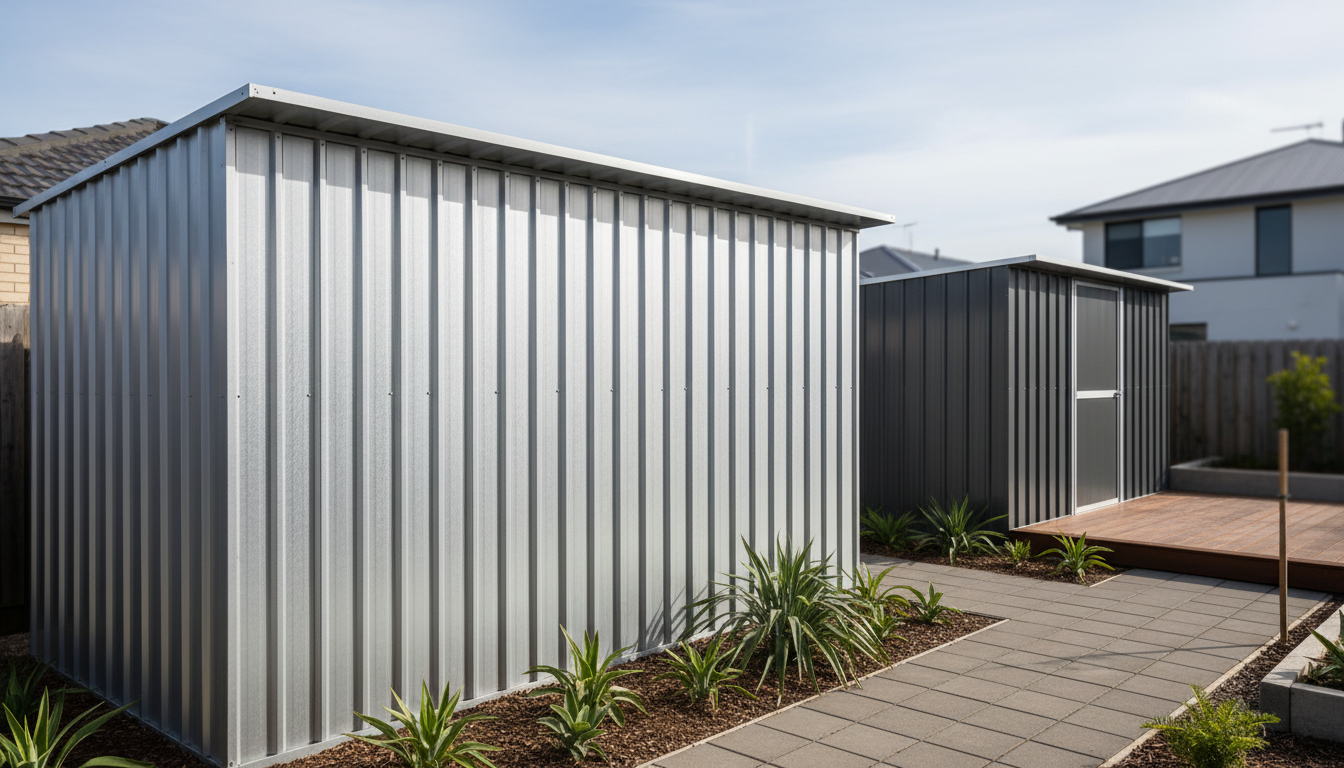
Your 2025 guide to long-lasting steel sheds for Aussie backyards
If you’re weighing up zincalume garden sheds against Colorbond, you’re already ahead. Material choice drives durability, maintenance, and council sign-off. Below we cover what actually matters in Australia: wind regions, coastal corrosion, bushfire compliance, and how to avoid cost blowouts on slabs, doors and installation.
What Are the Best Shed Materials for Perth’s Climate?
Perth homeowners juggle UV, heat, and sea breeze salts. That’s why the two industry workhorses—Zincalume and Colorbond—dominate steel sheds Perth-wide. Both are produced to AS/NZS 1397 and are engineered for Australian conditions.
Colorbond vs Zincalume — Which Is Better for WA Conditions?
| Criteria | Zincalume | Colorbond |
|---|---|---|
| Heat reflectivity | High reflectivity lowers heat load; great for Perth summers | Varies by colour; lighter colours perform best |
| Coastal performance | Strong, but increase wash-down near marine exposure | Comparable, with paint layer adding barrier in many environments |
| Aesthetics | Classic metallic finish only | Wide colour palette to match roofs/fences |
| Cost | Generally lower cost | Typically 10–20% higher, depending on colour and profile |
| Scratches/repairs | Minor scratches less visible | Chips show substrate; touch-up paints available |
| Typical use cases | Garden storage, DIY shed kits, rural sheds NSW & WA | Custom Colorbond garages Perth, premium residential builds |
Short answer: For a backyard zincalume garden shed, Perth heat resistance and price make Zincalume a smart pick. If you’re matching your home’s facade or fence, Colorbond steel looks flawless and still performs well.
Are Zincalume Garden Sheds Durable Enough for Coastal and Rural Australia?
Yes—when specified correctly. Durability depends on distance from surf, airborne salts, and maintenance. For marine and industrial zones, use marine-grade fasteners, avoid copper/lead contact, and rinse salt-laden surfaces during dry spells (per manufacturer guidance).
- Coating grade: AZ150 to AS/NZS 1397 is typical for Australian shed cladding.
- Fasteners: Class 4 screws in coastal zones; avoid galvanic corrosion by isolating dissimilar metals.
- Vents and sarking: Add sarking and an anticon blanket to reduce condensation and drips.
- BAL bushfire zones: Consider metal mesh ember guards, sealed eaves, and metal doors for BAL-12.5 to BAL-29; check specifics for BAL-FZ.
How Do I Choose Size, Roof Profile, and Wind Rating?
Getting these three right ensures your shed passes engineering and survives storms—especially in cyclonic regions.
Common sizes like a Garden Shed 3m x 2m are often available in both Colorbond and Zincalume variants.
Flat roof vs gable roof (and skillion) — which suits your block?
| Roof type | Pros | Cons | Best for |
|---|---|---|---|
| Flat (low pitch) | Low profile, modern look, easier near boundaries | Needs good drainage; not ideal in heavy leaf areas | Urban backyards, affordable carports for Australian homes |
| Gable | Classic look, strong in wind, great water run-off | Taller ridge may trigger extra council checks | Double garage, farm machinery storage, rural sheds NSW |
| Skillion (mono-pitch) | Maximises solar aspect, easy to add lean-to | Wind load on high side; flashing details critical | Custom sheds, custom carports Melbourne, garden storage |
Wind ratings explained for sheds
Engineering for sheds follows AS/NZS 1170.2 (wind actions) with NCC 2022 compliance, not just house ratings like N1–N3. In northern QLD and WA, cyclonic Regions C and D require cyclone-rated sheds with enhanced hold-downs, edge detailing, and door bracing.
- Regions A/B: Most of VIC, SA, TAS, southern WA and NSW — standard non-cyclonic wind regions.
- Regions C/D: Northern WA and QLD coastal belt — specify wind-rated sheds for cyclonic areas.
- Hold-downs: Cyclonic M12/M16 anchors, heavier base rails, tighter sheeting spacings.
Added 2024 WA wind-rating compliance notes: WA uses the NCC with WA variations; check your site wind region map and terrain category. A local engineer certification is usually required for council-approved sheds WA.
Do I Need Council Approval for My Shed? State-by-State Snapshot
Rules vary and can change. Always confirm with your local council or certifier.
How to Get Council Approval for Your Custom Shed in WA
- Confirm planning: Check R-Codes setbacks and height (often 2.4–3.6 m envelope depending on lot).
- Engineering: Obtain AS/NZS 1170.2 wind certification for your address; include slab design.
- Documents: Site plan, elevations, specs (cladding, doors, gutters, downpipes to soakwell).
- Lodge: Building Permit application (BA1/BA2) with owner/builder or registered builder details.
- Inspections: Slab and final as required by the permit authority.
Council-approved sheds WA often clear faster when you include full engineering, soakwell calcs, and neighbour comments if near boundaries.
Fast-track approvals in NSW and QLD
- NSW: Many small sheds qualify for Complying Development (CDC) if under size/height thresholds. Larger rural sheds need DA.
- QLD: Building approval via a private certifier is common. Cyclone-rated sheds QLD are mandatory in Regions C/D; door wind locks and extra bracing apply.
Tip: Ask your supplier about “council packs” with standard details to cut weeks off approval time.
DIY Shed Kits vs Custom-Built Installs: What’s Best for You?
| Option | Pros | Cons | Who it suits |
|---|---|---|---|
| DIY shed kits | Cheapest; fast delivery; great for standard zinc garden shed sizes | Requires tools/time; slab must be square; no custom tweaks | Handy homeowners, tradies, investment properties |
| Custom-built | Engineered to site; any size/door layout; easier council approval | Higher cost; longer lead time | Premium builds, custom carports Melbourne, custom Colorbond garages Perth |
Real Projects and Pricing Examples (2025)
Indicative prices only. Supply chain and engineering can shift costs. Always request a fixed, itemised quote.
- Perth backyard, zincalume garden shed 3 x 4 x 2.4 m, skillion roof: DIY kit $1,700–$2,300; slab 100 mm with thickened edge $1,200–$1,800; install $900–$1,400. Total typical: $3,800–$5,500.
- North QLD, cyclone-rated shed 6 x 4 x 2.7 m, gable: Supply/engineer $6,500–$8,500; cyclonic doors and tie-downs add $1,000–$1,800; slab $2,500–$3,500. Total: $10,000–$13,800.
- Melbourne custom carport (Colorbond roof) 6 x 5 m attached: $7,500–$11,000 installed, excluding permits and footings depending on soil class.
How to Keep Your Zincalume Shed Cool, Quiet, and Dry
- Insulation: Anticon blanket under roof sheets cuts radiant heat and condensation.
- Ventilation: Ridge vents/whirlybirds and low-level louvres improve airflow.
- Light: Add polycarbonate roof sheets on the leeward side to reduce heat gain.
- Moisture: Install sarking and sealed flashings; add gutters and downpipes to soakwells.
For temperature control and to prevent condensation, review our Insulated Garden Shed Australia article.
Maintenance and Warranty Essentials
- Quarterly rinse in coastal areas; remove leaf litter from gutters.
- Keep away from copper pipes, lead flashing, or fertiliser storage to avoid corrosion.
- Touch up scratches promptly; follow manufacturer paint systems for Colorbond.
- Doors: Lubricate rollers and check wind locks annually in cyclonic areas.
Warranties differ by brand and proximity to the coast. Register your job address and keep proof of maintenance to preserve coverage.
FAQs About Zincalume Garden Sheds
Is Zincalume better than Colorbond for sheds? Zincalume often wins on price and heat reflectivity. Colorbond wins on colour choice and a paint barrier—handy for harsher environments and design-led builds.
How long does a zinc garden shed last near the coast? With correct fasteners and wash-down, decades. In surf zones, consider Colorbond Ultra or increase maintenance frequency.
Can I paint Zincalume? Yes, with the right primer and topcoat after weathering or manufacturer-recommended prep.
What slab do I need? Commonly 100 mm concrete with thickened edges, SL72 mesh, and MPA 25 concrete. Engineer’s design prevails.
Do sheds need bushfire compliance? In BAL zones, yes. Use metal flyscreens, ember seals, and non-combustible cladding; verify with your certifier.
Lead time? DIY kits 1–3 weeks; custom builds 4–10 weeks depending on engineering and council approval.
5-Step Buying Guide for Custom Sheds in Australia
- Define use-case: garden storage, farm machinery storage, double garage, or workshop.
- Pick material and roof: Zincalume vs Colorbond comparison; flat vs gable vs skillion.
- Confirm wind region and BAL: order engineer-certified plans for your address.
- Budget fully: slab, drainage, doors/windows, insulation, electrical, approvals.
- Choose delivery method: DIY shed kits vs installed turnkey; lock in timelines around weather.
Key Definitions (Quick Reference)
Popular Keyword Clusters (Choose What Fits Your Project)
- Metro residential: steel sheds Perth, custom Colorbond garages Perth, zincalume garden sheds
- Regional/rural: rural sheds NSW, wind-rated sheds for cyclonic areas, farm machinery storage
- Value and convenience: DIY shed kits, affordable carports for Australian homes, custom carports Melbourne
- Compliance: council-approved sheds WA, cyclone-rated sheds QLD, Colorbond vs Zincalume comparison
References and Standards (Australia)
- Housing Industry Association (HIA) — outdoor structures insights and building guidance (see 2025 HIA Outdoor Structures and Home Improvement Report).
- Australian Steel Institute — technical notes on coated steel and fasteners.
- Bureau of Meteorology — regional wind and climate data for site design.
- Energy.gov.au — guidance on insulation, ventilation and reducing heat gain.
- Standards: AS/NZS 1170.2 (Wind Actions), AS/NZS 1397 (Steel sheet and strip), NCC 2022 (with state variations). Also refer to the “2025 Australian Steel Market Outlook” for supply trends.
Added cyclonic design reminders for QLD/WA and local council pathways to close the gaps seen in typical competitor articles.