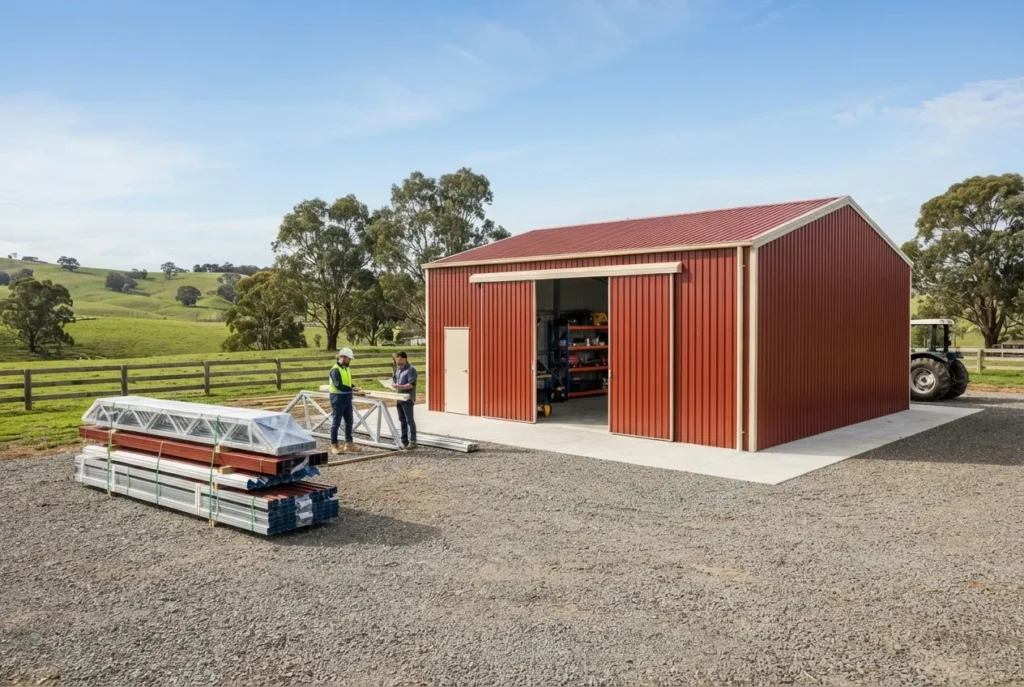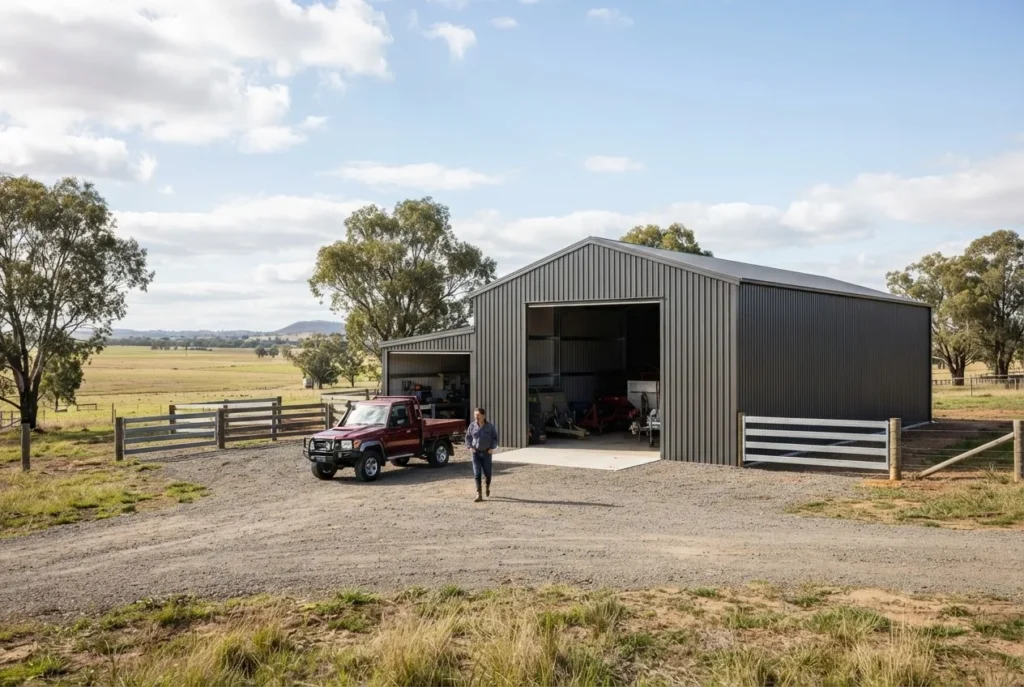


Looking at a 5 x 3 storage shed for your home or investment property? This expanded guide goes beyond product specs. We cover material choices for coastal Perth, wind-rating compliance (NCC, AS/NZS 1170.2), cyclone requirements in QLD, bushfire/ corrosion considerations, council approvals, costs (2025 guidance), DIY vs custom options and practical design tips used by professional builders.
What does a 5 x 3 storage shed fit, and who is it for?
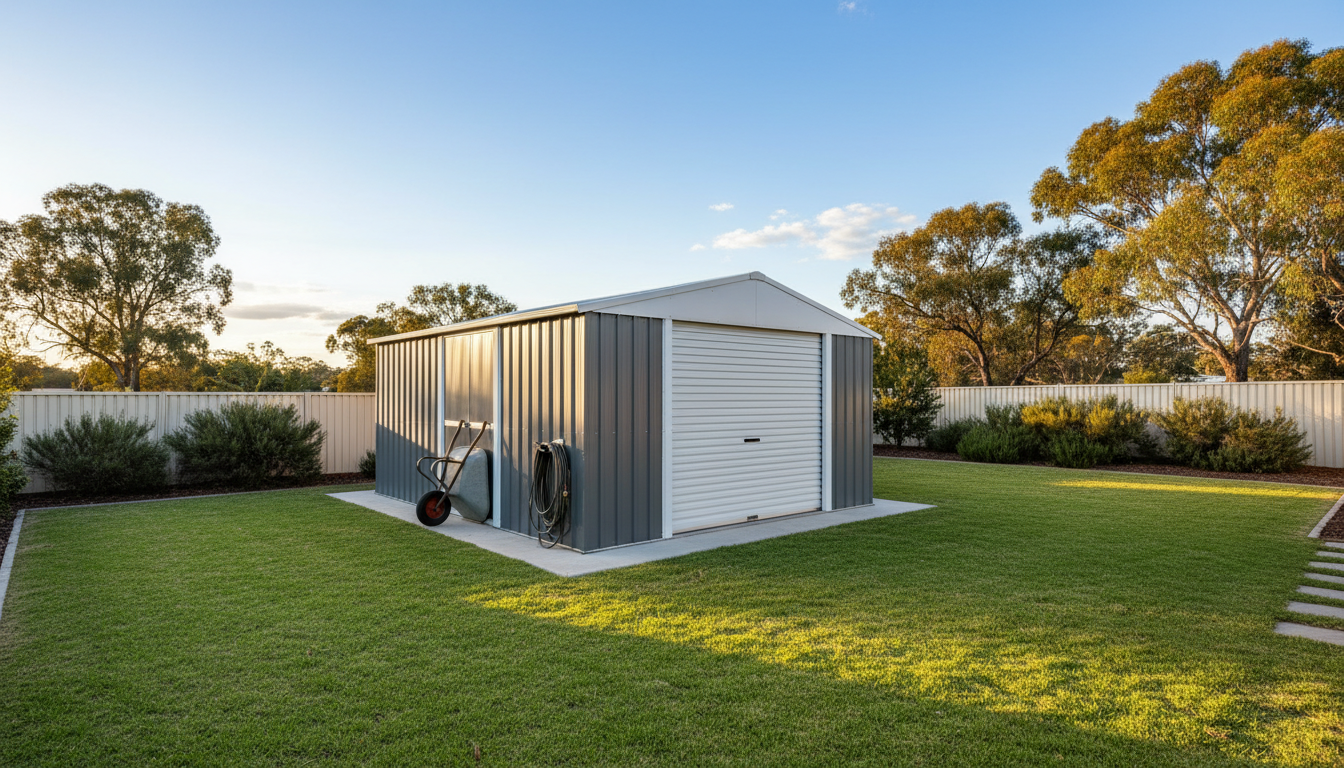
A 5 x 3 storage shed has a nominal 15 m² floor area and is ideal where secure storage is needed without taking too much yard space. Typical uses include garden equipment, bikes and boards, pool pumps, or a small workshop. It’s commonly used on urban blocks, strata lots and as a compact backyard workshop.
- Storage capacity examples: with shelving along one 5 m wall (3–4 linear metres of shelving) plus a 900 mm workbench, you retain ~6–7 m² usable floor space for bulk items.
- Workshop layout: 900 mm bench + 600 mm clearance aisle + 2 m tool/bike zone fits comfortably behind a 1.8 m roller door.
- Urban & strata: 5 x 3 often stays under local outbuilding triggers but always check council rules for easements and strata by-laws.
What are the best shed materials for Perth’s climate?
Perth’s hot summers and coastal salt exposure make two factors most important: heat reflectance and corrosion resistance. Pre-painted Colorbond steel in high-reflectance colours (Surfmist, Shale Grey) reduces roof radiant load and suits insulated panels. Zincalume (aluminium-zinc alloy) is cost-effective inland but requires careful detailing in marine environments.
Material longevity depends on exposure. Manufacturer guidance suggests Colorbond on suburban sites can last 15–25 years between repaint/repair cycles; near-surf zones expect more frequent maintenance. Recommended maintenance for coastal suburbs: annual freshwater rinse, inspect fixings and flashings every 12 months.
BMT (base metal thickness) guidance: for most 5 x 3 domestic sheds, BMT 0.35 mm is common for walls and roof; BMT 0.42 mm is recommended where higher wind ratings, closer screw spacing or a more rigid finish is desired. Discuss BMT with your supplier/engineer.
Colorbond vs Zincalume — Which is better for WA conditions?
| Criteria | Colorbond (pre-painted) | Zincalume (aluminium-zinc coated) |
|---|---|---|
| Coastal resistance (sea spray) | Better—use marine/ultra finishes and maintain a clear wash zone | Reasonable inland; avoid severe splash/spray zones or increase setbacks |
| Heat management | Light colours + insulation reduce internal temps and glare | Reflective but can heat quickly; insulation advised to control drumming |
| Aesthetics | Wide residential colour range; integrates with homes | Industrial look; can be painted for a premium finish |
| Maintenance | Low; annual rinse near coast | Moderate; rinse and inspect for early corrosion signs |
| Price (2025 guidance) | ~10–25% premium over Zincalume depending on colour and BMT | Lower upfront material cost; painting/upgrades add cost |
| Typical spec | COLORBOND steel cladding, BMT 0.35–0.42 mm | ZINCALUME steel cladding, BMT 0.35–0.42 mm |
How do wind ratings and Australian Standards affect a 5 x 3 shed?
All sheds must meet the National Construction Code (NCC) and relevant Australian Standards: AS/NZS 1170.2 (wind actions) and AS/NZS 4600 (cold-formed steel). Your wind rating determines member sizing, screw spacing, bracing and anchorage. Terrain Category (TC1–TC4), shielding and topography all influence design wind pressure.
- Terrain Categories: TC1 (open sea) to TC4 (urban); typical suburban lots are TC2. Higher TC increases design wind loads and may require thicker sections.
- Wind region: Non-cyclonic (N1–N3) covers much of southern Australia; cyclonic regions (C1–C4) apply in tropical coasts and require specialist detailing.
- Anchorage: typical anchorage for non-cyclonic suburban sheds is M10 chemset anchors into slab edge thickenings; cyclonic builds commonly require cast-in plates or screw piles with engineered embedment.
Typical member guidance (indicative only): purlins/top-hat sections and spacing may change from 900 mm centres in N1/N2 to closer centres (600–700 mm) in N3 or cyclonic areas. Always use site-specific engineering — refer to the standards abstract: Standards Australia.
Updated 2024: WA wind-rating compliance notes — many WA councils now require engineer-certified drawings showing Terrain Category, assumed shielding and an anchorage schedule (chemset anchors or cast-in). Include slab edge thickening and tie-downs on your documentation to speed approvals.
How to specify wind-rated sheds for cyclonic areas (QLD)
For cyclone-prone regions (QLD), specify the following on purchase/engineering documents:
- Site-specific engineer certificate for Region C and the relevant cyclonic class (C2–C3 where applicable).
- Reduced purlin spacing and heavier top-hat sections; provide bracing diagrams and connection details.
- Cyclone-rated fasteners (Class 4), sealed connections and cyclone-rated door systems with reinforced frames.
- Hold-downs: screw piles sized per engineer or cast-in anchor plates with specified embedment and concrete strength.
Bushfire and corrosion notes
For bushfire-prone areas, BAL (Bushfire Attack Level) classifications from BAL-LOW to BAL-FZ (AS 3959) affect acceptable cladding, ember seals and ventilation. BAL-12.5 to BAL-29 typically requires ember protection, screened vents and non-combustible cladding. Higher BAL levels may restrict openings and require specific materials.
Marine zones: differentiate splash (occasional wave action) vs spray (constant salt aerosol) zones. In spray zones choose marine-grade coatings, increase setbacks, avoid direct contact between treated timber and steel, and schedule freshwater rinses every 3–6 months. Use vermin flashing and corrosion-resistant fixings to extend life.
See AS 3959 and manufacturer instructions for BAL-specific details: Standards Australia.
Do I need council approval for a 5 x 3 shed?
Many 5 x 3 sheds are exempt from full building approval if they meet specific height, floor area and setback limits. However, if your property has overlays (heritage, bushfire, flood, strata) or you need reduced setbacks, a formal approval is required. Use a private certifier or lodge with council depending on your state and council rules.
Key checks: maximum floor area triggers, finished building height, boundary setbacks, easements, and whether the shed will be used for habitable purposes (which changes requirements).
How to get council approval for your custom shed in WA
- Check exemption thresholds in your local council policy (area, height, setback).
- Prepare drawings: site plan (1:200), elevations (1:100), footing/slab details (1:20), engineer-certified wind/structural drawings and colour/finish schedule.
- Determine BA type: BA1 (certified) vs BA2 (uncertified) — BA1 requires a registered certifier and engineer sign-off.
- Lodge the application with required fees, include neighbour consultation if seeking setback variations.
- On approval, book inspections: footing setout, slab reinforcement, and final inspection as required.
Design options that elevate a 5 x 3 shed
Design choices can make a small shed highly functional. Consider roof type, ventilation, door selection and floor specification early — these affect approvals, costs and usability.
- Roof: choose flat for low profile, skillion for solar orientation, or low gable for internal headroom. Size gutters to roof area and rainfall intensity.
- Doors: 1.8 m roller doors suit bikes and bulk items; 2.4 m roller allows small trailers. Hinged double doors give wider clearances for benches.
- Ventilation: crossflow via louvres plus a ridge vent or whirlybird reduces heat buildup; specify insect/flame-proof screening if required by BAL.
- Flooring: standard 100–120 mm slab (SL72 mesh) with 300 mm edge thickenings; use thicker slabs for heavy equipment or vehicle access.
- Finish: add LED battens, GPOs on a dedicated circuit, vermin flashing, shelving and powder-coated hardware for longevity.
Flat vs Gable vs Skillion roof — which suits where?
- Flat: lowest height; good near boundary; must ensure adequate fall (minimum 1:100) to gutters and proper waterproofing.
- Skillion: simple single pitch, excellent for north-facing solar panels and water capture; typically lower cost and easier to flash.
- Gable: better natural stack ventilation and classic appearance; may exceed height envelopes in some zones—check planning limits.
DIY shed kits vs custom-built
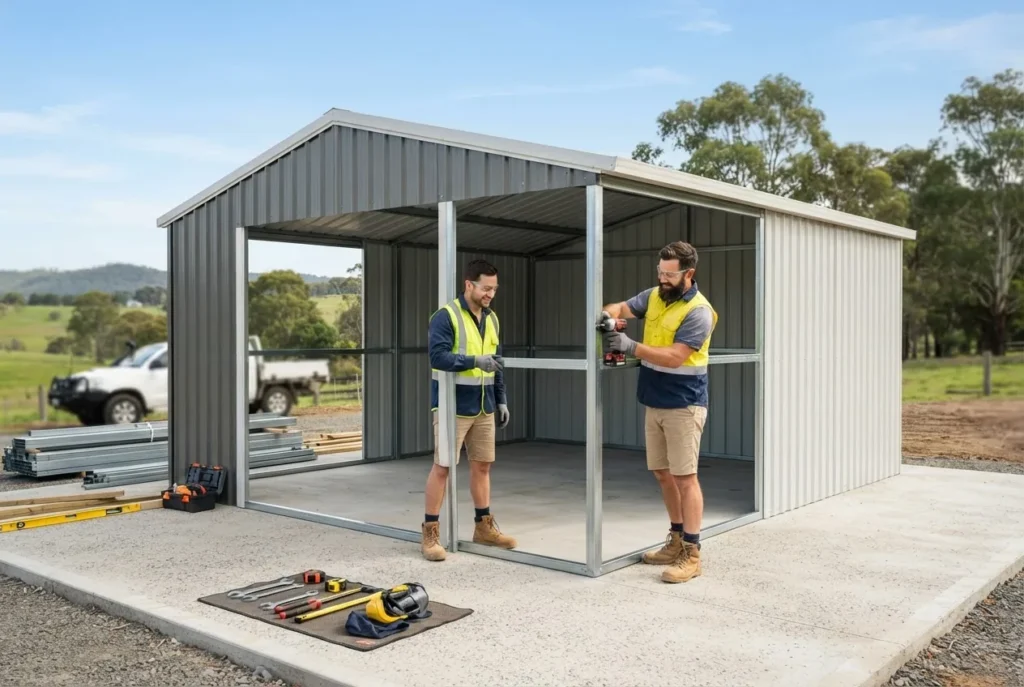
DIY kits are cost-effective and fast where site is level and access is good. Custom-built options handle complex sites, difficult access, BAL/cyclonic requirements and include engineering and approvals. Both routes can be ShedSafe-compliant when accompanied by certified drawings.
| Factor | DIY Shed Kits | Custom-Built/Installed |
|---|---|---|
| Cost | Lower upfront; you supply labour | Higher; includes labour, project management and warranty |
| Time | Fast to receive; assembly takes a weekend to a few days | Lead time for fabrication but quick onsite installation |
| Approvals | You arrange engineering and certification | Builder arranges engineered drawings and lodgement |
| Site complexity | Best on flat, accessible sites | Suitable for slopes, tight access, BAL/cyclonic requirements |
If choosing DIY, order an engineered plans pack and confirm ShedSafe compliance with your supplier.
How much does a 5 x 3 storage shed cost in 2025?
The table below gives indicative 2025 market ranges. Prices vary by access, soil, wind/BAL upgrades and finish level. Assumptions: standard suburban access, no major earthworks, typical soil profile (Class P–M). Prices exclude GST unless stated.
| Component | DIY Zincalume (AUD) | DIY Colorbond (AUD) | Custom-built (supply & install) (AUD) |
|---|---|---|---|
| Basic kit (frame + cladding) | $1,200–$2,500 | $1,800–$3,500 | $3,000–$5,500 |
| Concrete slab (100–120 mm) & labour | $1,200–$2,200 | ||
| Electrical (2 GPOs, 1 light) | $450–$900 | ||
| Engineering & approvals | $400–$1,200 | ||
| Total typical installed | $5,200–$12,000 | ||
Cost drivers: wind/cyclonic upgrades (+20–40%), BAL upgrades (+10–25%), insulated roof panels (+$700–$1,500), site access/earthworks can add $500–$3,000.
5-Step Buying Guide for Custom Sheds in Australia
- Site check: confirm boundaries, easements, overlays (bushfire/flood), and service runs. Ask for a site inspection if unsure.
- Material selection: choose Colorbond or Zincalume, specify BMT and finish. Ask suppliers about warranty and coastal grade options.
- Confirm wind class: have your designer/engineer verify N or C rating, Terrain Category and shielding assumptions in writing.
- Design access: decide door type, slab level, drainage and solar orientation. Check for planning height limits if near boundaries.
- Approvals & build: request engineered drawings, lodge BA1/BA2 as needed, schedule slab pour and installation. Ensure a written scope and warranty from the builder.
Keyword clusters to help you plan
- Local builds: steel sheds Perth, shed builders Brisbane, rural sheds NSW, custom carports Melbourne — see regional pages for local rules.
- Technical: Colorbond vs Zincalume comparison, wind-rated sheds for cyclonic areas, N2/N3/C2/C3 wind classes, BMT thickness, Class 4 screws, vermin flashing .
Useful standards and resources
- Bureau of Meteorology — climate and wind region background.
- Housing Industry Association (HIA) — industry guidance and market insights.
- ShedSafe (Australian Steel Institute) — compliant shed design information.
- COLORBOND steel — material specs and care instructions.
- Standards Australia — AS/NZS 1170.2, AS/NZS 4600, AS 3959 abstracts and acquisition.
Final word
A 5 x 3 storage shed is compact but requires correct specification. Choose materials for your postcode, confirm wind and BAL ratings, and sort approvals early.
Frequently Asked Questions
What size and storage capacity does a 5 x 3 shed offer for Australian homes?
A 5 x 3 shed provides about 15 m² of floor area. With shelving along one 5 m wall and a 900 mm bench you typically retain 6–8 m² of clear floor. It stores lawn equipment, bikes, surf gear or a compact workshop; layout depends on door position and internal fittings.
Which is better for coastal Perth — Colorbond or Zincalume?
For most Perth coastal suburbs Colorbond (marine/ultra finish) is preferable for corrosion resistance, colour choice and thermal control. Zincalume is economical inland but requires closer maintenance near surf. Always specify stainless or coated fixings and schedule freshwater rinses in marine zones.
How do wind ratings affect shed design and installation in cyclonic areas?
Wind ratings (N1–N3, C1–C4) determine purlin/section sizes, screw spacing, bracing and anchorage. Cyclonic (Region C) designs require heavier members, Class 4 fixings, reinforced door systems and engineered hold-downs (screw piles or cast-in plates). Always use site-specific engineering for cyclonic areas.
Do I need council approval for a 5 x 3 shed in WA or QLD?
Many 5 x 3 sheds are exempt if they meet local height, area and setback rules, but councils vary. In WA or QLD, overlays (BAL, heritage, strata) may require BA1/BA2 lodgement or certifier involvement. Check your local council or use a certifier to confirm requirements before ordering.
What are the foundation requirements for a secure 5 x 3 storage shed?
Standard domestic foundations: a 100–120 mm concrete slab with SL72 mesh and 300 mm edge thickenings, or pier footings where preferred. Anchor to slab with M10 chemset anchors or to cast-in plates where specified. Soil class and wind rating influence reinforcement—use engineer drawings.
How long does it typically take to assemble a DIY 5 x 3 shed kit?
With a prepared slab, two competent DIYers can assemble a standard 5 x 3 kit in a weekend (2–3 days). Allow additional days for insulated roofs, electrical, windows, or complex sites. Factor curing time for concrete before anchoring and door fitment.
What maintenance is needed to protect sheds in coastal or bushfire zones?
Coastal: freshwater rinse annually (quarterly in severe spray zones), inspect and replace corroded fixings, use marine-grade flashings and stainless hardware where exposed. Bushfire: fit ember seals, screened vents, use non-combustible cladding per AS 3959 and follow BAL-specific ventilation and opening restrictions.
How much does a custom-built 5 x 3 storage shed typically cost in 2025?
Typical installed custom-built 5 x 3 Colorbond sheds range from about $5,200 to $12,000 AUD depending on slab, wind upgrades, insulation, electrical and site access. Cyclonic or BAL upgrades increase costs. Request a site quote for accurate pricing tailored to your postcode and specifications.