

Single Garage Dimensions in Australia (2025): Sizes, Double Garage Widths, Wind Ratings, and Council Approvals
Standard Single Garage Dimensions in Australia
Choosing the correct single garage dimensions is the foundation of practical design—balancing vehicle fit, storage, and access. Below are industry-standard internal clearances broadly used by Australian shed suppliers and builders in 2025, with practical adjustments for modern vehicle sizes and accessories.
- Internal width: 3.0 m – 3.6 m. Many builders treat 3.0 m as minimum; 3.3–3.6 m offers easier door access and storage space.
- Internal length: 5.4 m – 6.0 m. 5.4 m suits compact cars; 5.8–6.0 m preferred for utes and SUVs with roof racks.
- Eave (wall) height: 2.4 m – 3.0 m. 2.7 m is common for tall vehicles and roof-mounted gear.
- Door width: 2400–3000 mm (single). 2700–3000 mm preferred for wider vehicles and mirror clearance.
- Door height: 2100–2400 mm. Select 2400 mm for lift kits or roof racks.
Examples and recommendations:
| Use case | Internal (W × L × eave H) | Notes |
|---|---|---|
| Compact urban car | 3.0 × 5.4 × 2.4 m | Minimum footprint, tight door swing; suitable for small hatchbacks |
| Everyday family car | 3.3 × 5.8 × 2.7 m | Comfortable for sedans, small SUVs; room for shelves at nose |
| Ute / larger SUV | 3.6 × 6.0 × 2.7–3.0 m | Allows for roof racks, tow bars and modest bench/storage |
For tight lots, consider a shallow apron or a one-piece roller door to maximise usable internal space. Always measure external clearances and driveway swing when choosing door width.
Double Garage Sizes and Dimensions
A practical standard double garage size has historically been 6.0 m × 6.0 m. With larger modern vehicles and owners wanting storage space, many builders now recommend 6.2–6.6 m widths and longer lengths. Below are common layouts and the trade-offs between one wide door and two singles.
Width and length recommendations
- Standard double garage width: 5.5–6.6 m. 6.0 m is typical; 6.2–6.6 m improves door clearance and spacing between vehicles.
- Standard double garage length: 6.0–7.0 m. 6.5–7.0 m recommended for longer SUVs, hoists or bench space.
- Door choices: One wide sectional door: 4800–5200 mm. Two single doors: 2400–3000 mm each (allow min 300 mm mullion between doors).
Spacing between vehicles and clearances
Between-vehicle clearance is crucial for door opening and comfort:
- Clearance between vehicles: 500–700 mm recommended for easy entry/exit and to reduce door dings.
- Side clearances: 300–450 mm either side of each vehicle for comfortable door opening (400–600 mm for large utes and SUVs).
- Front/back storage: 600–900 mm in front of bumper for shelves/bench; consider 3.5–4.0 m internal length if installing a hoist.
Layout examples
Example 1: Two large SUVs (e.g., Ford Everest + Toyota Prado). Recommended: 6.4 m (W) × 6.8 m (L) with two 2700 mm doors or one 5200 mm sectional door and 700 mm between cars.
Example 2: Car + workshop bay. Recommended: 6.6 m (W) × 7.0 m (L) arranged as car space plus 3.0 m workshop bay with internal access door.
Vehicle Sizes and Garage Clearance Requirements
Because Australian utes and SUVs have grown in size, plan garages around realistic vehicle dimensions plus clearance for doors, roof racks and trailers. Below is a concise reference table of common vehicles and practical garage allowances.
| Vehicle (example) | Approx L × W × H | Recommended internal garage (min) |
|---|---|---|
| Toyota Hilux / Ford Ranger | ~5.3–5.4 × 1.9–2.0 × 1.8–1.9 m | 3.6 × 6.0 m; door height 2400 mm; 400–600 mm side clearance |
| Toyota Prado / Nissan Patrol | ~4.8–5.0 × 1.9–2.0 × 1.8–1.9 m | 3.4–3.6 × 6.0–6.5 m; 2400 mm headroom if roof racks |
| Mazda CX-9 / Ford Everest | ~5.1 × 1.9 × 1.8 m | 3.4 × 6.0 m; 300–450 mm side clearance each side recommended |
| Medium caravan / trailer (towed) | Varies—allow extra length | Longer driveway or 7.0+ m internal length for storage |
Door and headroom specifics:
- Side clearance: 300–450 mm per side for standard cars; 400–600 mm for utes/SUVs.
- Front/back (nose/tail) clearance: 600–900 mm for shelves; 3.5–4.0 m internal length for hoist installations.
- Door height: 2100 mm standard; 2400 mm recommended for roof racks/lifts. Check garage door manufacturer specs for headroom and motor clearances.
Internal links: If you plan internal fit-outs, review our garage wall storage solutions .
Compliance: Australian Standards, Wind Ratings, and Council Approvals
NCC Class 10a explained
Most domestic garages/sheds are classified as NCC (National Construction Code) Class 10a structures: non-habitable buildings like garages, carports and sheds. Class 10a buildings are subject to building regulations, structural design requirements and local planning rules but are not considered habitable dwellings. You still need compliant structural drawings, certified engineering and building approvals where thresholds are exceeded.
AS/NZS 1170.2 — Wind actions, Regions A–D and terrain categories
AS/NZS 1170.2 sets design wind actions. Australia is mapped into Regions A–D:
- Region A: Non-cyclonic (most populated coastal and inland areas)
- Region B: Intermediate wind/weather
- Region C: Severe non-cyclonic
- Region D: Cyclonic (north Queensland, parts of WA and NT)
Terrain categories 1–4 (open sea to suburban/wooded) and local shielding affect the design wind speed. Engineers use the applicable map and terrain category to derive a 3-second gust wind speed, which then sets member sizes, hold-down capacities and cladding fixings. For site wind speeds consult BOM and AS/NZS 1170.2 tables or a licensed structural engineer.
Relevant Australian Standards and guidance
- AS/NZS 1170.2 — Wind actions (design wind speeds and loading)
- AS 2870 — Residential slabs and footings (site classification and slab design)
- AS/NZS 4600 — Cold-formed steel structures (manufacturing and connection rules)
- AS 4100 — Steel structures (hot-rolled steel design where applicable)
- AS 3959 — Construction of buildings in bushfire-prone areas (BAL ratings)
Authoritative links (examples): Bureau of Meteorology wind info, NCC/BCA guidance and Standards Australia summaries are essential references. See the further reading section below for links.
Typical documents required for a building permit
Standard permit application pack usually includes:
- Site plan with existing structures, driveways and setbacks
- Floor plan and elevations (showing eave height and roof pitch)
- Structural drawings and certified calculations (sized to AS/NZS 1170.2)
- Soil classification report or engineer’s slab design referencing AS 2870
- BAL report if in bushfire-prone area (AS 3959)
- Corrosion protection detail for marine zones
- Owner-builder or builder details and submission forms
How to get council approval — Western Australia (WA)
- Confirm local planning requirements: setbacks, height limits and site coverage with your local council. R-Codes may apply in residential zones.
- Commission an engineer for structural design and site-specific wind/soil inputs. Obtain certified plans and details for slab edge beams.
- Include BAL or corrosion detail where relevant, and show materials/colours for planning approval if required.
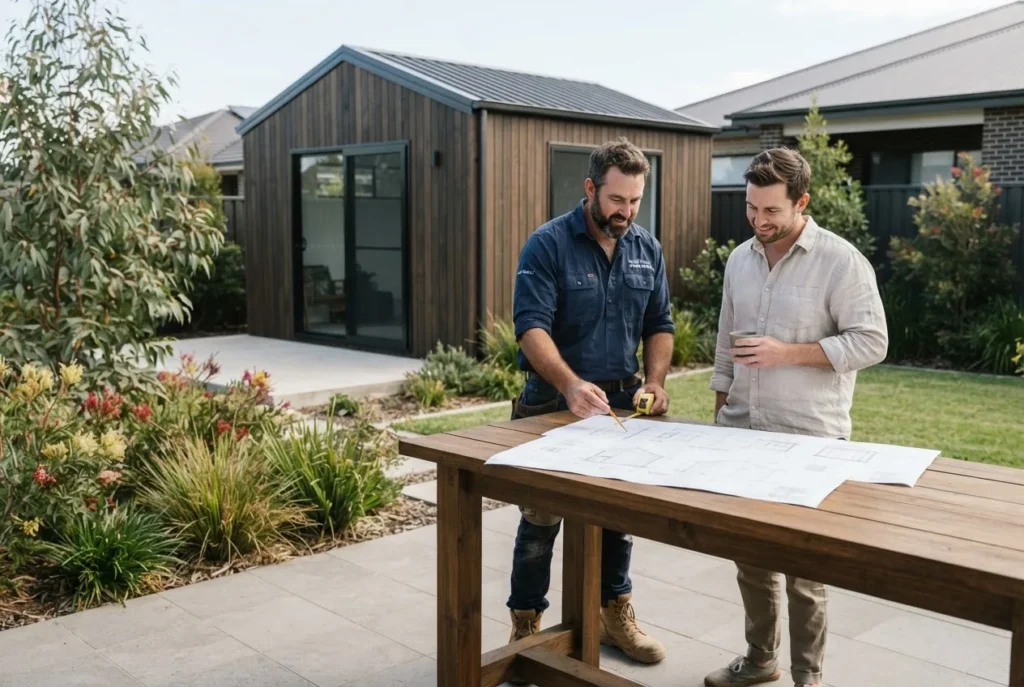
- Lodge building permit application with certified drawings, owner/builder declaration and fees. Many suppliers provide a permit pack service.
- Arrange required inspections (slab/footings and final) and retain compliance certificates.
How to get council approval — Queensland (QLD) (cyclone areas)
- Identify if your site is within Regions C or D using BOM/NCC maps and local council information.
- Engage a structural engineer to specify cyclone-rated connections: larger frame members, additional purlins/girts, and hold-down capacity.
- Specify wind-locked doors, cyclone washers and tested door spans; include these in drawings.
- Lodge building application with certified plans, BAL report if relevant, and submit any required plumbing/electrical permits.
- Ensure the builder or installer supplies a producer statement (PS1/PS2) and final compliance certificates.
National checklist and engineering notes
Nationally, the pragmatic permit workflow is:
- Pre-check planning (setbacks, covenants)
- Measure site and vehicles; confirm intended use (workshop, hoist)
- Commission site-specific engineering (wind & soil)
- Lodge building permit with certified plans and fees
- Construct with inspection points and obtain final certification
Practical engineering notes: slab thickness, reinforcement and edge beams vary with soil class (AS 2870). In simple suburban settings, a 100 mm slab with thickened edge and mesh is common; high exposure, poor soils, or hoists typically require 125–150 mm slabs with dowelled edge beams or suspended slab solutions—consult the structural engineer.
Material Choices for Australian Garages: Colorbond vs Zincalume
Choosing between Colorbond and Zincalume involves corrosion performance, aesthetics, thermal behaviour and cost. Below is an accessible summary table and technical considerations drawn from industry guidance and manufacturer literature.
| Feature | Colorbond | Zincalume |
|---|---|---|
| Coastal corrosion resistance | Paint system with corrosion-resistant substrate; select marine-grade surface and sacrificial paint zones for close-to-coast exposure | Zinc-aluminium coating provides good corrosion resistance; in marine spray zones requires more frequent rinses and protective details |
| Appearance & colours | Wide palette; pre-painted finish to AS/NZS 2728 | Metallic finish only; limited colour choice |
| Thermal performance | Light colours + Thermatech reduces heat gain; works well with insulation | Reflective when new; can heat internal space without insulation |
| Maintenance | Low when installed correctly; wash salt in marine zones | Low; periodic rinse in coastal areas |
| Cost | Usually higher due to paint system | Generally more economical |
Technical considerations
- Standards: Colorbond coatings conform to AS/NZS 2728 paint system performance classifications—verify the supplier certificate.
- Corrosion classes: Marine or high-salt zones may require sacrificial coatings, stainless fixings or additional sacrificial anodes.
- Insulation: Roof blanket, foil-backed blanket or insulated panels dramatically reduce heat gain; pair with ridge/eave ventilation to manage condensation.
- Maintenance: Rinse salt deposits on coastal sites every 6–12 months and inspect fixings.
Design Considerations Affecting Garage Dimensions
Beyond footprint, design choices such as roof form, eave height and door type materially change usable space. Consider the following quantified allowances and effects.
Door headroom, track and backspace allowances
- Sectional doors: Require headroom and backspace. Typical headroom allowance: 300–450 mm for track and motor. Backspace (distance from door to wall) may be 300–500 mm for bottom mount tracks.
- Roller doors: Require barrel depth 150–300 mm and minimal internal track; roller doors may reduce usable headroom near the lintel but free up ceiling space.
- Two single doors vs one double: Two single doors need a mullion of at least 300 mm between doors for structure and seals—plan accordingly.
Roof forms and internal height
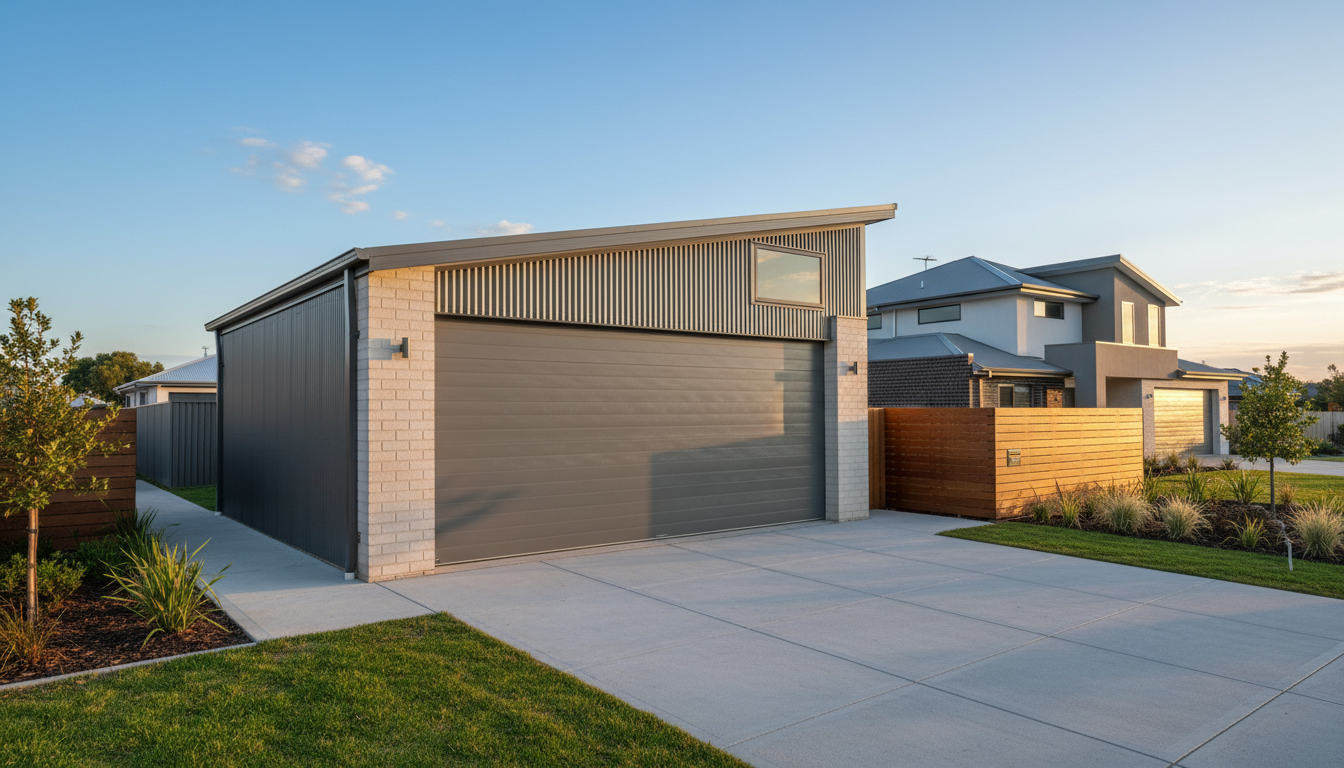
- Skillion roofs: Provide consistent wall height and maximize usable internal height on one side—good for hi‑cube vehicles and mezzanines.
- Gable roofs: Increase peak height and ventilation; may complicate mezzanine placement under rafters.
- Eave height vs peak: Eave height dictates clear wall height; check local planning limits for total height.
Mezzanines and storage
Mezzanine floors require increased eave height (typically 3.2 m+ for a single-level mezzanine) and engineered floor loads. Confirm purlin spacing and wall girts are positioned to take mezzanine loads, or include internal posts in layout.
Real-World Australian Build Examples
Case Study 1 — Custom-Built Double Garage in Perth
Baldivis, WA: 6.2 m (W) × 7.0 m (L) × 2.7 m (H) with a 5.0 m sectional door, Colorbond Surfmist cladding, roof blanket insulation and whirlybirds. Engineered for Region A wind rating; council-approved with a side setback variation. Result: comfortable Prado + Ranger parking and a 900 mm bench at the front.
Case Study 3 — Cyclone-Rated North Queensland Garage
Cairns region (Region D): 6.0 m × 7.0 m double garage upgraded to cyclonic design. Upgrades included larger cold-formed sections per AS/NZS 4600, denser purlin spacing, 12 mm thicker cladding fixings, tested wind-lock roller doors, M12 stainless cyclone washers and engineered hold-down anchors. Approval required cadastral wind report and certified structural drawings—construction timeline 10–12 weeks from engineering sign-off.
Case Study 4 — Urban Constrained Melbourne Lot
Inner-Melbourne: 3.3 m × 6.0 m single garage sited against a laneway with reduced setback. Negotiated minor setback variation under local planning (R-codes) and used thickened slab edge beams due to Class H1.2 clay soils per AS 2870. Internal roller door chosen to preserve ceiling clearance and meet boundary treatments—project completed with a four-week permit turnaround.
Step-by-Step Custom Shed Buying Guide
Follow this expanded checklist when buying a custom garage or shed. Typical lead times and fee ranges are included as guidance; actual costs vary by region and supplier.
- Measure vehicles and site: Record vehicle L×W×H, roof-rack height, trailer needs, door swing and driveway approach. Note site slope and underground services. (Time: 1–2 days)
- Select size and layout: Choose internal clearance based on vehicles and storage. Decide on single vs double doors, mezzanine needs and workshop bays. (Time: 1–3 days)
- Material specification: Choose Colorbond or Zincalume, insulation strategy and roof pitch. Include corrosion details for coastal sites. (Time: 1–3 days)
- Engineering and permits: Engage an engineer for wind and slab design; compile drawings for council. Permit fees typically range from a few hundred to several thousand dollars depending on council and complexity. (Lead time: 2–6 weeks)
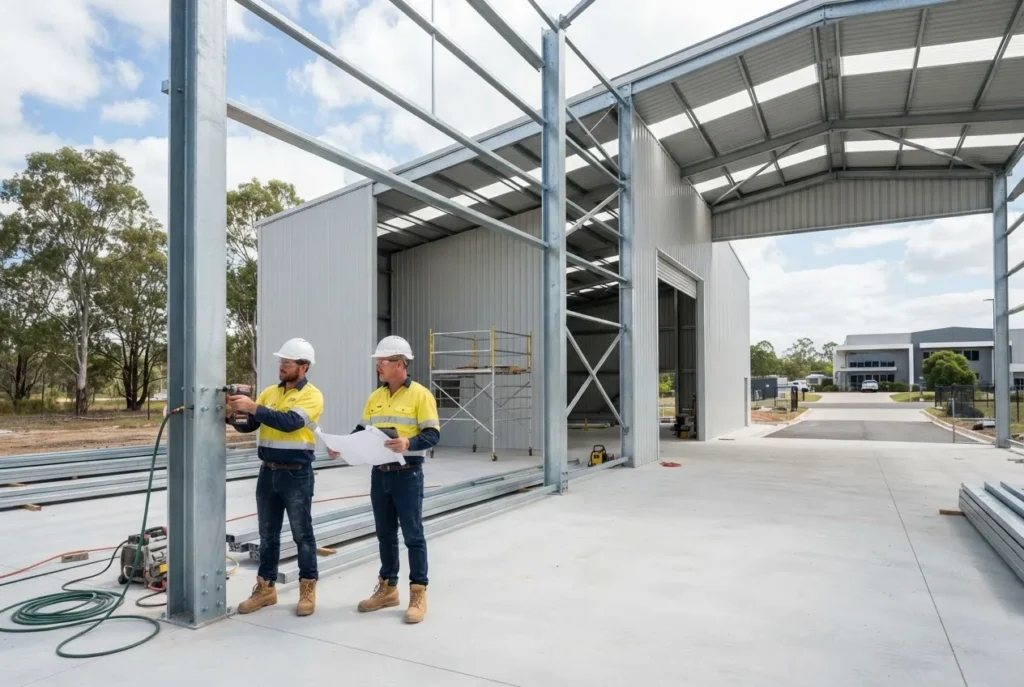
- Procurement & construction: Order materials (lead times vary 2–12 weeks); slab and footing work (1–2 weeks); erection (1–2 weeks for typical garages). Confirm inspections and final compliance documentation.
- Warranty & handover: Ensure builder/supplier provides warranty, producer statements and a final compliance certificate.
Key Specs and Jargon Glossary
- NCC Class 10a: Non-habitable building classification for garages/sheds under the National Construction Code.
- BAL (Bushfire Attack Level): Rating from AS 3959 indicating bushfire exposure and construction requirements.
- Terrain category: AS/NZS 1170.2 classification of surrounding roughness/obstructions used to derive design wind speed.
- Purlin / Girt: Horizontal roof and wall members supporting cladding and transferring loads to rafters or frames.
- Hold-down / Cyclone washer: Connections that resist uplift and racking in high-wind/cyclonic areas.
- Slab edge beam: Thickened perimeter beam to control edge stresses in slab-on-ground designs.
- Windlock: Tested door locking mechanism to keep roller/roller-type doors closed under high wind.
Further Reading and Authoritative Resources
- Bureau of Meteorology — wind and cyclone information
- NCC / BCA guidance (Australian Building Codes Board)
- Standards Australia — for AS/NZS references
- Housing Industry Association — permits and building guidance
- Australian Steel Institute — steel product information
- CSIRO — materials and corrosion research
Frequently Asked Questions
What are the standard single garage dimensions in Australia for 2025?
Standard single garage internal sizes commonly range from 3.0×5.4 m to 3.6×6.0 m. For comfortable door access and storage, aim for 3.3–3.6 m width and 5.8–6.0 m length, with 2.7 m eave height recommended for taller vehicles or roof racks.
How wide and long should a double garage be to fit two large SUVs comfortably?
To fit two large SUVs comfortably, allow 6.2–6.6 m width and 6.5–7.0 m length. Provide 500–700 mm between vehicles, 400–600 mm side clearance per vehicle and choose door widths of 2700 mm each or a 4800–5200 mm sectional door for easier access.
What Australian standards and wind ratings apply to garage constructions?
Key standards are AS/NZS 1170.2 (wind actions), AS 2870 (residential slabs), AS/NZS 4600 (cold-formed steel) and AS 3959 for bushfire. Wind regions A–D and terrain categories from AS/NZS 1170.2 set design wind speeds that determine frame sizing, fixings and hold-downs.
How do I get council approval for a custom shed or garage in Western Australia?
In WA, confirm local planning setbacks and R-Code requirements, obtain certified structural drawings and soil/slab details, include BAL or corrosion reports if needed, lodge the building permit with certified plans and fees, and arrange slab and final inspections to secure compliance certification.
Should I choose Colorbond or Zincalume steel for my coastal shed?
Colorbond offers a pre-painted finish, wider colour choice and good coastal performance when the correct grade is specified; Thermatech colours reduce heat. Zincalume is economical and durable inland but may require extra maintenance in marine spray zones. For close-to-surf sites, specify marine-grade coatings and stainless fixings.
What is the recommended slab thickness for a garage foundation in Australia?
Typical suburban garage slabs are 100 mm with mesh over a compacted base and thickened edge beams per AS 2870. For hoists, poor soils or higher loads, slabs are often 125–200 mm with engineered footings. Always follow your structural engineer’s site-specific design.
Are DIY shed kits better than custom-built garages?
DIY shed kits can save labour and cost if you have the skills and time; they suit simpler builds on prepared sites. Custom-built garages provide tailored design, warranties and streamlined approvals—preferable for complex sites, cyclone regions or where council packs are required.
Do I need a cyclone-rated shed in North Queensland, and what does that involve?
Yes—North Queensland in Regions C/D often requires cyclone-rated design per AS/NZS 1170.2. This involves larger frame section sizes, closer purlin/girt spacing, tested wind-locked doors, cyclone washers and engineered hold-downs. You must lodge certified structural drawings with council for approval.