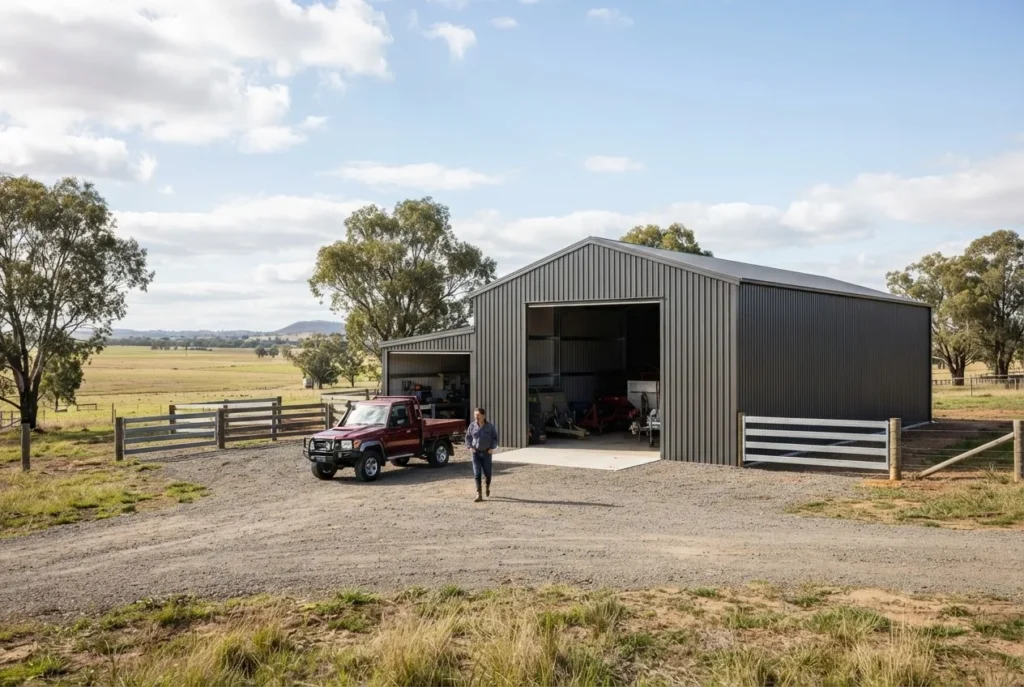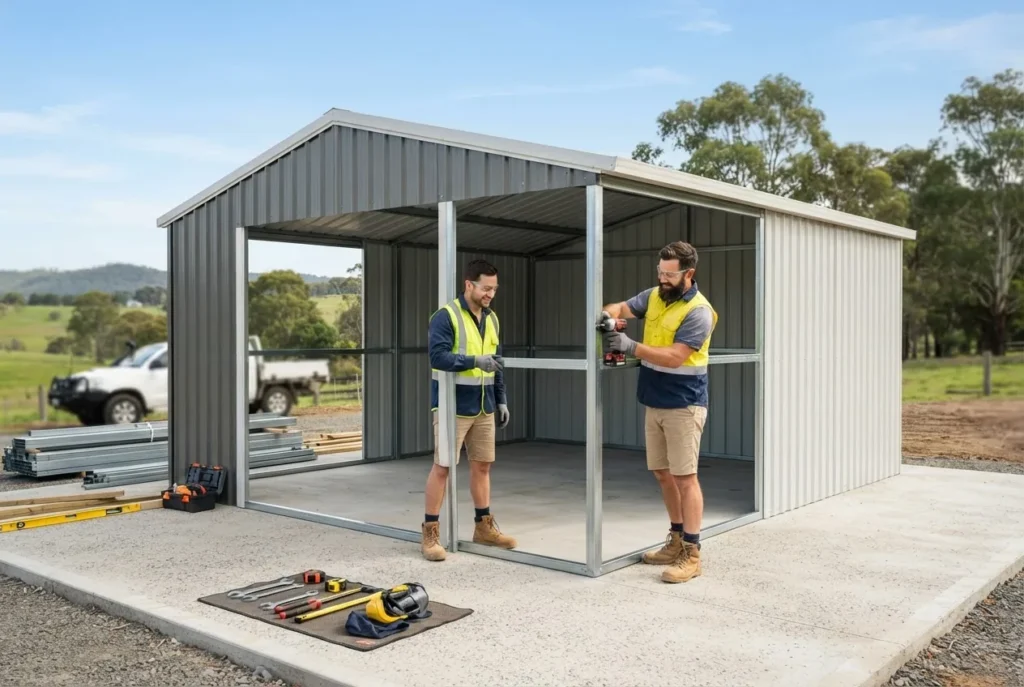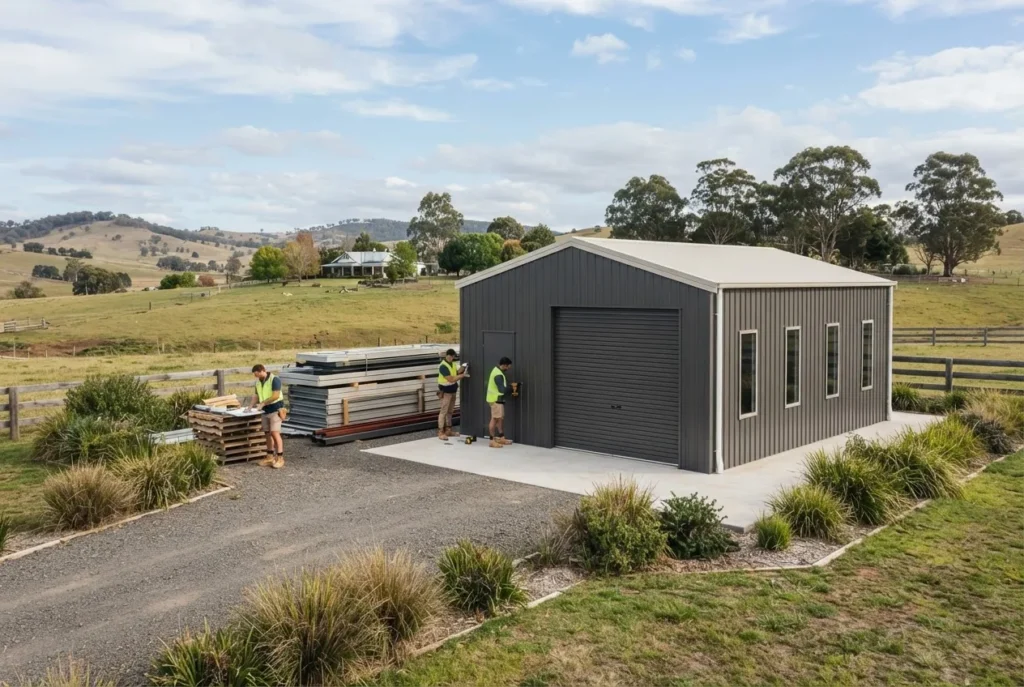

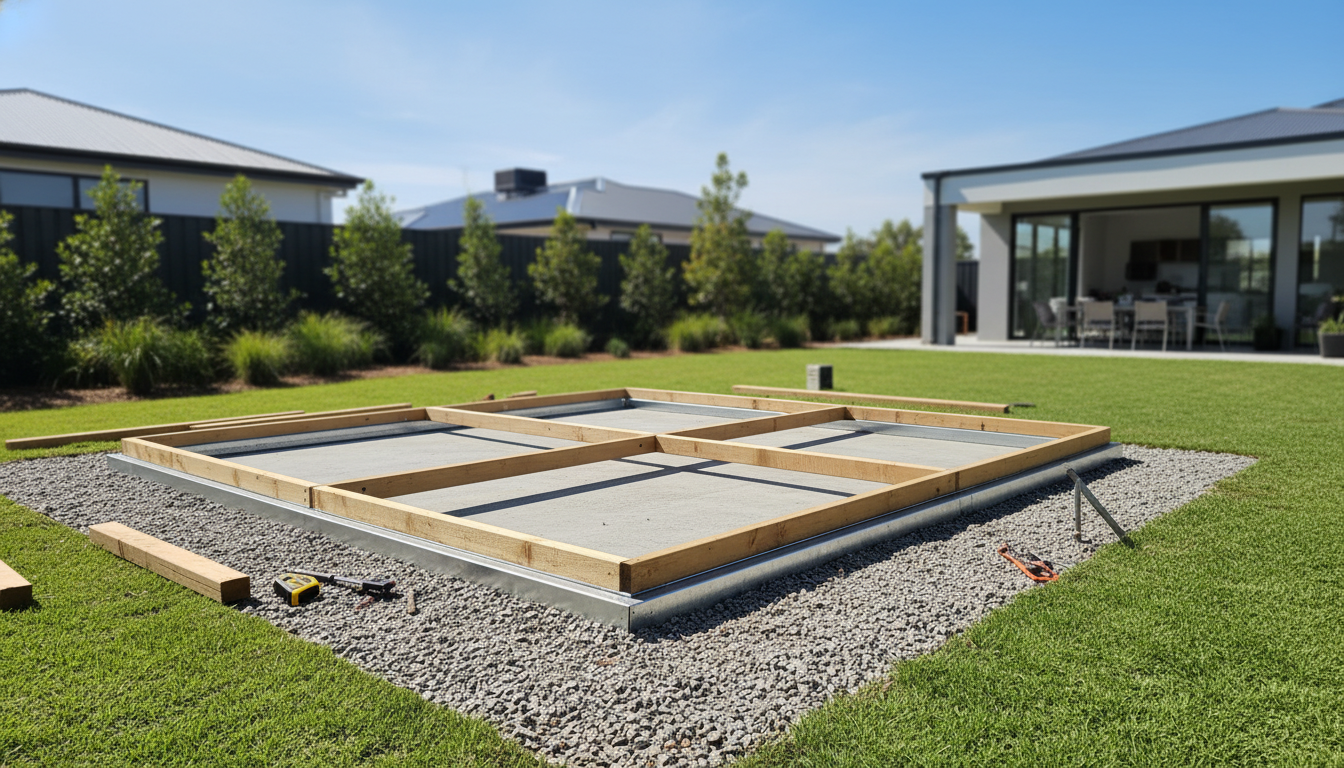

A shed base kit is the starting point for a long-lasting Colorbond steel shed, custom-built double garage in Perth, or a garden shed base kit in Melbourne’s clay soils. The right base resists movement, meets AS/NZS wind actions, handles drainage, and protects from termites and corrosion.
- Best for: DIY shed kits, garden storage, farm machinery storage, boat and caravan cover, custom Colorbond garages Perth, rural sheds NSW.
- Compatible with: steel portal-frame sheds, skillion carports, and small garden sheds.
- Meets local needs: wind-rated sheds for cyclonic areas (QLD), bushfire-prone sites (BAL), coastal corrosion zones.
What Are the Best Shed Materials for Perth’s Climate?
For steel sheds Perth homeowners choose between Colorbond and Zincalume cladding on a galvanized frame. Perth’s heat and coastal air demand UV resistance and corrosion protection.
Colorbond vs Zincalume — Which Is Better for WA Conditions?
| Feature | Colorbond Steel | Zincalume Steel |
|---|---|---|
| Coating | Painted, baked-on finish over zinc/aluminium/magnesium | Zinc/aluminium/magnesium alloy (no colour) |
| UV/Heat resistance | Excellent; good for Perth sun | Very good, but reflective glare |
| Corrosion (coastal) | Strong in C3/C4 zones with correct grade and detailing | Strong, but may mark; rinse in marine spray zones |
| Colour options | Wide Colorbond palette | Silver-grey only |
| Cost | Higher upfront | More affordable |
| Use case | Premium custom garages, visible carports | Budget rural sheds, farm sheds Victoria |
Pro spec tip: Ask for BlueScope base steel with documented coating class and warranty eligibility when comparing “Colorbond vs Zincalume comparison.”
Which Shed Base Kit Type Suits Your Site and Shed?
Plastic grid base + crushed rock
- Great for garden shed base kit, bike storage, pool pump enclosure.
- Permeable drainage; quick DIY.
- Use with ground anchors; not for heavy vehicles.
Treated timber subfloor (bearers/joists)
- Good on sloping ground; avoid poor drainage.
- Use H4 bearers, termite barrier to AS 3660.1.
- Ventilated, serviceable space.
Steel piers and adjustable posts
- Precise leveling; ideal for reactive clay (Melbourne, Adelaide).
- Engineer footing sizes to AS 2870 for soil class.
- Good for custom carports Melbourne and patios.
Concrete slab-on-ground (engineered)
- Best for custom-built double garage in Perth and workshop fitouts.
- Typical 100–150 mm slab, 25–32 MPa concrete, mesh SL72–SL82.
- Integrates hold-down bolts for portal frames.
How to Choose the Right Shed Base Kit: A 5-Step Buying Guide
- Site and soil: Get soil class (AS 2870) and check drainage. Avoid ponding and tree roots.
- Wind rating: Confirm N2/N3 or Region C/D (AS/NZS 1170.2) from your designer or engineer.
- Use-case and loads: Farm machinery storage and 4WDs need engineered slabs; garden tools may suit plastic grids.
- Compliance pack: Ensure plans note wind region, hold-downs, slab spec, termite management, BAL (if applicable).
- Warranty and steel grade: Request BlueScope steel certificates, hot-dip galvanizing class for brackets, and fastener spec for marine areas.
Want a deeper dive into slab vs timber vs plastic bases? See our storage shed floor guide to compare build-ups, anchoring and moisture control for different sites.
How Much Does a Shed Base Cost in Australia (2025)?
- Garden shed base kit (plastic grid + 100–150 mm crushed rock): $400–$1,200 installed (up to ~3×3 m).
- Treated timber subfloor (small shed): $1,200–$3,500 depending on posts, access, and decking sheets.
- Steel pier system (adjustable): $2,000–$5,000 for small carports Adelaide or custom carports Melbourne.
- Concrete slab (single garage 6×3 m): $3,800–$7,500; double garage 6×6 m: $7,000–$13,000+ including excavation, mesh, vapor barrier, and thickened edges.
Pricing varies by region, concrete indexation, and steel market movements noted in 2025 industry outlooks from the Australian Steel Institute and HIA. See industry overviews at Australian Steel Institute and HIA.
What Council Approvals Do You Need for a Shed Base in WA, QLD, NSW, and VIC?
How to Get Council Approval for Your Custom Shed in WA
- Planning check: setbacks, open space, height, streetscape.
- Building permit: submit certified plans to your local government.
- Include: site plan, slab/footing details, wind classification, anchorage schedule, termite barrier, stormwater management.
- Council-approved sheds WA often require N2/N3 wind notes and engineer sign-off.
QLD, NSW, VIC quick notes
- QLD: Cyclone-rated sheds QLD (Regions C/D) need specific hold-down bolts, screw spacing, and cladding thickness to AS/NZS 1170.2.
- NSW: Complying Development may apply for rural sheds NSW; check bushfire (AS 3959) and flood overlays.
- VIC: Building permit for most sheds >10 m²; reactive clays require footing adjustments to AS 2870.
Consult your local council and a registered engineer or builder (see Master Builders Australia).
Garden Shed Base Kit: Fast, Clean and DIY-Friendly
Best practice for small backyard sheds
- Use a plastic grid base over geotextile and compacted crushed rock (75–100 mm minimum).
- Install perimeter edging and ground anchors to resist uplift in N2–N3 winds.
- Seal the shed floor with formply or pavers over the grid for a clean finish.
For wet sites, raise the base 50–100 mm and include a spoon drain. In coastal or high-rainfall areas, prefer corrosion-resistant fixings and consider Zincalume base rails with isolation strips.
If you’re planning a weekend build, a DIY garden shed kit pairs well with plastic grid bases and ground anchors for a clean, fast install.
What Roof Type Works Best: Flat, Skillion, or Gable?
| Roof Type | Pros | Considerations | Best for |
|---|---|---|---|
| Flat | Low profile, budget-friendly | Lower headroom, drainage detailing critical | Garden sheds, boundary-adjacent |
| Skillion | Modern look, easy water fall, solar-ready | Wind uplift on overhangs; brace well | Custom carports Melbourne, patios |
| Gable | Classic look, better ventilation | More parts, ridge detailing | Custom Colorbond garages Perth |
Installation: How to Build a Compliant Base (Step-by-Step)
Concrete slab base (single/double garage)
- Set out: Peg and stringline to plan; verify diagonals equal.
- Excavate: Depth for slab and thickened beams; allow for 50 mm crushed rock subbase + vapor barrier.
- Formwork and reinforcement: Place SL72–SL82 mesh on chairs; add edge thickenings as per engineering.
- Services and earthing: Conduits, drainage, and shed earthing lug position.
- Pour 25–32 MPa concrete, finish, cure 7 days minimum before frame.
- Set M12/M16 cast-in bolts or chemset anchors as per anchor schedule.
For door clearances, wind‑locked roller doors and permit tips on larger garages, see our guide to a garage en kit Australia before you pour.
Plastic grid garden shed base
- Excavate 100–150 mm; compact subgrade.
- Lay geotextile; add 75–100 mm of crushed rock (Compacted to 95% MMDD).
- Clip grid panels; fill with rock; screed level.
- Fit perimeter edging, anchors, and damp-proof membrane under flooring if desired.
Wind Ratings, Anchors, and Compliance You Can’t Ignore
- Design wind actions to AS/NZS 1170.2. Typical suburban sites: N2–N3. Cyclone regions: C or D (wind-rated sheds for cyclonic areas need extra fixings).
- Hold-downs: Use engineer-specified anchor bolts, tie-down brackets, and screw patterns. Stainless or Class 4 fasteners in coastal zones.
- Termite protection to AS 3660 for timber components. Damp-proof membranes under slabs for moisture control.
- NCC 2022 compliance: Drainage, overflow provisions, and structural adequacy. Check bushfire (AS 3959) and corrosion categories.
For regional wind maps and cyclone info, see the Bureau of Meteorology. For steel design references, see ASI and CSIRO resources.
Case Studies: Real Australian Shed Bases
Perth double garage on sand (N3)
- Project: Custom Colorbond garages Perth, gable roof, 6×6 m.
- Base: 100 mm slab, 300 mm edge thickenings, SL82 mesh, vapor barrier, termite perimeter treatment.
- Outcome: Council permit approved; smooth install; workshop-ready in 2 weeks.
North QLD rural shed (Region C)
- Project: Farm machinery storage, 9×12 m skillion.
- Base: 150 mm slab, N-class concrete, M16 hold-downs, increased screw density, cyclone washers.
- Outcome: Certified to Region C; robust against tropical systems.
Melbourne garden shed on reactive clay
- Project: 3×2.3 m garden storage.
- Base: Plastic grid over geotextile and 100 mm crushed rock, adjustable edging, ground anchors.
- Outcome: Fast DIY; no cracking; excellent drainage in winter.
FAQs: Shed Base Kits, Garden Bases, and Steel Sheds
Do I need a concrete slab for a garden shed?
No. A garden shed base kit using grids and gravel works well for light storage. Choose a slab for heavy loads or workshop use.
How do I know my wind rating?
Your shed supplier or engineer will classify your site (N2/N3/C/D) using AS/NZS 1170.2. Always design anchors and cladding fixings to match.
Can I DIY a shed base?
Yes for smaller DIY shed kits and garden shed base kits. For garages or carports, engage a concreter and follow engineered drawings.
What about corrosion near the coast?
Specify appropriate coating (Colorbond Ultra or equivalent), use Class 4 or stainless fasteners, isolate dissimilar metals, and rinse salt spray when practical.
Supplier Checklist: What to Ask Before You Buy
- Are the plans engineered to AS/NZS 1170.2 and AS 2870 for my soil class?
- What is the anchor schedule and fastener corrosion class?
- Is the steel BlueScope Colorbond/Zincalume with warranty eligibility?
- Does the pack include stormwater and overflow provisions?
- Can you provide council-approved sheds WA documentation if I’m in Perth/Regional WA?
When a Shed Base Kit Isn’t Enough
If you plan vehicle storage, a hoist, or heavy racking, a fully engineered slab with thickenings and possibly fibre reinforcement is essential. Industrial sheds Sydney and larger rural sheds NSW typically require certified footing designs and geotechnical input.
Choosing a Shed Partner with Australian Credentials
Look for fabricators aligned with the Australian Steel Institute, and builders who follow HIA or Master Builders contracts. Verify NCC 2022 compliance, wind region notes, and insurance. For outdoor structures trends and budgeting, see HIA’s home improvement reports (HIA).
Resources and Standards
- Bureau of Meteorology — Cyclone and wind information: bom.gov.au/cyclone
- HIA — Building approvals and contracts: hia.com.au
- Australian Steel Institute — Steel design resources and outlooks: steel.org.au
- CSIRO — Building science and durability: csiro.au
- Energy.gov.au — Insulation guidance: energy.gov.au
Buying Checklist: 5-Step Guide for Custom Sheds in Australia
- Confirm site wind rating (N2/N3/C/D) and soil class (AS 2870).
- Select cladding: Colorbond for premium coastal performance; Zincalume for budget rural builds.
- Pick base type: grid/timber for light loads; engineered slab for garages and workshops.
- Get permits: planning and building approvals with engineer-certified drawings.
- Lock in specs: hold-down bolts, fastener class, termite and moisture control, stormwater.